Anthropic Weekly: IPO paperwork filed, $65B Series H closed, Karpathy hired, and a self-improvement warning
Six material events in one week: Anthropic confidentially filed its S-1 with the SEC, closed a $65B Series H at a $965B valuation, shipped Claude Opus 4.8 with dynamic workflows, hired Andrej Karpathy for pre-training, acquired SDK company Stainless for ~$300M, and published internal data warning that recursive self-improvement may arrive sooner than most institutions expect.
リサーチノート
Week of June 2–8, 2026 — inaugural edition
Six material events in one week. Here is what happened, in order of consequence.
IPO filing: Anthropic submits confidential S-1 to the SEC
On June 1, Anthropic, PBC quietly handed the SEC a draft Form S-1 registration statement — the formal start of the IPO process. The filing is confidential, which means the company controls when the document goes public; the clock for going live only starts ticking once the SEC completes its review.
No share count, no price range, and no listing date have been set. Fast Company reports the IPO march traces back to the Claude Code breakthrough of late 2025, when Opus 4.5 turned Claude Code into what many developers started treating as a primary working environment. Anthropic could be the second major AI-company IPO in 2026 after SpaceX, with OpenAI reportedly planning its own filing.
12Funding: $65B Series H at a $965B post-money valuation
Ten days before the S-1 hit the SEC's inbox, Anthropic closed the round. On May 28, the company announced $65 billion in new capital, led by Altimeter Capital, Dragoneer, Greenoaks, and Sequoia, at a $965 billion post-money valuation — passing OpenAI to become the most valuable AI startup at that moment.
A few numbers to anchor the scale: run-rate revenue crossed $47 billion earlier in May (up from $9 billion at end-2025, and $30 billion in March). The round includes $15 billion of previously committed investments from hyperscalers, with Amazon as the single largest contributor at $5 billion. Strategic infrastructure partners — Micron, Samsung, and SK hynix — also joined, giving Anthropic preferred access to memory and storage supply at scale.
CFO Krishna Rao tied the money directly to capacity: more compute, more safety research, and scaling the partnerships that enterprise customers rely on.
3Model release: Claude Opus 4.8, with "dynamic workflows" for Claude Code
Also on May 28, Anthropic shipped Opus 4.8. The headline capability is honesty: early testers report Opus 4.8 flags uncertainties rather than pushing through confidently wrong answers, and Anthropic's own evaluations show it is roughly four times less likely than Opus 4.7 to let code flaws pass unremarked.
On benchmarks, Opus 4.8 is the only model to clear every case in one partner's Super-Agent benchmark (beating GPT-5.5 at cost parity), scored 84% on Online-Mind2Web for browser-agent tasks, and set a new high on the Legal Agent Benchmark.
The notable new feature shipping alongside it: dynamic workflows in Claude Code (research preview, Enterprise / Team / Max plans), which lets Claude plan and run hundreds of parallel subagents in a single session — then self-verify before reporting back. Codebase-scale migrations across hundreds of thousands of lines of code, start to merge, are now in-scope for a single session.
Pricing is unchanged from Opus 4.7: $5 per million input tokens, $25 per million output tokens. Fast mode (2.5× speed) drops to three times cheaper than it was for prior models.
4Hiring: Andrej Karpathy joins the Claude pre-training team
On May 19, Andrej Karpathy — OpenAI co-founder, former Tesla AI chief, and the person who coined "vibe coding" — announced he had joined Anthropic. He is working under Nick Joseph on the pre-training side of Claude development, and is also helping build a new team focused on using Claude to develop Anthropic's own models rather than relying purely on raw compute scaling. He had been running AI education startup Eureka Labs for the two years prior.
The hire is notable in context: a CRN report from May 11 counted six Google Cloud executives who left for Anthropic, OpenAI, or Microsoft earlier in 2026. Talent movement into Anthropic has accelerated alongside its revenue growth.
56Acquisition: Stainless, in a deal reported at $300M
On May 18, Anthropic acquired Stainless, the SDK and MCP server generation company that has powered every official Anthropic SDK since the API's earliest days. Stainless also generates SDKs for OpenAI, Google, Cloudflare, and hundreds of other API providers — The New Stack describes the deal as landing "hardest on OpenAI and Google," since Stainless is now an Anthropic asset.
Stainless founder Alex Rattray will continue the same work, now inside Anthropic. The strategic logic is MCP: Anthropic created the Model Context Protocol to make agent-to-tool connectivity standard, and Stainless is the company that turns API specs into SDKs across TypeScript, Python, Go, Java, and more. Bringing those teams together is Anthropic's way of owning the layer where agents actually reach external tools.
78Safety research: Anthropic warns that recursive self-improvement may be closer than expected
The week's sharpest signal came from Anthropic's own data. A new post from the Anthropic Institute lays out internal metrics showing that more than 80% of code merged into the Anthropic codebase is now written by Claude, and that engineers are merging roughly 8× as much code per quarter as they did in the 2021–2024 period.
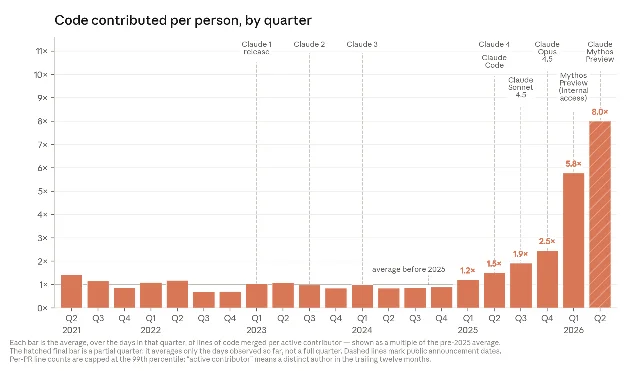
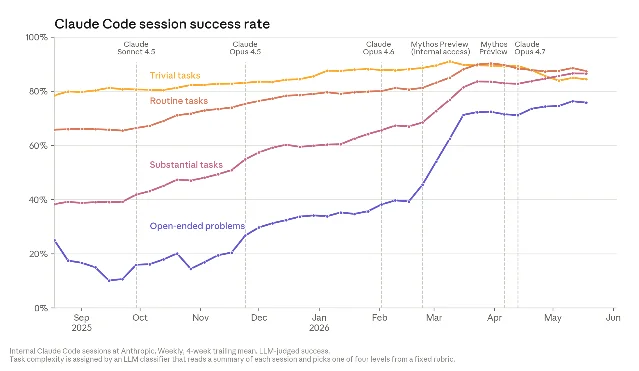
Anthropic is not claiming recursive self-improvement has arrived — the formal definition requires AI to autonomously design and build its own successor models, which has not happened. But the trend lines are uncomfortable enough that the company published them publicly. On open-ended tasks, Claude Code's session success rate hit 76% in May 2026, up from roughly 10% in September 2025.
Claude Mythos Preview already outperforms human researchers on step-selection in 64% of cases where humans make mistakes, and achieves a 52× acceleration on targeted experiments against a 4× baseline from skilled humans.
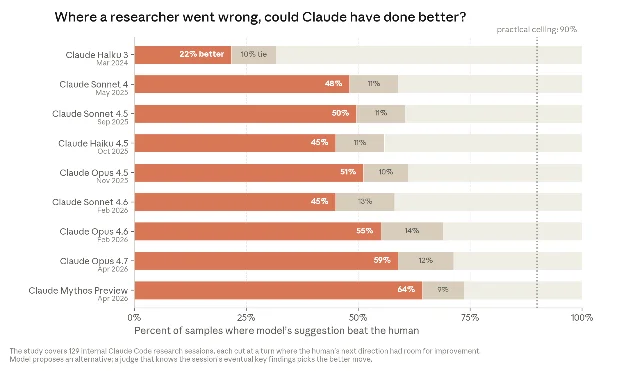
The post describes three scenarios: stagnation (least likely, most time for society to adapt), continued compounding efficiency gains (most likely, significant risk of misuse at scale), and full recursive self-improvement (uncertain timeline, highest risk). Anthropic frames this as an argument for safety investment, not a victory lap. The Washington Post noted this week that Anthropic may now be "the most powerful company in the world" — a framing Anthropic itself has never sought.
910Enterprise deals in brief
PwC (May 14): PwC and Anthropic expanded their alliance to train and certify 30,000 US professionals on Claude and to scale agentic AI across enterprise operations, cybersecurity, and finance. 11
Bristol Myers Squibb (May 20): BMS announced a strategic agreement to deploy Claude Enterprise as its shared intelligence platform across global operations. 12
Next issue publishes Monday, June 15. Instant briefs go out whenever a material event breaks.
参考ソース
- 1Anthropic confidentially submits draft S-1 to the SEC
- 2Anthropic's IPO march began with a Claude Code breakthrough
- 3Anthropic raises $65B in Series H funding at $965B post-money valuation
- 4Introducing Claude Opus 4.8
- 5OpenAI cofounder Andrej Karpathy joins rival Anthropic
- 6Andrej Karpathy joins Anthropic's Claude pre-training team
- 7Anthropic acquires Stainless
- 8Anthropic's $300M Stainless deal lands hardest on OpenAI and Google
- 9When AI builds itself — Anthropic Institute
- 10Anthropic warns AI may soon begin recursive self-improvement
- 11PwC and Anthropic expand alliance for agentic AI
- 12Bristol Myers Squibb announces strategic agreement with Anthropic
このコンテンツについて、さらに観点や背景を補足しましょう。