Friday Strength: StrongLifts 5×5 Workout A — Squat, Bench Press, Row

Friday Strength: StrongLifts 5×5 Workout A — Squat, Bench Press, Row

Your complete Friday Workout A for StrongLifts 5×5 — third session overall (Squat 55 lb, Bench Press 50 lb, Row 70 lb), with warm-up ramp tables, video demos for every lift, scaling tables, posterior-chain cool-down, and next-session preview.
Workout Plan Pick
2026/5/22 · 22:21
購読 1 件 · コンテンツ 10 件
Today's discipline: Strength | Program: StrongLifts 5×5 | Session: Workout A (3rd session overall) Total time: ~45–60 min | Equipment: Barbell, squat rack / power rack, flat bench, weight plates
Workout A is the pull side of StrongLifts 5×5. You squatted Monday and Wednesday — today you squat again, then bench press, then row. Three compound lifts, all 5 sets of 5 reps, same working weight across every set. Monday's weights were Squat 45 lb, Bench 45 lb, Row 65 lb. Wednesday you hit Workout B. Today's weights step up by 5 lb across the board: Squat 55 lb, Bench Press 50 lb, Barbell Row 70 lb. 1

Today's session at a glance

ExerciseSets × RepsWork weightRest between sets
Barbell back squat5 × 555 lb90 sec (extend to 3 min as weight grows)
Bench press5 × 550 lb90 sec (extend to 3 min as weight grows)
Bent-over barbell row5 × 570 lb90 sec (extend to 3 min as weight grows)

Warm-up (8–10 min)

Start with a few minutes of general movement before touching the bar — body-weight squats, arm circles, hip circles, and 10 leg swings per side. Then go straight into the bar warm-up ramp.
Warm-up ramp protocol: Start with an empty 45 lb bar, add weight in jumps no larger than 45 lb per set, 5 reps each, zero rest between warm-up sets. Rest 60–90 seconds before your first working set. 2
LiftWarm-up setsNotes
Squat2 × 5 @ 45 lb (empty bar) → 5 × 5 @ 55 lb10 lb jump — single warm-up set more than enough
Bench press2 × 5 @ 45 lb (empty bar) → 5 × 5 @ 50 lb5 lb jump — very light, just grooves the setup
Barbell row1 × 5 @ 65 lb → 5 × 5 @ 70 lbRow never starts with an empty bar; 65 lb is the floor-appropriate minimum warm-up weight
Today's weights are light enough that your warm-up ramps are short — one or two sets to find the groove, then straight into work sets. 2

Exercise 1 — Barbell back squat

Sets × Reps × Rest: 5 × 5 × 90 sec (or up to 3 min if needed) | Work weight: 55 lb
The squat opens every StrongLifts session — it demands the most technique and benefits most from a fresh nervous system. The low bar back squat used in StrongLifts places the bar on your posterior deltoids (the shelf of muscle just below the top of your shoulder blades), not on your traps or neck. This shifts more load to the hips and posterior chain.
Key form cues:
  • Bar position: bar rests on rear deltoids, not on the traps — a lower shelf than the high-bar squat creates a different torso angle
  • Stance: heels shoulder-width apart, toes turned out; knees track in line with toes throughout
  • Grip: narrow enough to lock the bar onto the shelf; keep wrists straight
  • Depth: hip crease drops below the top of your kneecap — that is parallel, and you need to break it
  • Ascent: drive hips straight up out of the hole; if the bar shifts forward and your chest drops, you're turning the squat into a good morning
  • Breathing: big breath before you unrack, hold through the descent and ascent, exhale only at lockout
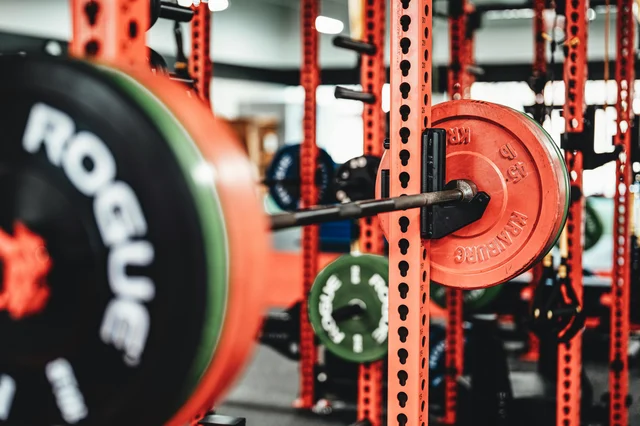
Barbell and weight plates on a squat rack — strength training setup
Barbell rack loaded for squats — the starting point for every StrongLifts session.
📹 Video demo — squat: 3
リンクプレビューを読み込んでいます…
Scaling guide — squat:
LevelWork weightNotes
Beginner55 lb (today's prescribed weight — your 3rd session)Rest the full 3 min if any set felt shaky
IntermediateStart where your last successful 5×5 left off+5 lb per session
AdvancedContinue from last successful session+5 lb per session; switch to +2.5 lb when progress stalls

Exercise 2 — Bench press

Sets × Reps × Rest: 5 × 5 × 90 sec (or up to 3 min if needed) | Work weight: 50 lb
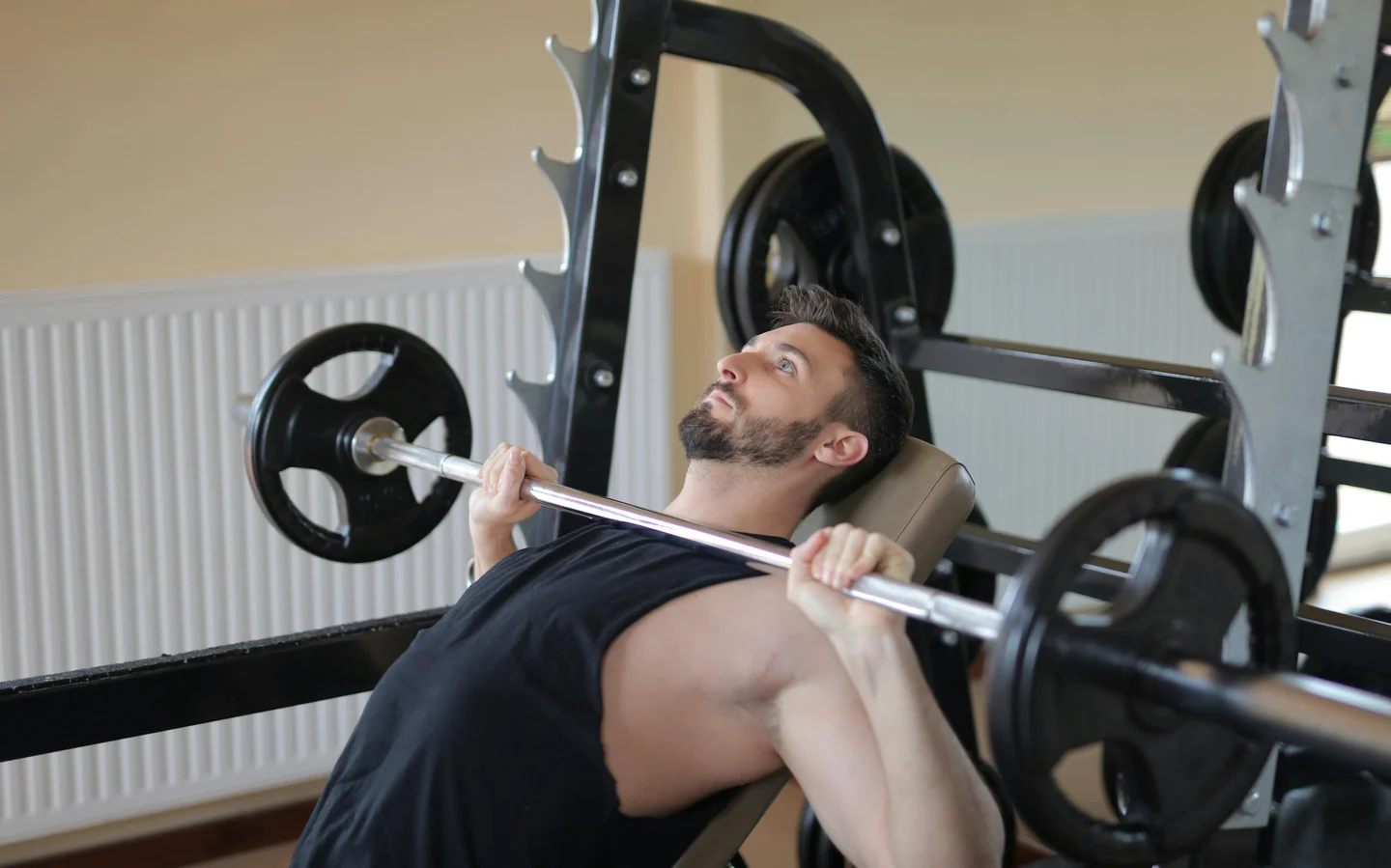
After the squat, your upper body is fresh. The bench press is a five-step lift — setup, grip, unrack, lower, press — and the details on each step directly affect both performance and shoulder health.
Key form cues (StrongLifts 5-step method): 4
  1. Setup: lie on the bench with your eyes directly under the bar; lift your chest and squeeze your shoulder-blades together and down; feet flat on the floor, shoulder-width apart
  2. Grip: pinky finger inside the ring marks of the bar; hold the bar in the base of your palm (close to the wrist, not the fingers); full grip with thumbs wrapped around the bar — never thumbless; keep wrists straight so bar, wrist, and elbow form a straight line
  3. Unrack: take a big breath and hold it; straighten your arms to lift the bar out of the uprights; move the bar horizontally until it's balanced over your shoulders with elbows locked
  4. Lower: lower the bar to your mid-chest; tuck your elbows to approximately 75° from your torso — not flared to 90°, which causes shoulder impingement; keep forearms vertical (perpendicular to the floor from every angle); hold your breath at the bottom
  5. Press: drive the bar diagonally from mid-chest to above your shoulders; keep your butt firmly on the bench the entire time; lock elbows at the top; exhale, then take a new breath for the next rep
The bar path is not a vertical line — it travels diagonally from mid-chest to above the shoulders. That diagonal path is both safer for the shoulder joint and more mechanically efficient. 4
📹 Video demo — bench press: 5
リンクプレビューを読み込んでいます…
Scaling guide — bench press:
LevelWork weightNotes
Beginner50 lb (today's prescribed weight)If wrists feel bent under the bar, consciously push the bar toward the heel of the palm
IntermediateStart from last successful 5×5+5 lb per session; switch to +2.5 lb when progress stalls
AdvancedContinue from last successful session+2.5 lb increments are common at advanced loads

Exercise 3 — Bent-over barbell row

Sets × Reps × Rest: 5 × 5 × 90 sec (or up to 3 min if needed) | Work weight: 70 lb
The row in StrongLifts is a Pendlay row — the barbell starts from the floor and returns to the floor on every single rep. This is not the bodybuilding-style bent row where the bar stays in the air between reps. Dead-stop from the floor each time. 1
Key form cues:
  • Stance: feet shoulder-width apart, bar over mid-foot; bend at the hips until your torso is near-parallel to the floor — back angle should be under 30° from horizontal
  • Grip: medium grip (roughly the reverse of your bench press grip); full grip with thumbs wrapped around the bar; grip the bar on the floor
  • Pull: row the bar explosively from the floor up to your solar plexus / lower chest; keep forearms vertical throughout the pull; drive with your upper back
  • Lower: return the bar to the floor under control; let it settle fully before the next rep — each rep is a dead stop
  • Back: keep your lower back neutral and tight throughout; if your back rounds, reduce the weight
  • Bar path: vertical line from floor to lower chest and back down; the bar should touch your torso at the top of each rep
The Pendlay row builds explosiveness from a dead stop and has direct carryover to the deadlift — same hip hinge, same upper back engagement, same floor reset. 6
📹 Video demo — barbell row: 7
リンクプレビューを読み込んでいます…
Scaling guide — barbell row:
LevelWork weightNotes
Beginner70 lb (today's prescribed weight)If your lower back rounds before the bar reaches your chest, lighten the load first
IntermediateStart from last successful 5×5+5 lb per session; switch to +2.5 lb when progress stalls
AdvancedContinue from last successful sessionPendlay row at advanced loads is demanding — full 3 min rest is standard

Progression rules

Linear progression is the engine of the whole program: add weight only after you complete every rep. 1
  • Complete all 5×5 reps on all three lifts → add 5 lb to each lift next Workout A session
  • Miss reps on the same weight three sessions in a row → deload 10% and rebuild from there
  • Rest intervals: 90 seconds works fine at today's light loads; extend to 3 minutes as weights climb and sets get hard; extend to 5 minutes if completing the last set was a real struggle 1
  • Progression note for Bench and Row: both start with +5 lb per session; switch to +2.5 lb (1.25 lb plates each side) when progress slows — smaller muscles stall earlier than the squat 1

Cool-down (5–8 min)

After your last row set, don't just walk out. Your posterior chain — hamstrings, glutes, lower back, upper back — has been loaded across three compound movements.
  • Chest opener: hands clasped behind your back, lift chest, hold 30 sec
  • Doorway (or rack post) chest stretch: arm at 90°, lean through, 30 sec each side
  • Hip flexor stretch (kneeling lunge, tall torso): 45 sec each side
  • Hamstring stretch (seated toe reach or standing hinge): 30 sec each side
  • Lat stretch: hang from the bar or grip a rack upright and lean back, 30 sec
  • Child's pose: 1 min to decompress the lower back and hips

Equipment checklist

  • Barbell (standard 45 lb Olympic bar)
  • Weight plates (10 lb, 5 lb, 2.5 lb increments; 1.25 lb plates useful when bench/row progress slows)
  • Squat rack / power rack with safety pins set just below parallel
  • Flat bench (for bench press)
  • Collars (mandatory — especially for the row where the bar is lifted from the floor)
  • Flat-soled shoes or lifting shoes (not thick-heeled running shoes — heel elevation shifts squat mechanics)

Workout B preview (next session — Monday May 25)

Monday brings Workout B: Squat / Overhead Press / Deadlift. The squat climbs to 60 lb, the overhead press picks up where Wednesday's left off, and the deadlift moves up by 10 lb (larger jumps are standard for the deadlift early on). That's the program. 1

このコンテンツについて、さらに観点や背景を補足しましょう。

  • ログインするとコメントできます。