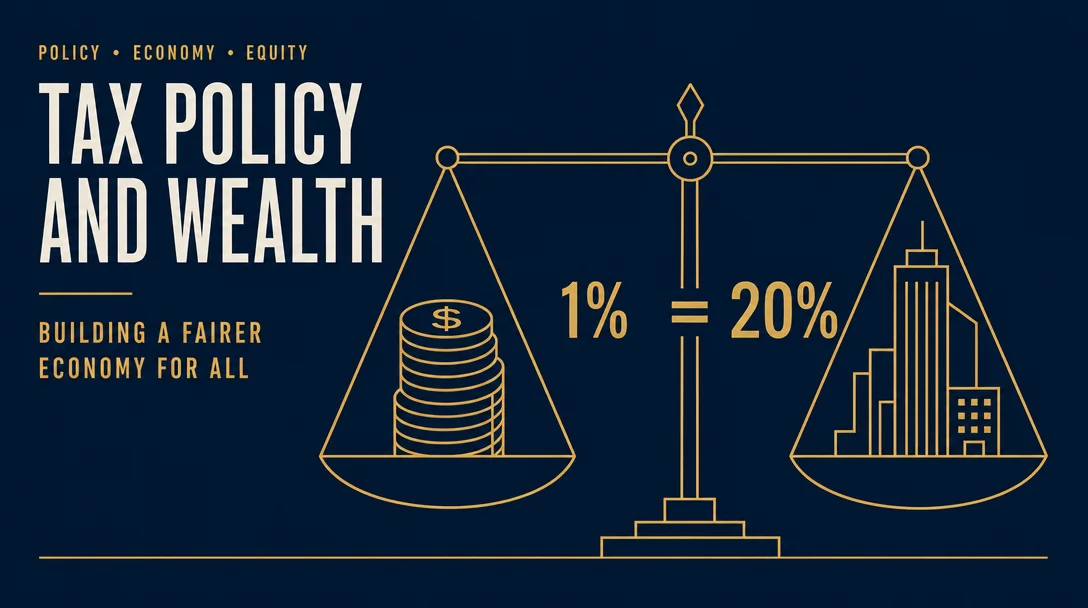
When "1%" Isn't 1%: Paul Graham on the Tax Confusion Founders Should Understand
Paul Graham's May 2026 essay reveals the conversion most politicians miss: a 1% wealth tax equals roughly a 20% income tax. Here's the math, and what it means for founders thinking about jurisdiction, equity, and capital structure.

The debate over wealth taxes is louder than ever in 2026. States are floating new proposals, politicians invoke familiar numbers, and most of the discussion stays stuck at the surface. In a short essay published this May, Paul Graham — co-founder of Y Combinator — cuts through it with a piece of arithmetic so obvious it's embarrassing: a 1% wealth tax is not "a mere 1%." It's equivalent to a 20% income tax. 1
For founders building companies, allocating equity, or advising boards navigating tax exposure, the gap between what politicians say and what these numbers actually mean is worth closing.
The conversion that changes everything
The essay's core argument fits on a napkin. Wealth taxes and income taxes are mathematically equivalent through a single conversion: divide by the risk-free rate of return on capital.
Graham lays out the arithmetic: assume a 5% risk-free return on $100 of capital. Under a 20% income tax, you pay $1 at year-end and keep $104. Under a 1% wealth tax, you also pay $1 — and keep $104. They're identical in after-tax outcome. The conversion rate is 20. 1
"Each 1% of wealth tax is equivalent to 20% of income tax." — Paul Graham, How to Convert Between Wealth and Income Tax, May 2026
His historical caveat: 5% is an optimistic assumption for the risk-free rate. At 4%, the wealth-to-income conversion ratio rises above 25 — meaning a 1% wealth tax could represent something closer to 25% in income tax terms. The "median case" he works through for a US state is striking: add a 1% wealth tax to existing federal and state income taxes, and you've pushed total marginal rates past 61%. That would be the highest marginal rate in the world. 1
コンテンツカードを読み込んでいます…
Why do politicians consistently get this wrong?
The confusion isn't random. Wealth and income taxes look like they measure different things. Politicians who propose a "1% wealth tax" and politicians who oppose "a 20% income tax hike" can be talking about the same policy — and neither side typically knows it. The framing of "1%" exploits the fact that percentages of different bases don't intuitively translate.
A visual version of Graham's example makes this concrete:
チャートを読み込んでいます…
The bars for 20% income tax and 1% wealth tax are identical. That's the entire argument, made visible.
Graham's explanation is blunt: they don't know the conversion exists. No one ever taught them to ask. The political framing of "a mere 1% wealth tax" would never survive contact with its income tax equivalent — no politician would casually announce "let's add 20% to the income tax rate." Yet the economics are the same. 1
This isn't a partisan point. It's a structural one. The language of wealth taxes obscures the underlying magnitude in a way that income tax language doesn't.
What this means if you're building a company
Graham writes primarily as a policy observer here, but the arithmetic maps directly onto decisions founders and startup executives make. A few places where this conversion matters:
- Evaluating tax residency and incorporation jurisdictions. When comparing locations that impose wealth or net-worth taxes (common in some European contexts) against high-income-tax US states, the standard comparisons are usually apples-to-oranges. Converting to a common denominator — effective income tax equivalent — gives a clearer picture.
- Modelling equity compensation. Unrealized equity holdings can become a wealth-tax liability. The conversion Graham describes helps founders gauge the real cost of holding large illiquid positions in jurisdictions where wealth taxes are on the table.
- Thinking about capital vs. income structures. If you're advising on financial architecture — how to pay yourself, how to think about retained vs. distributed profits — understanding that 1% of assets is roughly equal to 20% of income sharpens every trade-off conversation.
The essay is short (under 500 words), and Graham closes with a genuinely optimistic note: "I'm optimistic that we can teach them. The answer's not hard to understand, once you realize the question exists." 1 Whether that optimism is warranted is a separate debate. The math, at least, is available now.
Essay at a glance
| Author | Paul Graham (co-founder, Y Combinator) |
| Published | May 2026 |
| Format | Short argumentative essay (~480 words) |
| Core claim | A 1% wealth tax ≈ 20% income tax; most politicians don't know the conversion |
| Key assumption | 5% risk-free return on capital (Graham notes 4% may be more realistic) |
| Read time | ~3 minutes |
This issue covers recent long-form writing by Silicon Valley founders. Paul Graham's May 2026 essay is the most recent long-form publication from a major Valley founder as of this inaugural edition.
このコンテンツについて、さらに観点や背景を補足しましょう。