Hollow Knight — The Underground Kingdom That Asks You to Figure It Out Yourself
Today's pick: Hollow Knight (Team Cherry, 2017). Metacritic 87–90 (PC/Switch), Steam Overwhelmingly Positive (97% of 180,000+ reviews). This guide covers the charm build system and Soul mechanic, what players love and where the game genuinely loses people (backtracking, map system, slow start), and a spoiler-free setup for the fallen underground kingdom you're dropped into with no explanation.

| Developer | Team Cherry |
| Release | PC: Feb 24, 2017; Switch/PS4/Xbox: 2018 |
| Genre | Metroidvania |
| Metacritic | 87 (PC) / 90 (Switch) — Universal Acclaim |
| OpenCritic | 97% recommend |
| Steam | Overwhelmingly Positive (~97%, 180,000+ reviews) |
| Time to beat | Main story ~27 hrs; completionist ~65–70 hrs |
| Platforms | PC, Nintendo Switch, PS4/PS5, Xbox One/Series, Switch 2 |
| Price | ~$15 USD (frequently on sale) |
Three developers. One underground kingdom. 15 million copies sold. Hollow Knight came out in 2017, cost $15, and has since landed on multiple "greatest games of all time" lists — IGN, Rolling Stone, GQ. That's not typical for an indie Kickstarter game that started as a bug eating other bugs in a Ludum Dare jam. So what is it actually doing that most Metroidvanias aren't?
How it plays
The Knight is a small, silent insectoid warrior armed with a sword called a Nail. The core loop is simple: you explore, fight enemies, absorb their Soul energy by hitting them, use that Soul to heal or cast spells, and die. When you die, a Shade appears where you fell — holding all your Geo (currency) — and you respawn at the last bench you rested on. Kill the Shade and you get it all back. Die again before you do, and it's gone. 1
This death mechanic is borrowed from Dark Souls, and reviewers noticed. What they also noticed was that it's remarkably fair: exploration progress, abilities, and collected items never reset on death. Only the Geo is at stake. The intent, according to developers Ari Gibson and William Pellen, was to make players feel that any hit they took could theoretically have been avoided — the controls are tight enough that the game rarely argues back. 2
The deeper system is charms. You find or buy up to 45 different charms across the game — each one altering your combat, exploration, or healing in a distinct way. Equipping a charm costs charm notches (limited slots), so every loadout is a tradeoff. PC Gamer reviewer Tom Marks wrote: "What's so impressive about these charms is that I could never find a 'right' answer when equipping them. There were no wrong choices." 3 That absence of a dominant build is rarer than it sounds in action games.
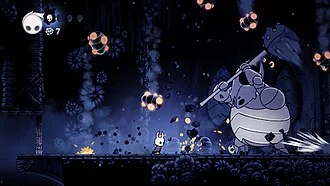
Movement unlocks as you explore: double jump, wall-cling, dash. New abilities don't just open new zones — they retroactively make the map navigable in ways it wasn't before. The map itself is deliberately hostile at first: you have to buy the base map from a cartographer NPC (named Cornifer, who you find hiding in each new area), and your explored rooms only update after you sit at a bench to rest. This sounds punishing. Quite a few players have noted it is. But it's also the mechanism by which the game maintains its atmosphere of genuine discovery.
What players are saying
The broad consensus from critics is that Hollow Knight is a "new classic" (PC Gamer), a "masterpiece of gaming" (Destructoid, 10/10), and that IGN's Tom Marks called its atmosphere built from "a million details." 4 Eurogamer's Vikki Blake called it "ruthlessly tough, even occasionally unfair" — and recommended it anyway. 5 OpenCritic reports that 97% of critics recommend it. 6
Steam players echo that — but also provide the more honest minority view. Negative reviews cluster around a handful of genuine grievances:
The backtracking is real. YouTube analysis of the negative Steam reviews found backtracking is "the biggest complaint by a very large margin." Areas can be far apart, and early on, fast travel is limited. Players who prefer games that respect their time find this friction intentional and irritating in equal measure.
The map system trips up newcomers. The compass charm (which shows your location on the map) costs currency and occupies a charm notch. Until you have it, you're navigating on memory. Several Metacritic user reviews specifically call this out — one reviewer with a 7/10 noted it "can feel unnecessarily punishing." 7
The opening hours are slow. Combat abilities arrive gradually, and the first few hours of Hallownest are more atmospheric trudge than action game. Nintendo World Report's reviewer had "so frustratingly hard that I cannot recommend this game" written in their notes partway through — then changed their mind. That arc is genuinely common.
Short attack range matters. Some players find the default Nail frustratingly short, making certain enemy types feel like guaranteed chip damage. Charms can fix this, but you have to find them first.
Who this works for: players who like piecing together a world from environmental clues, who want challenging combat that rewards memorizing enemy patterns, and who don't need the game to hold their hand or explain what just happened. Who it doesn't: players who find aimless exploration without a clear objective draining, or who need the map to always make sense.
Spoiler-free story setup
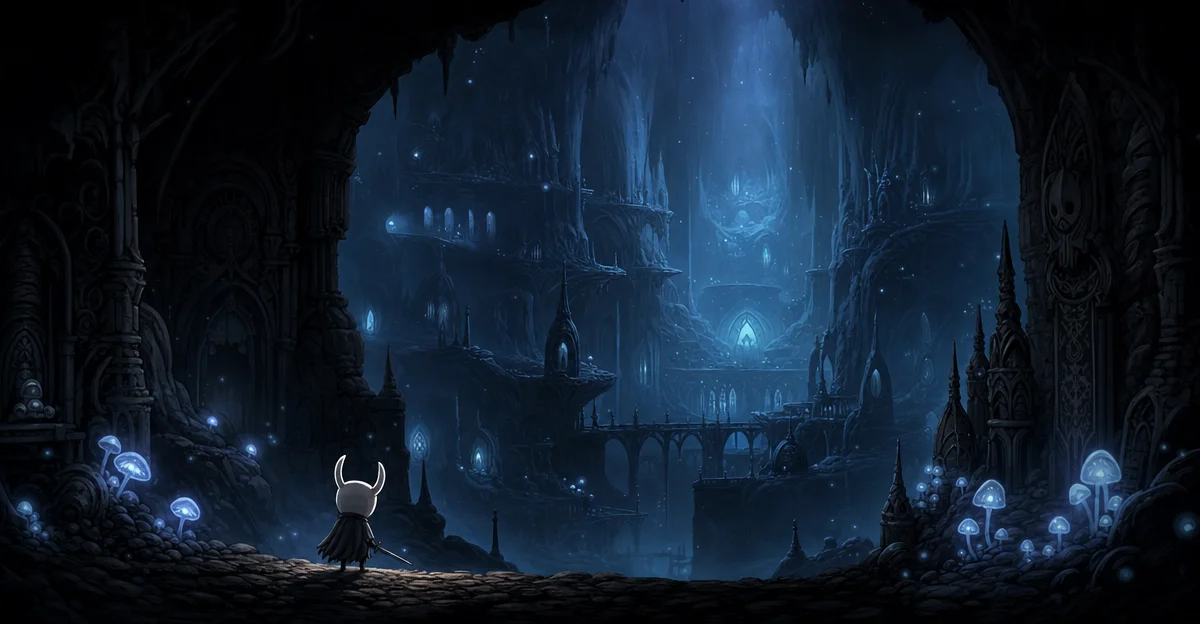
You are the Knight — a small, silent bug warrior of unknown origin — who drops into Dirtmouth, a dying town at the edge of a vast underground kingdom called Hallownest. The kingdom is ruined. Most of its inhabitants are hollow-eyed, wandering, afflicted. Something went wrong here, and whatever it was, it's still going on.
The story is told in Hollow Knight's specific way: almost nothing is explained. Lore fragments sit on tablets buried in caves. NPCs give you a line or two and move on. The nature of the Knight — who you are, where you came from, why you're here — is deliberately withheld. You discover the shape of the catastrophe by exploring its wreckage, not by watching cutscenes. The tone sits somewhere between melancholy and dread, anchored by Christopher Larkin's score, which is widely considered one of the best game soundtracks of the last decade.
There are multiple endings, and reaching the fuller ones requires paying attention to the world in a way the game never tells you to. Whether that's appealing or infuriating is a reliable litmus test for whether this game is for you.
Should you play it?
At roughly 27 hours to reach the main ending — and 40+ hours if you engage with side content — Hollow Knight is not a short game. It's also not a game that orients you or apologizes for its difficulty. The charm system, the non-linear exploration, and the incremental ability unlocks give experienced Metroidvania players a lot to engage with, and the game's price (~$15, frequently lower on sale) makes the trial cost low.
If the idea of getting genuinely lost in a hand-drawn underground kingdom, gradually piecing together what it once was, sounds good to you — and you're okay with a few dozen boss deaths along the way — Hollow Knight earns its reputation. 8
Available on PC, Nintendo Switch, PS4/PS5, Xbox One/Series, and Nintendo Switch 2.
このコンテンツについて、さらに観点や背景を補足しましょう。