Tabasco: The Broke Banker's Sauce That Outlasted His Own Memory of Making It
In 1868, a ruined Confederate banker named Edmund McIlhenny — living off his wife's family in a Louisiana salt-dome plantation — grew his first commercial pepper crop and distributed 658 bottles of hot sauce along the Gulf Coast. He never considered it worth recording in his autobiography. His sons, and his great-grandson Walter (a Marine brigadier general who'd eaten too many bad C-rations), built it into a brand sold in 195 countries, still family-owned, still made on the same island, with the same three ingredients and the same recycled cologne bottle shape, 155 years later.

Edmund McIlhenny died in 1890 without mentioning Tabasco in his autobiography. He left no instructions for his heirs. He barely spoke about the sauce in the final years of his life, and his obituaries said nothing about it either. The McIlhenny Company's own authorized historians found this baffling: how does a man create one of the most commercially durable condiments in American history and consider it not worth recording?1
Possibly because making the sauce had been, for most of his life, a secondary activity — something he did while ruined and living off his wife's family. What mattered to McIlhenny was the banker's life he lost in the Civil War. The pepper mash in the back garden was just something to do.
The plantation, the war, and the broke banker
McIlhenny was born in Hagerstown, Maryland, in 1815, of Irish and Scottish descent. He moved to New Orleans around 1840 and made himself into a banker of some standing — eventually an independent bank owner with what contemporaries described as a small fortune.1 In 1859, he married Mary Eliza Avery. The Averys owned Avery Island, a salt-dome formation rising out of the Louisiana marshlands about 140 miles west of New Orleans. It was a prosperous place, producing salt and sugar, and the family lived well.
The Civil War ended that. McIlhenny fled New Orleans with his in-laws in 1863 as Union forces approached, spending the war years as a Confederate civilian financial agent in Texas. When the South collapsed, his assets went with it. By the mid-1860s he was back at Avery Island, living in his father-in-law's plantation house, tending the family garden.2
Whether McIlhenny invented the Tabasco pepper sauce himself is, strictly speaking, contested. A 2007 Wall Street Journal review of Jeffrey Rothfeder's book McIlhenny's Gold laid out the counter-evidence: a New Orleans plantation owner named Maunsel White had been growing tabasco peppers and making a sauce from them as early as 1849, two decades before McIlhenny's version. According to Jean Andrews's 1995 book Peppers: The Domesticated Capsicums, citing US Circuit Court testimony from 1922, White — who died in 1863 — gave McIlhenny pepper pods and a recipe before his death.2 McIlhenny's Company has disputed this version for over a century. The dispute is probably unresolvable.
What is clear is that by 1868, McIlhenny had grown his first commercial pepper crop. In 1869, he distributed 658 bottles of what he called "Tabasco brand pepper sauce" — the name comes from a Mexican Indian word meaning either "place where the soil is humid" or "place of the coral or oyster shell"3 — along the Gulf Coast, pricing each at one dollar. He packaged them in recycled cologne bottles he sourced from a New Orleans glass supplier, small enough to shake over food rather than pour.2 The diamond-label, cologne-bottle silhouette that every subsequent Tabasco bottle imitates dates from this moment.
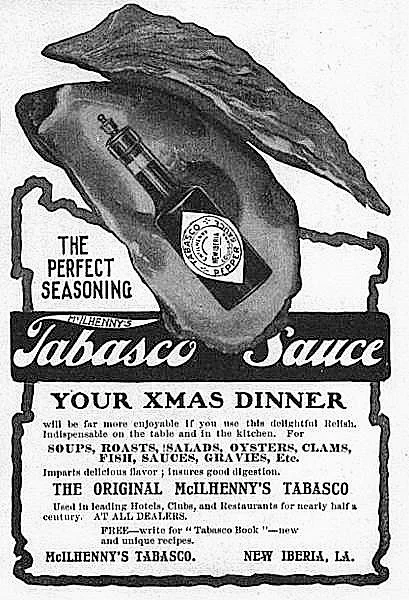
In 1870, McIlhenny filed for and received his patent. By the early 1870s, working through E.C. Hazard and Company — a major nineteenth-century food distributor — he had broken into New York, Philadelphia, and Boston.1 By the late 1870s, the sauce was selling across the US and had begun appearing in Europe. McIlhenny died in 1890 having built, without apparently realizing it, the foundation of a durable business.
The production process that hasn't changed
The formula McIlhenny developed has three ingredients: tabasco peppers, distilled vinegar, and Avery Island salt. The production sequence has been slightly modified over 155 years but not fundamentally altered.
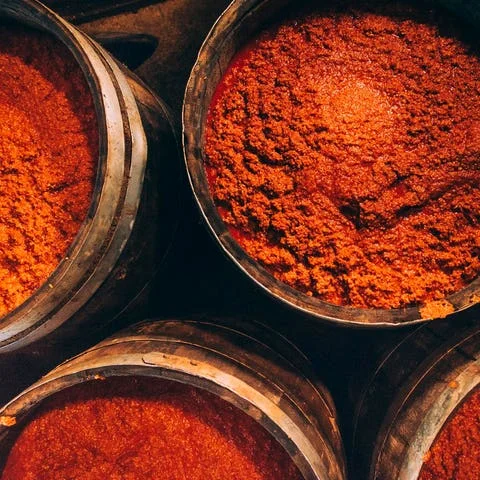
Peppers are picked by hand. Pickers compare each pepper against a small wooden dowel — "le petit bâton rouge," the little red stick — and only peppers that match its color are harvested. The peppers are ground into a mash on the day of harvest and packed with salt into used whiskey barrels made from white oak, whose inside surface is stripped, re-toasted, and cleaned to remove residual whiskey flavor. The barrels are then stored in a warehouse on Avery Island, where the mash ages for up to three years under the Louisiana heat.2 After aging, the mash is strained to remove skins and seeds. The resulting liquid is blended with distilled vinegar, stirred occasionally for a month, and bottled.
The salt used for generations came from the Avery Island salt dome itself — one of the largest salt domes along the Louisiana coast.2 Originally, all peppers came from Avery Island too. As demand outgrew the island's capacity, the company began contracting growers across Louisiana in the 1960s and eventually established farms in Central America, South America, and Africa. Today the island supplies the seed stock; the growing happens elsewhere. The production and bottling remain in Louisiana.
The factory produces as many as 720,000 two-ounce bottles per day.2
The succession that built the company
McIlhenny's two sons did more to build the McIlhenny Company than their father had. On Edmund's death in 1890, the eldest son, John Avery McIlhenny, took over — then resigned after a few years to join Theodore Roosevelt's Rough Riders in 1898, riding with the 1st US Volunteer Cavalry Regiment.2 The younger son, Edward Avery McIlhenny — a self-taught naturalist who had recently returned from an Arctic expedition — took over in 1898 and ran the company until his death in 1949. Under Edward, the brand expanded internationally and modernized its manufacturing.
The most consequential figure in the company's twentieth-century history, however, was Walter Stauffer McIlhenny. Walter had joined the Virginia National Guard in 1931, transferred to the Marine Corps in 1935, and fought in the Pacific during World War II, reaching the rank of brigadier general in the reserves by 1959.3 He took control of the company in 1949, having spent the war eating C-rations and developing strong views about them.
The general, the cookbook, and the MRE
Walter McIlhenny understood two things that his predecessors hadn't fully exploited: that American soldiers hated their rations, and that his family's sauce could fix that.
In 1966, the company released a pocket cookbook called No Food Is Too Good for the Man Up Front — packaged around a two-ounce bottle of Tabasco in waterproof camouflage wrapping — and aimed at American troops in Vietnam. It included instructions for improving C-rations into something vaguely edible: dishes with names like "Combat Zone Burgoo" and "Breast of Chicken under Bullets."2 The sauce sold for a dollar, the wrapping made it field-proof, and soldiers began requesting it in care packages from home.
This wasn't yet official military procurement — it was guerrilla marketing. But it worked. When the modern MRE (Meal, Ready-to-Eat) was introduced in 1983, Tabasco was already familiar to two generations of American soldiers. In 1992, the Department of Defense formalized what had been informal practice: 1/8-ounce glass bottles of Tabasco were included in the MRE kit as standard issue.3 Eventually the miniature bottles appeared in two-thirds of all MRE menus. The Australian, British, and Canadian armies followed with their own ration inclusions.2 In 1991, Army General Norman Schwarzkopf wrote to the McIlhenny Company: "Your product has always been in demand by troops in the field. I have enjoyed spicing up my own rations with your pepper sauce for many years."3
Walter ran the company until his death in 1985.
The trademark fight no one expected to matter
In the decades after Edmund McIlhenny's death, a legal subplot ran underneath the company's expansion. The word "tabasco" was a generic name for a type of chili pepper — one that Maunsel White had been using before McIlhenny, and that multiple sauce makers used interchangeably. The McIlhenny Company spent five decades in litigation asserting that "Tabasco" was its proprietary brand rather than a descriptive ingredient name.
In 1948, a Louisiana court ruled in their favor.2 The ruling allowed McIlhenny to use the word "Tabasco" as a trademark while other producers could still list "tabasco peppers" as an ingredient. The distinction seems technical, but it meant that no competitor could call their product Tabasco sauce. For a condiment brand with three ingredients, owning the word that described both the product and one of its components was commercially significant.
The trademark wars continued sporadically. In the 1970s, a University of Auburn professor who developed a new tabasco pepper variety and called it "Greenleaf tabasco" received a legal threat from the company; the US attorney general's office eventually resolved the matter.2 The McIlhenny legal posture on the name remains consistent to the present.
What the company actually is today
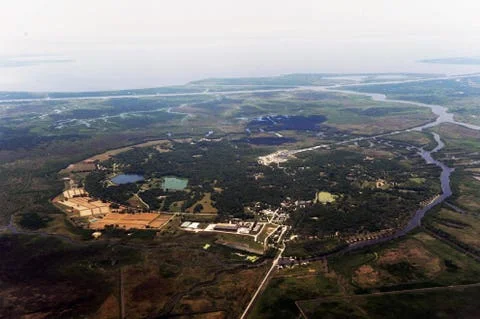
McIlhenny Company does not publish annual financial reports. It is privately held, family-owned, and has received and declined multiple acquisition offers. A 2007 Wall Street Journal review of Rothfeder's book cited the company's annual revenue at approximately $250 million.5 A 2022 Forbes article described it as one of the most widely consumed condiment brands most people had never thought much about — still family-owned, still operating from Avery Island, with about 200 employees.4
The current CEO, Harold Osborn, is the sixth generation of the founding family, appointed in June 2019.2 The company holds a Royal Warrant of Appointment from Queen Elizabeth II, granted in 2009 as "Supplier of Tabasco HM The Queen."2 The sauce appears on Air Force One, has been on the International Space Station, and in 2005, after Hurricane Rita hit Avery Island hard, the family built a 17-foot levee around the factory and invested in backup generators rather than relocate.2
The product line has grown. The original red sauce remains the flagship — three years in white oak, three ingredients — but the brand now extends to jalapeño, chipotle, habanero, sriracha, scorpion, and several other variants. None of the non-flagship varieties use the three-year aging process. Since 1994, Tabasco advertisements have been running in international markets at a scale the company rarely discusses.
The company describes itself as running on a hundred-year planning horizon.4 Whether that framing reflects actual strategic methodology or family mythology is hard to say from outside. What is clear is that 155 years after a ruined banker started growing peppers in a Louisiana salt-dome garden — not as a business plan but as something to do — the original bottle shape, the three-ingredient formula, and the same family are still in place.
The man who built it never considered it worth writing about.
このコンテンツについて、さらに観点や背景を補足しましょう。