Four world records in 45 minutes — with a broken back
Jesse Owens broke 6 world records in 45 minutes at the 1935 Big Ten — injured.
On the afternoon of May 25, 1935, a 21-year-old Ohio State sophomore named Jesse Owens walked onto the cinder track at Ferry Field in Ann Arbor, Michigan. He couldn't bend over far enough to touch his own knees. His lower back had been wrenched in a fall down a flight of stairs five days earlier — one account says he was roughhousing with fraternity brothers; another says he slipped on water during a prank gone sideways. 1 Either way, his coach Larry Snyder had spent the better part of the week trying to talk him out of competing at all.
By 4:00 PM — 45 minutes after his first event went off — Owens had broken or equaled six world records across four events, a feat that sports historian Richard C. Crepeau (University of Central Florida) later selected as "the most impressive athletic achievement since 1850." 2 No athlete before or since has done anything remotely comparable in a single afternoon.
Comedian Will Rogers, hearing about it, offered the only appropriate reaction: "Mr. Owens broke practically all the world records, with the possible exception of horseshoe pitching and flagpole sitting." 2
Event 1: The 100-yard dash (3:15 PM) — and the timers who weren't allowed to tell the truth
The gun fired. Owens, who was never a fast starter, exploded off the blocks slowly and then — around the 30-yard mark — turned on an acceleration that left the field standing. He crossed in 9.4 seconds, tying the world record he himself had first set as a Cleveland high-school junior in 1933. 1
Here's the part that still stings: more than half the official timers on the line had their watches at 9.3 seconds — which would have been a new outright world record. Under the rules of the day, officials were required to use the slowest reading when timers disagreed. So Owens' fastest sprint was officially recorded slower than it actually was. The first 9.3-second 100 yards wouldn't be officially recognized until Melvin Patton ran it in 1948. 2
Event 2: The long jump (3:25 PM) — one attempt, 25 years
Ten minutes after his sprint, Owens stood at the end of the long jump runway. Normally he would take several practice jumps before his competitive attempts. He couldn't. His back wouldn't allow it.
He took one jump.
The sand read 26 feet 8¼ inches (8.13 meters) — crushing the previous world record by more than half a foot. 3 That single leap stood as the world record for 25 years, until American Ralph Boston cleared 8.21 meters at the 1960 Rome Olympics. In a remarkable coincidence, Owens was sitting in the stands as a spectator when Boston broke his mark. 1
Track & Field News deputy editor Jon Hendershott put the absurdity plainly: "The scary part to me always has been how good Owens was for the very little long jump training he did. And the back problem restricted him to just a single jump at the '35 Big Ten. Yet he set a world record that lasted for a quarter-century. Pretty stunning stuff." 2
For context: his 8.13 m, set while in pain on one attempt with minimal training in the event, would still have ranked seventh in the world at the 2008 Beijing Olympics — 73 years later. 1
Events 3 and 4: Two more records before 4 PM
At 3:34 PM, Owens lined up for the 220-yard dash (roughly 201 meters). He won by so much that an Ohio State coach looking at photos afterward said it looked "like there was no one else on the track." His time of 20.3 seconds obliterated the existing world record of 20.6 seconds — and because 220 yards is slightly longer than 200 meters, the same performance simultaneously broke the 200-meter straightaway world record too. 2 That 20.3-second mark wasn't beaten until 1949.
The final event at 4:00 PM was the 220-yard low hurdles — and this is where the story gets genuinely odd. Owens was not, by any technical measure, a great hurdler. The low hurdles (just 2 feet 6 inches high, about 76 cm) suited him because the barriers were short enough that raw speed between the sticks could compensate for imperfect technique. He won by roughly five yards and crossed in 22.6 seconds, becoming the first human ever to break 23 seconds in the event. The 200-meter low hurdles world record fell simultaneously. 3
Four events. Six world records. Forty-five minutes. Back injury throughout.
The roughly 5,000 spectators at Ferry Field — a Michigan home track, not even Ohio State's own venue — mobbed the infield so completely that Owens had to exit through a locker-room window afterward. 2
What happened next: Berlin, gold, and a president who never sent a telegram
At the time of that Big Ten meet, Jesse Owens was not yet famous. He was a scholarship-less Black athlete at Ohio State who lived off-campus because the university's dorms didn't accommodate African American students. He was good — very good — but the world hadn't fully clocked it yet.
One year, two months, and eight days later, he stood at the 1936 Berlin Olympics and won four gold medals: 100 meters, 200 meters, long jump, and the 4×100-meter relay. 1 The event categories were almost exactly the same as his Big Ten record day — sprint, long jump, longer sprint, relay sprint. It wasn't a coincidence; it was the same athlete expressing the same gifts on a bigger stage.
The world record count from May 25, 1935 stood up remarkably:
| Event | Owens' 1935 mark | Record broken by | Year broken |
|---|---|---|---|
| Long jump (8.13 m) | 26 ft 8¼ in | Ralph Boston (8.21 m) | 1960 |
| 220-yard dash (20.3s) | 20.3 sec | Melvin Patton (20.2s) | 1949 |
| 100-yard dash (9.4s, tied) | 9.4 sec (tied WR) | Melvin Patton (9.3s) | 1948 |
| 220-yard low hurdles (22.6s) | 22.6 sec | Fred Wolcott (22.5s) | 1940 |
When Owens returned from Berlin as the most celebrated athlete at the Games, President Franklin D. Roosevelt never invited him to the White House, never sent a telegram. Years later, Owens remarked: "Hitler didn't snub me — it was our president who snubbed me. The president didn't even send me a telegram." 1
His post-Olympic years were financially precarious. The Amateur Athletic Union suspended him from amateur competition after he refused to continue a punishing exhibition tour of Europe organized for the AAU's financial benefit. To make money, he raced against horses, motorcycles, and cars. His own assessment: "People say it was degrading for an Olympic champion to run against a horse, but what was I supposed to do? I had four gold medals, but you can't eat four gold medals." 1
President Gerald Ford finally awarded him the Presidential Medal of Freedom in 1976. A Congressional Gold Medal came posthumously in 1990, ten years after Owens died of lung cancer at 66. 5
The plaque at a rival's stadium
Here is the last strange detail worth noting. Ferry Field — the University of Michigan's track facility, the rival-school venue where Owens ran his "greatest 45 minutes" — has kept a bronze plaque on its grounds ever since, commemorating what an Ohio State athlete did there on May 25, 1935. In 2024, the University of Michigan added a second, newer plaque at the site. 1
Sports Illustrated called it "the highest compliment in college athletics" — a school permanently honoring an opponent on its own home ground. 2
The records came down, one by one, over the years. The plaque stayed.
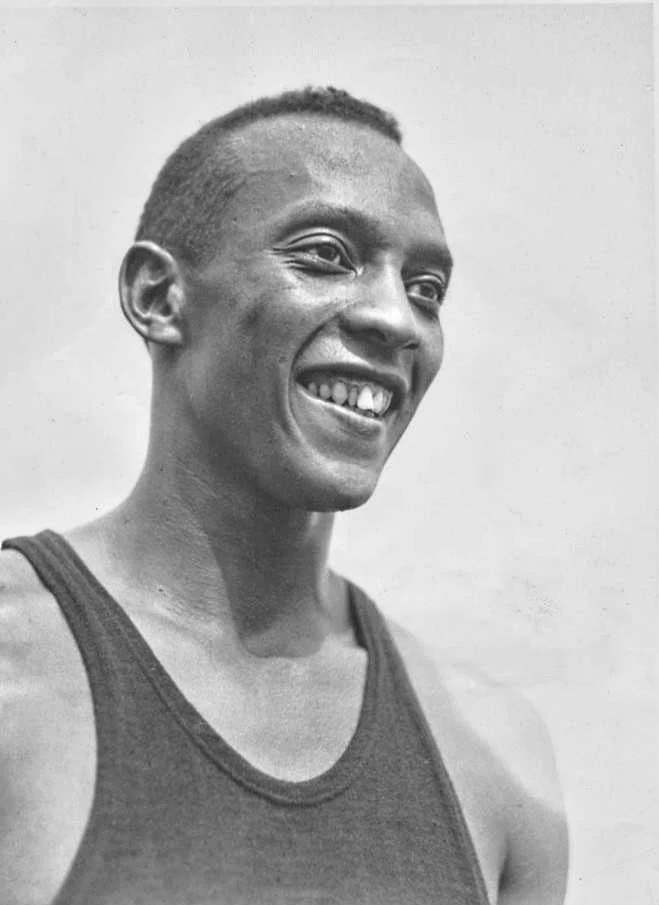
Cover image: Jesse Owens at the 1936 Berlin Olympics, Bundesarchiv (via Wikimedia Commons)
このコンテンツについて、さらに観点や背景を補足しましょう。