A report on the City of Heaven, written by a man no one can find
A newly digitized Vatican manuscript — Ott.lat.2667, a 16th-century Italian relazione by the entirely unknown Contugo Centugli — describes the great city of Quinsay (Hangzhou, China) and its king, written in 1583, the same year Matteo Ricci entered China. The manuscript has sat in Cardinal Pietro Ottoboni's collection since before 1748 and is now freely viewable on DigiVatLib for the first time.

In 1583, someone in Italy sat down and wrote a relazione — a structured diplomatic report — on the great city of Quinsay and the king of China. The document runs to 40 folios, composed in a careful Italian cursive hand. The author signed his name: Contugo Centugli. He gave the date: 1583. Then he seems to have vanished from the historical record entirely.
Vatican manuscript Ott.lat.2667 — Relazione della Gran Città del Quinsay et del Re della China — was digitized by the Biblioteca Apostolica Vaticana in June 2026 as part of its Week 22 batch of 80 newly scanned manuscripts. 1 It is now freely viewable at DigiVatLib. 2 The IIIF manifest is not yet live — as is typical for freshly digitized Vatican manuscripts — so individual folios cannot yet be browsed programmatically, but the viewer itself is accessible. What you can see on the cover page alone is enough to stop and stare.
The manuscript nobody has heard of
The title, written in the same flowing hand as the text, reads: Relatione della Gran Città del Quinsay et del Re della China fatta dal S[ignor] Contugo Centugli nell'ano 1583. That translates, roughly, as: "Report on the great city of Quinsay and the king of China, made by Signor Contugo Centugli in the year 1583." The shelfmark "2667 Ottob" is written at the bottom right. A circular Vatican library stamp sits beside the text. 3
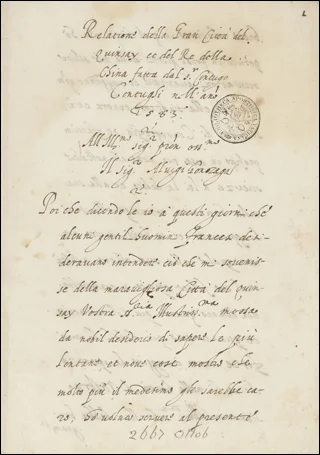
The manuscript is a paper codex of 40 folios (folios 1r–40v), with two front flyleaves and one rear flyleaf, digitized to TIFF at 3006×4277 pixels per page using a Metis DRS 750 scanner with color checker and millimeter scale included in each shot. 4 The language code in the Vatican catalog is listed as "und" — undetermined — but the visible title and the genre clearly point to Italian.
As for the author, Contugo Centugli appears nowhere else. Six separate searches across English and Italian — combinations of his full name, partial name, "Venezia," "1583," "Cina," "Quinsay" — returned nothing. No Wikipedia article, no citation in an academic database, no genealogical trace. He may have been a Venetian merchant who compiled reports without publishing, a low-ranking diplomatic secretary, or someone writing from others' accounts rather than firsthand travel. Without access to the manuscript's full text, none of these can be confirmed or ruled out.
What a relazione was, and why it existed
The word relazione in this context is a technical term. In the Venetian Republic, ambassadors were required by law to deliver a formal written report to the Senate upon returning from any foreign posting. These reports followed a standard structure: geographic overview, the character and habits of the ruler, military and economic conditions, social customs, and strategic recommendations for Venetian policy. The genre was mandatory; it was also meticulous. 5
The historian Donald E. Queller described what a relazione contained: "a broad and comprehensive synthesis, periodically brought up to date by successive ambassadors, of the political, military, economic, and social conditions of the country visited." 5 By the 16th century, the reports had become so famous beyond Venice that, as Queller put it, "copies were sold abroad at good prices, not only to governments, but also to erudite collectors." 5
That last detail explains a great deal. Ott.lat.2667 is not a Venetian state document — it ended up in a cardinal's private library, not in the Archivio di Stato di Venezia. By 1583, the relazione form had spread beyond official diplomatic channels; it had become a prestige genre, a format that signaled serious engagement with a foreign subject. Whoever Centugli was, by titling his manuscript Relazione, he was signaling exactly that: this is not a traveler's tale. This is a report.
Whether he had been to China is a different question entirely — and, for now, unanswerable.
1583: the year everyone was thinking about China
The date on the manuscript is not incidental. 1583 sits at a specific hinge in European engagement with China.
On September 10 of that year, the Italian Jesuit missionary Matteo Ricci (1552–1610) entered China and established the first permanent Catholic mission there since the Franciscan missions of the Yuan dynasty, settling in Zhaoqing, Guangdong province. 1 Ricci had arrived in Macao in August 1582 and spent a year preparing; his settlement in Zhaoqing opened a channel of firsthand intelligence about China that would flow back to Europe for the next century. At the same time, in England, the mathematician and imperial theorist John Dee (1527–1608) was incorporating "Quinsay" into his cartographic writing — positioning Hangzhou as a destination reachable via a Northwest Passage, part of his vision of a British maritime empire extending to Asia. 1
In 1583, in other words, three separate Europeans were writing about the same Chinese city. One of them — Ricci — would go on to spend the rest of his life there and become one of the most consequential figures in Sino-European history. One — Dee — remained in England and never got close. And one — Centugli — wrote 40 folios and disappeared.
The city itself: Marco Polo's legacy
Quinsay was not an obscure place. It was Hangzhou (杭州), the Southern Song dynasty capital — one of the largest and wealthiest cities in the medieval world. Marco Polo visited around 1276 and could not contain himself. He called it "without a doubt the finest and most splendid city in the world," writing: "Inside there is a lake that has a compass of some 30 miles, and all round it are beautiful palaces and mansions of the richest and most exquisite structures you can imagine." 6 He called it Kinsay — from the Chinese 行在 (Xíng zài, meaning the temporary imperial residence) — and wrote that those who had once seen it "say they have been to Kinsay, or the City of Heaven, their only desire is to get back thither as soon as possible." 6

Polo's Travels, compiled by Rustichello da Pisa around 1298, circulated widely across Europe in manuscript copies throughout the 14th and 15th centuries. By 1583, Hangzhou had been lodged in the European imagination for nearly three hundred years as a city of almost mythological richness — "12,000 bridges," "the greatest palace in the world," a lake ringed by palaces. 6 Centugli was writing about a real city that most Italian readers would have known only as a legend.
Whether his account updated or simply recycled that legend — whether he brought new intelligence or dressed old Polo material in the respectability of a relazione format — cannot be determined without reading the full text. That question is part of what makes the manuscript interesting.
How it reached the Vatican
The manuscript belongs to the Ottoboniani latini collection, which takes its name from Cardinal Pietro Ottoboni (1667–1740). 7 Ottoboni was born in Venice — the same city whose diplomatic tradition produced the relazione genre — and was the grandnephew of Pope Alexander VIII. He settled in Rome and became one of the great cultural patrons of his age: he sponsored Arcangelo Corelli, Alessandro Scarlatti, Antonio Vivaldi, and Antonio Caldara; he held weekly music academies at the Palazzo della Cancelleria that were famous throughout Rome; he built a private theatre and, by some accounts, ran it at personal financial ruin. 7
The musicologist Ellen T. Harris described him as someone who "loved pomp, prodigality, and sensual pleasure, but was in the same time kind, ready to serve, and charitable." 7 That mix — extravagance and genuine curiosity — is evident in his library. He assembled thousands of manuscripts spanning history, literature, diplomacy, and music. A Venetian cardinal with a taste for the world's knowledge would naturally have acquired a relazione on China.
After Ottoboni's death in 1740, his heirs dispersed his estate. The Vatican purchased the manuscript collection in 1748. 8 In 1797, French troops — acting on the Revolutionary-era confiscations across Europe — seized approximately 500 manuscripts from the Ottoboni collection; all but 36 were eventually returned. 7 Ott.lat.2667 survived both the dispersal and the confiscation and has remained in the Vatican holdings since.
Explore it now
The Vatican published Ott.lat.2667 in its Week 22, 2026 digitization batch — 80 manuscripts released on June 2, 2026. 1
コンテンツカードを読み込んでいます…
The full 40 folios are free to view. The handwriting on the cover page alone — Italian cursive, a careful hand, the words "Quinsay" and "China" and a date that places it at the exact moment Matteo Ricci walked into the Middle Kingdom — is worth a few minutes of attention.
What Centugli actually wrote about the city, what sources he drew on, what he thought the king of China was like: those answers are in the folios. The manuscript has been in the Vatican since at least 1748. As of this week, anyone can read it.
Cover image: AI-generated illustrative image.
参考ソース
- 1Vatican Manuscripts Added Week 22 of 2026 — wiglaf.org
- 2Ott.lat.2667 — DigiVatLib Viewer
- 3Ott.lat.2667 — DigiVatLib Manuscript Detail
- 4DigiVatLib Viewer Edition — Ott.lat.2667
- 5Relazione — Wikipedia
- 6China Daily: Marco Polo's City of Heaven
- 7Wikipedia: Pietro Ottoboni (cardinal)
- 8wiglaf.org: Vatican Manuscripts Added Week 14 of 2020 — Ottoboni fond
このコンテンツについて、さらに観点や背景を補足しましょう。