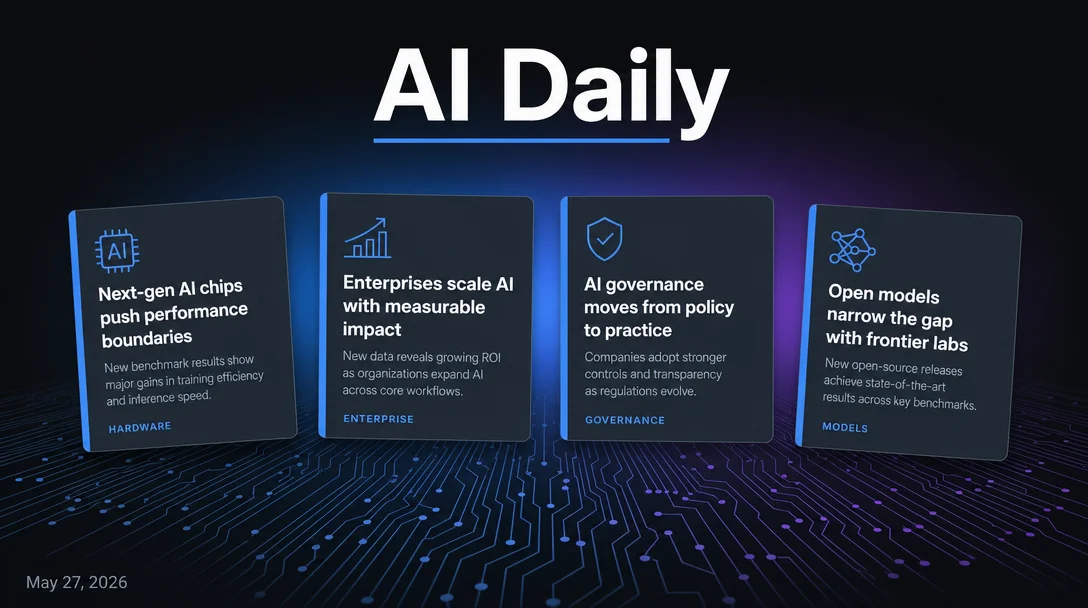
AI Daily — May 27, 2026
A ranked 5-item briefing: Trump shelves a federal AI safety executive order; a novel copyright suit names individual Meta AI researchers personally; OpenRouter raises $113M Series B at $1.3B valuation; OpenAI hires ServiceNow's CMO Colin Fleming; and Microsoft ships its first OS-level AI agent panel in Windows 11.

Five developments that moved the AI industry in the past 24 hours: Washington pulled back from regulating frontier models, a copyright lawsuit named individual AI scientists for the first time, the multi-model infrastructure layer closed its biggest round of the year, OpenAI locked in its enterprise sales general, and Microsoft shipped the first OS-level tool for monitoring AI agents in real time.
Today's 5
1. Trump shelves the AI safety executive order
President Trump confirmed he postponed signing a draft AI safety executive order that would have created a voluntary framework for AI developers to engage with the U.S. government before publicly releasing advanced models. 1
"I didn't like certain aspects of it," Trump said. "I think it gets in the way of, you know, we're leading China, we're leading everybody, and I don't want to do anything that's going to get in the way of that lead." 1
Lawfare characterized the episode as "AI governance by phone call" — the administration's second-term deregulatory posture on AI now has a concrete data point: a safety review mechanism was drafted, reached the president's desk, and was killed over competitiveness concerns before it could take effect. 2 For founders and compliance teams watching the federal regulatory calendar, the message is that Washington does not plan to impose pre-release review requirements on AI models in the near term.
2. Authors sue Meta's AI scientists personally in Llama copyright case
A proposed class action filed in federal court in New York — Hobbs v. Meta Platforms et al — named Meta Platforms, CEO Mark Zuckerberg, and two former senior Meta AI researchers as defendants individually, alleging they orchestrated "large-scale piracy of tens of millions of books" to train the Llama AI model family. 3
Suing individual AI researchers — rather than only the corporate entity — is rare in AI copyright litigation. If the court allows the individual defendants to remain, it could expand personal liability exposure for researchers involved in training-data decisions at any AI company, not just Meta. The case adds a new pressure point to an already crowded field of AI copyright disputes.
3. OpenRouter raises $113M Series B at $1.3B valuation
OpenRouter (founded 2023, San Francisco), which operates an AI model-routing gateway giving developers access to 400-plus models from a single API, closed a $113M Series B led by CapitalG (Alphabet's growth-stage venture fund) at a post-money valuation of approximately $1.3 billion — more than double its valuation of $547M roughly one year earlier. 4
The platform now counts 8 million global users and processes roughly 25 trillion tokens per week, up from 5 trillion per week six months ago. 4 TechCrunch noted that OpenRouter's growth reflects a "multi-model future" in which enterprises are choosing not to lock into a single model vendor the way they once locked into SaaS platforms — the routing layer captures value from that flexibility. 4
4. OpenAI hires ServiceNow CMO Colin Fleming to lead enterprise marketing
OpenAI brought on Colin Fleming as CMO for its enterprise business unit. Fleming was most recently CMO at ServiceNow (after 13 years at Salesforce, where he rose to EVP of Global Marketing). 5
Fleming announced the move on LinkedIn, describing it as a "gut-wrenching" decision and saying he "would have regretted not taking the swing." Adweek reported that the hire signals OpenAI's intent to deepen enterprise marketing and expand beyond its core AI product into broader business-software territory. 5 The appointment follows a pattern of enterprise-sales infrastructure buildout at OpenAI over the past several months.

5. Microsoft ships OS-level AI agent monitoring in Windows 11 preview
Microsoft released Windows 11 preview update KB5089570 (OS Build 28000.2179), which adds a taskbar agent-monitoring panel — the first instance of agent-status visibility built directly into the operating system. 6
The panel lets users track running AI agents from the taskbar, supporting both first-party and third-party apps. The first integrated application is the Researcher feature inside Microsoft 365 Copilot, which now displays live progress on report generation and sends a push notification on completion. Developers can plug third-party agents into the same surface via the
Windows.UI.Shell.Tasks API. 6 The same build updates four Copilot+ PC AI components — Image Search, Content Extraction, Semantic Analysis, and Settings Model — to version 1.2604.515.0.Cover image: AI-generated illustration.
参考ソース
- 1Trump says he postponed signing of AI executive order
- 2AI Governance by Phone Call
- 3Authors Sue Meta's AI Scientists Directly in Llama Copyright Case
- 4OpenRouter more than doubles valuation to $1.3B in a year
- 5OpenAI Hires ServiceNow CMO Colin Fleming to Lead Business Marketing
- 6May 26, 2026—KB5089570 (OS Build 28000.2179) Preview
このコンテンツについて、さらに観点や背景を補足しましょう。