Adobe (ADBE) — 40% cheaper than a year ago, but earnings keep growing

Adobe (ADBE) — 40% cheaper than a year ago, but earnings keep growing

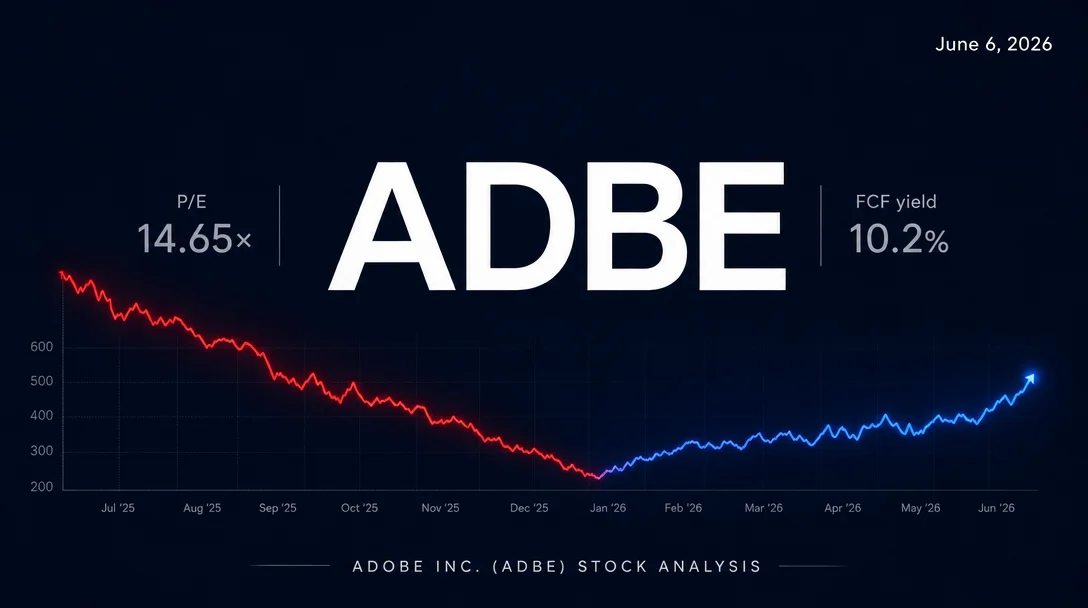
Adobe Inc. (NASDAQ: ADBE) passes all three hard screening criteria: ROE of 37.9% / 38.8% / 39.0% for FY2023–FY2025 (each year well above the 15% threshold), TTM FCF of $10.3 billion (FCF yield ~10.2%), and a trailing P/E of 14.65× — 64% below Adobe's own 5-year average and 50% below enterprise software peer median. The article covers all nine required areas and closes with a structured bull/bear framework anchored on the June 11 Q2 FY2026 earnings report.

US Stock Pick: 3-Year ROE > 15%
2026/6/6 · 21:28
購読 1 件 · コンテンツ 19 件
Current price: $251.44 (June 5, 2026 close) · Market cap: $101.6B · Sector: Technology / Packaged Software 1
Adobe Inc. (NASDAQ: ADBE) clears all three hard screening criteria with room to spare. Return on equity has held above 37% for three consecutive fiscal years — 37.9% / 38.8% / 39.0% for FY2023–FY2025 (GAAP, SEC EDGAR) — each year well above the 15% threshold. 2 Free cash flow has grown from $6.9B to $9.9B over that period and hit $10.3B on a trailing-twelve-month basis. 3 And valuation? At a trailing P/E of 14.65× against a 5-year average of ~40×, Adobe is trading at a 64% discount to its own history — a compression not seen since the 2008–2009 financial crisis. 4
The central tension: Adobe's stock has lost 40% over the past year as investors debate whether generative AI will erode the creative software moat that justified its premium for two decades. Firefly has generated 9B+ AI images; ARR growth has slowed to ~10%. Which dynamic wins — the cash machine or the disruption risk — is what this article examines.

What Adobe does and how it makes money

Adobe Inc. (founded 1982, headquartered in San Jose, California) makes software that people use to create, publish, and measure digital content. 2 Its business runs across three divisions.
Digital Media is the core and accounts for approximately 74% of total revenue. 5 Creative Cloud — which bundles Photoshop, Illustrator, Premiere Pro, After Effects, and a dozen other tools — had approximately 41 million paid subscribers as of late 2025. 6 Document Cloud (Acrobat, PDF services) generated $3.18B in FY2024 revenue, up 18% year-over-year, with over 400 billion PDF opens per year. 5 Total Digital Media segment revenue reached $15.86B in FY2024.
Digital Experience (Experience Cloud) serves enterprise marketing teams with analytics, commerce, and customer journey tools. The segment generated $5.37B in FY2024, up 10% year-over-year. 5 At the April 2026 Adobe Summit in Las Vegas, the company launched CX Enterprise (a customer experience platform) and a dedicated AI agent platform. 1
Publishing and Advertising is a small residual segment.
Adobe operates in more than 90 countries, serves 99 of the Fortune 100, and counts 850 million monthly active users across its platforms. 5 It holds approximately 70% of the professional creative software market, with Photoshop alone commanding roughly 90% share in graphic design tools. 5 Adobe does not pay a dividend; its last cash distribution was in 2005. 1

ROE track record — FY2023–FY2025

All three years clear the 15% criterion decisively, with ROE stable in a narrow band around 38–39%.
Fiscal yearNet incomeStockholders' equity (year-end)ROE
FY2023 (ended Dec 1, 2023)$6.887B$18.168B37.9%
FY2024 (ended Nov 29, 2024)$6.981B$17.984B38.8%
FY2025 (ended Nov 28, 2025)$7.171B$18.398B39.0%
TTM (through Feb 28, 2026)$7.208B~39%
Source: SEC EDGAR XBRL 10-K filings, year-end equity method. 2
A methodological note worth flagging. Commercial data providers (Finviz, StockAnalysis, Macrotrends) show Adobe's ROE at 58–62%, roughly 20 points above the SEC GAAP figure. The difference traces to their equity denominator: these platforms use a figure approximately $6.4B lower than the SEC total stockholders' equity, a gap that closely matches Adobe's accumulated goodwill and intangible assets from past acquisitions. Both calculations are valid but answer different questions — GAAP ROE measures returns on total invested capital including acquisition premiums; the tangible-equity ROE measures returns on the net physical and financial asset base. The table above uses the SEC GAAP figure, which is more conservative and more directly comparable across companies. ROIC (return on invested capital) stands at 42%, and ROCE (return on capital employed) at 49%, both confirming the capital efficiency signal independently of equity methodology. 7

Free cash flow — building, not spending

Adobe's FCF has compounded at roughly 19% annually since FY2023, reaching a TTM figure of $10.3B — and the capital expenditure required to generate it amounts to less than 1% of revenue, the hallmark of a software business with almost no physical asset requirement.
チャートを読み込んでいます…
FCF figures from StockAnalysis (OCF minus CapEx methodology). 3
PeriodOperating CFCapExFCFFCF marginFCF yield
FY2023$7.30B$0.36B$6.94B35.8%
FY2024$8.06B$0.18B$7.87B36.6%
FY2025$10.03B$0.18B$9.85B41.5%
TTM$10.51B$0.19B$10.32B42.2%~10.2%
TTM FCF yield is calculated as $10.32B / $101.6B market cap. 3 7
At 10.2%, Adobe's FCF yield is roughly 2.4× the 10-year US Treasury yield of approximately 4.3–4.5% as of early June 2026. For context, the S&P 500 aggregate FCF yield is typically 4–5%. The TTM FCF-to-net-income conversion ratio is 143% ($10.32B FCF vs. $7.21B net income), meaning Adobe's cash generation substantially exceeds its reported accounting profits — a quality signal. Capital expenditure as a share of revenue fell from 2.2% in FY2021 to 0.75% in FY2025. 3
Adobe announced a $25 billion share repurchase program in April 2026, authorized through April 2030 — equivalent to 24.6% of the current market cap. CFO Dan Durn stated: "Our new $25 billion share repurchase authorization is a direct expression of confidence in our robust cash flow and the long-term value we are delivering to investors." 8 The company has retired shares consistently; the float shrank roughly 5.6% year-over-year as of TTM data. 7

Valuation — at a decade-low multiple

Adobe's current valuation is the lowest it has been since the 2008–2009 financial crisis, across both historical and peer-relative metrics.
統計カードを読み込んでいます…
Metrics as of June 5, 2026 close. 1 7
Historical context. Adobe's trailing P/E averaged approximately 40.3× over the five years from 2021 through 2025, with a range from 12.7× (current) to 66.9× (late 2021). 4 Today's 14.65× sits 63.6% below that 5-year average. P/FCF of 9.85× is 67.7% below its 5-year average of approximately 30.5×. The P/E compression is the primary driver of the stock's ~40% decline over the past year — TTM diluted EPS has actually grown from roughly $15.30 (mid-2025) to $17.17, meaning EPS grew while the stock fell. 4
Peer comparison. All peer data from Finviz, as of June 5, 2026 close.
CompanyTrailing P/EForward P/EP/BEV/EBITDAPEGOne-line description
ADBE (Adobe)14.65×9.50×8.93×10.35×0.75×Creative Cloud, Document Cloud, Experience Cloud — creative and enterprise digital software
MSFT (Microsoft)24.82×21.45×7.47×16.32×1.15×Enterprise cloud (Azure), productivity software (Office 365), Windows, Xbox
ORCL (Oracle)38.36×26.66×18.32×25.78×1.25×Enterprise database, cloud infrastructure, and business applications
ADSK (Autodesk)33.60×16.18×15.22×25.43×1.01×Design and engineering software for architecture, construction, and manufacturing
CRM (Salesforce)21.49×11.95×4.44×13.91×0.94×Cloud-based CRM platform; expanding into AI agents via Agentforce
NOW (ServiceNow)66.89×22.23×9.89×40.25×1.06×Enterprise IT workflow automation; building AI-native autonomous workforce tools
Peer median29.28×20.06×8.68×20.88×1.09×
ADBE vs. median−50.0%−52.6%+2.9%−50.4%−31.2%
All peer data from Finviz as of June 5, 2026 close. 1 9 10 11 12 13
Adobe trades at a 50%+ discount to the software peer median on trailing P/E, forward P/E, and EV/EBITDA. The only metric close to parity is P/B (8.93× vs. 8.68× peer median), since Adobe's goodwill and intangibles inflate its book value relative to tangible assets. Its PEG of 0.75× is the lowest in the peer group; the traditional interpretation of PEG < 1.0 is that a stock is potentially underpriced relative to its expected earnings growth rate. Whether the discount is justified or excessive depends heavily on the AI disruption thesis addressed in the risk section below.

Revenue and earnings growth

Revenue growth has been strikingly consistent — a tight band of 10–12% every year for four years — while net income growth has been lumpier due to a one-time $1 billion Figma termination fee in FY2024.
チャートを読み込んでいます…
Revenue and margin data from StockAnalysis (SEC 10-K source). 14
PeriodRevenueYoY growthNet incomeOperating marginNet margin
FY2021$15.79B+22.7%$4.82B36.8%30.6%
FY2022$17.61B+11.5%$4.76B34.6%27.0%
FY2023$19.41B+10.2%$5.43B34.3%28.0%
FY2024$21.51B+10.8%$5.56B31.4%25.9%
FY2025$23.77B+10.5%$7.13B36.6%30.0%
TTM (Feb 2026)$24.45B+11.0%$7.21B36.7%29.5%
Q1 FY2026 (quarter)$6.40B+12.0%$1.89B37.8%29.5%
Revenue and margin data from StockAnalysis and Macrotrends (SEC 10-K source). 14 15
Three observations from the table. First, FY2024's operating margin dropped to 31.4% — 3 points below adjacent years — entirely because Adobe booked a $1 billion termination fee when its proposed $20 billion acquisition of Figma was blocked by the DOJ and the European Commission in December 2023. 1 Excluding that non-recurring item, the underlying margin trend is flat to improving. Second, FY2025 net income surged 28.2% on just 10.5% revenue growth, as operating leverage returned and cost discipline took hold. Third, Q1 FY2026 revenue of $6.40B (+12.0% year-over-year) extended the steady-growth trend into the current fiscal year, and operating margin reached 37.8% — the highest quarterly figure in at least four years. 14
TTM EPS (diluted, GAAP) is $17.17. Analyst consensus projects FY2026 EPS at $26.46 and FY2027 at $29.74, implying a 5-year EPS CAGR of approximately 12.6%. 1
Gross margin is 88.8%, reflecting the economics of a subscription software business where the marginal cost of delivering an additional seat is near zero. 1

Balance sheet health

Adobe's debt load has risen meaningfully since 2023 but remains comfortably manageable against its cash generation.
MetricFY2025TTM (Feb 2026)
Total debt$6.65B$6.66B
Cash & equivalents$6.89B$6.89B
Net debt / net cashNet debt ~$0.0BNet cash ~$0.23B
Debt / equity (D/E)57.2%58.2%
Interest coverage (EBIT / interest)33.1×33.9×
Current ratio1.000.91
S&P credit ratingA+ (Stable)
Moody's credit ratingA2 (Stable)
Balance sheet data from StockAnalysis; credit ratings from S&P and Moody's announcements. 16 17
The D/E ratio of 57–58% looks elevated on first glance but reflects two deliberate capital allocation choices rather than financial distress. Adobe issued $2 billion in new senior notes in January 2025 18 and has been aggressively buying back shares, which mechanically compresses the equity denominator. With interest coverage of 33.9× — meaning operating income covers annual interest expense nearly 34 times over — there is no debt service stress. S&P's April 2025 affirmation of the A+ rating came with the statement that Adobe is expected to "maintain its conservative financial policy," with leverage projected to stay below 1.5×. 17
A note on the current ratio of 0.91: it looks sub-1 on the surface, but $7.3 billion of the $11.4 billion in current liabilities consists of unearned revenue — prepaid subscriptions that represent services Adobe will deliver, not cash it owes to creditors. Excluding unearned revenue, the adjusted current ratio is well above 2.0×. 16
The next significant debt maturity wall is 2027 ($1.35 billion), followed by $800 million in 2028 and $750 million in 2029. With $10.5 billion in annual operating cash flow, none of these maturities create refinancing pressure. 18

Risk factors

1. CEO succession — leadership vacuum at a critical juncture
CEO Shantanu Narayen, who has led Adobe since 2007, announced in March 2026 that he will step down once a successor is identified. Narayen will remain as Board Chairman. 19 The two internal candidates most discussed are David Wadhwani (President, Digital Media) and Anil Chakravarthy (President, Digital Experience); the board is also conducting an external search emphasizing AI leadership credentials. The timing is awkward — a transition announced when the stock is 40% below its 52-week high and just five days before a scheduled earnings report adds uncertainty at precisely the moment the company needs to communicate a clear AI strategy. Adobe's stock has declined 22.5% year-to-date since the announcement. 19
2. AI disruption risk — real question, contested magnitude
The bear thesis on Adobe — articulated most forcefully in a Seeking Alpha analysis — is that generative AI is commoditizing creative workflows. Canva has launched AI tools that some users describe as replacing Creative Cloud's core functionality at a fraction of the price. Anthropic released Claude Design in April 2026, directly targeting Adobe's creative user base; the announcement sent ADBE shares down on the day. 1 FY2026 full-year ARR growth is expected at only 10.2%, and Q1 FY2026 net new ARR of approximately $400 million came in below expectations. 20
The bull counter-argument comes from Michael Burry of Scion Asset Management, who ranked ADBE second out of 50 software stocks in a May 2026 analysis and called it a "fat pitch." His reasoning: Adobe's 850 million monthly active users plus its platform-agnostic AI strategy — with partnerships spanning Anthropic, OpenAI, Google, and Microsoft simultaneously — make its distribution position difficult to displace. As Burry wrote: "Those 850 million monthly active users plus Adobe's wide distribution across and within Anthropic, OpenAI, Google, and Microsoft amount to an aggressive moat. If and when AI agents try to compete, Adobe still puts forth platform-agnostic connections across all four foundation-model ecosystems and has effective control of the playing field." 21 Adobe's Firefly AI has generated more than 9 billion images since its March 2023 public beta. 5 The honest read is that the disruption is real, the pace is uncertain, and the outcome is genuinely contested.
3. Insider selling — no buying signal from management
Insider ownership is 0.20% of shares outstanding. Recent insider transactions are entirely sales: CEO Narayen sold 75,000 shares on April 28, 2026 (at $243.54/share, totaling $18.3 million through the Narayen Family Trust); CFO Daniel Durn sold 1,336 shares on April 20 ($248.02/share, $331,355); and SVP/CAO Jillian Forusz sold 755 shares on April 30 ($246.25/share, $185,915). 1 No insider has made a public market purchase in the past 12 months. All transactions were option exercises at zero cost. While option-based sales are a routine form of compensation realization and do not necessarily signal bearish conviction, the absence of any open-market buying at these compressed prices is a data point worth noting.
4. Short interest — elevated but not extreme
Short interest stands at approximately 18.98 million shares (about 4.7% of float), with a days-to-cover ratio of 3.4 days based on average daily volume. 1 Short interest as a percent of float increased approximately 9.1% between April 30 and May 27, 2026. For a large-cap tech stock, 4.7–5.2% short interest is moderately elevated — not an extreme short position, but enough to suggest meaningful bearish conviction exists among professional investors.
5. DOJ settlement and regulatory overhang
In March 2026, Adobe settled with the DOJ for $150 million — comprising a $75 million civil penalty and $75 million in free services to customers — over allegations that Adobe obscured early-termination fee disclosures and created barriers to subscription cancellation. 22 The settlement required Adobe to clearly disclose termination fees upfront and provide straightforward cancellation processes going forward. The financial impact ($150M) is immaterial against $10.3B in TTM FCF, but the consent decree imposes ongoing compliance obligations and signals regulatory scrutiny of Adobe's subscription practices. A separate class-action lawsuit filed in August 2025 makes similar allegations on behalf of individual customers; that case remains open. 1
6. The Figma termination — a strategic option that closed
Adobe's attempted $20 billion acquisition of Figma was blocked by US and European regulators in December 2023, resulting in a $1 billion breakup fee. 1 Figma has since operated independently and, as of May 2026, attracted activist investor Findell, which is seeking to press for operational improvements. Adobe cannot attempt to acquire Figma again for a regulatory cooling-off period. Figma represents a direct competitive threat in collaborative design — the segment most exposed to younger-generation creative professionals who have grown up using browser-based tools. Adobe's e-signature product (Adobe Sign) also trails DocuSign, which holds 67.6% of the e-signature market versus Adobe Sign's approximately 5.2%. 23

Near-term catalysts

Q2 FY2026 earnings — June 11, 2026 (after market close) is five days away. Analyst consensus is EPS of $5.83 and revenue of $6.457 billion. 24 Company guidance for Q2 is non-GAAP EPS of $5.80–$5.85 and revenue of $6.43–$6.48 billion. A year ago, Q2 FY2025 delivered EPS of $5.06 and revenue of $5.87 billion; reaching consensus would represent 15.2% EPS growth and 10.0% revenue growth year-over-year. Adobe has exceeded consensus EPS in each of the past two quarters (by 3.06% and 2.04%, respectively). 24 The call will be webcast beginning at 2:00 PM PT. The four variables most likely to move the stock: total ARR growth rate, net new ARR versus expectations, any commentary on CEO succession progress, and whether the $25B buyback authorization is accelerating.
Analyst consensus. Among 39 analysts tracked by Finviz, the consensus rating is Hold (score 2.34 out of 5, where 1 = Strong Buy). 1 The average 12-month price target is $322.16, implying 28.1% upside from $251.44 — though the distribution of targets tells a more cautious story: Goldman Sachs Sell at $290, KeyBanc Underweight at $310, Melius Sell at $310, Barclays Equal Weight at $275, Mizuho Neutral at $270, Citi Neutral at $264, and Piper Sandler Neutral at $280. At least eight investment banks downgraded the stock between January and March 2026. Analyst price targets carry systematic optimism bias; these should be read directionally, not literally. 1
52-week range and price context. The 52-week range is $224.13 (low, reached around April 9, 2026) to $421.48 (high, reached approximately June 2025). 1 At $251.44, the stock is 40.3% below its 52-week high and approximately 12.2% above its 52-week low. Year-to-date: −28.2%; one-year: −39.4%; three-year: −42.1%. The stock's beta is 1.40, meaning it typically moves 40% more than the broader market in either direction on a given day. 1
Dividend status. Adobe does not pay a dividend and has not since March 2005. Capital is returned entirely through share repurchases. 1

Competitive positioning and moat

Adobe's competitive position rests on four reinforcing structures.
Creative Cloud lock-in through workflow integration. Photoshop, Illustrator, Premiere Pro, After Effects, InDesign, and Lightroom are not simply individual products — they are a deeply interconnected workflow where files move between applications using proprietary formats (.psd, .ai, .aep, .indd) that embed metadata, layer structures, and color profiles. 5 A professional photographer who shoots RAW, edits in Lightroom, retouches in Photoshop, and exports to Illustrator for layout is not simply choosing a tool; they are embedded in a workflow that would require relearning and re-tooling to exit. With 41 million paid subscribers and a daily net addition rate of approximately 11,600 new paid members as of late 2025, the subscriber base is still growing. 6
Content creation network effects. Behance, Adobe's creative portfolio platform, has more than 50 million members. 5 Adobe Stock's library holds over 450 million assets. PDF has become a universal document format — over 400 billion PDFs are opened per year through Adobe's tools — and Acrobat processes approximately 16 billion document edits annually. 5 These platform assets are expensive and slow to replicate.
Intellectual property and AI training data. Adobe has a structural advantage in AI training that is easy to overlook. Its Stock library is one of the largest commercially licensed asset libraries on the internet, meaning Adobe can train its AI (Firefly) on content it owns the rights to — avoiding the copyright disputes that have plagued competitors training on scraped internet data. This matters for enterprise adoption: Fortune 500 legal teams are more comfortable deploying AI tools where the provenance of training data is clean. Of the Fortune 100, 87 use Adobe software in enterprise workflows. 5
AI strategy: platform-agnostic distribution. Rather than building one proprietary foundation model and betting on it beating OpenAI or Anthropic, Adobe has embedded its tools into all four major AI ecosystems — Anthropic, OpenAI, Google, and Microsoft — through integration and distribution agreements. Adobe is rebuilding Photoshop and Premiere to run on NVIDIA's RTX Spark AI chip architecture. 1 Total ARR entering FY2026 stood at $25.66 billion, and remaining performance obligations (RPO — contracted but not yet recognized revenue) rose 13% to $20.4 billion. 7
The moat has real vulnerabilities — primarily Canva's consumer-facing growth, Figma's collaboration advantage among younger designers, and the general risk that AI tools lower the barrier to entry for good-enough creative output. But the professional creative market — agencies, studios, media companies, enterprise marketing departments — has shown limited willingness to disrupt established workflows for small cost savings.

Bull vs. bear thesis

The bull case rests on three observations.
The P/E of 14.65× against 12%+ earnings growth produces a PEG of 0.75× — the lowest in the entire peer group. 1 A software company generating $10.3B in TTM FCF with 88.8% gross margins and zero debt stress is not priced as a growth business; it is priced as a business in secular decline. The decline thesis requires AI disruption to materialize at a speed that is not yet visible in Adobe's revenue trajectory — four consecutive quarters of 10–12% growth with margin expansion does not look like a franchise under serious competitive stress.
The $25 billion buyback at these prices is a meaningful capital return. At $251/share, $25 billion buys back roughly 100 million shares, or about 25% of the float. If earnings grow and shares shrink simultaneously, per-share earnings could compound meaningfully even if the multiple stays flat.
Michael Burry's "fat pitch" framing makes a specific structural argument: Adobe's value derives less from any single product or AI model and more from controlling the distribution layer across which creative workflows are accessed at enterprise scale. That position is harder to displace than any individual tool. 21
The bear case focuses on three risks that are unresolved.
ARR growth at ~10% is not matching the P/E multiple re-rating that bulls expect. If AI genuinely commoditizes creative tools over three to five years — Canva, Anthropic's Claude Design, and emerging AI-native alternatives all targeting the same user base — Adobe's pricing power in the consumer and SMB segments could erode even as enterprise relationships hold. The bear model from Seeking Alpha's analysis argues Adobe's current stock price is still ~7% above intrinsic value even after the 40% decline. 20
The CEO transition creates a period of strategic ambiguity precisely when the board needs to make large, fast decisions about AI product positioning and capital deployment. A prolonged search or a poor candidate choice is a real, though unquantifiable, risk.
Insider selling — especially the CEO's $18.3 million sale in April — is not encouraging. Management teams that believe a stock is severely undervalued typically buy; they do not sell. The absence of any open-market purchase is the absence of the strongest bullish signal.
The variable to watch at Q2 FY2026 earnings on June 11: net new Digital Media ARR. Q1 FY2026 net new ARR of approximately $400 million came in below expectations; two consecutive soft quarters would confirm the deceleration narrative. A beat — net new ARR meaningfully above expectations — would signal that AI integration is contributing to subscriber growth rather than cannibalizing it. The second watch item is any CEO succession update: a credible internal or external candidate announced with a timeline would remove a significant overhang.

All financial data sourced from SEC EDGAR XBRL 10-K filings, StockAnalysis, Finviz, Macrotrends, and the additional sources cited throughout. Price data represents the June 5, 2026 close. This article is for informational and research purposes only and does not constitute investment advice or a recommendation to buy or sell any security. All data should be independently verified before making any investment decision.

このコンテンツについて、さらに観点や背景を補足しましょう。

  • ログインするとコメントできます。