
How Ted Turner lost control by building too well

How Ted Turner lost control by building too well

In 1995, Ted Turner agreed to sell his cable empire to Time Warner for $7.5 billion — not because he was outmaneuvered, but because the governance structure he built to protect himself had eliminated every other strategic option. The case traces Turner's decade of blocked moves (CBS, NBC), John Malone's kingmaker premium, Levin's five-week Montana-to-Manhattan close, the FTC's contested 3–2 consent decree, and why Turner called it the biggest mistake of his life.

Business Negotiation Classics: One Case a Day
2026/6/3 · 21:34
購読 1 件 · コンテンツ 16 件
In August 1995, Gerald Levin flew to Montana and pitched Ted Turner a deal that Turner had been, in practical terms, unable to refuse for at least two years. Turner agreed. 1 Levin would later call it "a sublime combination." Turner called it a chance to stop "being little for my whole life." 1
Seven years later, Turner would describe it as the biggest mistake of his life and claim he had lost more money than anyone in the history of capitalism. 2 Both of those statements are worth holding in mind from the start, because the negotiation they bracket is one of the most instructive in modern deal-making — not because Turner was outsmarted, but because the ownership structure he had built to protect himself had, by 1995, become the cage that drove him into Levin's arms.
The deal: Time Warner acquired the 82% of Turner Broadcasting System (TBS) it did not already own in an all-stock transaction worth approximately $7.5 billion, announced September 22, 1995, and closed October 10, 1996. 1 3 The combined company would hold CNN, TNT, TBS, Cartoon Network, HBO, Warner Bros., Time magazine, People, Sports Illustrated, Warner Music Group, New Line Cinema, and the Atlanta Braves. By estimated 1996 revenue of $21 billion, it was the world's largest media and entertainment company. 3
リンクプレビューを読み込んでいます…

The parties, the stakes, and what each side actually wanted

Ted Turner / TBSGerald Levin / Time WarnerJohn Malone / TCI–Liberty Media
Stated objectiveGain scale, reach a Hollywood studio, and connect CNN to a global distribution platformAcquire CNN and Turner's cable networks to cement Time Warner's position as the world's largest media companyMonetize TCI's 21% TBS stake and secure long-term distribution terms for Turner content on TCI cable systems
Hidden preferenceRetain creative control and operating authority; avoid becoming an executive with no real powerComplete the acquisition before a competitor — Disney, NBC-GE, or Microsoft — moved on Turner firstExtract a per-share premium over ordinary shareholders without triggering public shareholder revolt; secure discounted carriage rates for TCI systems
BATNAContinue as a constrained independent; TCI and Time Warner's dual veto rights would keep blocking any major independent acquisitionRemain a debt-laden second-tier media company while Disney's $19 billion ABC deal reshaped the landscape around him 4Hold and wait — but a deal between Turner and any other party would have triggered a cash buyout at a lower implicit valuation
Key leverageOwnership of CNN — Levin's explicit priority target and the one asset no competitor could quickly replicateExisting 18% stake in TBS gave Levin insider intelligence and a standing relationship with Turner; $15B debt precluded a cash bid, but TBS shareholders would accept stock 521% equity stake plus a veto over any Turner transaction exceeding $2 million; first-mover on deal construction gave Malone the ability to set the terms of his own exit
Key asymmetryTurner's freedom to act was structurally constrained: he needed Malone's and Time Warner's consent for any major transaction, which meant he could not independently acquire NBC, CBS, or any network-scale assetLevin understood Turner's constraints better than Turner did — he had been the veto-holder watching Turner's blocked moves since 1987Malone held leverage over both buyer and seller simultaneously; uniquely, he could define the price of his own cooperation

How Turner boxed himself in: the decade before the deal

The 1995 merger announcement was actually the end of a ten-year narrowing of options. Understanding that decade is more important than understanding the five weeks of negotiations Levin described as "fun."
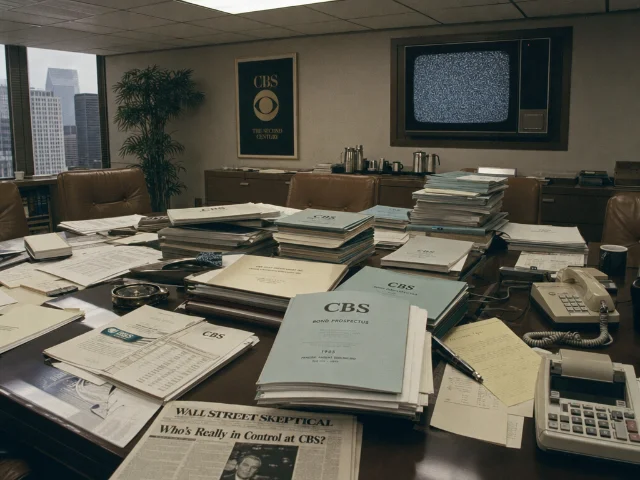
In April 1985, Turner launched a hostile $5.4 billion all-paper bid for CBS. The offer contained no cash — it was a package of notes, bonds, and TBS stock. 6 Wall Street immediately dismissed it as financially unsound. CBS filed an FCC petition arguing the deal would "ruin CBS financially" and simultaneously initiated a $1 billion stock buyback to fend Turner off. 7 By June 1985 the bid had collapsed. Turner had wanted a broadcast network for two decades and been turned away by his own balance sheet.
A recreation of the 1985 corporate war-room atmosphere, with CBS documents and hostile bid papers spread across a conference table — the failure that launched Turner's decade-long strategic search for scale
AI-generated editorial illustration depicting the corporate atmosphere of the 1985 failed CBS bid. 6
The following year, Turner compounded his balance-sheet problem by purchasing the MGM/UA film library for approximately $1.5 billion — acquiring over 3,600 films, including the pre-1948 Warner Bros. catalog, the MGM library, and the RKO library. 8 The debt nearly destroyed the company. Turner was forced to sell back the MGM studio lot and the UA distribution arm but kept the film library. In June 1987, a cable-operator consortium led by John Malone through Tele-Communications Inc. (TCI) and its programming arm Liberty Media rescued TBS with approximately $565 million in capital. 8
The rescue terms were punishing in ways that would take years to fully register. Malone received Class C preferred shares carrying special voting rights and approximately 21% equity, along with a veto over any Turner transaction exceeding $2 million. Time Warner — then still Time Inc. — also participated, contributing about 40% of the Class C capital and receiving roughly 18% ownership with its own major-transaction veto. 8 A private legal agreement between Time Warner and Liberty Media prevented either from displacing the other.
Turner had been rescued, but he had handed the keys to two overseers who could, at any time, prevent him from doing almost anything of strategic consequence.
By January 1995, the results of that structure were on full display. Top-level talks between Turner and GE's NBC — Turner's second serious attempt at a broadcast network acquisition — ended on January 15, 1995. 9 The core problem was identical to CBS in 1985: control. A source close to the talks described the impasse bluntly: "The issue all along was who would control the merged company. In essence, NBC wanted to buy TBS, and Ted Turner wanted to buy NBC." 9 GE Chairman Jack Welch had publicly committed to majority control in any combination; Turner, facing the same math he faced in 1985, walked away. The dual-veto structure meant that even if Turner had wanted to accept minority terms, Malone and Time Warner would have had to approve — and neither had any incentive to support a deal that handed TBS to GE.
That same month, Disney announced its acquisition of Capital Cities/ABC for $19 billion — creating a combined company with projected revenues of $16.4 billion. 1 The consolidation of American media around three or four dominant platforms was not a future possibility; it was happening in real time. Turner watched it happen from a company he controlled in name but not in practice.

Levin's move: five weeks from Montana to Manhattan

In August 1995, Levin concluded that Time Warner was too small for the emerging media landscape and that CNN was the asset he needed. He flew to Montana and met Turner on his ranch, where Jane Fonda picked Levin up from the airfield and Turner prepared lunch. 10
Levin's pitch was precise. Turner Broadcasting would be "the pivot point in the center of the merged company," and Turner would be "a partner, not an employee." 10 Turner, according to the New Yorker's account, agreed partly because he was "tired of dealing with his cable partners, and trusted that Levin cared deeply about journalism." 10 The Time Warner board gave formal approval to proceed in August 1995.
Before the public announcement was possible, however, Levin had to reach Malone — because Malone's veto could kill any deal. Levin flew to Colorado and made the case to TCI's CEO before Turner and Levin had finalized terms. Malone agreed to support the transaction, but his conditions were substantial. He wanted a better exchange ratio than ordinary TBS shareholders: 16 Time Warner shares per 20 Turner shares for his Class C preferred stock, versus the 15-for-20 base ratio offered to Class A shareholders. 11 He wanted a 20-year discounted carriage agreement for Turner and Time Warner networks on TCI's cable systems. He wanted Time Warner to buy Turner's 44% stake in SportSouth for $60 million and Time Warner's 15.3% in Sunshine Network for $14 million. 12
Malone's 66 million Turner shares, worth approximately $1.5 billion before the announcement, converted into Time Warner shares valued at approximately $2.1 billion after the exchange ratio premium. 11 Merrill Lynch assessed the value of Malone's structural premium at $70 million; some investment bankers put the true benefit at closer to $500 million when long-term carriage discounts were included. 11 Turner shareholder Scott Black of Delphi Management put the situation plainly: "We got a full price — $28 or $29 a share on a stock that was languishing at $16 to $17. Pleasing Malone was the only way to get the deal done." 11
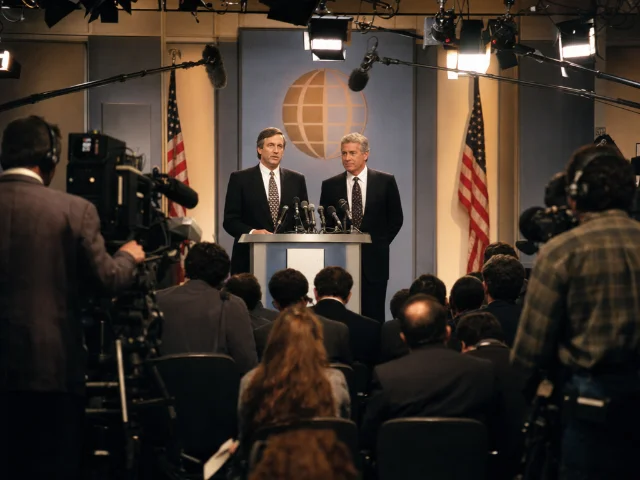
On September 22, 1995 — after five weeks of negotiations — Levin and Turner stood together and announced the deal. "I'm tired of being little for my whole life," Turner told reporters. "We've always been a small company fighting the big guys. I'm looking forward to having some muscle on our bones for a change." 13
A 1995 media company press conference, the format in which Time Warner and Turner Broadcasting jointly announced their $7.5 billion all-stock merger on September 22, 1995
AI-generated editorial illustration depicting the joint announcement press conference format. 1

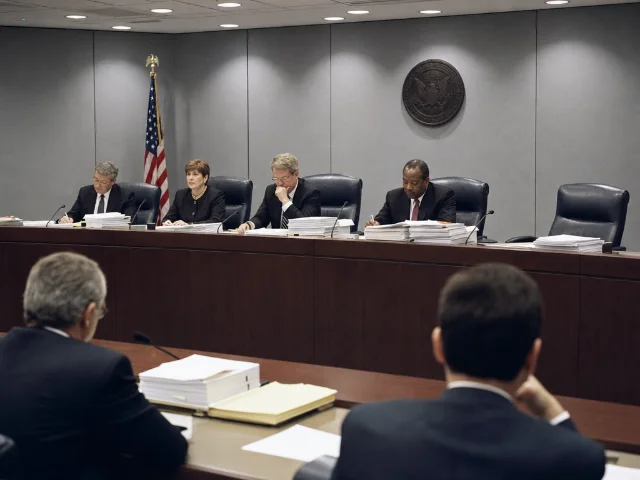
After a 12-month investigation, the FTC approved the merger on September 12, 1996, through a consent decree that addressed the Commission's core concern: the combination of the nation's two largest cable operators with three of the country's largest cable programmers. 14 TCI was the nation's largest cable operator; Time Warner was second. Their combined footprint, once TCS's Turner stake converted to Time Warner stock, would link two companies controlling more than 40% of US cable households. The vote passed 3–2, with Commissioners Mary L. Azcuenaga and Roscoe B. Starek dissenting on the grounds that the evidence did not support a finding of anticompetitive harm. 15
The FTC hearing room where the Commission voted 3-2 on the Time Warner–Turner consent decree in September 1996, with two dissenting commissioners arguing the evidence did not support a finding of competitive harm
AI-generated editorial illustration depicting a federal regulatory hearing of the era. 14
The decree's four core conditions were:
  • TCI/Liberty structural separation. TCI and Liberty Media were required to spin all their Time Warner ownership interests into a newly created "Separate Company," distributed to Liberty tracking stock holders. The Separate Company's equity was capped at 14.99% of Time Warner's fully diluted shares. TCI's controlling shareholders — John Malone, Bob Magness, and Kearns-Tribune Corporation — were required to exchange their Separate Company shares for convertible preferred stock with voting rights limited to fundamental corporate changes only. 14
  • HBO–Turner bundling prohibition. Time Warner was barred from tying carriage of its HBO premium channels to carriage of Turner cable networks, eliminating a vertical foreclosure mechanism the FTC identified as the most immediate competitive risk.
  • Mandatory carriage of an unaffiliated news service. Time Warner was required to execute a programming agreement with at least one 24-hour news service not owned or controlled by Time Warner — a service with at least 10 million unaffiliated subscribers on multi-video programming distributor (MVPD) systems by February 1997. 14
  • Non-discrimination provisions. Time Warner was barred from discriminating against unaffiliated programmers and cable operators in carriage and access decisions.
The mandatory carriage provision immediately created a crisis. On September 17, 1996, Time Warner notified Rupert Murdoch that it had selected MSNBC — the newly launched Microsoft–NBC joint venture — over Fox News as its qualifying service. 16 Fox News filed an antitrust lawsuit 18 hours before the shareholder vote. 3 New York City officials, encouraged by Murdoch, then threatened to block Time Warner's franchise renewal unless it carried Fox News — Deputy Mayor Fran Reiter went so far as to use public-access channels to insert Fox News programming into Time Warner's cable lineup. Judge Denise Cote of the Southern District of New York granted a preliminary injunction in November 1996, finding that "the City has engaged in a pattern of conduct with the purpose of compelling Time Warner to alter its constitutionally-protected editorial decision not to carry Fox News." 17 The FTC's consent decree had, inadvertently, lit the fuse for one of the decade's more consequential First Amendment cable battles.
The merger closed on October 10, 1996, with more than 98% approval from Time Warner shareholders. 3 Turner called it "quite a job to get it completed." Levin told shareholders: "The long march of Time is now complete." 3 Turner owned approximately 10–11% of the merged company and became its largest individual shareholder, with a paper net worth by 1999 of roughly $11 billion. 18
The partnership framing lasted four years. When AOL merged with Time Warner in 2000, Turner was excluded from the negotiations entirely. Within months, Levin called to tell Turner he was losing his Vice Chairman title; Turner's businesses would report to AOL COO Robert Pittman. Turner learned of the final restructuring via fax while on his New Mexico ranch. 10 Malone's advice, when Turner called him: "You can sue, but you won't get your job back. You'll just get money." 10 By 2003, after the AOL Time Warner stock collapse wiped out roughly 80% of the company's market value, Turner's fortune had fallen from approximately $11 billion to around $2 billion. He called his Vice Chairman role "a title without a portfolio, like the emperor of Japan." 18

Frameworks you can use

Structural seller: when your governance architecture removes your BATNA

Turner's situation by mid-1995 is a case study in what happens when a founder's defensive architecture neutralizes his own ability to act. The 1987 cable-operator rescue — necessary, rational, and apparently a good trade at the time — gave both TCI and Time Warner veto rights over any Turner transaction above $2 million. 8 In practice this meant Turner could not acquire NBC without Malone and Time Warner's consent — and neither party had any incentive to approve a transaction that would dilute their stakes without compensating them.
The CBS bid failed on balance sheet; the NBC talks failed on control. But the deeper failure was structural: Turner's company grew so dependent on its two largest shareholders that it could not make consequential independent moves. By 1995, his BATNA — the option to remain independent and pursue a strategic acquisition — required the cooperation of the very parties he was negotiating against.
Application: Before any significant external deal, map your own governance structure for veto points. Minority shareholders who hold blocking stakes, lenders with affirmative consent rights, board members representing competing interests — each one narrows your BATNA in the same way TCI and Time Warner narrowed Turner's. Founders who raise capital from strategic investors should treat consent-right provisions as BATNA-destroying mechanisms, not just governance formalities. The question is not "who can stop this deal?" but "who must approve my exit from a bad deal?"

The kingmaker premium: when a blocking stakeholder designs their own exit terms

John Malone's position in the Time Warner–Turner negotiation is worth studying as a distinct archetype: the veto-holder who can monetize his blocking power by setting the terms of his own consent. Malone's Class C shares gave him a formal veto over Turner transactions, but his real leverage was that Levin could not close the deal without him. 12 Levin flew to Colorado to sell Malone on the deal before he finalized terms with Turner.
The result was that Malone negotiated both the price (the enhanced 80-for-100 exchange ratio versus 75-for-100 for ordinary shareholders) and the operational benefits (20-year discounted carriage rates, worth hundreds of millions of dollars in the FTC's own analysis). 11 He captured value that, in a bilateral deal between Levin and Turner, would have flowed to ordinary TBS shareholders. The FTC recognized this and made Malone's structural neutralization — through the forced Separate Company spin-off and non-voting shares — the centerpiece of its consent decree. 14
Application: In any deal with three or more material stakeholders, identify who holds a blocking stake and ask what they need to cooperate — before you announce terms publicly. If a blocking party can name their own price for consent, and the buyer has no alternative path to close, that party will extract terms structurally disconnected from their nominal ownership percentage. The FTC's conduct-based remedy here — stripping voting rights and eliminating the carriage discounts — shows that regulators recognized the kingmaker problem and addressed it specifically. Acquirers should model this dynamic in advance: a "clean" deal without a blocking stakeholder is genuinely different from a deal that requires buying off a veto-holder at unspecified cost.

"Partner, not an employee": the face-saving architecture of an unequal deal

Levin's Montana pitch contained language that was simultaneously accurate and misleading. Turner was told he would be a partner, not an employee, and that Turner Broadcasting would be "the pivot point in the center of the merged company." 10 The structural facts, however, were these: Levin remained Chairman and CEO with full operational control; Time Warner's pre-merger board dominated the expanded 17-seat combined board; Turner's 10–11% stake was large but far from controlling; Malone's 9% was placed in a non-voting trust. The Title of Vice Chairman carried real operational scope — Turner ran TBS businesses and had supervisory responsibility over HBO — but it was not an equal partnership.
Levin understood that Turner's willingness to close depended on preserving a narrative in which Turner was not simply selling. The New Yorker's Ken Auletta later reported that Levin's philosophy was to "let Ted be Ted" — allowing Turner's idiosyncrasies and public outspokenness as the price of keeping him engaged. 10 Turner, for his part, accepted the framing because exhaustion with the veto-laden status quo was real, and because the content of the pitch — connecting TBS to a Hollywood studio, a music company, the largest magazine enterprise in America, and the largest cable system — was genuinely attractive. Turner's own post-merger observation was quieter than his public announcement: "I have to check with the boss." 10
Application: In high-profile deals involving founder-operators, the "face-saving" terms — title, naming rights, public framing, organizational position — often matter more than their formal power implies. Acquirers who dismiss these as soft considerations miss two dynamics: first, a founder who feels publicly diminished can become a disruptive force inside the combined entity; second, the "partnership" framing that closes the deal becomes legally and culturally irrelevant once a subsequent transaction changes the ownership structure. Turner's Vice Chairman role, effective through 1996–2000, was dismantled by the AOL merger without his consent and without the face-saving architecture that had made the original deal acceptable to him. The lesson for both sides: face-saving terms are real but temporary, and their shelf life is bounded by the next transaction.

Vertical foreclosure vs. efficiency: when the FTC's theory and the academic evidence diverge

The FTC's theory in approving the consent decree was that Time Warner's vertical integration — owning HBO while controlling Turner's cable networks and having TCI as a major shareholder with its own distribution network — would allow the combined company to foreclose rivals from reaching consumers. 15 Ayako Suzuki's 2009 event study in the International Journal of Industrial Organization provides the most rigorous empirical test of this theory. Using 1995 and 2000 distributor-level panel data with nonparametric matching and difference-in-differences controls, Suzuki found that competing cable channels did face measurable foreclosure in Time Warner markets after the merger — Turner-affiliated channels (TBS, TCM) gained carriage share at the expense of rival programmers. 19 However, Suzuki also found that per-channel prices in Time Warner markets fell relative to the counterfactual — consistent with efficiency gains from eliminating double-marginalization (the markup charged at each stage of a vertically separated supply chain). The catch: those efficiency gains were not passed on to consumers. Penetration rates stayed flat, indicating that demand fell as consumers responded to the lower-quality bundle produced by reduced channel variety. 19
The case thus illustrates an antitrust dilemma that remains live today: vertical mergers can simultaneously produce real efficiencies and real foreclosure. The FTC's conduct-based remedy — non-discrimination provisions, mandatory carriage, structural separation of TCI — was an attempt to preserve the efficiencies while limiting the foreclosure, but the Fox News litigation demonstrated how difficult behavioral remedies are to enforce when parties have strong incentives to find workarounds.
Application: When evaluating a deal with significant vertical integration, distinguish between the foreclosure theory and the efficiency theory — they are not mutually exclusive. The FTC's consent-decree architecture here (conduct rather than structural divestiture) is a useful model for situations where the efficiency case is real but the foreclosure risk is also real. Be precise about which market(s) the foreclosure risk applies to. The Time Warner case produced foreclosure in cable channel carriage; it did not clearly produce higher consumer prices for basic cable service. That asymmetry — competitive harm at the B2B distribution layer, potential efficiency gain at the consumer layer — is one the remedial framework should match specifically, not address with blunt structural relief.

What to remember

  • Your BATNA is only as strong as your freedom to act. Turner entered the 1995 negotiations with no viable independent alternative because TCI's and Time Warner's dual veto rights had made every major strategic option contingent on their consent. Building capital-efficient governance structures during a distress rescue is rational; failing to renegotiate those terms as the company grows is where the real cost accumulates.
  • The blocking stakeholder defines the price of the deal. Malone's enhanced exchange ratio — 80 for 100 versus 75 for 100 for ordinary shareholders — was the cost of closing the transaction, not a negotiating failure. Any acquirer who needs consent from a blocking party that holds veto rights but no selling obligation should model that party's reservation price before announcing deal terms. Surprises at the board table compress timelines and create public governance optics problems.
  • "Partner, not an employee" has an expiration date. Face-saving governance terms — titles, organizational reporting lines, public narratives — close deals. They do not survive the next ownership disruption. Turner's Vice Chairman role functioned as intended through 1996–2000 and was then dismantled by fax. Any founder accepting such a package should ask: what happens to these terms in the acquirer's next financing round, next acquisition, or next management reshuffle?
  • Behavioral consent-decree remedies require continuous enforcement. The FTC's mandatory carriage provision — designed to prevent Time Warner from using CNN's dominance to squeeze out competing news services — immediately produced the Fox News–New York City coercion case, a First Amendment battle that consumed years of litigation. Conduct remedies that depend on the constrained party's daily compliance are structurally weaker than structural divestitures; their value is proportional to the regulator's ongoing willingness to monitor and enforce.

このコンテンツについて、さらに観点や背景を補足しましょう。

  • ログインするとコメントできます。