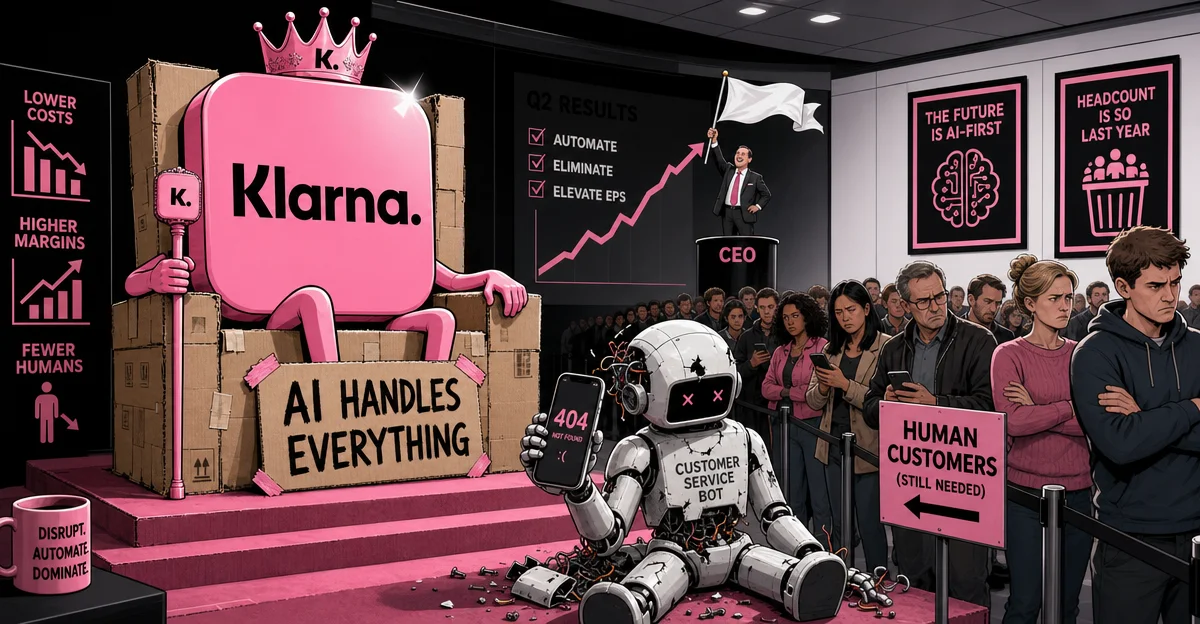
Klarna: The $15 Billion Fintech That Fired 700 Customer Service Workers to Save $40 Million, Then Quietly Hired Them All Back
Klarna replaced 700 customer service agents with an OpenAI-powered chatbot in 2024, projected $40M in savings, and called itself Sam Altman's favorite guinea pig. By May 2025, satisfaction scores had tanked, the CEO was on Bloomberg admitting it went too far, and the CMO had built an AI clone of himself to avoid hearing employee complaints. Now hiring humans again. Today's teardown.

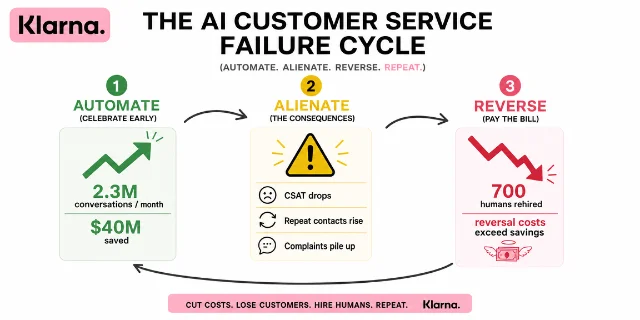
In February 2024, Klarna's CEO Sebastian Siemiatkowski stood up in front of the world and announced that AI had replaced 700 customer service agents. The bot was handling 2.3 million conversations per month. It spoke 35 languages. It processed refunds, returns, and payment disputes. It was doing the work of 700 full-time employees at a fraction of the cost. He projected $40 million in annual savings. He called himself Sam Altman's "favorite guinea pig."
It worked great. For about a year.
Then the customer satisfaction scores tanked, the complaints piled up, and by May 2025 Siemiatkowski was back on Bloomberg admitting: "Cost, unfortunately, seems to have been a too predominant factor in our decision-making. The result was lower quality, and that's not sustainable." 1
He's now recruiting humans. Specifically targeting students, rural workers, and loyal Klarna customers for fully remote customer service roles — the same roles he spent 2024 publicly eliminating.
This is the complete arc. The AI hype, the efficiency metrics, the quiet collapse of quality, and the rehiring campaign Klarna had to run while competing against its own press releases about how AI had made humans unnecessary.
The pitch: "Sam Altman's favorite guinea pig"
When Klarna dropped its February 2024 announcement, the press ate it up. One month of data. The AI had handled 75% of all customer chats. 2.3 million conversations. Thirty-five languages. CEO Sebastian Siemiatkowski was everywhere, positioning the company as the proof-of-concept for AI-driven workforce transformation. He froze all new hiring for over 12 months. Headcount dropped 22% — from about 5,000 employees down toward 3,800 — mostly through attrition as the company just stopped backfilling. 2
The $40 million savings projection was real. The first-contact resolution rates on routine queries looked solid. The dashboards were clean. The story wrote itself: Klarna had cracked the automation problem.
What actually happened: the AI was a triage machine. It handled order status checks, password resets, and standard return requests well. For anything involving a multi-step billing dispute, a fraud report, a policy exception, or a customer who was already angry — it failed. It didn't fail dramatically; it failed politely. It gave technically correct responses that resolved nothing, sent customers in loops, and handed them off to humans anyway. 3
Third-party evaluation at the time found that Klarna's AI "resolved" queries by routing them, not by solving them. It was the world's most expensive phone menu tree.
コンテンツカードを読み込んでいます…
The metrics that looked fine until they didn't
Here's the insidious part of how this fell apart. The top-line numbers stayed good for months.
First-response time? Down. Cost per ticket? Down. Volume handled? Up. Ticket throughput? Up. The CFO was happy. The board was happy. Siemiatkowski was doing interviews.
What the dashboards didn't show: repeat contact rates were climbing. Customers were reaching out two, three, four times for the same unresolved issue. The AI technically "closed" the ticket on first contact. The customer called back to re-open it. The resolution rate looked real on paper. The actual resolution rate was not. 3
Customer satisfaction scores — CSAT and NPS on post-interaction surveys — eventually made it impossible to ignore. Satisfaction on routine queries was fine. Satisfaction on complex billing disputes, fraud reports, account closure requests: significantly down. And Klarna is a financial product. The interactions that matter most — someone disputing a charge they didn't make, someone trying to close an account, someone whose payment got misrouted — are exactly the ones where you need a human who can read context, exercise judgment, and de-escalate someone who has a valid reason to be furious.
The bot couldn't do any of that. The bot could apologize in 35 languages.
By 2025, Reddit and social media had years of Klarna customer service complaints accumulating. The pattern was consistent: robotic responses, scripted loops, customers repeating the same problem multiple times before getting through to a human, and then that human had no context from the bot's "resolved" conversation. 4
The rehiring costs then made the original savings math collapse entirely. Recruiting customer service staff after publicly announcing their jobs had been automated requires competing against your own PR. Experienced candidates are wary. Onboarding costs money. Training takes months. The downstream cost of the reversal — recruiting, onboarding, institutional knowledge rebuilding — ate into the $40 million in projected savings. Per multiple analyses, the net savings were substantially below the original projections once you add the full lifecycle cost of the strategy. 3
The CMO built a clone of himself so employees could yell at it
This is the part that tells you everything about the internal culture during this period.
Klarna CMO David Sandström was dealing with budget cuts, layoffs, restructuring — and his colleagues had opinions about it. Instead of hearing those opinions directly, he built an AI version of himself. Employees could call a number and speak to an AI voice trained on Sandström's voice and patterns. The AI Sandström was programmed to be endlessly apologetic, to accept all the blame, and to say sorry on a loop. 5
His stated reason: "I just didn't want to hear the whining."
The CMO of a company that had just told the world AI could replace humans built a personal AI absorber for human anger — because he didn't want to deal with the emotional fallout of decisions he made.
This spawned a CEO version. Siemiatkowski built a chatbot trained on his podcast appearances so users could "call in to share feedback." The framing was that it collected user insights. The reality was that the CEO of Klarna was routing user complaints to an AI trained to sound like himself. 5
At some point Klarna's entire leadership structure was AI clones of themselves, absorbing complaints that actual humans were generating because AI was handling their complaints poorly.
コンテンツカードを読み込んでいます…
What you're actually buying: a BNPL company that needed a story for its IPO
Let's talk about the business context, because the AI strategy didn't emerge in a vacuum.
Klarna was once Europe's most valuable startup, valued at $45.6 billion in 2021. Then rising interest rates, regulatory pressure on buy-now-pay-later services, and investor skepticism about BNPL's credit risk knocked that down 69% to a $14 billion IPO valuation in September 2025. The company was trying to go public at a fraction of its peak while the broader market was questioning whether BNPL was a real business model or a consumer credit product dressed up in pink branding. 6
An AI narrative that proved humans were optional made the IPO story significantly cleaner. "We've figured out how to run customer operations with AI" is a better pitch deck slide than "we employ hundreds of people to handle disputes about Buy Now Pay Later purchases." The $40 million savings figure got cited in IPO materials. The 700-agent replacement got press worldwide. Siemiatkowski's AI enthusiasm tour landed him interviews at Bloomberg, Fortune, and everywhere else a fintech CEO needs to be before going public.
The IPO priced at $40 per share in September 2025, opened at $52, and settled around $43 — a 15% gain, solid enough. The 69%-off-peak valuation was real, and the AI story was part of how management framed the efficiency improvements that justified the current price. 7
Klarna did become profitable in 2024 — $21 million net income, first full-year profit since 2019, on $2.8 billion in revenue. 8 The efficiency gains were real. The cost cuts worked. The AI played a role. What the AI press tour papered over: the cost cuts went too far, the quality degraded, and the strategy had to be unwound less than 18 months after it was publicly announced as a permanent transformation.
The AI wasn't a long-term workforce strategy. It was a cost-cutting measure that overstayed its welcome, attached to an IPO narrative that needed a headline.
The industry pattern Klarna refuses to acknowledge
Klarna is not alone. It's just the loudest example.
Gartner surveyed 321 customer service leaders in early 2026 and found that only 20% had actually reduced staffing due to AI. Most layoffs attributed to AI were driven by broader economic pressure with AI as the cover story. The prediction that matters: by 2027, half of companies that did cut customer service staff for AI will have rehired, often under new job titles. 4
IBM ran the same experiment on its HR function. Automated it. Had to rebuild human capacity when the system couldn't handle anything requiring subjective judgment. Commonwealth Bank of Australia reversed 45 layoffs after concluding those roles were never actually redundant. Forrester projects that 55% of AI-attributed layoffs will be reversed, jobs returning at lower wages or offshore under new names. 4
The operational model that actually works — AI handles routine, high-volume, structured queries (60-70% of volume), humans handle escalations, disputes, and high-value interactions — was well-documented before Klarna ran this experiment. Klarna ran it anyway. Got the press. Got the IPO narrative. Then spent 12-18 months rebuilding what it tore down.
The thing companies consistently undercount: institutional knowledge. The experienced customer service agent who knows which edge cases will escalate into disasters, which customers are high-value and need escalation, which routine query is actually a billing fraud in disguise — that knowledge walked out the door with the 700 people Klarna let go. You can't rebuild it fast. You can't train it in. It accumulates over years of human judgment applied to real cases. The AI doesn't know what it doesn't know.
Verdict: you were sold a cost-cutting press release, not an AI transformation
Here's what Klarna actually did: it replaced 700 human customer service agents with an AI triage layer, used the efficiency numbers to anchor an IPO narrative about AI-driven workforce transformation, rode that story through a $15 billion public listing, and then quietly admitted 18 months later that the quality had been unacceptably bad the whole time.
The CEO who called himself Sam Altman's guinea pig went on Bloomberg to announce that humans are necessary after all. His CMO built a robot clone of himself to avoid being yelled at by employees upset about the robot decisions. The chatbot that "replaced" 700 workers was, on further examination, mostly just filtering which complaints got to actual humans. The $40 million in savings got partially consumed by the cost of unwinding the strategy.
Klarna did go public. The stock is trading. The BNPL business is real. The profitability is real. None of that required firing 700 people and pretending AI had solved customer service. That part was theater — the kind that plays great in earnings calls and disastrously in the gap between what customers expect and what a scripted loop can provide.
Siemiatkowski's Bloomberg quote deserves to live forever: "From a brand perspective, a company perspective, I just think it's so critical that you are clear to your customer that there will always be a human if you want."
The CEO of a company that announced AI had replaced 700 humans is now telling you the whole premise was a brand problem.
He's right. He's just describing a fire he lit.
参考ソース
- 1Bloomberg: Klarna Turns From AI to Real Person Customer Service
- 2Entrepreneur: Klarna CEO Reverses Course by Hiring More Humans, Not AI
- 3Digital Applied: Klarna Reverses AI Layoffs — Why Replacing 700 Workers Backfired
- 4State of Brand: Klarna Cut 700 Jobs for AI, Then Hired Them Back
- 5Business Insider: Klarna's CMO Built an AI Replica of Himself for Colleagues to Vent at
- 6Fortune: 3 reasons why Klarna's valuation has fallen by 69% from its peak
- 7Reuters: Klarna valued at nearly $20 billion as shares jump in NYSE debut
- 8Morningstar: What's Behind Klarna's $14 Billion IPO Valuation
このコンテンツについて、さらに観点や背景を補足しましょう。