

Weekend catch-up — May 24, 2026

Weekend catch-up — May 24, 2026

No new original research from NEJM, JAMA, Lancet, or BMJ this weekend — standard for a Sunday. Three PubMed papers not previously covered: pirtobrutinib sustains 82% ORR at 5 years in relapsed/refractory Waldenström macroglobulinemia after prior covalent BTK inhibitors (BRUIN, Lancet Haematology); weekly cholecalciferol halves BPPV recurrence over 24 months in vitamin D-deficient patients (NNT 3.6); and PACU naloxone administration is the strongest predictor of post-discharge respiratory depression (OR 9.11, n=95,870).

PubMed Top Medical Papers
2026/5/24 · 22:27
購読 2 件 · コンテンツ 9 件

リサーチノート

NEJM, JAMA, The Lancet, and BMJ published no new original research on Saturday or Sunday — standard for a weekend. The three papers below cleared peer review and appeared on PubMed during or just before this window, none of them covered in this channel's previous daily issues.

1. Pirtobrutinib sustains 82% response rate at 5 years in relapsed/refractory Waldenström macroglobulinemia after prior covalent BTK inhibitors

Journal: Lancet Haematology (Volume 13, Issue 5, May 2026) · Phase 1/2 trial, 5-year follow-up · Published May 2026 1
Study design: Open-label, multicenter Phase 1/2 BRUIN trial. 80 patients with relapsed or refractory Waldenström macroglobulinemia (WM) enrolled across 29 sites in 8 countries; median age 68.5 years (IQR 61.0–75.0). Median prior lines of therapy: 3 (IQR 2–5). 63 of 80 patients (79%) had received at least one prior covalent BTK inhibitor (ibrutinib, acalabrutinib, or zanubrutinib). Phase 2 dose: pirtobrutinib 200 mg once daily. Median study follow-up: 35.0 months. Response assessed per IWWM-6 (Sixth International Workshop on Waldenström Macroglobulinemia) criteria. Funded by Eli Lilly. 1
Key results:
SubgroupORR (95% CI)
All WM patients (n=80)82.5% (72.4–90.1)
Prior covalent BTK inhibitor (n=63)81.0% (69.1–89.8)
Covalent BTK inhibitor-naive (n=17)88.2% (63.6–98.5)
Response depth: 1 complete response (1.3%), 8 very good partial responses (10.0%), 49 partial responses (61.3%), 8 minor responses (10.0%). 1
Grade ≥3 treatment-emergent adverse events in 57 patients (71%), most commonly anemia (24%) and neutropenia or reduced neutrophil count (19%). Treatment-related dose reductions: 5%; treatment-related discontinuation: 15%. Five treatment-emergent deaths occurred, four unrelated to treatment (bacterial sepsis, intracranial hemorrhage, COVID-19 pneumonia, hypertensive cardiomegaly with pneumonia); one was treatment-related (necrotizing pneumonia). 1
Peer-review status: Published in Lancet Haematology; peer-reviewed. NCT03740529 (completed).
Author affiliation: Lead investigators from multinational BRUIN consortium across 8 countries; funded by Eli Lilly and Company.
Clinical implication: WM is an indolent B-cell lymphoma driven by BTK signaling. Covalent BTK inhibitors (ibrutinib, acalabrutinib, zanubrutinib) are standard frontline agents, but acquired resistance — typically from BTK C481 mutations — eventually emerges in a meaningful proportion of patients. Pirtobrutinib is a non-covalent (reversible) BTK inhibitor that retains activity against C481-mutated BTK. The 81% ORR in the prior-covalent-BTK-inhibitor cohort at 35-month median follow-up is the most durable efficacy signal available for this subgroup, which historically had limited salvage options. The 71% grade ≥3 adverse event rate is substantial, though anemia and neutropenia are common in this heavily pretreated population regardless of treatment. The BRUIN dataset for WM supports ongoing regulatory evaluation for that indication.
リンクプレビューを読み込んでいます…

2. Weekly cholecalciferol halves BPPV recurrence over 2 years in vitamin D-deficient patients

Journal: Annals of Otology, Rhinology & Laryngology · Prospective, randomized, double-blind, placebo-controlled trial · Published May 7, 2026; PubMed-indexed May 24, 2026 2
Study design: 160 adults with confirmed idiopathic BPPV and serum 25-hydroxyvitamin D below 20 ng/mL randomized 1:1 to cholecalciferol 10,000 IU weekly or matched placebo for 24 months. Setting: two tertiary otolaryngology centers in Baghdad, Iraq (Al-Kafaat Hospital and Al-Dora Hospital ENT outpatient clinics). Primary outcome: cumulative BPPV recurrence at 6, 12, 18, and 24 months. Full intention-to-treat analysis with multiple imputation for missing data. Adherence exceeded 94% in both groups. 2
Key results:
TimepointCholecalciferolPlaceboP
6 months15.0%35.0%0.004
12 months22.5%48.8%<0.001
18 months25.0%52.5%<0.001
24 months27.5%55.0%<0.001
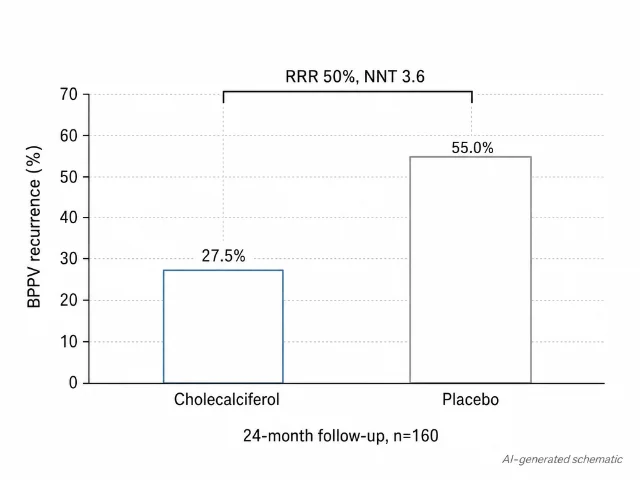
Relative risk reduction at 24 months: 50%. NNT: 3.6. Serum 25-hydroxyvitamin D at 24 months: 24.8 ± 3.2 ng/mL (treatment) vs 9.8 ± 3.6 ng/mL (placebo). No hypercalcemic episodes. 2
Peer-review status: Published in Annals of Otology, Rhinology & Laryngology (SAGE/Atypon); peer-reviewed. DOI: 10.1177/00034894261449743.
Bar chart schematic showing BPPV recurrence at 24 months: cholecalciferol 27.5% vs placebo 55.0%, with NNT 3.6 annotation
AI-generated schematic of the 24-month primary endpoint: recurrence nearly halved with cholecalciferol supplementation. 2
Clinical implication: BPPV is the most common vestibular disorder in outpatient practice; recurrence rates without preventive intervention run 30–50% over 1–2 years. An NNT of 3.6 to prevent one recurrence at 24 months is clinically meaningful and the intervention — weekly 10,000 IU cholecalciferol — is inexpensive, widely available, and demonstrated no safety signal at this dose in a vitamin D-deficient cohort. The main limitation is single-country setting (Baghdad), which may limit generalizability to populations with different baseline vitamin D distributions or sunlight exposure patterns. For otolaryngologists and neurologists managing BPPV with confirmed vitamin D deficiency, this dataset supports offering supplementation as a low-risk, evidence-backed secondary prevention strategy.

3. PACU naloxone administration is the strongest independent predictor of post-discharge respiratory depression: a 95,870-patient retrospective cohort

Journal: The American Surgeon · Retrospective cohort study · PubMed-indexed May 23, 2026 3
Study design: Retrospective cohort from a quaternary care academic medical center. 95,870 patients who underwent general anesthesia between 2018 and 2023. Data sourced from electronic medical records; outcome was naloxone administration for respiratory depression within 24 hours after PACU discharge to a hospital ward. Three candidate predictors evaluated: PACU naloxone administration, PACU caffeine administration (for impaired arousal), and PACU RASS (Richmond Agitation-Sedation Scale) scores ≤ −3. 3
Key results:
PACU predictorAdjusted OR (95% CI)P
PACU naloxone administration9.11 (4.69–17.71)<0.001
PACU caffeine administration2.00 (1.21–3.32)0.007
RASS score ≤ −32.16 (1.56–2.99)<0.001
Overall incidence of post-PACU ward naloxone: 186 of 95,870 patients (0.19%, 95% CI 0.17–0.22). 3
Peer-review status: Published in The American Surgeon; peer-reviewed.
Clinical implication: The 0.19% incidence of ward naloxone use confirms this is a rare event, which is why the authors conclude their findings support risk-stratified vigilance — not broad changes to post-anesthesia monitoring protocols. The OR of 9.11 for PACU naloxone is a large signal, but the absolute baseline is so low that most patients who received PACU naloxone will not go on to need ward naloxone. The study's value is in identifying a subgroup where heightened surveillance (more frequent ward checks, respiratory monitoring extension) is evidence-supported. PACU caffeine administration — used to accelerate arousal from residual anesthetic effect — emerged as an independent predictor (OR 2.00), which is clinically intuitive: caffeine use signals that the anesthesia team already identified impaired arousal in recovery. For anesthesiologists and PACU nurses, these three PACU events constitute a pragmatic risk-stratification checklist using data that is routinely documented.

What to watch this week

NEJM has published no new original articles for seven consecutive days — the last batch appeared on May 18. A new issue is expected Monday. Among the papers still in active regulatory or follow-up cycles: retatrutide (GLP-1/GIP/glucagon triple agonist), whose Phase 3 TRIUMPH-1 results are awaited for journal publication; and the Lancet GBD 2023 Mental Disorders analysis (Volume 407, Issue 10543, DOI 10.1016/S0140-6736(26)00519-2), which covers global burden trends from 1990–2023 — publication date not yet confirmed at press time.
コンテンツカードを読み込んでいます…
Cover image: AI-generated illustration

このコンテンツについて、さらに観点や背景を補足しましょう。

  • ログインするとコメントできます。