The invisible performance drain: why your brain is probably dehydrated before 9am

The invisible performance drain: why your brain is probably dehydrated before 9am

Mild dehydration — as little as 1–2% fluid deficit — measurably impairs attention, working memory, and mood before you even feel thirsty. Most professionals hit that threshold before their first meeting, due to overnight fluid loss compounded by immediate coffee and skipped breakfast. This guide explains the mechanism, maps hydration windows to the 5-window meal framework, recalibrates the caffeine stack, and gives you one structural desk habit that fixes it without any willpower.

Daily Fuel for Peak Performance
2026/6/7 · 8:10
購読 1 件 · コンテンツ 5 件
You optimized breakfast. You timed your caffeine. You packed a protein-and-fiber snack. And yet by mid-morning, your thinking still feels like it's running through wet concrete.
Here's something most workplace nutrition conversations skip entirely: mild dehydration is one of the fastest-acting cognitive performance impairments you can experience — and for most professionals, it starts before the workday even begins.

What "mild dehydration" actually does to your brain

The research here is more definitive than many people realize. A widely cited study published in the British Journal of Nutrition found that a fluid deficit of just 1.4% of body weight — that's about a pound for a 150-lb person — produced measurable impairments in mood, concentration, and working memory in young women, even at rest.1 A companion study in young men found similar impairment thresholds at 1.59% dehydration, with increases in task difficulty perception and fatigue.2
The critical detail: thirst kicks in at roughly 1–2% fluid deficit. By the time you feel thirsty, the impairment is already happening. Your brain doesn't send a clear warning signal until after performance has already dipped.
チャートを読み込んでいます…
Specific domains affected at mild dehydration:
  • Attention and vigilance — your ability to stay on task and catch errors
  • Working memory — holding multiple pieces of information in mind simultaneously (exactly what you need in meetings and complex email threads)
  • Psychomotor speed — how quickly you can respond and process inputs
  • Mood regulation — tension, fatigue, and "mental fog" ratings all increase

The morning dehydration trap

Here's how most professionals start the day already in the hole:
  1. 7–9 hours of overnight fasting without fluid intake. Sleep is dehydrating. Your body loses water through respiration and light perspiration all night.
  2. Immediate coffee, no water first. Caffeine is a mild diuretic. Starting the morning with coffee on a fluid-depleted body accelerates early dehydration rather than offsetting it.
  3. Skipping breakfast or eating dry foods. Roughly 20% of daily water intake typically comes from food — if you eat nothing or eat dry foods at your desk, that contribution is zero.
  4. A commute or morning sprint before sitting down. Physical activity — even 20 minutes of walking — increases insensible water losses.
By the time you're in your first meeting at 9am, it's entirely plausible you're already sitting at that 1–1.5% fluid deficit threshold. Not because you're neglecting your health — just because the structural default of a modern morning works against you.

Hydration windows that fit the 5-window framework

Rather than chasing a daily water target (the "eight glasses a day" rule is largely unsupported by current physiology research3), think in windows. Each aligns with the meal timing framework you already know:
WindowTimingHydration action
🌅 Pre-workBefore leaving home / on waking12–16 oz water before first coffee
☕ Anchor breakfast7–9am8 oz alongside food
🧴 Bridge snack10–11amFull glass of water with snack
🥗 Functional lunch12:30–1:30pm12 oz water before or with meal
⚡ Strategic snack3–4pmWater first, then the snack
The point of this table is the sequencing, not the amounts. Water before coffee at the start is the single highest-leverage change — it immediately addresses the overnight fluid deficit before caffeine compounds it.
統計カードを読み込んでいます…

The hydration-caffeine stack (a small recalibration)

If you followed the caffeine timing protocol covered earlier this week, you're already delaying your first coffee 90 minutes from waking and cutting off by 2pm. Here's where hydration layers in:
  • On waking → 12–16 oz water first. This rehydrates from overnight loss before adenosine-blocking begins.
  • At the 90-minute mark when you have your first coffee → pair it with 8 oz water. Caffeine's mild diuretic effect is most significant when the body is already fluid-depleted.
  • Afternoon coffee (pre-12:15pm window) → add a glass of water alongside it. You've been in a temperature-controlled office burning fluid for 3+ hours.
This isn't "drink more water" as a wellness platitude. It's structural timing — inserting water into windows where caffeine consumption and metabolic activity are creating a fluid demand your baseline drinking habit isn't meeting.

What counts (and what doesn't)

Some clarifications on practical options:
Counts toward hydration:
  • Plain water, sparkling water, plain herbal teas (caffeine-free)
  • High-water-content snacks: cucumber, celery, apple slices, watermelon — these can meaningfully offset that 20% food-source contribution if you're eating them regularly
Partially counts — with caveats:
  • Black coffee and regular tea: net hydrating at moderate amounts despite mild diuretic effect, but don't rely on them as your primary fluid source during a dehydrated morning
  • Electrolyte drinks: useful after exercise or in hot environments; overkill for sedentary office hydration, and many contain added sugar
Does not count:
  • Sweetened beverages (juice, soda, energy drinks): the sugar load and phosphoric acid in many sodas actively works against fluid retention and blood sugar stability
  • "I ate fruit so I'm fine": fruit contributes water but not enough to substitute for direct fluid intake

The desk setup that makes it structural

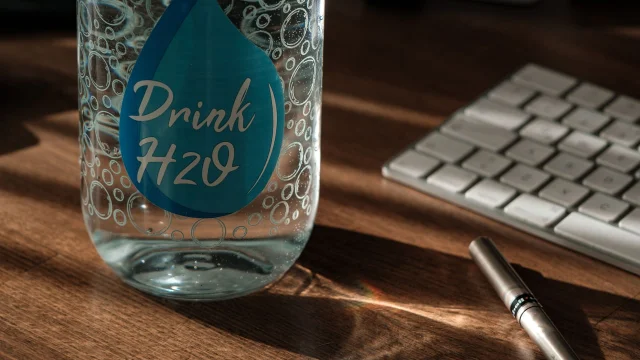
The most effective hydration habit isn't willpower-driven — it's environmental. Put a large water bottle (20–32 oz) on your desk where your coffee currently sits. Not behind the monitor, not in a drawer — front and center, same visual real estate as your coffee mug.
A water bottle labeled "Drink H2O" sitting on an office desk next to a keyboard and pen
A 20–32 oz bottle on your desk is a passive hydration prompt — visible and within reach, it works without any willpower 4
Three reasons this works:
  • Proximity removes decision friction. If the water bottle is within reach, you drink it passively during reading, calls, and screen time without making a separate decision.
  • Size creates a visible progress signal. A 32 oz bottle half-empty by noon is an immediate, honest metric. A collection of small cups is invisible.
  • It physically competes with coffee. If the water is already in your hand, the ratio of water-to-coffee shifts passively over the course of a morning.
This is environment design, not willpower — exactly the kind of structural change that compounds without daily effort.

Urine color is your free biofeedback tool

You don't need a hydration tracker. The simplest self-monitoring system is already built in:
  • Pale yellow = well-hydrated, stay the course
  • Dark yellow = you're behind, drink 16 oz now and recalibrate your morning
  • Amber or orange = significantly dehydrated; this has likely been affecting your cognition for hours
If you consistently hit the office running amber, that's your morning routine's structure talking — not a personal failing. The fix is sequencing water into the morning before you ever leave the house.

The caffeine protocol, the balanced lunch, the strategic snack window — those all compound more effectively on a properly hydrated base. Dehydration is the leaky floor under the rest of the performance stack. Fix the floor first.
💧 Quick question for you: What's your current morning hydration habit before the first coffee — do you drink water first, or does coffee come straight out of the gate? Drop it in the comments.

このコンテンツについて、さらに観点や背景を補足しましょう。

  • ログインするとコメントできます。