1/4
Pragya Yoga: Tips & Tricks
Pragya Verma
Vrikshasana — Root Down, Rise Up
Vrikshasana (Tree Pose) — the balance pose you already do every time you wait for the kettle. This 4-card set covers Sanskrit etymology, physical & emotional benefits, age-group guidance from children to seniors, a mnemonic to remember the name, and a no-mat take-home practice grounded in a Patanjali Yoga Sutras quote.
2026/6/3 · 18:19
ギャラリー
Vrikshasana — Stand Like a Tree
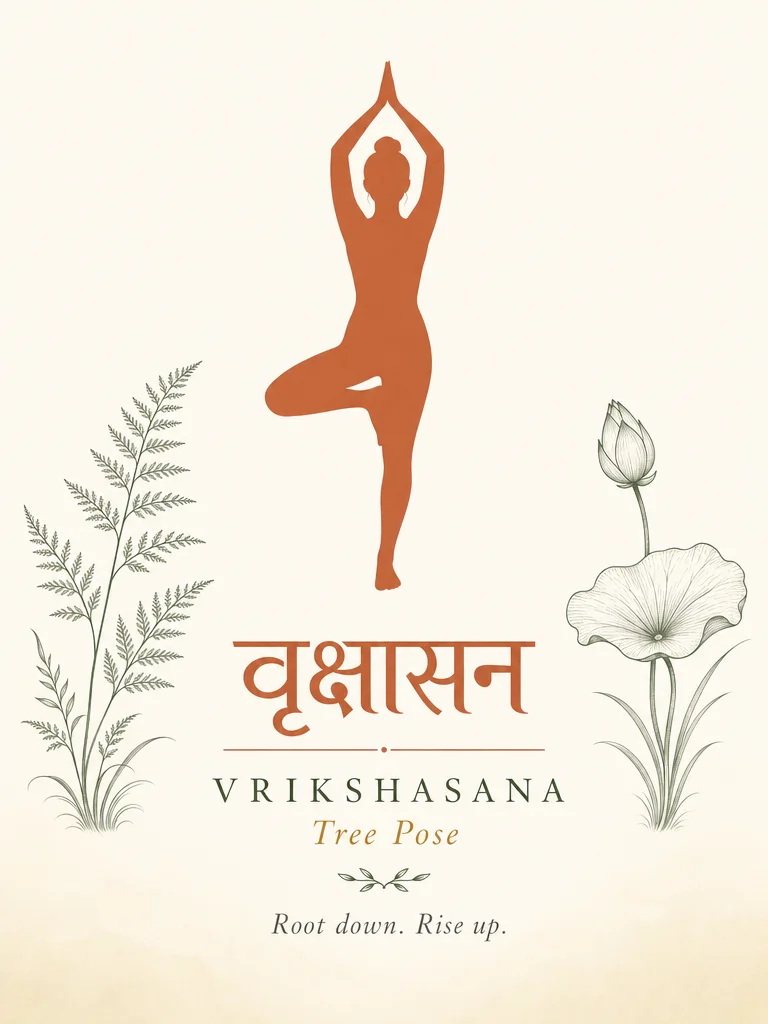
Sanskrit: वृक्षासन (Vṛkṣāsana) | English: Tree Pose
There is a moment — just a second — when you shift your weight onto one foot and lift the other, and the world suddenly demands that you pay attention. That is Vrikshasana. It does not ask for flexibility or strength. It asks for presence.
The name comes directly from Sanskrit: vṛkṣa (वृक्ष) means tree. And the pose is exactly that: one leg rooted like a trunk, the body rising upward, arms branching overhead. Ancient. Simple. Quietly difficult.
The Sanskrit name and its philosophy
वृक्षासन — Vṛkṣāsana
Pronunciation: VRIK-shah-suh-nuh
Literal meaning: vṛkṣa (tree) + āsana (seat, posture)
The tree is one of yoga's oldest metaphors. Rooted in the earth, reaching toward the sky — it is neither rigid nor collapsing. This pose teaches the same paradox: stability through softness, height through groundedness.
The classical Sanskrit quote for today's card comes from Patanjali's Yoga Sutras, 1.2:
योगः चित्तवृत्तिनिरोधः yoga: citta-vṛtti-nirodhaḥ "Yoga is the stilling of the fluctuations of the mind."
Vrikshasana is often a beginner's first encounter with this truth. The wobble is not failure — it is the mind fluctuating. The stillness, when it comes, is yoga.
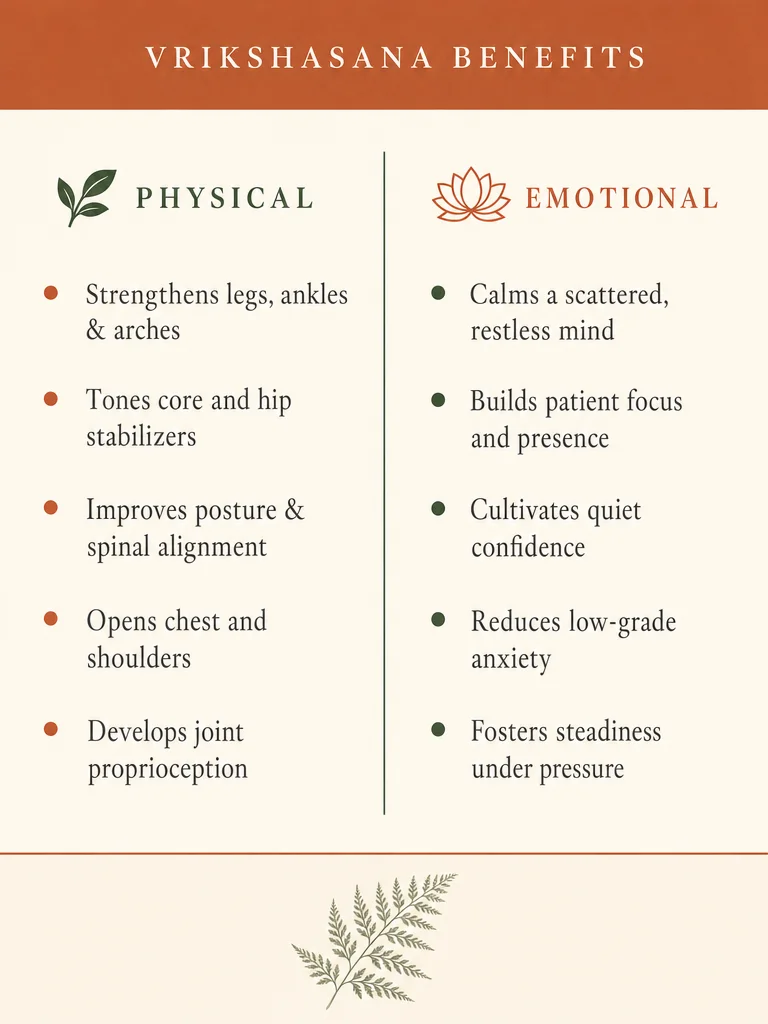
Physical benefits
Vrikshasana is a standing balance pose, which makes it a full-body engagement despite its apparent simplicity:
- Strengthens the standing leg entirely — ankle, calf, knee, hip, glute — through sustained single-leg loading
- Tones the core and hip stabilizers — maintaining upright alignment demands constant subtle muscular engagement from deep abdominals and hip rotators
- Improves spinal posture — the upward reach lengthens the spine, counteracting hours of seated forward-flexion
- Opens chest and shoulders — arms raised overhead passively expand the thoracic cavity and mobilize shoulder girdle
- Develops proprioception — the ankle and knee joints recalibrate their sense of position, reducing the risk of future sprains and falls
One unusual physical benefit worth noting: people who practice standing balance poses regularly tend to recover balance faster after unexpected perturbations — a stumble on stairs, a sudden stop on a bus. The neuromuscular pathway gets trained whether you know it or not.
Emotional and mental benefits
- Calms a scattered, restless mind — you cannot think about three things at once when your ankle is wobbling
- Builds patient focus — holding for 30–60 seconds across both sides is a quiet lesson in staying without fixing
- Cultivates quiet confidence — mastering balance, even briefly, translates to physical self-trust
- Reduces low-grade anxiety — focused single-pointed attention activates parasympathetic tone
- Fosters steadiness under pressure — practicing small-scale stability builds the internal template for larger composure
Age-group guidance
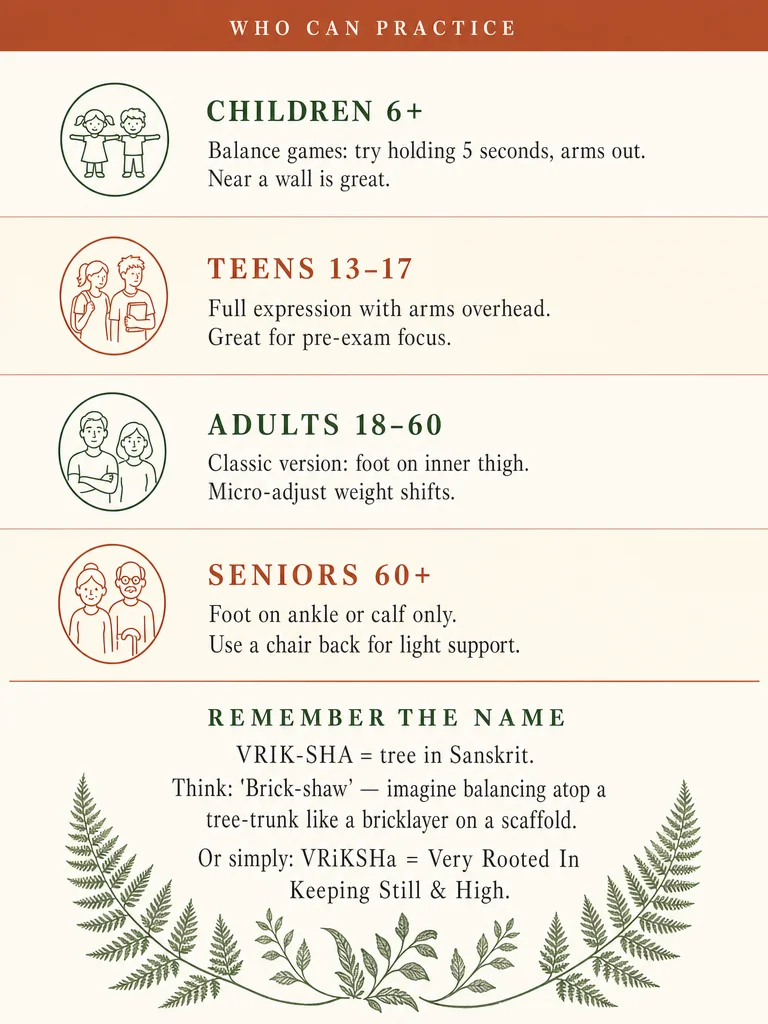
Children (6+)
Encourage balance as play rather than performance. Start with foot at ankle, arms out like wings. Holding for five seconds while giggling still counts. Practicing near a wall removes the fear and keeps it fun. Do not correct wobbling — it is the point.
Teens (13–17)
The full expression — foot on inner thigh, both arms overhead, palms joined — is appropriate and often easier than adults expect, because younger bodies carry less fear of falling. A good pre-exam or pre-presentation pose: 60 seconds each side visibly settles the nervous system. Works well in pairs, challenging each other without touching.
Adults (18–60)
Classic version: foot placed on inner thigh (never directly on the knee joint). Arms overhead, palms together or wide. The challenge is mental, not physical — the standing knee wants to lock, the mind wants to look around. Let both soften slightly. Micro-weight-shifts are normal and healthy. If balance is very difficult, extend arms for a wider base or gaze at a lower point.
Seniors (60+)
Use foot-at-ankle or foot-at-calf only. A chair back or wall provides light support without diminishing the balance training — contact is permitted. Focus on tall spine and soft gaze rather than foot height. Even 10 seconds standing tall with one foot lifted is full Vrikshasana for the nervous system.
Caution for all: Avoid this pose during acute ankle or knee injury. Anyone with severe vertigo should practice near a wall and avoid closing the eyes.
Remember the name: a mnemonic
VRIK-SHA — think "brick-shaw".
Imagine a bricklayer balanced on a tree trunk, building upward. He cannot rush. He cannot wobble. He stacks one brick at a time while rooted to his spot.
Or try the acronym:
Very Rooted In Keeping Still & High → VRIKSH
Once heard, it does not leave.
The real-world moment that is already Vrikshasana
You are standing at the kitchen counter making tea. The kettle is on. You have 90 seconds. You lift one foot to rest against your calf. You look at a point on the wall. Without calling it anything, you are doing Tree Pose.
Or: waiting for a lift. One leg, hands at heart. Fifteen seconds of presence in a moment that would otherwise be empty.
This is what the ancient teachers meant by āsana as a quality of being, not a mat-bound event.
Five ways to weave Vrikshasana into your day — no mat, no announcement
- Morning kettle balance: every time you wait for tea or coffee to brew, stand on one leg. Switch halfway through.
- Lift lobby tree: waiting for an elevator, bring palms to heart and foot to calf. The doors opening is your exit bell.
- Brushing teeth balance: two minutes, split across both legs. Your teeth get cleaned, your ankles get trained.
- Phone-scrolling antidote: notice when you're about to mindlessly scroll. Stand on one leg instead. The scroll can wait 30 seconds.
- Red light presence (for pedestrians): at a traffic crossing, take one-legged stance while waiting for the green. Grounded, present, and slightly unusual in the best way.
Today's take-home practice
Next time you're waiting — for a kettle, a lift, a webpage to load — stand on one leg. Lift the other foot to your calf. Bring your palms together at your chest.
Hold for as long as the wait lasts. Switch sides. Do not look at your phone.
That is Vrikshasana. That is yoga. No mat needed, no special clothes, no announcement.
Sanskrit source: Patanjali, Yoga Sutras 1.2 — योगः चित्तवृत्तिनिरोधः (yoga: citta-vṛtti-nirodhaḥ)
コメント