Main span
1,991 m
Total length
3,911 m
Tower height
282.8 m
Cable diameter
1.12 m
Wires per cable
36,830
Design wind speed
80 m/s
Construction cost
¥500 billion
Construction period
10 years
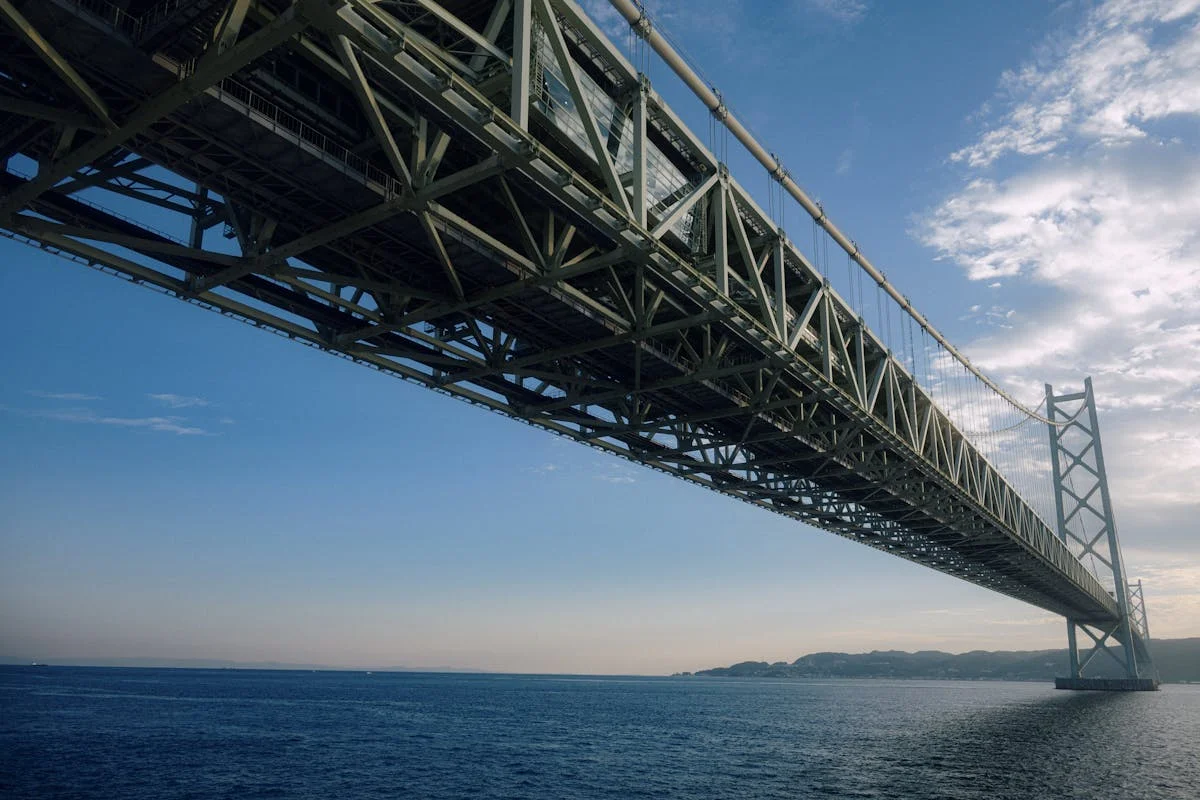
The Akashi Kaikyō Bridge (opened 1998) holds a 1,991-metre main span across the Akashi Strait — a crossing of 7-knot tidal currents, 110-metre depths, and an active fault. This case study traces every forced decision: why suspension beat cable-stayed at world-record scale, how 290 factory-wound PPWS strands replaced aerial spinning, how the world's largest wind-tunnel programme produced vertical stabilizer plates that hold the deck stable at 80 m/s, and how the January 17, 1995 Kobe earthquake shifted a tower foundation 1.3 metres mid-construction — extending the main span by 0.8 metres — while causing only one month of delay.
| Parameter | Value |
|---|---|
| Main span | 1,991 m |
| Total bridge length | 3,911 m |
| Side spans | 960 m each |
| Tower height above sea level | 282.8 m (297.3 m including saddle) |
| Tower construction | 30 prefabricated steel segments, laser-levelled |
| Main cable diameter | 1.12 m |
| Wires per cable | 36,830 (290 strands × 127 wires) |
| Wire tensile strength | 180 kg/mm² |
| Wire diameter | 5.23 mm |
| Total wire length | ~300,000 km |
| Cable-spinning method | PPWS (Prefabricated Parallel Wire Strand) |
| Deck type | Open stiffened-truss girder, 14 m deep × 35.5 m wide |
| Design wind speed | 80 m/s (288 km/h) |
| Design seismic standard | Mw 8.5 at 150 km epicentre distance |
| TMDs per tower | 20 |
| Navigation clearance | 65 m above mean sea level |
| Caisson diameter | 80 m |
| Caisson height | 70 m |
| Anchorage plan dimensions | 63 m × 84 m |
| Anchorage concrete volume | ~350,000 tonnes per anchorage |
| Construction period | May 1988 – April 1998 (10 years) |
| Construction cost | ¥500 billion (~US$3.6 billion, 1998 rates) |
| Daily traffic | ~23,000 vehicles |
| Toll | ¥2,300 per crossing |
このコンテンツについて、さらに観点や背景を補足しましょう。