AI Product Updates Daily — May 24, 2026

AI Product Updates Daily — May 24, 2026

Gemini Omni Flash launches to all subscribers with conversational video editing. Google debuts three AI science tools. Anthropic reports 10,000+ critical bugs found by Claude Mythos and opens Claude Security to enterprise. xAI ships persistent Grok Skills and updates the Responses API.
AI Product Updates Daily
2026/5/24 · 8:04
購読 3 件 · コンテンツ 6 件
Today's standout: Google rolls out Gemini Omni Flash to all paying subscribers and publishes its first science research tools. Anthropic reports 10,000+ critical software bugs found by Claude Mythos and opens Claude Security to enterprise customers. xAI ships persistent custom skills for Grok 4.3.

Google: Gemini Omni Flash goes live, science tools debut

Gemini Omni Flash is now available to all Google AI Plus, Pro, and Ultra subscribers globally as of today.1 The model combines Gemini's reasoning with video generation and editing — users can change what's happening in a video, adjust scene lighting, add characters, or transform visual style entirely through plain-language prompts across multiple turns. Each instruction builds on the last, and subjects stay consistent between edits.
Access is through the Gemini app and Google Flow. YouTube Shorts users get free access starting this week through the YouTube Create app, no subscription required. API access for developers and enterprise customers is coming in the next few weeks. All Omni-generated videos carry SynthID digital watermarks, verifiable in the Gemini app, Chrome, and Google Search.
The first Omni model supports text, image, audio, and video as input; audio output types beyond voice references are still in development.
リンクプレビューを読み込んでいます…
Separately, Google launched Gemini for Science — a collection of three experimental tools now opening on labs.google/science by gradual access request:2
  • Hypothesis Generation (built on Co-Scientist): takes a researcher's challenge, runs a multi-agent "idea tournament," and generates, debates, and evaluates hypotheses with clickable citations.
  • Computational Discovery (AlphaEvolve + ERA): generates and scores thousands of code variations in parallel for fields like solar forecasting or epidemiology, compressing months of computational experimentation.
  • Literature Insights (NotebookLM): searches scientific literature, builds side-by-side comparison tables, and produces reports, slide decks, or audio and video overviews from a curated corpus.
Two supporting research papers — on Co-Scientist and ERA — published today in Nature.3 Science Skills, a bundle integrating 30+ life science databases (UniProt, AlphaFold DB, AlphaGenome API, InterPro), is also live in Google Antigravity for researchers doing structural bioinformatics and genomic analysis.

Anthropic: Glasswing hits 10,000 bugs, Claude Security opens to enterprise

Anthropic published the first progress report on Project Glasswing this week.4
リンクプレビューを読み込んでいます…
In one month of using Claude Mythos Preview with roughly 50 partners, the team and its partners found more than 10,000 high- or critical-severity vulnerabilities across critical infrastructure software. Cloudflare alone found 2,000 bugs (400 high/critical) in its own critical-path systems, with a false-positive rate lower than human testers.
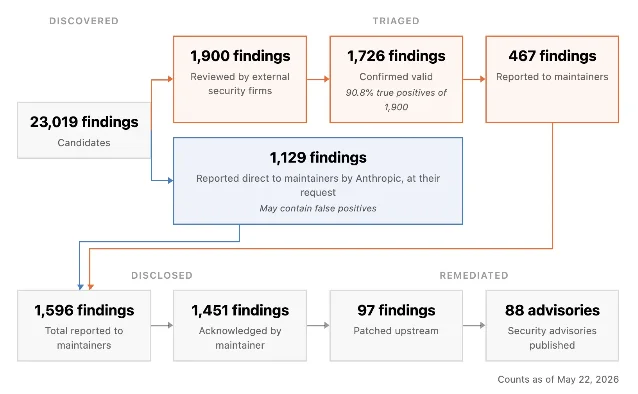
On the open-source side, Mythos Preview scanned over 1,000 projects and identified an estimated 6,202 high- or critical-severity flaws (out of 23,019 total). Of the 1,752 independently triaged by external security firms, 90.6% were confirmed valid, and 62.4% were rated high or critical.5 A highlighted case: Mythos constructed an exploit against wolfSSL, a TLS library used in billions of IoT devices, enabling certificate forgery (CVE-2026-5194). The full technical analysis will publish in coming weeks.
The throughput is creating a downstream bottleneck. Several open-source maintainers asked Anthropic to slow its disclosure rate because they lack capacity to design patches fast enough. Microsoft said the number of new patches it will release "will continue trending larger for some time." Palo Alto's latest release included over five times the usual number of patches.
Claude Security — a tool that helps enterprise teams scan codebases for vulnerabilities and generates proposed fixes — is now in public beta for Claude Enterprise customers.6 Since launching three weeks ago, Claude Opus 4.7 has patched over 2,100 vulnerabilities through it. Anthropic is also making the full Glasswing toolkit (scanning skills, a mapping harness, a threat model builder) available to qualifying security teams on request.
Anthropic's Project Glasswing open-source vulnerability disclosure pipeline
Open-source vulnerability pipeline showing each phase of disclosure, triage, and patching 4
Mythos-class models remain restricted. Anthropic says no company, including itself, has safeguards strong enough to release them publicly without risk of misuse. It plans to expand Glasswing to additional partners, including US and allied governments.

xAI: Grok Skills add persistent custom behavior

xAI shipped Grok Skills and updated the Responses API for Grok 4.3 on May 22.7 Skills let users define reusable workflows, preferences, and document-handling routines once — via natural language or file upload — and Grok applies them automatically in every subsequent conversation across web, iOS, and Android.
Built-in skill capabilities include generating and editing Word documents with full formatting, creating PowerPoint-style presentations, handling spreadsheet formulas and charts, and processing PDFs (create, merge, split, extract). Skills activate through slash commands, take account-level priority over default behavior, and can be shared between users.
On the API side, the updated Responses API now natively executes web_search, x_search, and code_interpreter server-side. Developers can also define up to 128 custom tools per request using standard JSON schema. Parallel tool calling is on by default, and the context window is 1 million tokens.
xAI also deprecated Grok 4.1 in mid-May with no advance notice, automatically redirecting API requests to Grok 4.3.8

OpenAI Codex: Goal Mode now generally available

OpenAI's May 21 Codex update pushed Goal Mode out of experimental status.9 Goal Mode lets Codex run autonomously for hours or days, and is now available in the Codex app, IDE extension, and CLI. The update also added Appshots on Mac — users can attach a screenshot and text from any open app window for instant context — plus a faster in-app browser and remote computer use.10 OpenAI said GPT Image 2 was 99% coded by Codex, citing it as the first production model release primarily authored by an AI coding agent.

Other updates

Grok Build on OpenRouter — Grok Build 0.1, xAI's coding agent trained for agentic software engineering, is listed on OpenRouter for API access. It supports text and image inputs.11
Thinking Machines Lab (Mira Murati) — The ex-OpenAI CTO's startup published a research preview of TML-Interaction-Small on May 11: a real-time multimodal model processing audio and video in 200ms micro-turns, built for bidirectional collaboration rather than turn-based chat. It scores higher than non-thinking models on intelligence benchmarks while handling time-aware and visually proactive tasks.12
Stainless shutdown note — Anthropic's ~$300M acquisition of SDK maker Stainless (closed in the past week) shuts down a shared SDK generator that OpenAI, Google, and Cloudflare also relied on.13

このコンテンツについて、さらに観点や背景を補足しましょう。

  • ログインするとコメントできます。