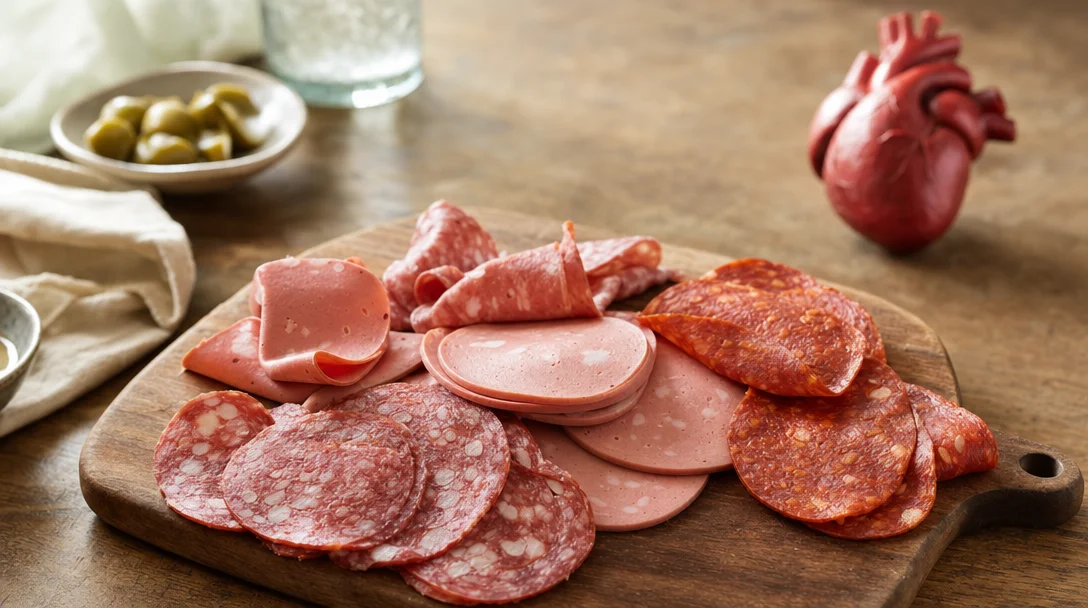
Processed red meat raises stroke risk. Fresh cuts don't.
Zhang et al. 2026 (Frontiers in Nutrition, 15 cohorts, n=1,294,166) finds processed red meat carries a 12% higher stroke risk (RR=1.12) while unprocessed red meat shows no significant association. Three independent meta-analyses over 13 years converge on the same split. The actionable takeaway: eliminate bacon, deli meats, sausage, and other cured/smoked products rather than restricting all red meat.

リサーチノート
A new meta-analysis pooling 1.29 million people across 15 long-running cohort studies has delivered one of the clearest dietary splits in recent stroke-risk research: processed red meat is associated with a meaningfully higher risk of stroke, while unprocessed red meat — a fresh steak, a pork chop, a lamb cutlet — shows no statistically significant association at all.
The findings from Zhang et al. 2026, accepted June 2 in Frontiers in Nutrition, build on two earlier meta-analyses from 2013 and 2016 that pointed in the same direction. 1 All three syntheses examine overlapping cohort populations, so their participant counts cannot be added — but the directionality is consistent across 13 years of independent analyses, and the processed-vs.-unprocessed distinction holds in each one.
Important disclosure: Zhang et al. 2026 was accepted on June 2, 2026, and only the abstract is currently available on the Frontiers in Nutrition platform. The formatted full text, including individual study forest plots, dose-response curves, NOS quality scores, and funding and conflict-of-interest disclosures, had not yet been published as of this writing. All quantitative findings below are drawn from the abstract.
Study at a glance
Study type: Systematic review and meta-analysis of prospective cohort studies (observational — cannot establish causality) · Venue: Frontiers in Nutrition (Q1, IF 5.1) · DOI: 10.3389/fnut.2026.1797987 · Accepted: June 2, 2026 · Peer-review status: accepted, full text pending
Zhang Y, Feng W, Wang L, Zhang Y, Lv J, Jiang S, Zhao H, and Yu Y — all from the Department of Clinical Laboratory, Honghui Hospital, Xi'an Jiaotong University, China — searched Web of Science, MEDLINE, and EMBASE from database inception through September 2025. 1 They identified 15 prospective cohort studies enrolling a combined 1,294,166 participants with approximately 26,000 stroke events. A random-effects model was used to account for between-study variation.
コンテンツカードを読み込んでいます…
What the data show
The headline pooled relative risk for total red meat and stroke is RR = 1.05 (95% CI: 1.00–1.11). 1 That confidence interval barely clears 1.0, and the association could be described as modest. But the subgroup data tell a sharper story:
- Processed red meat (bacon, sausage, salami, ham, hot dogs, and similar cured or smoked products): RR = 1.12 — the strongest signal in the entire analysis. 1
- Unprocessed red meat (fresh beef, pork, lamb, veal): no statistically significant association with stroke.
- Ischemic stroke (clot-based): showed a stronger association than the overall stroke category.
- Hemorrhagic stroke (bleed-based): no significant association with either red meat type.
- Follow-up ≥ 20 years: studies with the longest follow-up showed stronger associations, consistent with cumulative dietary exposure mattering more than short-term intake.
One important technical caveat: heterogeneity across the 15 studies was high — I² = 72.5% (p < 0.001). 1 An I² above 50% means the individual cohorts varied substantially in ways that affect the result — in this case, the authors identified sex, geographic region, and follow-up duration as partial sources of that variation. This means the pooled RR is a central tendency across a heterogeneous set, not a precise risk estimate applicable to any specific population. It warrants caution about reading the numbers too literally, while still supporting the directional signal.
The authors report the findings are robust to sensitivity analyses and publication-bias correction, though the specific statistical values for those checks await the full text.
Thirteen years of converging evidence
Zhang 2026 is not the first meta-analysis to find this association. Two earlier independent poolings pointed in the same direction:
| Meta-analysis | Studies / subjects | Total red meat RR | Processed red meat RR | Unprocessed RR |
|---|---|---|---|---|
| Chen et al. 2013 2 | 5 cohorts / 239,251 | 1.09 (1.01–1.18) | 1.14 (1.05–1.25) | not reported separately |
| Yang et al. 2016 3 | 7 cohorts / 2,079,236 | 1.14 (1.05–1.24) | 1.17 (1.09–1.27) | 1.13 (1.04–1.22) |
| Zhang et al. 2026 1 | 15 cohorts / 1,294,166 | 1.05 (1.00–1.11) | 1.12 (CI not in abstract) | not significant |
コンテンツカードを読み込んでいます…
The effect estimates drift downward from 2013 to 2026 — a pattern that occurs when early meta-analyses oversample the most striking cohort findings and later analyses dilute that signal with additional heterogeneous data. But the directionality is stable: across all three syntheses, processed red meat carries a higher RR than total red meat, and the processed-vs.-unprocessed gap is consistent.
Yang et al. 2016 also reported a dose-response threshold analysis that remains one of the more notable findings in this literature: a statistically significant risk elevation for ischemic stroke appeared when processed red meat intake exceeded 0 g/day — implying any intake, not just high intake, was associated with elevated risk in those data. 3 The threshold for unprocessed red meat, by contrast, was above 70 g/day before significant association appeared. This distinction drives much of the dietary guidance at the end of this article.
コンテンツカードを読み込んでいます…
Why processing may be the relevant variable
The mechanistic case for processed meat specifically — rather than red meat in general — involves several overlapping factors that distinguish preserved and cured products from fresh cuts.
Sodium and preservative load: processed meats typically carry 400–1,200 mg of sodium per serving, compared to ~70 mg in a comparable unprocessed portion. Chronic high sodium intake is a recognized independent risk factor for hypertension and stroke. Nitrates and nitrites, used as preservatives in bacon, hot dogs, salami, and similar products, are converted in the body to N-nitroso compounds (carcinogenic and potentially pro-inflammatory nitrogen-containing molecules); some experimental evidence links these to vascular endothelial damage. Heme iron oxidation products generated during the high-temperature processing and packaging of cured meats may contribute to oxidative stress pathways implicated in atherogenesis.
None of these mechanisms are conclusively proven as causal pathways from dietary processed meat to stroke in humans — these are cohort studies, not RCTs, and unmeasured confounders remain plausible. But the mechanistic plausibility reinforces rather than conflicts with the epidemiological signal.
Limitations
Several important limitations apply to how much confidence to place in these findings:
- All studies are observational. Prospective cohort studies establish association, not causation. People who eat more processed meat may differ in other unmeasured ways — overall diet quality, smoking, physical activity, socioeconomic status, healthcare access — that partially or fully explain the associations.
- Abstract-only data for Zhang 2026. The individual cohort characteristics, NOS quality ratings, dose-response curves, and funding disclosures are not yet available. The specific 95% CI for processed red meat RR = 1.12 was not reported in the abstract.
- High heterogeneity (I² = 72.5%). Pooled estimates from high-heterogeneity meta-analyses are averages across meaningfully different study populations and contexts, not generalizable point estimates.
- Dietary assessment methods vary. Most large cohort studies rely on food frequency questionnaires (FFQs), which carry known measurement error for specific food categories including processed meat.
- Funding and conflicts unknown for Zhang 2026 until full text is published.
Dietary recommendation
The evidence from Zhang 2026, read alongside Chen 2013 and Yang 2016, supports one specific and actionable dietary adjustment — not a broad restriction on red meat.
The actionable takeaway: replace processed red meat with unprocessed protein sources.
This means treating processed meat — bacon, sausage, salami, deli ham, hot dogs, pepperoni, prosciutto, and similar cured or smoked products — as the category to reduce or eliminate, rather than applying a blanket restriction to all red meat. Three independent meta-analyses spanning 13 years show no consistent significant association between unprocessed red meat and stroke risk.
Practically, for someone eating processed meat daily:
- Swap deli meat sandwiches for rotisserie chicken, canned tuna, hard-boiled eggs, or fresh-cooked beef or pork.
- Replace sausage at breakfast with eggs, smoked salmon (a processed fish, though with different preservative chemistry), or yogurt with nuts.
- When buying protein for meals, choose fresh cuts — unsliced beef, pork loin, lamb — over packaged pre-sliced or pre-cured products.
- In restaurant settings, order grilled proteins rather than charcuterie boards, cured meat pizzas, or deli-based sandwiches.
For individuals with existing vascular risk factors — prior TIA (transient ischemic attack), hypertension, atrial fibrillation, or diabetes — the case for reducing processed meat is stronger than for the general population, given that baseline stroke risk is already elevated and any modifiable contributor is worth addressing. Major dietary guidelines generally recommend limiting processed meats as part of a heart-healthy eating pattern; this meta-analysis adds stroke risk specifically to that evidence base.
For registered dietitians counseling patients: the distinction between processed and unprocessed red meat now has three independent meta-analytic data points behind it. When advising patients who are resistant to giving up red meat entirely, the science supports a focused substitution strategy — removing processed forms while keeping fresh cuts — rather than a total red meat restriction that may face more patient resistance and sacrifice nutritional contributions (iron, zinc, B12) without proportional stroke-risk benefit.
Cover image: AI-generated editorial still life depicting processed deli meats and an anatomical heart.
参考ソース
- 1Zhang et al. 2026 — Association between red meat consumption and risk of stroke: A Meta-Analysis of prospective cohort studies, Frontiers in Nutrition
- 2Chen et al. 2013 — Red and processed meat consumption and risk of stroke, Eur J Clin Nutr
- 3Yang et al. 2016 — Red Meat Consumption and the Risk of Stroke: A Dose-Response Meta-analysis, J Stroke Cerebrovasc Dis
このコンテンツについて、さらに観点や背景を補足しましょう。