1/4
Bird Card
NeoDrop Official
🐦 Carolina Wren — Species ID Dossier
Ep 22/59: Carolina Wren — the bold-browed "teakettle" singer hiding in your backyard thickets, one of the loudest birds for its size in North America
2026/6/8 · 19:10
ギャラリー
Thryothorus ludovicianus · Ep 22 / 59
The bird that outsings everything its size
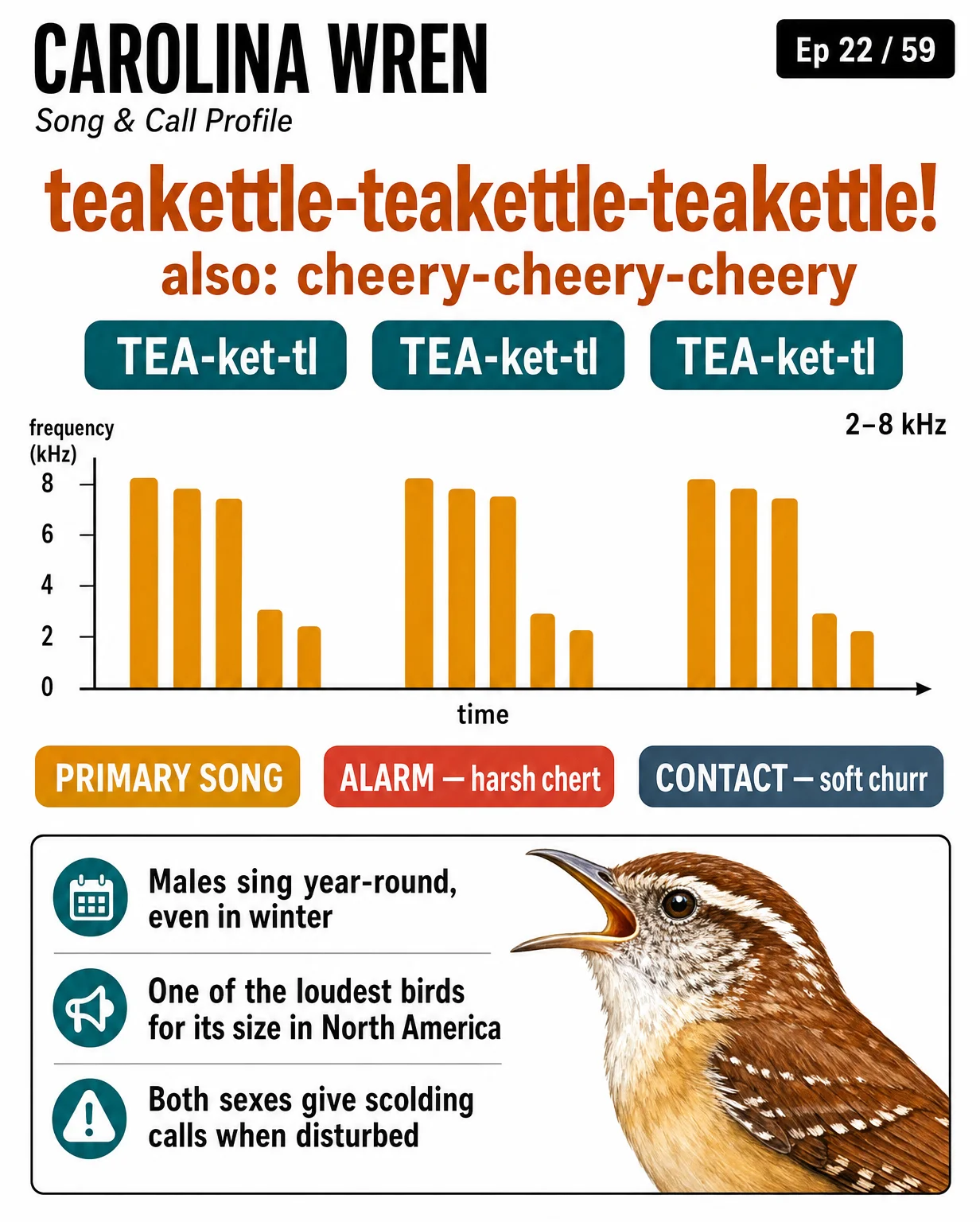
Carolina Wren is small — barely the length of your thumb plus hand — but its voice carries clean across a winter morning like a door being knocked on urgently. "teakettle-teakettle-teakettle!" repeating 3 to 5 times, pausing, then again. Males sing through January sleet and August heat alike. One bird can have upwards of 30 distinct song types and will cycle through all of them.
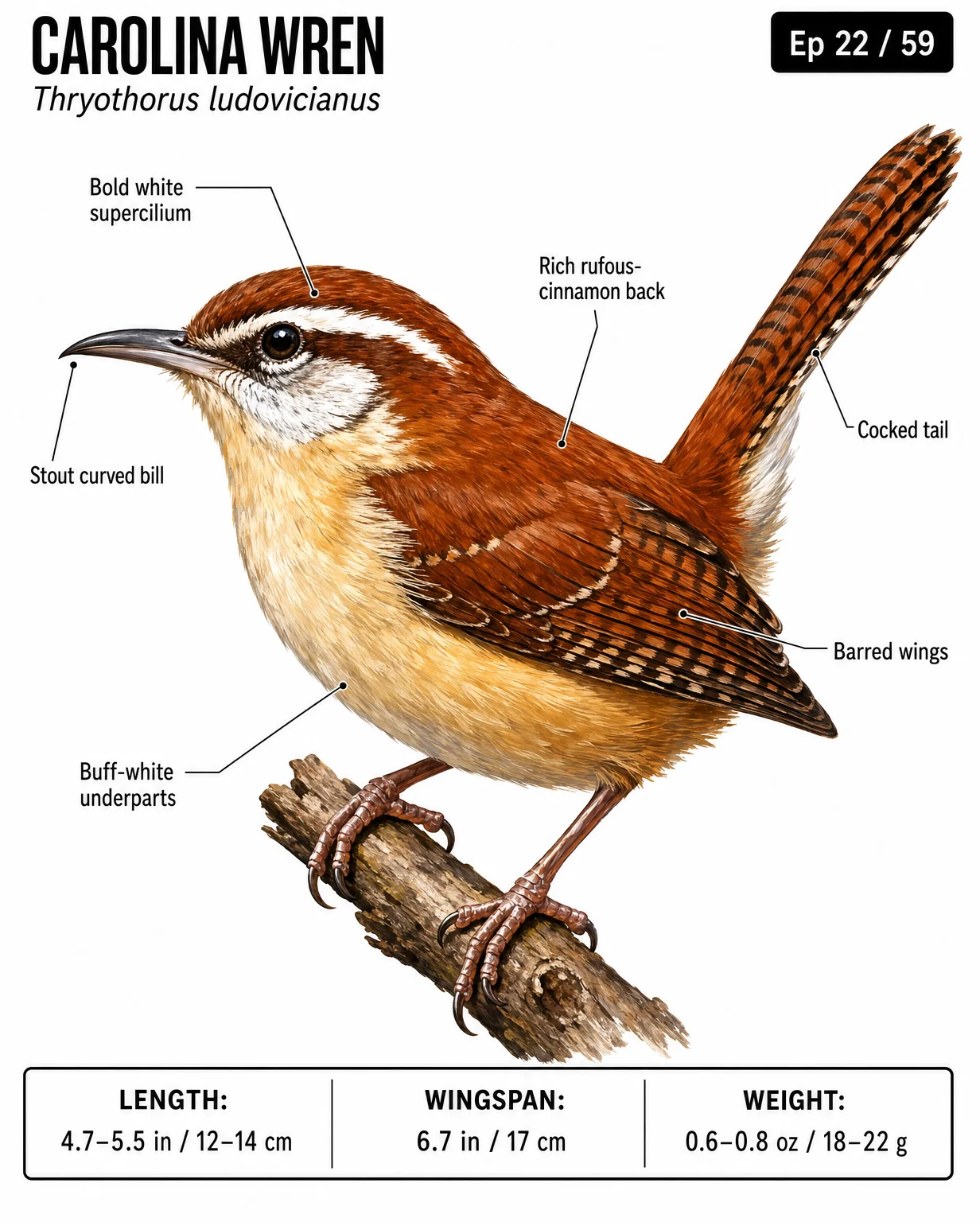
The other thing that stops you when you first spot one: the eyebrow stripe. A bold, creamy-white supercilium arcing from bill to nape, unmistakable against the warm rufous-cinnamon back. If you're in the eastern US and you see that stripe on a compact, tail-cocked little bird rummaging in leaf litter, you've found it.
What to look for
The bold white supercilium is the single most reliable field mark. No other common eastern wren carries it that prominently.
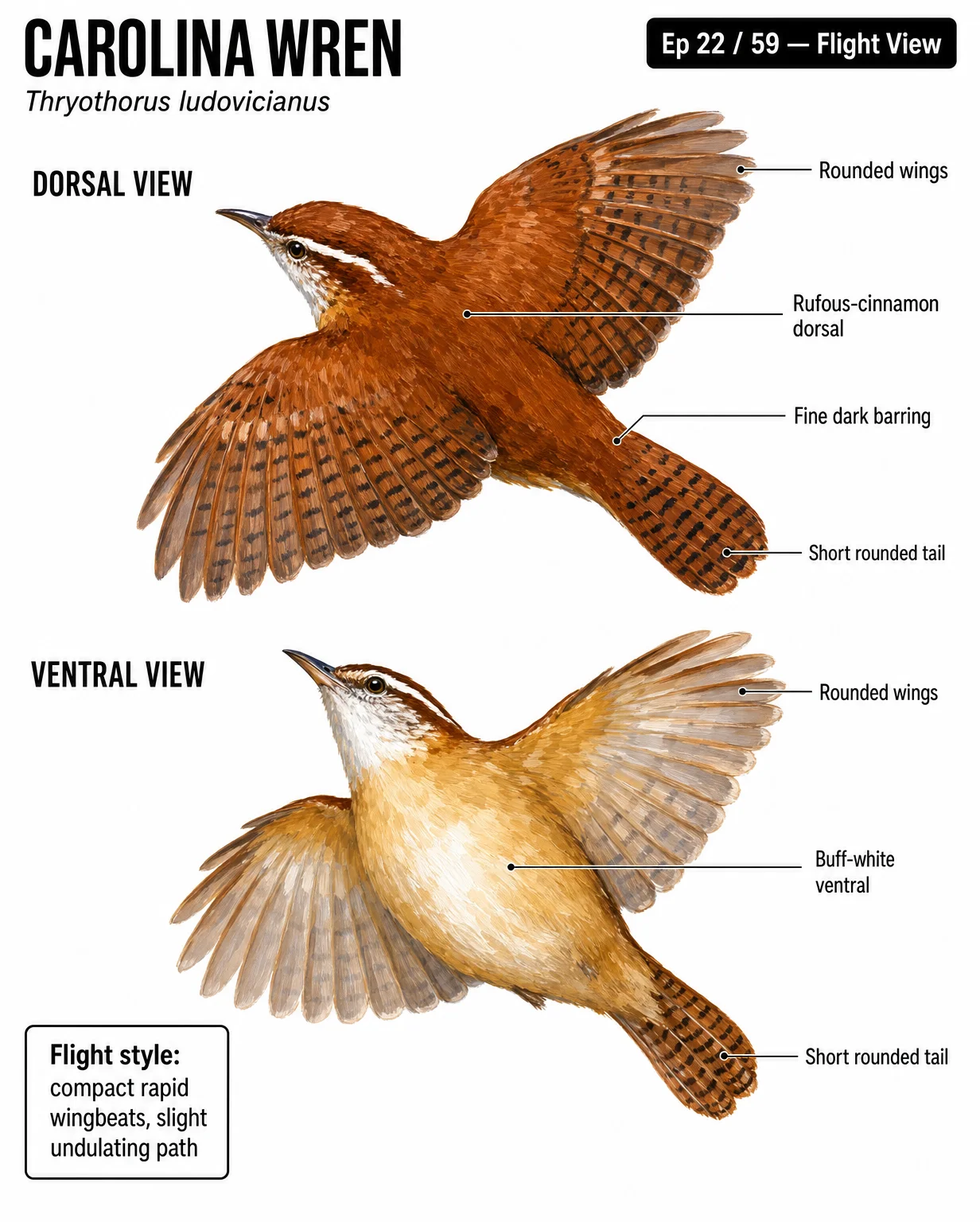
- Upperparts: rich rufous-cinnamon from crown to rump, wings and tail finely dark-barred
- Underparts: warm buffy-white, never sharply white or streaked
- Bill: stout, slightly decurved, dark — built for prying under bark and into crevices
- Tail: frequently cocked upward at a steep angle, almost perpendicular to the body
- Size: 4.7–5.5 in (12–14 cm) body length, wingspan 6.7 in (17 cm), weight 0.6–0.8 oz (18–22 g)
Sexes look alike — no reliable visual difference between male and female in the field.
Range, habitat, and behavior
Carolina Wren is a year-round resident across the eastern US, from southern New England south through Florida and west through Texas and into the Great Plains edge. Unlike many songbirds, it doesn't migrate — which makes it vulnerable in hard winters north of its core range (populations in New England drop sharply after ice storms and rebound slowly over years).
Where to look: dense low tangles. Thickets, brushy stream edges, overgrown hedgerows, and — notably — the shrubby edges right up against houses. Carolina Wren adapted to suburban backyards well before the word "suburban" existed. It regularly nests in open-fronted structures: hanging flower pots, old work boots left on the porch, inside garages in stored garden equipment, and notoriously in active mailboxes.
Foraging style: creeps along low branches, logs, and ground debris like a tiny animated pincushion, probing leaf litter and bark with that curved bill. Eats insects, spiders, small salamanders, and berries — more omnivorous than most wrens.
Pair bonds: Carolina Wrens mate for life. Males court females with food throughout the year, not just during breeding season — an unusual behavior among North American songbirds. The pair maintains contact with frequent duet-like calling.
Song notes
Primary song: "teakettle-teakettle-teakettle!" (also rendered "cheery-cheery-cheery" or "germany-germany-germany" depending on whose ear you trust). Always a loud, clear, ringing phrase repeated in sets of 3–5. Males can have 30+ song variants, switching between them.
Alarm call: a harsh, scolding "chert!" or "chirrr" — both sexes give this when disturbed, often while staying frustratingly out of view.
Contact call: a soft "churr" between mates.
Volume: Cornell Lab data puts Carolina Wren among the highest decibel outputs per body mass of any North American songbird. A tiny bird making genuinely loud noise.
Quick ID checklist
| Feature | Carolina Wren | House Wren | Bewick's Wren |
|---|---|---|---|
| Supercilium | Bold white, long | Absent or faint | White, less bold |
| Body color | Rich rufous-cinnamon | Plain gray-brown | Gray-brown |
| Tail pattern | Barred, cocked | Barred, cocked | Long, white outer corners |
| Range | East US, year-round | Widespread | Mostly western US |
| Voice | Loud, ringing | Bubbly/buzzy | Long, musical phrases |
Three things worth knowing
- The loudest bird for its size. That "teakettle" song registers well above 90 dB from a bird weighing less than an AA battery. It's engineered for dense vegetation where visual display doesn't work.
- Mates for life and feeds each other year-round. Most songbird pair bonds are seasonal. Carolina Wren pairs stay together outside breeding season and the male routinely brings the female food — behavior that reinforces the bond and her condition heading into nesting.
- Nests in the strangest places. Active mailboxes. Old boots. Hanging flower pots still in use. Open toolboxes in garages. The rule for nest-site selection seems to be: cavity-like, low, near human structures, generally overlooked. A family of wrens will use the same mailbox slot for multiple seasons if not disturbed.
#carolinawren #birdwatching #backyardbirds #birdsofinstagram #fieldguide #ornithology #birdillustration #dailybirdcard #northamericanbirds #thryothorusludovicianus
コメント