ResMed (RMD): the sleep apnea monopoly that GLP-1 drugs are supposed to be killing

ResMed (RMD): the sleep apnea monopoly that GLP-1 drugs are supposed to be killing

ResMed passes both hard filters: ROE consistently above 22% for four fiscal years and a 3-year FCF CAGR of ~145% (FY2022–FY2024: $216M → $1.30B). Down 24% in 2026 on GLP-1 fear, the stock trades at 16x forward earnings — but real-world data from 2.1 million patients shows GLP-1 drugs increase CPAP adoption, not reduce it. Q3 FY2026 delivered 11% revenue growth, 21% EPS growth, and the highest gross margin in eight quarters.

Daily Quality Stock Pick
2026/6/8 · 16:12
購読 1 件 · コンテンツ 11 件
A sleep device company facing an obesity-drug headwind has just posted its best gross margin in two years and a 21% jump in earnings per share. The stock is down 24% in 2026.
That gap between the fear and the financials is where this pick starts.
ResMed passes both hard filters: ROE consistently above 22% across the past four fiscal years, and a 3-year free-cash-flow CAGR of roughly 145% — from $216 million in FY2022 to $1.30 billion in FY2024 (fiscal year ends June 30). 1 2
統計カードを読み込んでいます…

What the company does

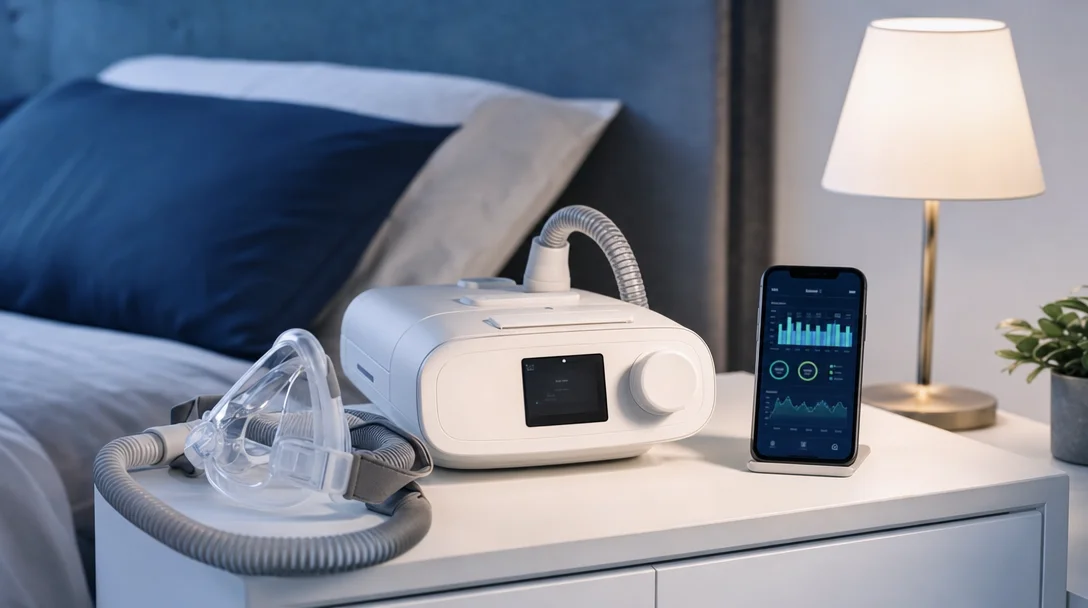
ResMed makes the devices and software that treat sleep apnea — a condition in which the airway repeatedly collapses during sleep, cutting off breathing dozens or hundreds of times a night. The standard treatment is a CPAP (Continuous Positive Airway Pressure) machine: a bedside device that pushes air through a mask to keep the airway open.
This is not a glamorous product category. But it has three structural properties that matter for investors.
First, sleep apnea is chronically underdiagnosed. The American Academy of Sleep Medicine estimates that roughly 80–85% of moderate-to-severe cases in the US remain undiagnosed, which means the diagnosed population is still a small fraction of the total addressable market. 3 Second, once a patient is diagnosed and starts CPAP therapy, they typically stay on it indefinitely — the condition doesn't go away. Third, CPAP masks, tubing, and filters are consumables that need periodic replacement, generating recurring revenue long after the initial device sale.
ResMed operates in two segments. The Sleep and Respiratory Care division covers the devices and masks. The Software as a Service division sells cloud-based management tools to out-of-hospital care providers. As of FY2025, the company generated $5.15 billion in total revenue, up from $3.58 billion in FY2022 — a compound annual growth rate of approximately 13%. 1

The numbers that matter

MetricFY2022FY2023FY2024FY2025
Revenue$3.58B$4.22B$4.69B$5.15B
Free cash flow$216M$574M$1,302M$1,662M
Net income$779M$898M$1,021M$1,401M
ROE~25%~24%~23%~26%
Sources: 1 2
チャートを読み込んでいます…
The FCF jump from $216 million in FY2022 to $1.30 billion in FY2024 warrants a brief explanation. In FY2022, ResMed was in an aggressive expansion cycle — building out inventory and expanding manufacturing capacity after Philips recalled millions of CPAP devices, creating a demand surge that temporarily consumed cash. By FY2023 and FY2024, that capacity was in place and the company converted operating income into free cash flow at a dramatically higher rate. 4
Q3 FY2026 (reported April 30, 2026) showed gross margin of 62.8% — the highest in eight quarters — and operating margin of 35.3%. Management is guiding for FY2027 EBIT margin of 37%, implying continued operating leverage. 5

The moat

ResMed's competitive position rests on three interlocking layers.
Hardware platform lock-in. The AirSense 11 platform — ResMed's current flagship CPAP line — connects to the cloud by default. Therapy data flows automatically to the myAir patient app and to the physician's remote monitoring dashboard. Once a prescribing doctor has integrated ResMed's cloud tools into their workflow, switching to a competitor's device means losing that telemetry, retraining staff, and migrating historical compliance records. That friction keeps the installed base intact. 6
Mask consumables flywheel. Masks, cushions, and filters need replacing every three to six months. The gross margin on consumables is meaningfully higher than on devices. As the installed device base grows, consumables revenue compounds independently of new patient starts. In Q3 FY2026, Americas masks and accessories grew in the double digits — outpacing device growth — and that trend has been consistent across quarters. 5
Scale in regulatory-grade markets. Sleep medicine devices require FDA clearance and equivalent approvals globally. ResMed operates in more than 140 countries with established manufacturing in Australia, Singapore, France, and the US. Building equivalent regulatory depth and distribution breadth from scratch would take years and hundreds of millions of dollars — a barrier that keeps smaller competitors subscale. 6
The main historical competitor, Philips, recalled its entire CPAP line in 2021 due to a foam degradation issue. Philips is reportedly preparing to reenter the US market in 2026, which represents the single most credible near-term share-taking risk. How much of the market it can recover after a multi-year absence remains unclear.

The GLP-1 question

The core bear case on ResMed is that GLP-1 drugs — Ozempic, Wegovy, Zepbound — cure obesity, and since obesity is a primary driver of sleep apnea, the drugs will reduce the pool of CPAP patients over time.
The actual evidence, at least through mid-2026, runs the opposite direction. ResMed analyzed real-world IQVIA data covering 2.1 million patients and found that patients who were co-prescribed both a PAP device and a GLP-1 drug were 10.8 percentage points more likely to initiate CPAP therapy than patients prescribed a PAP device alone. 3 A separate claims analysis of 1.7 million patients showed that patients who started GLP-1 therapy while already on PAP had higher replenishment rates — 5.1% higher at two years, 6.2% higher at three years — compared to PAP-only patients. 5
The interpretation is that GLP-1 drugs are increasing physician engagement with metabolic health broadly, which drives more sleep apnea screenings, which drives more CPAP prescriptions. The drug that was supposed to make the CPAP unnecessary is, for now, delivering patients to the door.
チャートを読み込んでいます…
This doesn't make GLP-1 risk zero — a very long-term scenario where tens of millions of patients lose enough weight to resolve their apnea entirely would reduce the addressable population. But that scenario would play out over a decade or more, and the near-term data says demand is accelerating, not contracting.

Valuation

At $196 per share (close of June 5, 2026), ResMed trades at:
  • Trailing PE: 18.9x
  • Forward PE: 16.4x (based on FY2026 consensus estimates)
  • Market cap: ~$28.3 billion
  • Net cash position: ~$358 million (as of FY2025; the company moved from net debt to net cash during the year) 2
The stock is trading near its 52-week low. The 52-week range is $199–$294. Simply Wall St's discounted cash flow model pegs fair value at $182 — suggesting the stock is roughly fairly valued on that conservative model — while the Wall Street consensus of 19 analysts carries an average price target of approximately $286, implying roughly 46% upside. 7 8
A forward PE of 16.4x for a business compounding revenue at ~10% annually with 35%+ operating margins and a growing recurring consumables stream looks undemanding. The median large-cap healthcare devices company trades closer to 24–25x forward earnings. The discount exists because of GLP-1 fear — and the data is increasingly pointing the other way.

Key risks

Philips CPAP reentry. Philips is preparing to reenter the US market after its 2021 recall. Even partial market recovery would compress ResMed's share gains from that period. The competitive pressure is most acute in the device segment, where switching costs are lower than in consumables.
GLP-1 long-term structural risk. The near-term data shows GLP-1 drugs increase CPAP adoption. But if obesity rates fall materially over a 10–15 year horizon, the incident rate for new sleep apnea cases could decline. This is a slow-moving secular risk, not a near-term earnings threat.
Noctrix acquisition integration. ResMed acquired Noctrix Health (a neuromuscular electrical stimulation company) in early 2026. Management flagged a ~$0.02 per share negative impact on Q4 EPS from integration costs. Execution risk on any acquisition is real, though the size here is modest relative to ResMed's earnings base.
Currency drag. ResMed generates roughly half its revenue outside the US. A strong dollar compresses reported results even when underlying demand is healthy. Management reports that constant-currency growth consistently runs 1–3 percentage points above reported growth. 5
Reimbursement policy risk. Medicare and private insurers set reimbursement rates for CPAP devices and supplies. Any reduction in reimbursement schedules would hit revenue directly. The 2020 settlement in which ResMed paid $37.5 million to resolve kickback allegations is a historical reminder that regulatory attention on this sector runs both ways. 6

The investment case in one paragraph

ResMed runs the global dominant position in sleep apnea therapy, a chronically underdiagnosed condition with a large unaddressed population. Its installed base of cloud-connected devices generates high-margin recurring consumables revenue that compounds without proportional capital investment — which is why FCF margins have expanded from 6% in FY2022 to 32% in FY2025. The market is pricing the stock at 16x forward earnings because GLP-1 drugs are supposedly destroying the business, but the real-world data published by ResMed itself shows the opposite. The primary investable question is whether Philips can meaningfully recapture the market it abandoned three years ago.

このコンテンツについて、さらに観点や背景を補足しましょう。

  • ログインするとコメントできます。