Oil, Yields, and a New Fed Chair: Week of May 19–23, 2026

Oil, Yields, and a New Fed Chair: Week of May 19–23, 2026

Brent crude swung from $112 to $102 and back to $105, pulling Treasuries, FX, and equities with it. The FOMC minutes confirmed a hawkish shift, Kevin Warsh was sworn in as Fed Chair, UK and European PMIs slipped into contraction, and Japan's soft April CPI clouded BoJ hike timing — all while markets start pricing a Fed rate increase by year-end.
Global Macro Weekly
2026. 5. 23. · 12:33
구독 1개 · 콘텐츠 1개

Oil, Yields, and a New Fed Chair: The Week of May 19–23, 2026

The week was effectively run by one variable — crude oil. Brent opened above $110 on Monday, dropped toward $102 by Thursday on diplomatic signals from Tehran, then bounced back toward $105 on Friday when Iran's Supreme Leader insisted on keeping the country's enriched uranium stockpile. Every asset class — bonds, equities, FX, gold — moved in sequence with those oil headlines. The underlying macro story, however, runs deeper than any single commodity.

Central bank scorecard

No major central bank changed rates this week. The narrative, though, shifted noticeably toward hawkishness — and the arrival of new Fed Chair Kevin Warsh added an extra layer of uncertainty.
Central bankCurrent rateRecent decisionBias this week
Fed4.25–4.50%Hold (Apr 29–30, 8-4 vote)Hike watch: ~25 bps priced by year-end; Warsh sworn in Fri
ECB2.00%Hold (Apr); first hike likely JuneHawkish; Eurozone CPI at 3.0% y/y in April
BoJ0.75%Hold; 3 dissenters voted to hike AprSoft Apr CPI (1.4% vs 1.6% est.) briefly cooled hike bets
BoE3.75%Hold; 1 dissent for hikeUK flash PMI collapsed to 48.5; hike timing uncertain
RBAHold after 3 hikesPause favoredWeak jobs; trimmed-mean CPI still near 3.5% y/y
PBoC1-yr LPR 3.0%; 5-yr 3.5%HoldEasing pressure building into H2 amid slower growth
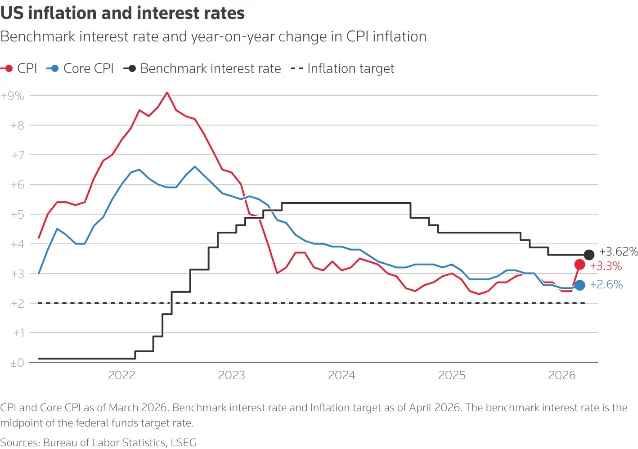
The most consequential shift: markets are no longer pricing cuts from the Fed — they are pricing a hike. Scotiabank Economics puts a "very high bar" on the FOMC actually delivering one, citing the disruptive optics of an about-face and the uncertainty over annual payroll revisions that could reveal Q1 job gains were substantially overstated. 1
The FOMC minutes from the April 28–29 meeting, released this week, showed most policymakers had shifted to a more hawkish stance given persistently above-target inflation — a direct consequence of Iran-war-driven energy prices. 2
The BoJ situation has its own dynamic: Japan's Q1 GDP came in at 2.1% annualized — beating the 1.7% consensus — and the GDP deflator hit 3.4%, which normally would firm up rate-hike expectations. But April national CPI came in softer than expected at 1.4% headline (vs. 1.6% expected), cooling 2-year JGB yields by 2 bps to 1.43% by Friday. The pull between solid growth and soft near-term inflation keeps the BoJ at 0.75% for now with a gradual tightening trajectory intact. 3

Data: PMIs slide, payroll integrity questioned

링크 미리보기를 불러오는 중…
The most alarming macro number of the week was the UK flash composite PMI, which fell from 52.6 in April to 48.5 in May — the first reading in contraction territory in over a year, and well below the 51.6 consensus. The breakdown was stark: manufacturing held at 53.7, but services plunged to 47.9 from 52.7. UK unemployment also rose unexpectedly earlier in the week.
Germany's flash composite PMI came in at 48.6, a second consecutive contraction. France registered 42.9 in services — its weakest since the pandemic. The pattern across Europe: energy-cost inflation squeezing service sector margins, households cutting discretionary spending. 3
The US was an outlier on manufacturing — the flash reading was the strongest in four years, likely reflecting front-loading of orders ahead of further energy-driven price increases. But the University of Michigan consumer sentiment survey for May fell to a historical low, with long-run inflation expectations deteriorating sharply.
Scotiabank's economists raised a methodological issue with US payrolls that deserves attention: the April nonfarm payroll gain of 115k was heavily inflated by a record-high 391k birth-death model adjustment (seasonally unadjusted). If the pre-pandemic average adjustment had been applied instead, the print would have been approximately -223k. Annual benchmarking revisions due in September could revise April 2025–March 2026 payrolls down by an average of -60k per month — enough to put the entire period on a clear downward trajectory. 1
This matters for the policy calculus: if the Fed is contemplating hikes based partly on a labor market that turns out to have been weaker than reported, and the revision lands just before the September FOMC, the committee faces a genuine contradiction.

FX and rates: oil ran the desk

The dollar index stabilized near the mid-99 range — its highest since Middle East tensions briefly eased in early April — but individual pairs showed more texture. 4
EUR/USD held near 1.1600 all week, with Thursday's dip to 1.1576 quickly reversing. One-month implied volatility dropped below 5.9% despite the Iran war overhang and the arrival of a new Fed Chair — the market is essentially saying the range-trade continues until a catalyst breaks it.
USD/JPY stayed stuck near 159.00. Soft Japanese CPI briefly pulled the pair lower, but dollar strength reasserted. The Ministry of Finance's intervention threat is becoming a test of credibility: with BoJ at 0.75% and the 10-year JGB near 2.77%, the yen carry structure remains intact. One-month USDJPY implied volatility has slipped below 7%, its lowest since early 2022. 3
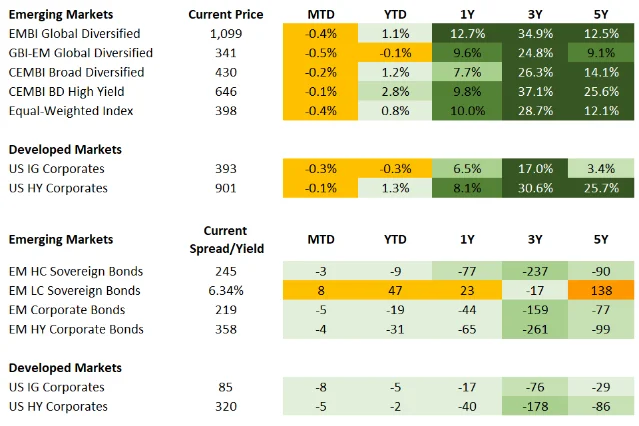
EM Weekly fixed income performance chart week of May 22 2026
Fixed income performance across EM regions, week of May 22, 2026 4
GBP/USD saw the week's most interesting FX narrative. Sterling had been under pressure following the UK's weak PMI and labor data, and EUR/GBP spiked to 0.8730 Monday on concerns about Labour's fiscal constraints. A decisive intervention came from Andy Burnham — the candidate most likely to replace Keir Starmer as Labour leader — who ruled out revising the UK's borrowing limits. EUR/GBP dropped back to 0.8680 and GBP/USD recovered toward 1.3450. The episode shows how tightly UK sovereign policy credibility is now priced into sterling.
US Treasuries had a significant intraweek swing. The 30-year yield touched 5.2%, a level not seen since approximately 2007, before falling on Iran de-escalation signals. By Friday the 10-year was back near 4.56%, the 2-year at 4.08%, and the curve had flattened sharply. TIPS breakevens (2-year at 2.75%, 10-year at 2.40%) suggest the market views the energy shock as largely temporary — a useful read on whether bond weakness has further room. The long JGB end was similarly turbulent: Japan's 30-year yield briefly spiked above 4.2% intraday before closing week near 2.77% on the 10-year. 1
US and UK inflation vs policy rate charts showing above-target inflation across major economies
US inflation and interest rates — rate remains below the current CPI trajectory 2

Cross-asset: equities decoupled, oil drove everything else

Equity markets — particularly in the US — shrugged off most of the macro noise, helped by Nvidia earnings (beats expectations, but the stock fell 1.8% on already-lofty expectations), strong AI-infrastructure spending signals, and $2 billion in US government quantum computing grants that sent IBM up 12.4%. The Dow hit a record 50,285.66 by Friday. 3
Japan's Nikkei ended the week up over 2.5% on Friday alone, driven by SoftBank and the broader tech recovery. The Hang Seng gained ~1.2% Friday, with Lenovo at a multi-decade high after AI-related earnings strength.
The commodity picture was defined by oil's intraweek swing — Brent from $112 to $102 to $105 — which drove everything downstream. Gold held above $4,500 but with a slight negative bias; copper traded near a one-week high on AI-infrastructure demand expectations. The Bloomberg Commodity TR Index was on track for a modest ~1% weekly loss, trimming year-to-date gains to 29%.
Emerging markets felt the dollar-strength and Iran-uncertainty combination. Turkey's lira came under pressure after a domestic court ruling and the central bank had to deploy roughly $6 billion via state banks to prevent further depreciation. Turkish equities fell 6% and triggered a circuit breaker Friday. Thai baht (-1.91%), Romanian leu (-1.89%), and Hungarian forint (-1.66%) also lagged. EM hard-currency sovereign credit was down ~0.14% for the week. 4

What to watch next week (May 26–30)

The data calendar is dense. The most important releases:
  • US PCE (Thursday): April total PCE estimated +0.4% m/m, core +0.3%. In line would just confirm the existing Fed outlook; a significant upside surprise would accelerate hike pricing.
  • Eurozone CPI estimates (Friday): Germany, France, Italy, and Spain all report. Scotiabank models put total Eurozone CPI above 3% y/y and core nearing 2.5%. If confirmed, the ECB June meeting becomes live for a 25 bps hike.
  • RBNZ decision (Tuesday): Hold expected at 2.25%, but updated forward rate projections are more important — markets are pricing ~75 bps of hikes by year-end.
  • Bank of Korea (Thursday): Hold expected at 2.5%, but a strike at Samsung (estimated to cut Q2 GDP by 0.5%) and won depreciation of ~12% since last summer add hawkish pressure.
  • SARB (Thursday): Most forecasters expect a +25 bps hike. South Africa's CPI hit 4% y/y in April; breakeven inflation expectations at 4.9%.
  • Kevin Warsh's first week as Fed Chair: No scheduled policy action, but watch for any framing comments on the balance sheet trajectory and the FOMC's inflation tolerance.
  • Canadian bank earnings: BNS, BMO, National Bank on Wednesday; TD, CIBC, RBC on Thursday. Bay Street bank shares have outperformed Wall Street peers by a significant margin over the past year. Credit quality and mortgage provisioning will be the dominant themes.

이 콘텐츠를 둘러싼 관점이나 맥락을 계속 보강해 보세요.

  • 로그인하면 댓글을 작성할 수 있습니다.