Five papers: June 9, 2026

Five papers: June 9, 2026

Five papers from June 8–9: apitegromab (EMBRAZE, Nature Medicine) preserves 54.9% more lean mass during tirzepatide-driven weight loss; HTD1801 (SYMPHONY-2, NEJM Evidence) delivers −1.2% HbA1c via AMPK/NLRP3; LASSARAB Phase 1 (Nature Medicine) achieves 100% anti-LASV-GPC seroconversion for Lassa fever; egg allergy prevalence has fallen 17.7% since 2008 (JAMA Pediatrics); a CHW telehealth RCT targets glycemic equity in safety-net diabetes care (JAMA Internal Medicine).

PubMed Top Medical Papers
June 9, 2026 · 10:26 PM
2 subscriptions · 22 items

Research Brief

June 8–9, 2026 brought five original research publications across Nature Medicine (two papers), NEJM Evidence, JAMA Pediatrics, and JAMA Internal Medicine. Three RCTs and one Phase 1 trial carry quantified primary endpoints; the JAMA Internal Medicine RCT has limited quantitative data available due to Cloudflare access restrictions on the full text. The Lancet three-paper cardiometabolic MLTC series (reviews, not primary research) and the JAMA Neurology EVT blood-pressure RCT (primary endpoint unconfirmed) are not included in this digest.

1. Apitegromab EMBRAZE — preserving lean mass during GLP-1–induced weight loss (Nature Medicine, Phase 2)

Journal: Nature Medicine · IF ~82.9, Tier 1 · Peer-reviewed, published June 8, 2026 · DOI: 10.1038/s41591-026-04440-4 · Preprint status: N/A (direct journal publication)
Study design: Phase 2 randomized, double-blind, placebo-controlled multicenter trial (EMBRAZE, NCT06445075). N = 102 adults with overweight or obesity (BMI ≥27). Seven US sites. Enrollment: June–September 2024. 1:1 randomization: apitegromab 10 mg/kg IV every 4 weeks + tirzepatide (n = 51) vs. placebo IV every 4 weeks + tirzepatide (n = 51). Tirzepatide titrated per approved label, maximum 15 mg/week. Duration: 24 weeks of treatment + 8-week off-drug follow-up to Week 32. Funded by Scholar Rock, Inc. 1
Mechanism: Apitegromab is a selective anti-myostatin antibody that binds the latent form of myostatin (a negative regulator of skeletal muscle mass), preventing its activation. The hypothesis: GLP-1 agonist–driven weight loss degrades lean mass alongside fat; blocking myostatin activation should bias loss toward adipose tissue.
Key findings (primary endpoint, Week 24): 1
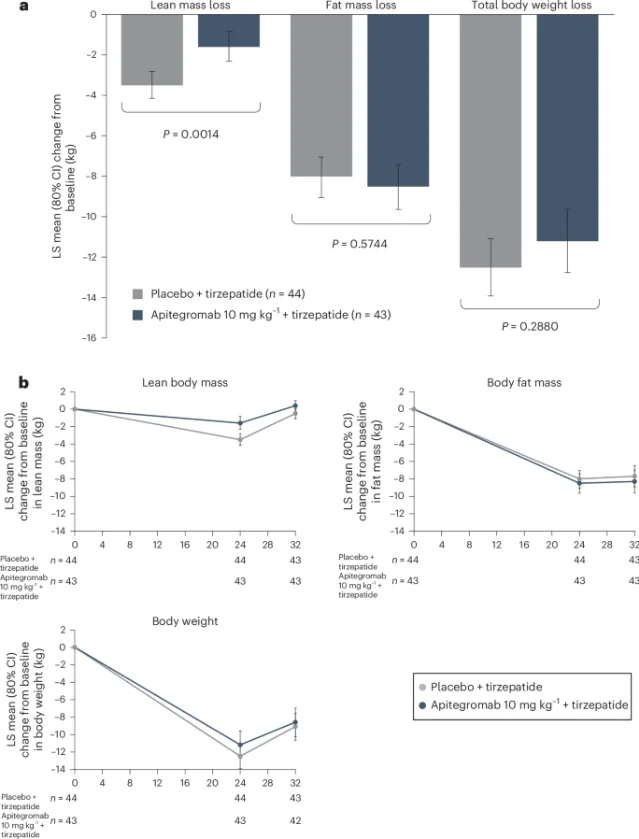
  • Apitegromab arm: lean mass loss 1.6 kg vs. placebo arm 3.5 kg — a 1.9 kg net preservation (80% CI: 1.2–2.7; nominal P = 0.0014), representing 54.9% relative retention of lean mass
  • Total body weight loss was similar and not statistically different: 11.2 kg (apitegromab, 95% CI: 9.6–12.7) vs. 12.5 kg (placebo, 95% CI: 11.1–13.9); P = 0.2880
  • Fat mass proportion of total loss: 85.3% (apitegromab) vs. 69.5% (placebo), indicating weight reduction with apitegromab was predominantly adipose-targeted
  • Week 32 exploratory analysis (8 weeks post-discontinuation): lean mass difference persisted at 0.9 kg (80% CI: 0.3–1.5; nominal P = 0.0480)
EMBRAZE Fig. 2 — lean mass loss (panel a), fat mass loss, total body weight loss by arm at Week 24; and lean body mass, fat mass, body weight trajectories through Week 32 (panel b)
EMBRAZE Fig. 2: panel a shows lean mass loss 1.6 kg (apitegromab) vs. 3.5 kg (placebo) at Week 24 (P = 0.0014); fat mass and total weight losses were not significantly different. Panel b shows lean body mass, fat mass, and body weight trajectories to Week 32, with the lean mass gap persisting 8 weeks after drug discontinuation. 1
PK/PD: Apitegromab reached steady-state concentration by Week 16; latent myostatin (PD biomarker) plateaued by Week 16 and remained elevated, confirming target engagement and dose saturation at 10 mg/kg. 1
Safety: AEs occurred in 76% (apitegromab) vs. 71% (placebo). SAEs: 1 per arm (2% each). GI AEs most frequent overall. Events ≥10% in the apitegromab arm and ≥5 percentage points above placebo: nausea, fatigue, headache. Gastrointestinal and metabolic AE profiles were otherwise similar across arms. 1
Demographics: 84.3% female in the apitegromab arm, 80.4% placebo. Mean age ~43 years. Mean baseline BMI: 34.4 (apitegromab) vs. 36.4 (placebo).
Clinical implication: Muscle loss during GLP-1 agonist therapy has become a practical concern as semaglutide and tirzepatide are used at scale — typical RCT data show 25–35% of total weight lost is lean mass. This proof-of-concept Phase 2 trial demonstrates that IV myostatin blockade can shift the composition of weight loss toward fat without blunting total weight loss magnitude. The 54.9% lean mass retention figure needs Phase 3 replication; the IV route and Scholar Rock's Phase 3 pipeline timeline are key variables for prescribers tracking this mechanism.
Affiliation: Corresponding author Richard E. Pratley, MD (AdventHealth Translational Research Institute, Orlando, FL). Six co-authors are Scholar Rock employees.

2. HTD1801 SYMPHONY-2 — Phase 3 HbA1c −1.2% with AMPK/NLRP3 dual mechanism (NEJM Evidence)

Journal: NEJM Evidence (NEJM Group) · Peer-reviewed, published June 7, 2026 · DOI: 10.1056/EVIDoa2500317 · Preprint status: peer-reviewed
Study design: Phase 3 (SYMPHONY-2) randomized, double-blind, placebo-controlled trial. HTD1801 + metformin vs. placebo + metformin in adults with type 2 diabetes (T2DM) inadequately controlled on stable metformin. 24-week double-blind phase; 52-week open-label extension. Sponsor: HighTide Therapeutics, Inc. (Rockville, MD / Shenzhen). Full text not directly accessible (Cloudflare-protected); all quantitative data below are sourced from the sponsor press release and have likely confidence rather than confirmed. 2
Drug identity: HTD1801 (berberine ursodeoxycholate) is a first-in-class oral anti-inflammatory metabolic modulator (AIMM). Mechanism: AMPK activation + NLRP3 inflammasome inhibition — distinct from incretin/GLP-1 class effects. FDA has granted two Fast Track designations and one Orphan Drug designation. China NMPA has accepted the NDA for review.
Key findings (Week 24 primary endpoint): 2
  • HbA1c reduction: −1.2% (HTD1801 + metformin) vs. placebo + metformin
  • Proportion achieving HbA1c <7.0%: 33% (HTD1801) vs. 11% (placebo)
  • Week 52 (open-label extension): HbA1c reduction −1.1% maintained; patients switching from placebo to HTD1801 achieved −1.2%
  • Cardiometabolic: LDL-C −13.6 mg/dL (HTD1801) vs. +0.2 mg/dL (placebo); GGT −4.4 U/L vs. +0.6 U/L at Week 24
  • Safety: diarrhea was the most common AE, generally mild-to-moderate and improving over time; SAEs uncommon
"HTD1801, with its unique dual mechanism around the AMPK-NLRP3 axis, demonstrated multiple benefits in the SYMPHONY-2 study, including superior and durable glycemic control, lipid reduction, attenuation of inflammation, and improvements in renal function."
— Prof. Linong Ji, Director, Dept. of Endocrinology, Peking University People's Hospital 2
Note on data confidence: N values, CIs, p-values, and the complete author list are not publicly confirmed from the primary source, as the NEJM Evidence page remains Cloudflare-gated and PubMed indexing is pending. Numbers above come from the sponsor's press release; independent verification will be possible once PubMed indexes the full text.
Clinical implication: A Phase 3 HbA1c reduction of −1.2% as add-on to metformin is clinically meaningful and sustained to 52 weeks. The concurrent LDL-C and GGT improvements, if confirmed in the primary paper, position HTD1801 as a candidate for the cardiometabolic–kidney disease (CKM) overlap population where incretin-based therapies are already in use. The AMPK/NLRP3 mechanism is non-overlapping with GLP-1 agonists, making combination use plausible.
Affiliation: Corresponding author Prof. Linong Ji (Peking University People's Hospital, Beijing). Funded by HighTide Therapeutics.

3. LASSARAB Phase 1 — 100% Lassa seroconversion from an inactivated rabies-vectored dual vaccine (Nature Medicine)

Journal: Nature Medicine · IF ~82.9, Tier 1 · Peer-reviewed, published June 9, 2026 · DOI: 10.1038/s41591-026-04429-z · Preprint status: N/A
Study design: Phase 1 randomized, controlled, dose-escalation trial (NCT06546709). N = 54 healthy adults aged 18–50. Single site: University of Maryland School of Medicine's Center for Vaccine Development and Global Health. Enrollment: January 22–April 22, 2025. Interim analysis through Day 61; final follow-up planned to Day 394 (~1 year). NIH/NIAID-funded (contract HHSN272201700082C). 3
Arms: LASSARAB low dose 700 rU (n = 15), medium 1,400 rU (n = 15), high 2,800 rU (n = 14); licensed rabies vaccine control Imovax (n = 10). Two intramuscular doses, 28 days apart. Formulated with TLR-4 agonist adjuvant 3D-6-acyl PHAD-SE.
Platform: LASSARAB uses an inactivated rabies virus (SAD B19 attenuated strain) engineered to express the Lassa virus glycoprotein complex (LASV-GPC, Josiah strain). It is the only inactivated/attenuated platform among the three Lassa vaccines currently in clinical development; the other two use replicating viral vectors (rVSV and measles-vectored). Manufacture under GMP at BSL-2 conditions by IDT Biologika. 3
Key findings (safety primary endpoint and immunogenicity):
OutcomeLASSARAB (all doses combined, n = 44)Imovax control (n = 10)
SAEs through Day 6100
Grade ≥3 AEs00
Local solicited AEs86.7–100%80%
Systemic AEs33.3–71.4%60%
LASV-GPC IgG seroconversion (≥4× rise, Day 61)100% (44/44)0% (0/10)
Rabies seroprotection (RFFIT ≥0.5 IU/mL, Day 61)100% all doses100%
3
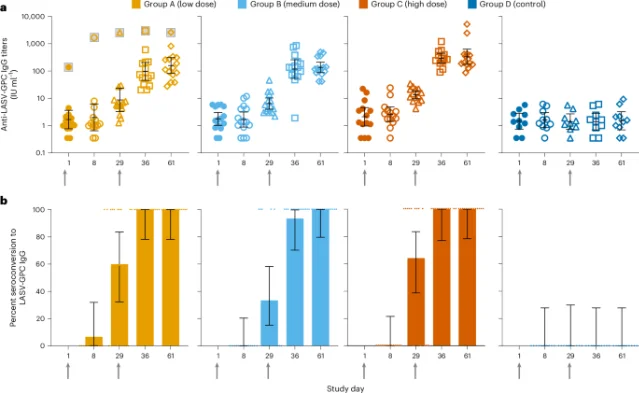
LASV-GPC GMT at Day 61: low dose 158.8 IU/mL, medium 135.4 IU/mL, high 331.0 IU/mL vs. control 1.5 IU/mL. After a single dose (Day 29), seroconversion was 60.0% (low), 33.3% (medium), and 64.3% (high). 3
LASSARAB Fig. 2 — anti-LASV-GPC IgG titers over time (panel a: GMTs by dose group, days 1–61) and LASV-GPC seroconversion rates (panel b: ≥4× rise from baseline by dose group)
LASSARAB Fig. 2: panel a shows anti-LASV-GPC IgG ELISA GMTs (log scale) by dose group and Imovax control across study days 1, 8, 29, 36, and 61 (arrows = injection days); panel b shows percent seroconversion (≥4× baseline) reaching 100% in all LASSARAB groups by Day 61. 3
"These results provide the first clinical evidence that a rabies-vectored platform can safely generate immunity to Lassa virus in humans. The ability to combine protection against Lassa fever and rabies in a single vaccine could have a substantial public-health impact in regions where both diseases remain endemic."
— Matthias J. Schnell, PhD, Director, Jefferson Center for Vaccines and Pandemic Preparedness, Thomas Jefferson University 4

Clinical implication: Lassa fever kills an estimated 2,000–5,000 people per year predominantly in West Africa, and no licensed vaccine currently exists. A 100% seroconversion rate at Day 61 with no SAEs and simultaneous rabies protection is a strong interim signal for this platform. The inactivated design's BSL-2 manufacturability is a practical advantage for endemic-region production compared with live vector alternatives. Limitations: N = 54, single-site, interim analysis only; immunogenicity correlates of Lassa protection in humans remain undefined. Final Day 394 follow-up data are needed before Phase 2 decisions.
Affiliation: Corresponding author Justin R. Ortiz, MD, MS (University of Maryland School of Medicine). Senior author Matthias J. Schnell, PhD (Thomas Jefferson University). 25 total authors.

4. Egg allergy prevalence fell 17.7% after Australia shifted to earlier introduction (JAMA Pediatrics)

Journal: JAMA Pediatrics · IF ~26.1 · Peer-reviewed, published June 8, 2026 · DOI: 10.1001/jamapediatrics.2026.2080 · Preprint status: peer-reviewed
Study design: Two large population-based cross-sectional studies in Melbourne, Australia — 2007–2011 cohort (n = 5,276, median age 12.4 months) vs. 2018–2019 cohort (n = 1,933, median age 12.5 months). Both cohorts: 76% response rate. Diagnostic method: skin prick testing followed by oral food challenge (gold standard) for screen-positive infants. Australia updated infant feeding guidelines in 2016 to recommend introducing egg and common allergenic foods within the first year of life. 5
Key findings: 5 6 7
  • Egg allergy prevalence: 9.2% (2007–2011) → 7.6% (2018–2019); 17.7% relative decrease, adjusted for known allergy risk factors; P = 0.04
  • Infants with early-onset eczema (highest-risk subgroup): 34.6%21.9%; P < 0.001 — the largest absolute reduction
  • Proportion introduced to egg by 6 months: 25% (2007–2011) → 57% (2018–2019); median age of introduction: 8 months6 months
Infant meal plate with boiled egg halves, avocado, cucumber, and grain mash — illustrating early egg introduction in infancy
An infant meal plate with boiled egg halves alongside avocado and cucumber — representative of the early-introduction feeding pattern that the 2016 Australian guideline change promoted. 6
The accompanying JAMA Pediatrics editorial (Aaron E. Carroll, MD, AcademyHealth; Ron Keren, MD, MPH, University of Pennsylvania/Children's Hospital of Philadelphia) did not confine its argument to congratulating the guideline authors: 6
"The field issued recommendations that outran the evidence, and families lived with the consequences. We owe families an honest accounting of that."
— Aaron E. Carroll, MD, and Ron Keren, MD, MPH 7
Lead author Jennifer J. Koplin, PhD (University of Queensland) noted: "To our knowledge, this is the first study to show a population-level reduction in egg allergy after the introduction of new infant feeding guidelines." 6
Clinical implication: Population-level evidence that guideline implementation translates to measurable reduction in food allergy prevalence has been absent until now. The LEAP trial established the mechanism for early peanut introduction; this study provides analogous population-scale confirmation for egg. The eczema subgroup data are particularly actionable: the 12.7 percentage-point reduction in the highest-risk group makes a strong case for prioritizing early introduction counseling in infants presenting with early eczema. The findings also mirror parallel peanut allergy trends following LEAP-based guideline updates in the US and UK.
Affiliation: Corresponding author Jennifer J. Koplin, PhD (Child Health Research Centre, University of Queensland, Brisbane). Co-author Rachel Peters (Murdoch Children's Research Institute, Melbourne).

5. Structured telehealth CHW–clinician feedback and diabetes outcomes (JAMA Internal Medicine, RCT)

Journal: JAMA Internal Medicine · IF ~39.0 · Peer-reviewed, published June 8, 2026 · DOI: not confirmed (PubMed indexing pending) · Preprint status: peer-reviewed
Study design: Randomized clinical trial evaluating a structured telehealth intervention pairing community health workers (CHWs) with a clinician-facing feedback loop for diabetes management in low-income settings. Lead investigator: Elizabeth M. Vaughan, DO, MPH (University of Texas Medical Branch). 8
Available findings: CHWs addressed 490 participant concerns (87.2%) through the structured feedback loop, covering medication refills, glucose management, and access-to-care barriers. The structured CHW–clinician intervention significantly improved diabetes outcomes compared with control. 8
Data limitations: The JAMA Internal Medicine full text is inaccessible (jamanetwork.com Cloudflare restriction; PubMed indexing pending as of June 9, 2026). Primary endpoint values — HbA1c change, effect size, CIs, p-value — and secondary outcomes, sample sizes per arm, trial duration, and baseline demographics are not currently confirmed from the primary source. The entry above reflects available search-level data only.
Clinical implication: CHW-integrated telehealth for diabetes management in low-income settings is an active area of implementation science. The 87.2% concern-resolution rate through structured feedback loops suggests operational feasibility, but the clinical effect size on glycemic outcomes remains unverifiable until the full text is accessible.

Loading stats card…
Cover image: AI-generated composite illustration

Add more perspectives or context around this Post.

  • Sign in to comment.