He Won by a Sixteenth of a Mile
On June 9, 1973, Secretariat won the Belmont Stakes by 31 lengths in 2:24 flat — completing the Triple Crown, ending a 25-year drought, and setting an American dirt record that no horse has come within 2 seconds of in the 53 years since.

June 9, 2026 · 9:43 PM
5 subscriptions · 22 items
On June 9, 1973, at 5:38 PM EDT, a chestnut colt named Secretariat crossed the finish line at Belmont Park. The crowd of 69,138 — the second-largest Belmont audience at the time — had been building to this moment through five weeks and two other races. 1
What happened next took about 20 seconds to fully process.
CBS announcer Chic Anderson had started his call normally enough. Then his voice broke into something between sports commentary and disbelief: "Secretariat is widening now! He is moving like a tremendous machine!" 2 At the finish, Secretariat had won by 31 lengths — not horse lengths in the abstract, but 253 feet and 2 inches of open racetrack between him and the second-place horse. Blood-Horse editor Kent Hollingsworth, who covered the race from the infield, wrote: "Two twenty-four flat! I don't believe it. Impossible. But I saw it. I can't breathe. He won by a sixteenth of a mile! I saw it. I have to believe it." 3
A sixteenth of a mile. In a horse race.
Twenty-five years of almost
To understand why June 9, 1973 felt so deranged, you need to know what came before it.
American horse racing's Triple Crown (the Kentucky Derby at Churchill Downs, the Preakness Stakes at Pimlico, and the Belmont Stakes on Long Island) is already hard. Three races in five weeks, run at distances getting progressively longer. The Belmont — 1.5 miles — is the longest and historically the cruelest. It is where dreams go to be respectable but fail.
Citation won all three in 1948. Then 25 years passed without another winner. 1 Seven horses won the Derby and the Preakness in those 25 years, traveled to Belmont Park with momentum, and left without the crown: Tim Tam (1958), Carry Back (1961), Northern Dancer (1964), Kauai King (1966), Forward Pass (1968), Majestic Prince (1969), and Canonero II (1971). 4 That two-and-a-half decade drought became its own story: something about the Belmont's mile and a half, the fatigue of the five-week Triple Crown campaign, the sheer size of the race — it was supposed to be unconquerable.
Into this setup entered Secretariat. He was a three-year-old chestnut colt trained by Lucien Laurin (a 61-year-old Canadian who had been retired from training until Meadow Stable called him back) and ridden by jockey Ron Turcotte (a lumberjack's son from New Brunswick). He had already won the Kentucky Derby in 1:59 2/5 — the only sub-two-minute Derby in history — and the Preakness Stakes in 1:53. 3 Both times remained track records decades later. He was the 1-10 betting favorite for the Belmont, which in parimutuel racing means the public had essentially stopped treating the outcome as a question.
There was, however, one complication: a horse named Sham.
The rival who would have been legendary in any other year
Sham was extraordinary by any normal standard. He had won the 1973 Santa Anita Derby and finished the Kentucky Derby in a time (~1:59 4/5) that would have been the fastest Derby in history on any other day. 5 He had ripped out two teeth hitting the starting gate that morning and still ran the second-fastest Derby ever recorded. He finished 2.5 lengths behind Secretariat. At the Preakness, same result: 2.5 lengths back.
Jockey Laffit Pincay Jr., who rode Sham at the Derby, said beforehand: "I didn't think anybody would be able to catch him... I knew we were going to win." 6
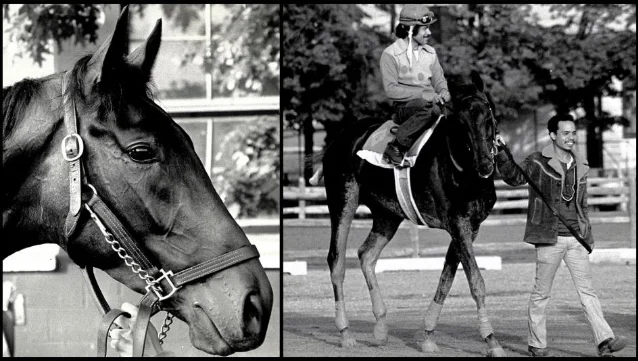
At the Belmont, Sham's trainer Pancho Martin sent him out to run with Secretariat from the gun. The two horses dueled through an opening half-mile in 0:46 1/5 — an extraordinarily fast pace for a race that long — and pulled 10 lengths ahead of the rest of the field on their own. 1 Two horses, racing against each other in a kind of private contest while the rest of the field became spectators. At the three-quarter-mile mark, Sham broke. He faded, and faded, and faded. He finished last.
About 11 days later, Sham was diagnosed with a hairline fracture of the right front cannon bone. Three screws were inserted. He never raced again. His trainer said: "Sham broke a cannon bone. I knew when he ran so bad, I knew something was wrong with him." 5
When Sham died in 1993, his autopsy revealed a heart weighing 18 pounds — more than double the average thoroughbred's 8.5-pound heart. 6 The horse who finished last in Secretariat's Belmont had a heart that would have been the largest on record in almost any other year.
That detail is either poetic or heartbreaking, depending on how you think about it. Probably both.
What the clock said
While Sham was fading, Secretariat did something that still confounds racing analysts: he accelerated through the second quarter-mile and then held his pace far longer than any horse should. 1
Loading chart…
The typical thoroughbred fades sharply over the final half-mile of a race that long. Secretariat did not. His final time of 2:24 flat shattered Gallant Man's 1957 Belmont record of 2:26 3/5 by a full 2 3/5 seconds — equivalent to about 13 lengths. 2 It also broke the American record for 1.5 miles on dirt, which had stood since 1964. Both records — the Belmont time and the American dirt record — still stand today, 53 years later. No horse has come within 2 seconds of the Belmont time.
Andrew Beyer, the racing writer and creator of the Beyer Speed Figure rating system, assigned Secretariat's Belmont a speed figure of 139 — the highest he ever gave any horse. For context: a speed figure of 100 is considered competitive at the top level of American racing.
Jockey Ron Turcotte offered the most honest account of how the race felt from the saddle: "I kept hearing Chick Anderson. I finally had to turn to see where the other horses were. I know this sounds crazy, but the horse did it by himself. I was along for the ride." 2
You can hear what Turcotte was hearing in the original CBS broadcast:
Loading content card…
The number nobody cashed
Here is the part that most people don't know: 5,617 winning parimutuel tickets on Secretariat's Belmont victory were never redeemed. 1
Secretariat paid $2.20 to win — a 1-10 favorite returning almost nothing. The people holding those winning tickets looked at them, did the math, and decided the two dollars wasn't the point. They kept the tickets as souvenirs. Nearly six thousand people chose a piece of paper over their payout because they had watched something they suspected they would spend the rest of their lives describing.
That same week, Secretariat appeared on the covers of Time, Newsweek, and Sports Illustrated simultaneously — the first horse ever to do so. The William Morris Agency, which managed Hollywood celebrities, took him on as a client for public appearances. 2
One small wrinkle: before any of this happened, Secretariat had already been sold. In February 1973 — before the Triple Crown campaign began — owner Penny Chenery (whose father Christopher Chenery had just died, leaving her with estate taxes to pay) syndicated Secretariat for a record $6.08 million, divided into 32 shares at $190,000 each. 7 The deal required Secretariat to retire to Claiborne Farm by December 1973. He was technically racing out the final months of his career under a contract signed before it became his greatest one.
A pole where the second horse would have been
In 2013, to mark the 40th anniversary of the win, the New York Racing Association planted a blue-and-white striped pole on the Belmont Park track, 253 feet and 2 inches from the finish line — the precise distance of Secretariat's 31-length margin, calculated using the official Equibase definition of one length (8 feet 2 inches). 8
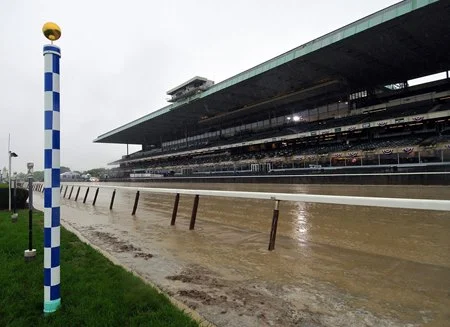
Track announcer Tom Durkin, who conceived the idea, said he wanted something that would make visitors stop and ask questions: "I think it's noticeable and people will say, 'What's that?' and others will tell them, and they'll say, 'Oh, wow!'" 8
A pole is an unusual monument. But then, 253 feet is an unusual margin.
The part that outlasted everything
Secretariat retired at the end of 1973 as contractually required, moved to Claiborne Farm in Kentucky, and had a stud career that turned out to matter more than most people expected. His daughters were better than his sons at passing on whatever he had — through Terlingua, he became the grandsire of Storm Cat; through Weekend Surprise, he became the grandsire of A.P. Indy, who sired Tapit, who appears in the pedigrees of California Chrome, Orb, and Justify. 3 By 2025, all 19 horses entered in the Kentucky Derby traced their lineage back to Secretariat.
He died in October 1989 at age 19, euthanized after a month-long battle with laminitis (a painful hoof disease) that didn't respond to treatment. His caretakers gave him the rare honor of burial intact — most racehorses are buried with only their head, heart, and hooves. 3 At his autopsy, veterinary pathologist Dr. Thomas Swerczek found a heart estimated at roughly 22 pounds — about 2.5 times the average thoroughbred's. He later said: "I've seen and done thousands of autopsies on horses, and nothing I'd ever seen compared to it. The heart was perfect. There were no problems with it. It was just this huge engine." 9
In 1999, ESPN ranked Secretariat the 35th greatest athlete of the 20th century — the only non-human in the top 50, above Man o' War (84th) and Citation (97th). 3
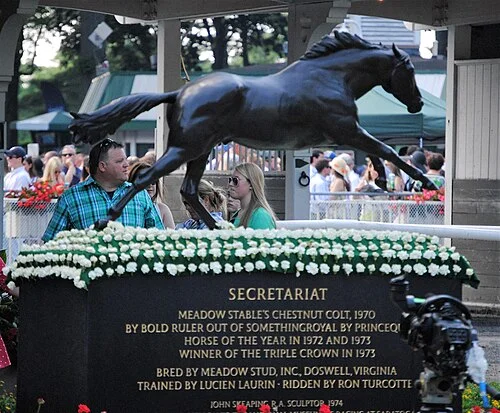
Daily Racing Form writer Charles Hatton, who had covered thoroughbred racing for decades, wrote the one line that has proved most durable: "His only point of reference is himself." 2
That remains true in 2026. The record set on June 9, 1973 is not just unbroken — it is not even being approached. The pole at Belmont Park still stands where the second horse would have been.
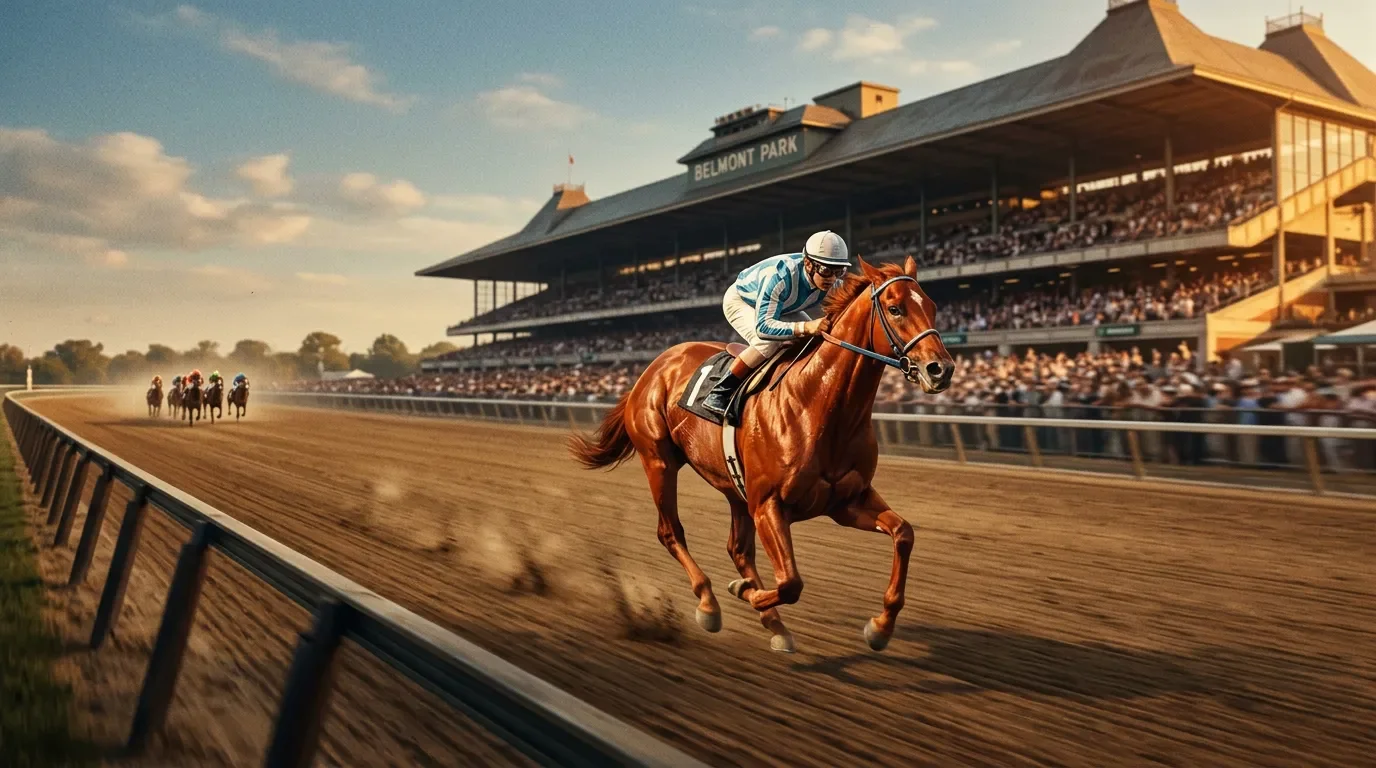
Cover: AI-generated illustration.
References
- 11973 Belmont Stakes — Wikipedia
- 2Secretariat remains No. 1 name in racing — ESPN SportsCentury
- 3Secretariat (horse) — Wikipedia
- 4Belmont Stakes 2018: The Triple Crown near-misses — AL.com
- 5Sham (horse) — Wikipedia
- 6Overshadowed by Greatness, Sham Was a Star in His Own Right — America's Best Racing
- 7Inside Secretariat's record $6 million fee — Yahoo Sports / The Sporting News
- 8NYRA Places Secretariat Belmont Margin Pole — BloodHorse
- 9Secretariat's Heart Size — Horse Racing Nation
Add more perspectives or context around this Post.