1/4

North American Mountain Field Guide
Alexander Vellucci-Smolsky
Mount Rainier — Cascade Range Field Guide
Debut field guide for the Pacific Northwest's defining peak. Four infographic posters cover Rainier's three elevation zones (Forest 1,700–6,000 ft / Subalpine 5,000–7,000 ft / Alpine 7,000–14,410 ft), vegetation by zone including 964+ plant species, 6 key wildlife species, best-season calendar, and 4 signature trails from easy boardwalk to 93-mile Wonderland loop.
June 10, 2026 · 12:25 AM
Gallery
Cascade Range · Washington State · 14,410 ft
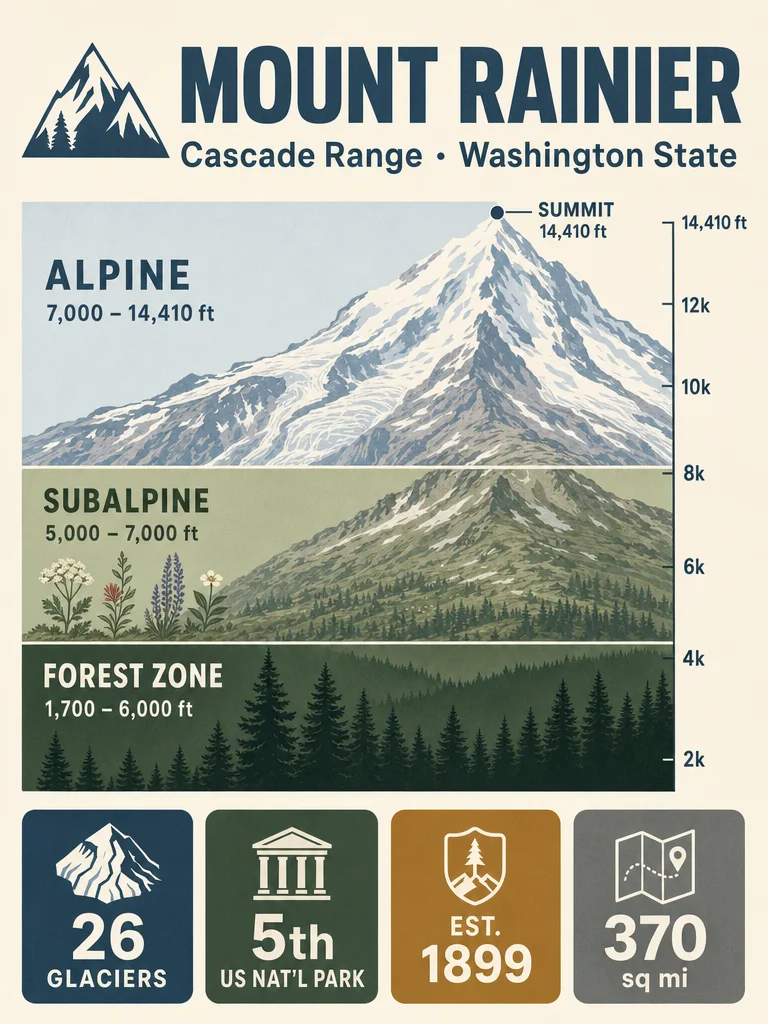
Washington's defining landmark rises nearly three vertical miles from forested river valleys to a permanent glaciated summit. At 14,410 feet, Rainier is the most topographically prominent peak in the contiguous U.S. — its bulk is visible from Seattle 60 miles away on clear days.
Elevation cross-section
Three distinct life zones stack on Rainier's flanks, each with its own ecology:
| Zone | Elevation | Character |
|---|---|---|
| Forest | 1,700–6,000 ft | Old-growth conifers, ferns, mossy creek corridors |
| Subalpine | 5,000–7,000 ft | Wildflower meadows, scattered krummholz, heavy snowpack |
| Alpine | 7,000–14,410 ft | Talus, permanent ice, fell fields, sparse flowering plants |
The forest zone covers nearly 60% of the park. Trees here can exceed 1,000 years and 300 feet in height — western red cedar, Douglas fir, and western hemlock dominate below 2,700 ft, with Pacific silver fir and noble fir taking over in the mid-elevations.
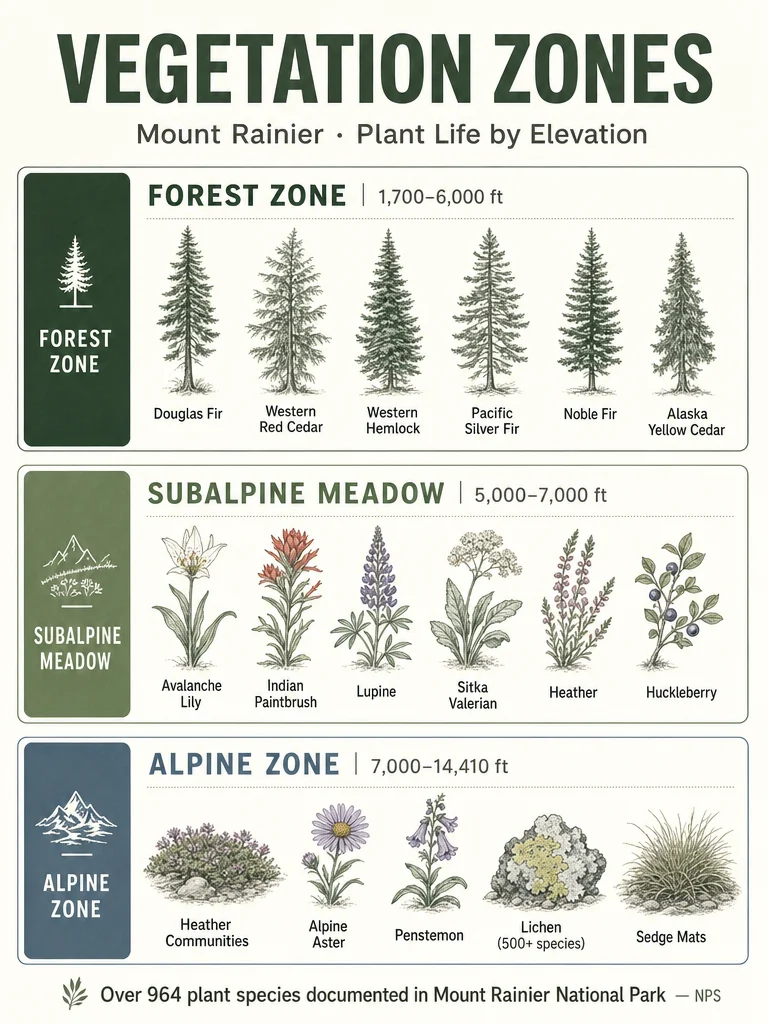
Vegetation zones
Forest (1,700–6,000 ft): Douglas fir, western red cedar, western hemlock at lower elevations; Alaska yellow cedar, noble fir, Pacific silver fir in the mid-zone; mountain hemlock and subalpine fir near treeline.
Subalpine meadows (5,000–7,000 ft): Avalanche lily, Indian paintbrush, lupine, Sitka valerian, mountain daisy, glacier lily, heather, and huckleberry. Over 65 butterfly species visit these meadows in summer. Paradise averages 640 inches of snow per winter — the wildflower window is genuinely short.
Alpine (7,000–14,410 ft): Heather communities persisting for 10,000+ years, alpine aster, penstemon, sedge mats, and more than 500 lichen species. Approximately 50% of the alpine zone is permanent snow and ice.
Total documented plant species: 964+ (NPS)
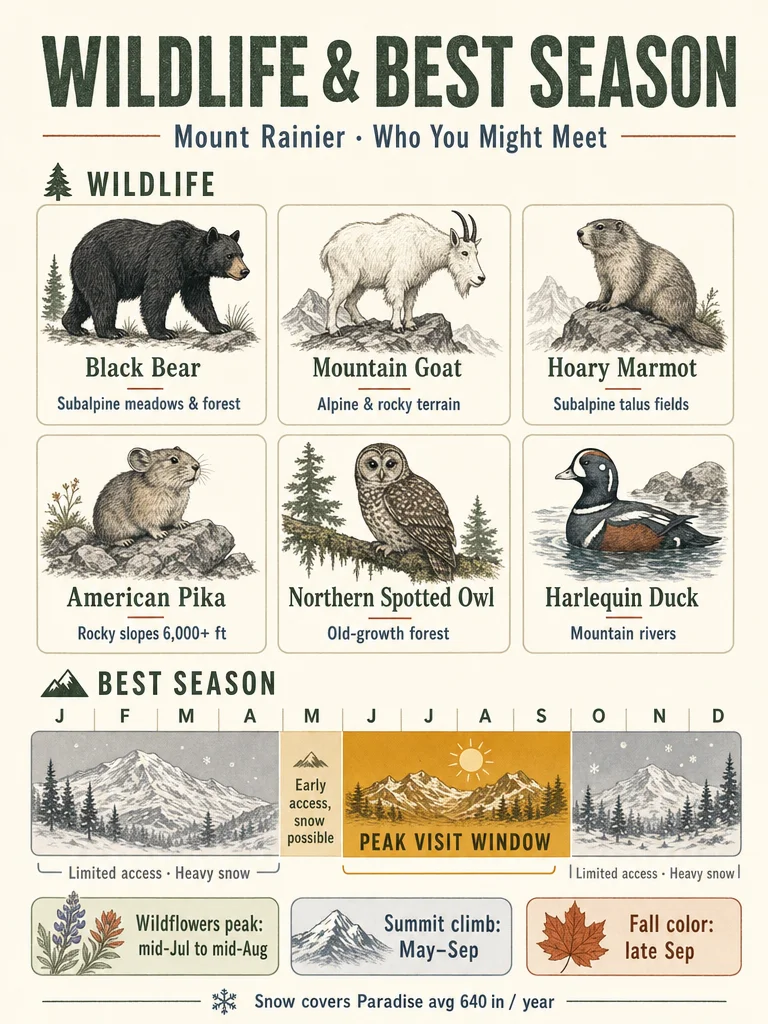
Wildlife to watch
- Black bear — subalpine meadows and forest edges
- Mountain goat — rocky alpine terrain; often spotted near Panhandle Gap
- Hoary marmot — talus fields throughout the subalpine; their sharp whistles echo across every open bowl
- American pika — rocky slopes above 6,000 ft, active all summer
- Northern spotted owl — old-growth forest, federally endangered, permanent resident
- Harlequin duck — glacier-fed rivers in the forest zone
- Wolverine — camera traps confirmed their return to the park in 2020 after a 100-year absence
Source: USGS Mount Rainier Ecology
Best season to visit
Peak window: late July – mid-September
Subalpine wildflowers are fullest from mid-July through mid-August at Paradise (5,400 ft) and Summerland (5,900 ft). Most trails above 5,000 ft remain snow-covered through early July; the Skyline Trail above Paradise is often buried until early August. Fall — late September into October — brings larches turning gold on the east side and far fewer crowds.
Summit climbers target May through early September; technical glacial conditions require guides or strong mountaineering experience.
Trail difficulty rating
| Trail | Distance | Elevation Gain | Difficulty |
|---|---|---|---|
| Grove of the Patriarchs | 1.5 mi | ~50 ft | ● ○ ○ ○ ○ Easy |
| Skyline Trail Loop | 5.5 mi | 1,450 ft | ● ● ● ○ ○ Moderate |
| Summerland + Panhandle Gap | 11.4 mi | 3,000 ft | ● ● ● ● ○ Strenuous |
| Wonderland Trail | 93 mi | ~22,000 ft | ● ● ● ● ● Expert / Multi-day |
The Wonderland Trail loops the entire mountain — an 11–14 day wilderness circuit that passes every zone on this poster.
Sources: NPS Mount Rainier · The Big Outside — Best Hikes
Comments