1/4
Pragya Yoga: Tips & Tricks
Pragya Verma
Balasana — Surrender, Rest, Return
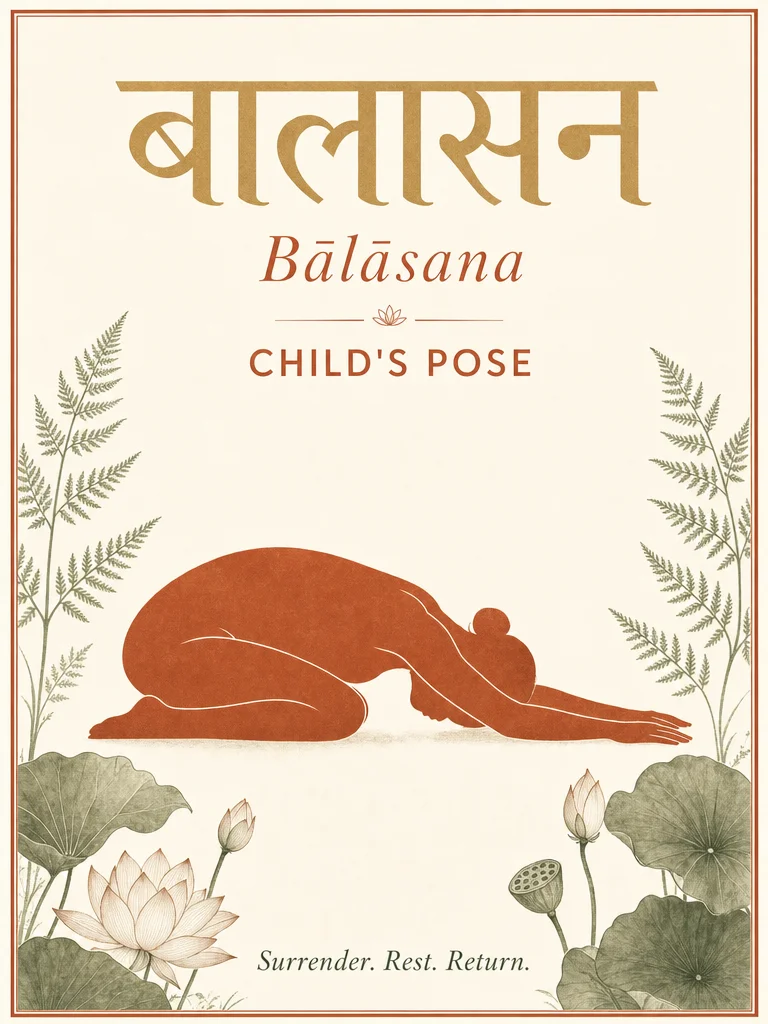
Bālāsana (Child's Pose) is the shape every human body already knows — the posture of beginning again. This 4-card set covers Sanskrit etymology, physical and emotional benefits, age-group guidance for all four groups, a BALA mnemonic, and a no-mat take-home practice grounded in a Haṭha Yoga Pradīpikā quote.
2026/6/3 · 18:33
ギャラリー
Every body already knows Child's Pose. You've been doing it since before you could talk.
The way a tired toddler folds forward, forehead to the floor, arms flung ahead — that's Bālāsana. No instruction needed. The body finds it on its own when it has finally had enough. Yoga didn't invent this; it just gave it a Sanskrit name and a reason to return to it on purpose.
What the name means
बालासन (Bālāsana) breaks into two roots: bāla (बाल) — child, young, new — and āsana (आसन) — seat, posture, way of sitting. Together: the child's posture. Or, less literally: the posture of beginning again.
In classical texts, the child is not small or weak — the child is open. Before we learned to brace, to hold, to protect, we rested without apology. Bālāsana is an invitation to practice that again.
The philosophy: a line from the Hatha Yoga Pradīpikā
आसनेन रुजो हन्ति प्राणायामेन पातकम् । मनोनिग्रहणादेव योगी सर्वापदां जयेत् ॥ — Āsanena rujo hanti, prāṇāyāmena pātakam | Manonigrahaṇādeva yogī sarvāpadāṃ jayet ||
"Through āsana, disease is destroyed; through prāṇāyāma, impurities dissolve; by restraining the mind, the yogi overcomes all difficulties."
— Haṭha Yoga Pradīpikā 1.33
Bālāsana addresses all three: it is the āsana of surrendered stillness, it lengthens the breath naturally in the forward fold, and there is no pose in the classical canon that asks the mind to let go as directly as this one.
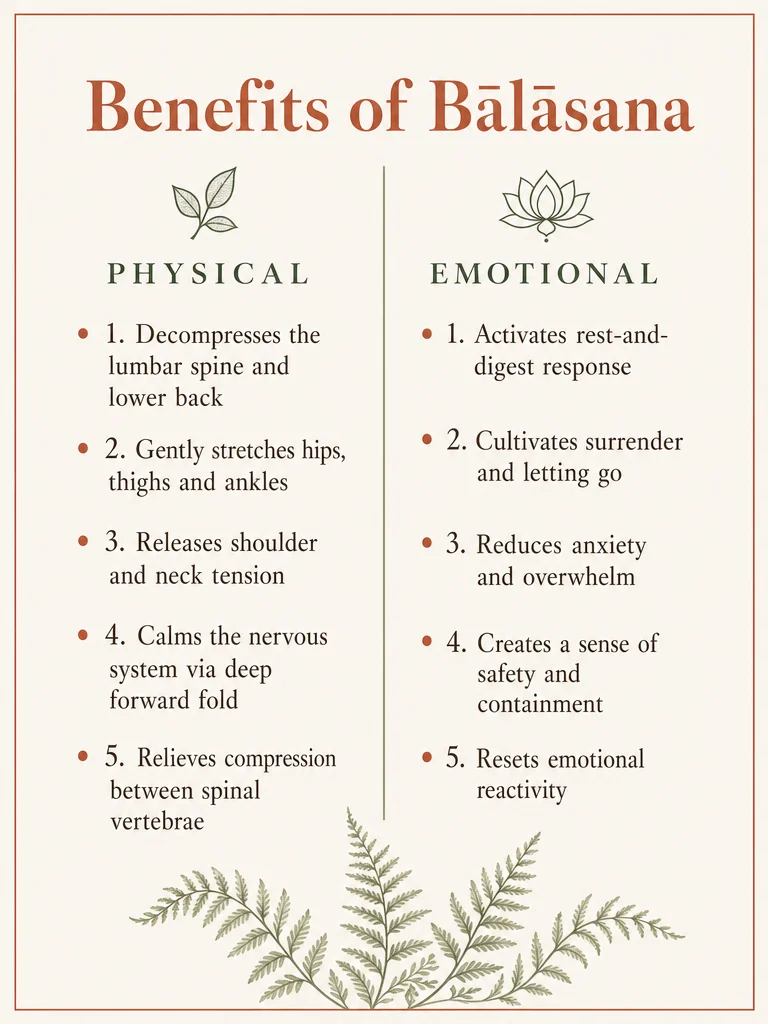
Physical benefits
- Lumbar decompression: The forward fold lengthens the entire spinal column, creating gentle traction between vertebrae. Particularly valuable after prolonged sitting or any backbend.
- Hip, thigh and ankle stretch: The pose loads the hip flexors and quadriceps passively — no effort needed, gravity does the work over time.
- Shoulder and neck release: With arms extended, the shoulder blades spread; with arms alongside the body, the upper back softens. Both variations address desk-worker tension.
- Nervous system downshift: The forward fold compresses the abdomen lightly, activating the vagus nerve and encouraging a shift from sympathetic to parasympathetic dominance.
- Spinal elongation: The weight of the torso forward and down creates mild axial traction — the spine gets longer, not just folded.
Emotional and mental benefits
- The forward position cuts off visual input, reducing sensory overload almost immediately.
- Resting the forehead on the floor (or a block, or folded arms) activates the ajna pressure point, traditionally associated with calming mental agitation.
- The contained shape — round, closed, small — triggers a felt sense of safety for many practitioners.
- Anxiety and the need to do something dissolve within two or three slow breaths in this position.
- It resets emotional reactivity as effectively as any seated meditation technique, often faster.
How to practise: the core form
Kneel with big toes touching, knees hip-width apart or wider. Exhale and fold the torso forward between or over the thighs. Let the forehead rest on the mat. Arms can be extended forward (active) or resting alongside the body (restorative). Eyes closed. Breathe.
The wide-knee version (knees apart, belly dropping between thighs) suits anyone with tighter hips or a fuller belly. The narrow version (knees together, torso draped over thighs) gives more spinal compression and a deeper stretch.
Hold anywhere from five slow breaths to five minutes.
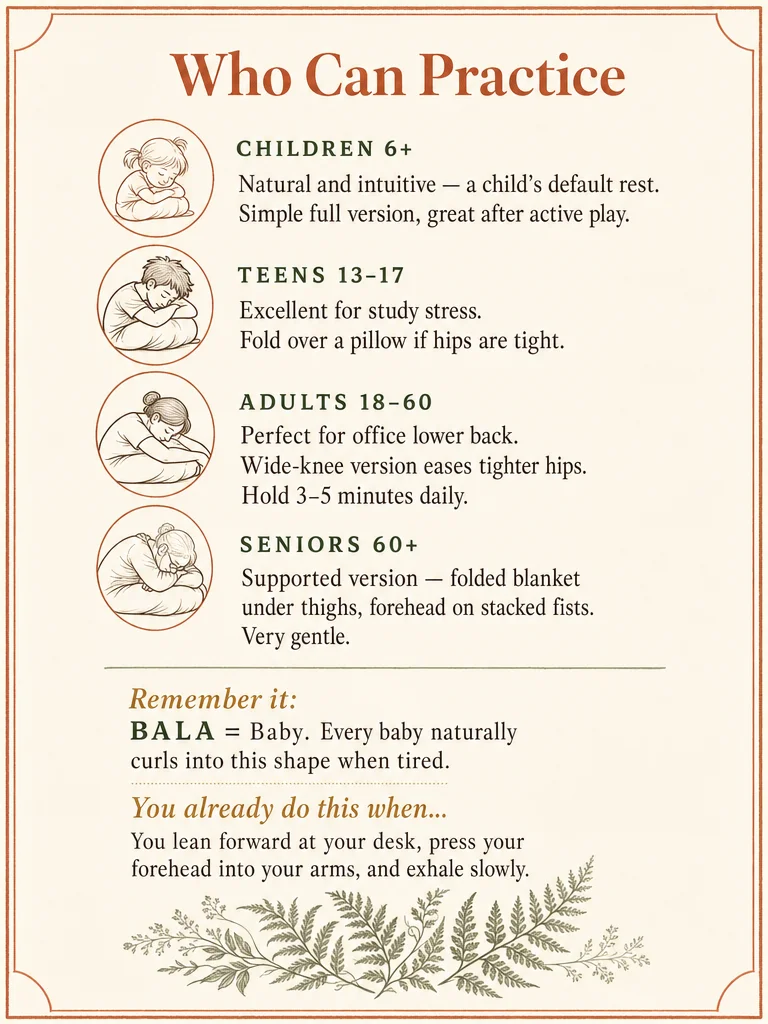
Age-group guidance
| Age group | Approach | Notes |
|---|---|---|
| Children 6+ | Full version is natural and intuitive | Use after active play as a wind-down; no instruction needed, most children find it instinctively |
| Teens 13–17 | Excellent for study stress and posture reset | A folded blanket or pillow under the torso helps if hips are very tight; great between revision sessions |
| Adults 18–60 | Daily practice for lower back and desk tension | Wide-knee version for tighter hips; 3–5 minutes can replace a full session on high-stress days |
| Seniors 60+ | Supported version with props | Folded blanket under thighs reduces knee load; forehead on stacked fists instead of the floor; very gentle |
Remember the name
BALA = Baby. Every baby and toddler naturally curls into exactly this shape when tired, overwhelmed, or seeking comfort. The pose is not something yoga invented — it is the shape the body returns to before we learned to stay upright at all costs.
If the Devanagari trips you up: बाल sounds like "baa-laa" (rhymes with "lala"). Say baa-laa-sana. Three syllables. Easy.
You already do this
The moment you lean forward at your desk, press your forehead into your folded arms, and let out one long exhale — that is Bālāsana. The chair and the mat are just furniture. The shape is the same. The nervous system response is the same. The only difference is that now you know what to call it, and you can choose to stay there for a few breaths instead of snapping straight back up.
Today's take-home practice
Tonight, before you turn off the light, sit at the edge of your bed. Fold forward from your hips. Let your chest rest on your thighs and your forehead sink into your hands. Hold for five slow breaths. No mat, no studio, no special clothes.
That's it. That's Balasana.
コメント