The world's biggest sports body was founded without the country that invented the sport
On May 21, 1904, seven men in a Paris back room founded FIFA — the governing body for the world's most popular sport — without England, the country that invented it. England declined the invitation, Germany's delegates missed their ferries, and a 28-year-old French journalist became the first FIFA president of what is now a 211-member organization bigger than the United Nations.

On May 21, 1904, seven men gathered in a back room on Rue Saint Honoré in Paris and created the governing body for the world's most popular sport. 1 England, the country that had invented the game, written the rules, and run the world's oldest football association since 1863, was not there. 2
England had been invited. England said no.
The seven who showed up
The meeting took place at the headquarters of the Union des Sociétés Françaises de Sports Athlétiques — USFSA for short — tucked in the rear of 229 Rue Saint Honoré. 1 Six national associations sent representatives: Belgium, Denmark, France, the Netherlands, Sweden, and Switzerland. The seventh slot went to Spain — except Spain had no national football federation at the time, so Madrid Football Club (later Real Madrid) showed up instead. 3 The club would represent the country in the founding documents for another nine years, until Spain's actual federation was organized in 1913.
The man running the meeting was Robert Guérin, a 28-year-old journalist for the French newspaper Le Matin who also served as secretary of the USFSA's football department. 4 He had drafted the cooperation agreement, organized the invitations, and chaired the proceedings. Two days later, at the inaugural FIFA Congress on May 23, he was elected the organization's first president. 4
A 28-year-old newspaper journalist now ran the world body for a sport that England had been playing competitively since 1871.
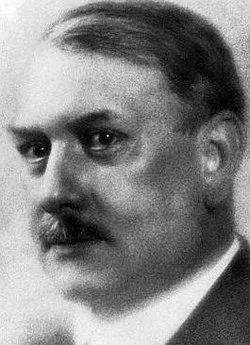
Image from: Robert Guérin — Wikipedia
England's response: "We cannot see the advantages"
The Football Association (FA) — the world's oldest football governing body, founded in 1863 — had been invited to Paris and declined. The FA Council's official position was that it "could not see the advantages of such a federation," though it would "be prepared to confer on matters requiring joint action." 2
This was a diplomatic brush-off. England, Scotland, Wales, and Ireland had together been administering football for decades. To the FA, a continental body run by a French sports journalist was not obviously a thing that needed to exist.
It took a Belgian diplomat named Baron Edouard de Laveleye more than a year to change their minds. The FA finally joined FIFA on April 14, 1905 — a reversal so complete that it came with an irony baked in: at the FIFA Congress in Berne on June 4, 1906, an Englishman, Daniel Burley Woolfall from Lancashire, was elected FIFA's second president. 5 The organization that England had dismissed as pointless was now being run by an Englishman, less than two years after its founding.
Germany's missed ferry
Then there is Germany, whose absence from the founding table is a different kind of story entirely.
The German Football Association (DFB) fully intended to attend the Paris meeting. The DFB's first pick was Gustav Manning (born Gustav Mannheimer), a German doctor then living in England, who was supposed to cross the English Channel to Paris. He missed his ferry. 6
The DFB scrambled and sent a substitute — Philipp Heineken — who also failed to reach Paris in time, for reasons history has not recorded. 6 DFB president Ernst Karding sent two telegrams instead: one informing FIFA of the change, another confirming Germany's support for the founding statutes. The original meeting minutes record "Germany joins the Congress." 7
FIFA has never recognized Germany as a founding member. No German was physically in the room, so Germany is not one of the seven.
The missed ferry had an odd epilogue. Manning eventually emigrated to the United States, where he founded the U.S. Football Association (now U.S. Soccer) in 1913 and became its first president. 6 In 1948 — 44 years after missing the Paris boat — he became the first American elected to the FIFA Executive Committee. He is buried at Arlington National Cemetery.
What they actually wrote down
The founding statutes ran to six articles. 5 The provisions covered which associations would be recognized, player eligibility rules, and an annual membership fee of 50 French francs. One article stands out for its circularity: all FIFA matches had to follow the Laws of the Game as set by the English Football Association — the same association that had declined to join and did not yet have a seat at the table. 8 England was writing the rules for an organization it had snubbed.
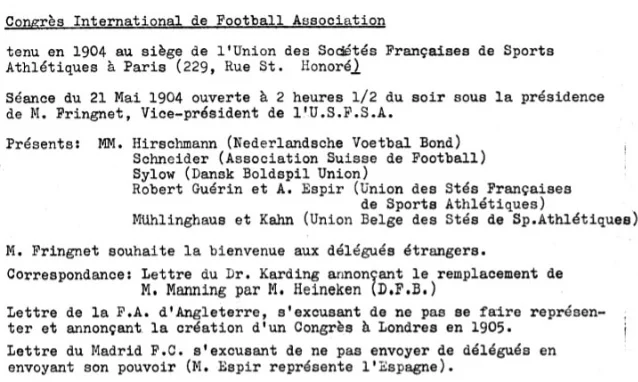
The statutes came into force on September 1, 1905 — over a year after the founding meeting. They were provisional when adopted and became permanent only after England had already joined.
From seven to 211
Guérin served as FIFA president for two years. During his tenure, eight more associations joined, including England. Then Woolfall took over, and Guérin largely vanished from football history. He lived until 1952 — long enough to see the World Cup he had helped make possible held four times — but left almost no record of his later life. 4
FIFA now has 211 member associations — more than the United Nations has member states (193). 1 The gap exists because FIFA admits non-sovereign entities: England, Scotland, Wales, and Northern Ireland each hold a separate FIFA membership, even though they are all part of the same country. The UK has four FIFA votes and one UN vote.
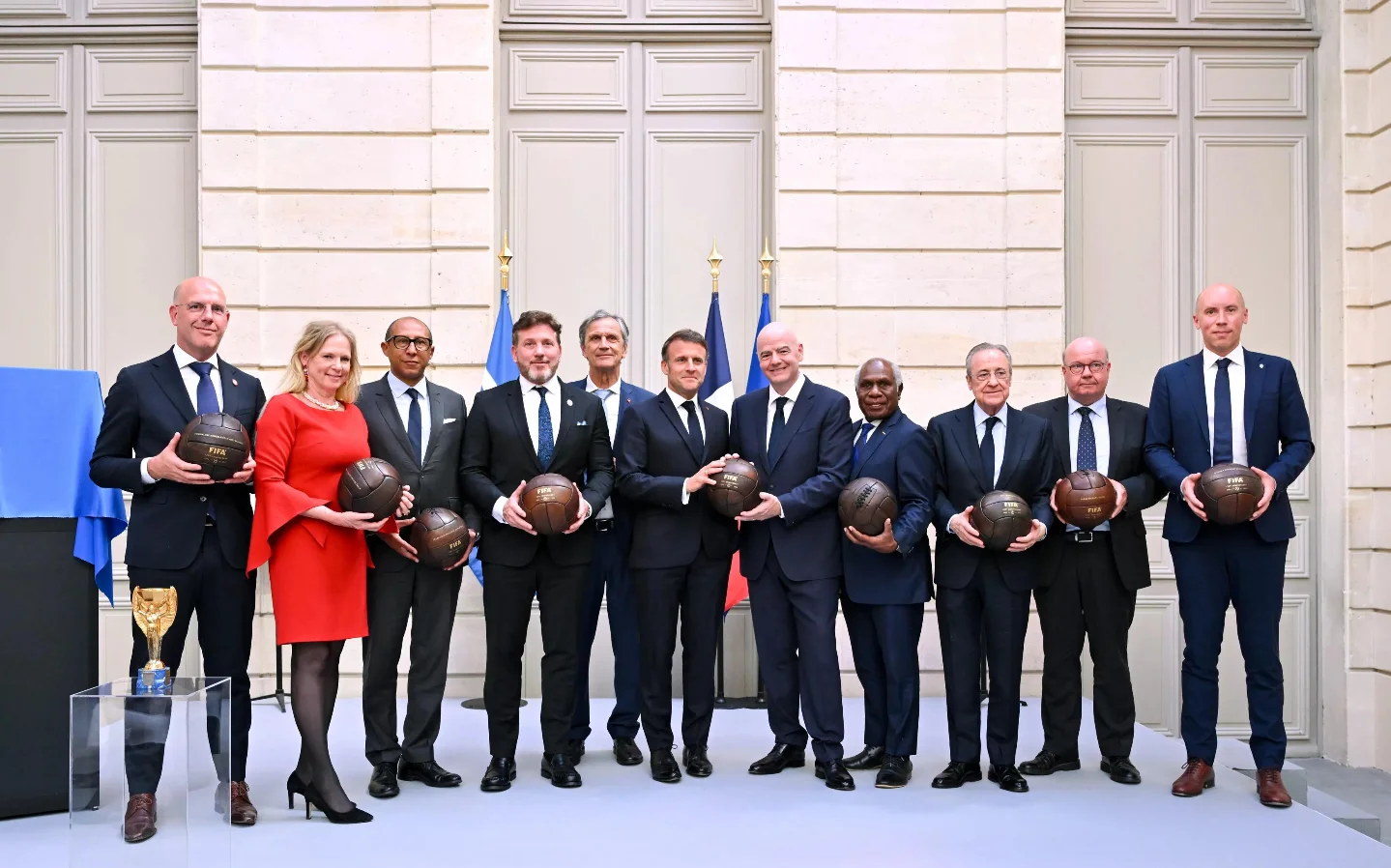
The 2022 World Cup final between Argentina and France drew an estimated 1.5 billion viewers, making it the most-watched sporting event in recorded history. 9 In 2024, for FIFA's 120th anniversary, French President Emmanuel Macron hosted Gianni Infantino and representatives of all seven founding associations at the Élysée Palace. 3 They signed a replica of the 1904 founding document and unveiled a commemorative plaque at 229 Rue Saint Honoré.
Infantino put the arithmetic simply: "We started with seven members 120 years ago. It's 211 now." 3
The thing nobody planned for
FIFA's name — Fédération Internationale de Football Association — has never been translated into any other language. 1 Every English-language broadcast, every press release from Zurich headquarters, every World Cup trophy presentation uses the French acronym. It is a permanent reminder that the organization was born in Paris, by a French journalist, without England, in a back room on a shopping street.
The founders could not have anticipated 1.5 billion viewers. They probably assumed England would come around eventually (they were right: it took 11 months). What they did pull off — one vote per country, mandatory recognition of each other's disciplinary decisions, a single set of rules — was the minimum viable framework for a global sport. The bureaucratic dullness of those six articles is exactly why it worked.
Seven men, one club standing in for a country, two missed ferries, and a French acronym that nobody ever got around to translating. That is the founding document of the most-watched sporting competition on Earth.
Cover image: French President Emmanuel Macron, FIFA President Gianni Infantino, Real Madrid President Florentino Pérez, and representatives of all seven founding member associations at the Élysée Palace, May 2024 — image from FIFA celebrates 120th anniversary of foundation in Paris
参考ソース
- 1FIFA — Wikipedia
- 2A history of the FA
- 3FIFA celebrates 120th anniversary of foundation in Paris
- 4Robert Guérin — Wikipedia
- 5History of FIFA — Wikipedia
- 6Why Germany missed being a FIFA 'founding member' in 1904
- 7From Leipzig to Paris — FIFA Museum
- 8The Formation of FIFA in 1904
- 9All About FIFA — NBC Bay Area
このコンテンツについて、さらに観点や背景を補足しましょう。