LinkedIn Humble-Brag Hall of Fame, Issue #4
Issue #4: 'quietly building' goes nonprofit, a 7-word retirement, the Cannes Lions inversion, and Reddit on incomprehensible hydration.

This week the "quietly building" template left tech entirely and showed up inside a 501(c)(3) charitable foundation. It also showed up inside an ADHD recovery post, a proptech startup announcement, and a partner-led digital agency launch. The template is no longer a startup idiom. It is a general-purpose LinkedIn opening move.
Three things also happened this week that deserve marking: a LinkedIn influencer used "humbled to announce" for something he didn't get. A man named Liam Darmody retired from Coinbase in exactly seven words. And Reddit decided that a friend who drinks a gallon of water per day is apparently incomprehensible.
June 1–8, 2026. Let's get into it.
Specimen #1: The minimalist specimen
LIAM DARMODY, 48,478 followers, 3,000+ posts, Coinbase. June 3, 2026. Engagement: 43 likes, 28 comments. 1
"Proud, humbled, and honored to announce my retirement. Thank you, Coinbase."
That's the whole post.
No story. No timeline. No near-miss moment. No lesson for the audience. No coaching pitch in the final paragraph. Just the seven words of the phrasing, the company name, and a period.
What's notable here is what the stripped-down version reveals about the template's machinery. The phrase "proud, humbled, and honored" is doing three contradictory emotional jobs at once: proud acknowledges the achievement, humbled disclaims it, and honored reattributes it to a benefactor larger than the self. Three words, three rhetorical maneuvers, in sequence. The sentence functions as a complete emotional transaction — and Darmody apparently decided no further elaboration was required.
Most people who use this template wrap it in a narrative to justify the phrasing. Here the phrasing is the post. As a result, it reads either as arch self-awareness (he knows exactly what he's doing) or as the most efficient deployment of the template ever attempted. The comments are full of congratulations. The template doesn't require decoration. It fires on its own.
Specimen #2: The acronym mutation
Dima Abu-Khaled, career coach for women in engineering, Canada. June 5, 2026. Engagement: 167 likes, 127 comments — the highest comment count of any LinkedIn post found this week. 2
The post opens with a scene: 11:47 PM, cursor hovering over the "Apply" button. Inner voice running the standard self-doubt checklist. Then:
"I remember sitting at my desk at 11:47 PM, cursor hovering over the 'Apply' button. My inner voice was screaming: 'You're going to waste their time.' 'They'll see right through you.' 'You're not ready for this.' Then I did something reckless. I clicked submit."
The post follows the standard "I almost didn't apply" arc cleanly: near-miss → surprise acceptance → promotion → transformation. She had the interview in 72 hours. She was leading projects within 6 months. The emotional payload is exactly where the template puts it.
Then, midway through, something new appears. An acronym:
BEGINNER: Be curious. Embrace feedback. Go before you're ready. Invest in learning. Network before you need it. Notice your skill gaps. Execute imperfectly. Repeat relentlessly.
The acronym is a recognizable mutation. The "I almost didn't apply" template usually ends with a call to action directed at readers who haven't submitted their own pending applications — "if this sounds like you, hit send." That's a broadcast. The acronym converts it into a framework, which is a product. The post closes with an offer for 3 coaching spots for women in engineering.
The structural sequence is: vulnerability → overcoming → formula-as-lesson → coaching pitch. The acronym is the hinge that makes that sequence feel earned rather than transactional. It gives the pitch a credential: she didn't just survive imposter syndrome, she systematized what she learned. Whether she did is unverifiable. But the BEGINNER framework signals that the insight has been processed, packaged, and is now available for purchase.
127 people commented. The template, plus the acronym hinge, appears to be working as designed.
Specimen #3: The template migrates to social impact
Asrat Alemu, Stanford alum, McKinsey, NFL background, 6,062 followers. June 5, 2026. Engagement: 431 likes, 82 comments — the highest of any post found this week. 3
The opening line: "Today I'm launching something I've been quietly building in my free time: The Méda Foundation. Méda means 'open field' in Amharic — what we fund and what every kid deserves."
Loading content card…
The Méda Foundation is a US 501(c)(3) organization funding youth sports in Africa. First grant: soccer equipment and field rental for 80 boys in Ethiopia, then a head coach and computers for 25 girls. Total raised from family and friends: $7,600. Administrative overhead: 2–3%. The board includes Olympic champion Haile Gebrselassie as an advisor, the former CAF (Confederation of African Football) chief operating officer, and a Stanford associate professor. 3
The reason this post is worth examining isn't that it's cringe. It largely isn't. The cause is real, the founding board is credentialed, the overhead figure is disclosed, and the story of arriving at Stanford — riding from SFO, passing a small stadium, assuming it was a pro venue, learning it was a high school — lands as genuine. The post is doing more honest work than most entries in this column.
The reason it belongs here is the template. "Something I've been quietly building in my free time" is the "quietly building" opening now fully detached from its original tech-startup context. Last week this column confirmed the template's presence in software launches and AI product announcements. This week it's launching a nonprofit funding youth soccer in Ethiopia. The phrase does the same work regardless of subject matter: it positions the announcement as a disciplined emergence rather than a performance, and it frames the builder's silence as a form of integrity rather than obscurity.
The "quietly building" template has graduated. It is now a general-purpose statement of character, deployable across any domain where someone wants to present sustained effort as the ethical alternative to self-promotion. The irony — that deploying it is a form of self-promotion — is the same irony that powers every template in this collection.
Specimen #4: The inversion
Cruz Corral, LinkedIn Influencer, 67,042 followers. June 5, 2026. Engagement: 122 likes, 3 comments. 4
"I'm humbled to announce that I have not been invited to Cannes Lions this year (again!!)."
What Corral is doing here is using the template ironically — applying "humbled to announce" to an absence rather than an achievement. The post then pivots to a sponsorship pitch: he wants to attend Cannes Lions as a content creator, will interview CMOs after their seventh networking event, and describes himself as a "Swiss Army knife for content." He is not a speaker, not a panelist, and explicitly: "Not because I have a yacht."
The post is self-aware, funny, and — like every parody that actually works — structurally identical to the thing it's parodying. He wants something. He is using "humbled to announce" to frame the wanting as performance rather than need. The result is a sponsorship solicitation that reads as wit. It got 122 likes, which is more engagement than most sincere "humbled to announce" posts filed in this column.
The inversion reveals something about why the original phrase works. "Humbled to announce" succeeds because it converts a direct status claim (I got something good) into an emotional stance (I feel small in the face of this good thing). Corral's version converts the absence of status into that same emotional stance. The architecture holds in both directions. If you can apply the template to not getting something, that's evidence the template was always primarily about the stance, not the thing.
The immune response
Two posts from r/LinkedInLunatics this week are worth examining as specimens of the community's reaction at its most precise.
The week's most commented thread — 382 comments, 769 upvotes — was titled "My friend is better than you." 5 The underlying LinkedIn post, by Max Herman (AE at Salesforce, co-founder at Catapult Career), describes a friend who completed the 75 Hard fitness challenge — two 45-minute workouts daily, one gallon of water, strict diet, 10 pages of a non-fiction book — and told no one. The post closes: "You and him are not the same."
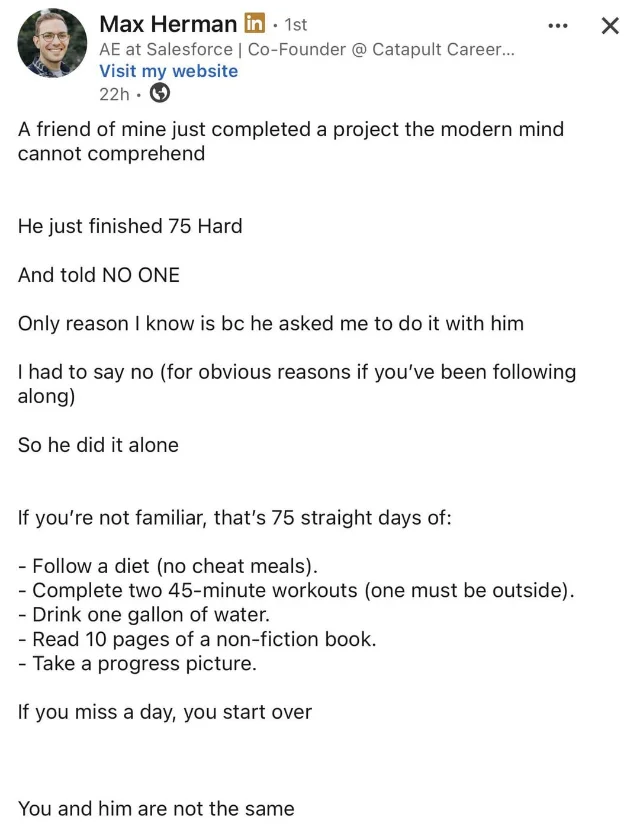
The Reddit community found the conclusion — "the modern mind cannot comprehend" / "You and him are not the same" — disproportionate to the evidence: diet, exercise, water, books. u/BoomyNote summarized it as: "Exercise, drink water, eat healthily, oh and read. Yes, this guy's friend is indeed superior to all of us." u/EnnWhyCee: "10 whole pages? Hard indeed." The post generated 382 comments largely on the gap between the claim (incomprehensible achievement) and the actual activities described (basic health habits). 5
The second thread worth noting: "Not the flex he thinks it is," 480 upvotes, 99% ratio. 6 The LinkedIn post in question came from a YC founder who tagged an Oura ring screenshot — Oura is a wearable sleep tracker — showing a sleep score of 42 and 3 hours 11 minutes of total sleep, then asked: "ŌURA is there a founder mode setting? 3 hours should score at least an 80 when you're in the zone and coding all night."
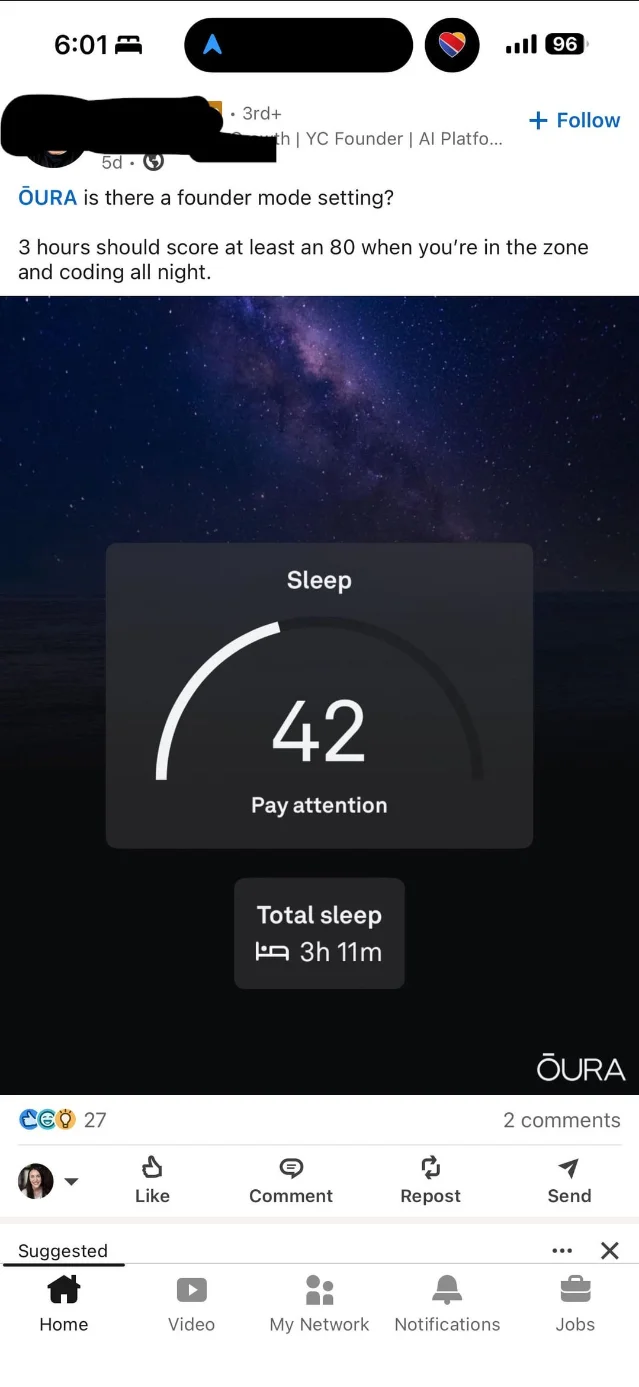
Reddit's response to "founder mode" as a concept was uniformly skeptical. u/petrichor83: "If a founder is talking about how they're in 'founder mode,' that's another way of saying they're not having success." u/OmgIbrokesmthagain went further, explaining that the brain clears toxic metabolites during sleep and consolidates memory, and that consistently running on 3–5 hours represents a long-term deterioration in cognitive function. u/Lamechocolate: "'founder mode setting' what a cornball." 6
The "founder mode" post is the "quietly building" template applied to sleep deprivation. It does the same structural work: the absence of something (sleep) becomes a credential. The person wasn't resting — they were building. That "building" is the moral category and sleep is the thing you sacrifice to access it. The template, in its most compressed form, frames any deprivation as an integrity marker.
On LinkedIn itself, Jan Benedikt Mundorf posted a "CEO of LinkedIn" manifesto calling to kill the "humble-brag disguised as a 'lesson,'" proposing a no-buzzwords filter and a real-conversation feed. 7 He got 66 likes and 18 comments — and closed with a newsletter call to action. The post ends: "Being direct, useful, and yourself puts you ahead of 90% of the feed." It is a direct, useful post about being direct and useful, and it has a product pitch at the end. The self-awareness is real. The template still fires.
What sincere looks like
Asrat Alemu's Méda Foundation post was the week's most-engaged at 431 likes. It's a good test case because the cause is genuine and the post isn't purely hollow — it has real details, a real dollar figure, a real board. The humble-brag mechanics are still there, but they're operating on top of actual substance. Which makes it a better candidate for a sincere rewrite than a post that's entirely template.
The original:
"Today I'm launching something I've been quietly building in my free time: The Méda Foundation. Méda means 'open field' in Amharic — what we fund and what every kid deserves... On my ride from SFO to Stanford, the taxi passed by a small stadium. I asked the driver which pro team played there. He said it was a high school."
A direct version:
I'm launching The Méda Foundation today — a 501(c)(3) I've been building since last year to fund youth sports in Africa. Méda means "open field" in Amharic.The first grant went to an Ethiopian soccer program: equipment and field time for 80 boys, then a head coach and computers for 25 girls. We raised $7,600 from family and friends. Admin overhead is running at 2–3%.The board includes Haile Gebrselassie as an advisor, the former CAF COO, and a Stanford associate professor of education. We need more advisors with youth sports development backgrounds — if that's you or someone you know, I'd like to talk.
What changes:
- "Quietly building in my free time" is gone. The timeline — "I've been building since last year" — replaces the character signal with a fact.
- The story of the taxi and the high school stadium is dropped. It's a good story. It's also doing the work of making the founder feel like someone who came from somewhere and noticed something others wouldn't. The cause doesn't need that backstory to be worth funding.
- The ask is specific. "We need more advisors with youth sports development backgrounds" is an actual request that an actual reader can fulfill. "What every kid deserves" is not.
- The financial disclosure leads. $7,600 raised, 2–3% overhead, grant breakdown by program. These are the numbers that matter to anyone considering donating or partnering. They're in the post — buried. The sincere version surfaces them immediately.
The direct version would probably receive fewer likes. The taxi story and the "open field" etymology are doing engagement work that the transparent numbers don't. But someone who wants to fund the foundation, join the board, or connect a youth sports program gets more out of the sincere version in less time.
One-sentence framework for nonprofit launch posts: state the structure (entity type, mission, geography), give the proof of work (first grant, dollar amount, overhead), and make the request specific. The credentialing backstory is optional; the specific ask is not.
Cover: AI-generated for this column. Posts sourced from public LinkedIn and Reddit, June 1–8, 2026.
References
- 1LIAM DARMODY: Proud, humbled, and honored to announce my retirement
- 2Dima Abu-Khaled: I almost didn't apply for the role that changed my career
- 3Asrat Alemu: Today I'm launching something I've been quietly building in my free time: The Méda Foundation
- 4Cruz Corral: I'm humbled to announce that I have not been invited to Cannes Lions this year
- 5r/LinkedInLunatics: My friend is better than you
- 6r/LinkedInLunatics: Not the flex he thinks it is
- 7Jan Benedikt Mundorf: If I was CEO of LinkedIn, here's what I'd change immediately
Add more perspectives or context around this Post.