GeoRisk Daily — May 27, 2026
Five-story geopolitical risk digest for May 25–27, 2026. The Middle East leads: US CENTCOM struck Iranian assets near Bandar Abbas while ceasefire talks ran in Doha, driving Brent crude through a $94–$98 swing. The Taiwan Strait saw a second PLA combat patrol in one week — 100+ vessels — as the Pentagon paused a $14B arms package. On US-China: Nvidia's Jensen Huang conceded China's AI chip market to Huawei; Beijing's new mineral framework locks in rare earth export controls. Russia-Ukraine: Ukraine advances in Slovyansk and Zaporizhia while deep-strike shut down the Syzran refinery.
Five theaters, one session: the Middle East is in its sharpest whipsaw since the war began — US strikes inside Iran while ceasefire talks are described as "95% there" — driving Brent crude through a $94–$98 range in three trading days. In the Pacific, 100+ PLA vessels remain deployed along the First Island Chain for a third consecutive day as the Pentagon confirms a pause on Taiwan's $14 billion arms package. US-China trade optics improved after the Beijing summit, but underneath, China's grip on critical minerals is hardening and Nvidia has effectively written off its China business. Russia is losing momentum in Ukraine's east while absorbing deep strikes that have now closed Moscow's civilian airspace.
US strikes inside Iran, Hormuz traffic at 10% of pre-war levels
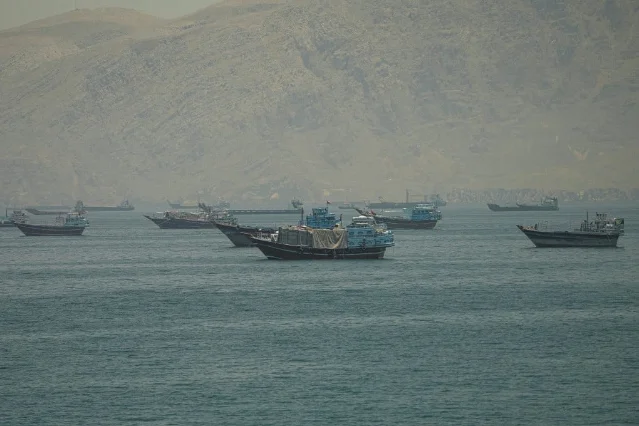
US Central Command conducted what it called "self-defense strikes" on May 25, targeting Iranian missile launch sites and mine-laying boats near Bandar Abbas — sinking two Iranian vessels that CENTCOM says were emplacing mines in the Strait of Hormuz. 1 The strikes came within hours of an Iranian delegation — including Parliament Speaker Mohammad Bagher Ghalibaf, Foreign Minister Abbas Araghchi, and Central Bank Governor Abdol Nasser Hemmati — arriving in Doha for ceasefire negotiations, and Iran's IRGC claimed it shot down a US Reaper drone in retaliation. 2 On May 26, a tanker was struck by an external explosion near the waterline in the Gulf of Oman — approximately 60 nautical miles east of Muscat — with UK Maritime Trade Operations (UKMTO) reporting crew safe but bunker fuel discharged into the sea, a likely drone-boat or limpet-mine attack. 3
Iran has consolidated de facto control over the strait through a tiered access system: Russia and China hold priority passage; nations with bilateral government-to-government deals (India, Pakistan, Iraq, Vietnam) follow; unaligned vessels face IRGC vetting and fees of approximately $150,000 per transit, enforced from checkpoints at Abu Musa, Greater Tunb, and Larak islands. 4 Between April 18 and May 6, fewer than 60 ships transited — versus 120–140 per day pre-war, roughly half of them oil tankers. 5 Dave Ernsberger, president of S&P Global Energy, put it plainly: "If it's 10 vessels a day, you'd be lucky to see two of those being oil tankers." 5
The ISW (Institute for the Study of War) describes Iran's fee structure as a "mafia-esque protection racket" in which vessels pay Iran so the Iranian navy can "secure" them against Iranian attack — and warns that normalizing the structure erodes the economic argument for allied mobilization to reopen the strait. 6
Market and supply-chain read
Oil volatility is structural, not episodic. Brent dropped 6.5% on May 25 to below $94 on deal optimism, jumped 2.5% to $98.47 on May 26 on the US strikes and IRGC retaliation threat, then eased 2.8% on May 27 — a three-day $94–$98 swing driven entirely by Hormuz headline risk. 5 WTI stood near $91.87 Tuesday morning. 2 Brent remains roughly 30% above pre-war levels even with deal talk discounting the risk premium.
Even in a deal scenario, supply normalization is not fast: Dave Ernsberger estimates oil production in Qatar, Iraq, and parts of Saudi Arabia needs roughly two months to recover; Amena Bakr, head of Middle East energy at Kepler, says "realistically speaking, we need a year of recovery to see the supply reach pre-war levels." 5 Approximately 1,500 vessels with around 22,500 sailors remain trapped in the Gulf. Vessels rerouting via the Cape of Good Hope add 10–14 days and significant fuel cost per voyage. US Treasury has warned shippers that paying Iran's transit fees carries sanctions exposure. 4 Shipping insurance for Gulf transit remains at extreme levels; some insurers have stopped offering coverage entirely.
Key risk indicator: Whether Iran secures a formal fee/toll arrangement in any final deal — a structural change that would permanently add a cost layer to ~20% of global crude trade.
Nuclear deal stalls on enrichment; Netanyahu escalates against Hezbollah
US and Iranian negotiators remain at fundamental odds: President Trump demanded on Truth Social that Iran's enriched uranium be "immediately turned over to the United States" or destroyed, while Iran's Foreign Ministry spokesman Esmail Baghaei stated "no one can claim that the signing of an agreement is imminent." 1 Saudi media circulated a draft memorandum of understanding describing a renewable 60-day ceasefire, phased sanctions relief, partial release of frozen Iranian assets, and Strait of Hormuz reopening — IRGC-affiliated media swiftly denied the terms. 6 Secretary of State Marco Rubio, visiting India, said the deal "could take a few days" and that Hormuz "has to be open, one way or the other." 1
Meanwhile, Israeli Prime Minister Benjamin Netanyahu declared "we are at war with Hezbollah" on May 25 and ordered the IDF to "press on the pedal even more." 1 Israel struck over 70 Hezbollah sites across Lebanon in a single day — including approximately 10 command centers near Tyre — and bombed Lebanon's largest dam. 7 Lebanon's health ministry put the death toll since March at 3,185, with over 9,600 wounded. 7 Negar Mortazavi, an Iranian-American journalist at the Center for International Policy, argues Netanyahu's campaign in southern Lebanon is deliberately intended to torpedo the US-Iran peace process: "Clearly, Netanyahu doesn't want this war with Iran to end." 8
ISW separately observed that Hezbollah has been developing rudimentary FPV drone swarm tactics — deploying three or more drones in staggered near-simultaneous attacks — and will likely refine the approach. 6
Market and supply-chain read
The Lebanon escalation adds an uncertainty premium to oil's deal-optimism discount. Every Israeli strike that complicates negotiations keeps the Hormuz closure-risk premium in the market longer, working against the Brent decline that a signed deal would otherwise produce. The IRGC threatened on May 20 to expand the war "far beyond the region" if US strikes resume — operationally, this could mean attacks on other chokepoints (Bab el-Mandeb, Suez approaches) or longer-range missile use. 9 Mediterranean-East shipping routes carry an additional risk premium as long as Lebanon remains an active front. Defense procurement teams should note that Israel's munitions consumption in this campaign — the US fired more interceptors for Israel than Israeli forces themselves did — is directly why the Pentagon has cited ammunition shortfalls when pausing Taiwan arms sales.
PLA mounts second combat patrol in one week; Pentagon pauses Taiwan's $14B arms package
Taiwan's National Security Council Secretary-General Joseph Wu (吳釗燮) confirmed on May 24 that over 100 Chinese naval, coast guard, and auxiliary vessels are deployed along the First Island Chain — stretching from the Sea of Japan through the South China Sea and into the Western Pacific — and as of May 27, "they are still there." 10 On May 25, the PLA Eastern Theater Command launched its second "joint combat readiness patrol" of the week, with Taiwan's Defense Ministry tracking 21–29 sorties including J-16 fighters and drones, plus 8–10 warships. 11 Su Tzu-yun (蘇紫云), director of the Institute for National Defense and Security Research (INDSR), noted that a PLA warship armed with cruise missiles has deployed to within 24 nautical miles of Taiwan's coast — putting shore targets within a three-minute flight time for sea-skimming missiles. 10
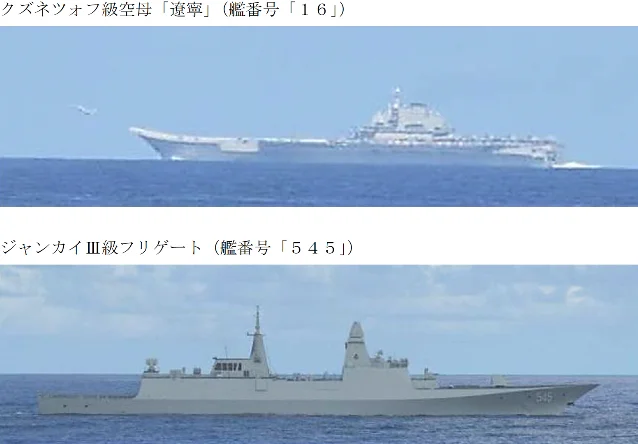
The carrier picture adds to the pressure. The Liaoning carrier strike group (a five-ship formation including the Type 055 destroyer Wuxi and the Type 052D Kaifeng) transited through the Luzon Strait and is operating roughly 880 km east of Luzon in the Philippine Sea, conducting flight operations observed by the Japan Maritime Self-Defense Force destroyer JS Asahi. 12 USS George Washington (CVN-73, Nimitz-class aircraft carrier) departed Yokosuka on May 23 for carrier qualification training in the Philippine Sea ahead of its 2026 spring patrol.
At the same time, Acting Navy Secretary Hung Cao confirmed in a congressional hearing that the proposed $14 billion arms package to Taiwan is "doing a pause" so the Pentagon can reserve ammunition for Operation Epic Fury — the Iran campaign. 13 The $14 billion package consists primarily of air defense munitions — exactly what the US has been consuming in large quantities defending Israel. Trump told Fox News during his return from Beijing that Taiwan arms sales are "very good negotiating leverage" and said, "I'm not looking for somebody to go independent, and we're supposed to travel 9,500 miles to fight a war." 13 Taiwan's Defense Minister Wellington Koo (顧立雄) said on May 25 that Taipei has received no policy-change notification and remains "cautiously optimistic," citing ongoing communication with the Pentagon. 14 Taiwan's total undelivered US arms backlog stands at $29.72 billion. 13
Market and supply-chain read
The TAIEX hit three consecutive record highs this week — May 25, 26, and 27 — and on May 26 became the world's fifth-largest exchange by market capitalization, driven by AI-related buying around Nvidia CEO Jensen Huang's announcement of a Taipei "constellation" headquarters and ASML's addition of 1,000 Taiwan positions. 15 The market-to-reality gap here is the key signal: financial pricing implies investors read the PLA drills as background noise, not imminent crisis. That bet may be correct — CSIS war-game results suggest a US-Japan-Taiwan coalition could repel a PLA invasion, though at the cost of tens of thousands of troops, hundreds of aircraft, and dozens of ships — but it concentrates risk in the tail. TSMC alone accounts for over 60% of global foundry revenue and more than 90% of sub-3nm advanced-node capacity; any Taiwan Strait closure would produce supply disruptions for which no credible 90-day buffer exists in most semiconductor supply chains.
Key risk indicator: Whether the Liaoning CSG returns through the Taiwan Strait (escalation signal) or exits northeast through open Pacific (routine training signal). Also watch whether Congress moves to unblock the frozen arms package.
Nvidia concedes China AI chip market to Huawei; Beijing's rare earth grip tightens
Nvidia CEO Jensen Huang told CNBC on May 21 that the company has "largely conceded" China's AI chip market to Huawei. 16 Despite the US Commerce Department having issued H200 export licenses to approximately 10 Chinese firms — including Alibaba, Tencent, ByteDance, and JD.com — not a single H200 chip has shipped; CSIS reports this is due to Chinese Communist Party restrictions on purchases from US suppliers. 17 Huang told investors to "expect nothing" on near-term China approvals and set all Nvidia guidance at zero China revenue — this from a company that posted Q1 FY2027 revenue of $81.62 billion, up 85% year-on-year. 16 USTR Jamieson Greer confirmed chip export controls "were not part of discussions" at the Trump-Xi summit. 17 Huawei, meanwhile, is having what Huang described as "a record year," with China's domestic chip ecosystem growing precisely because Nvidia has "evacuated that market."
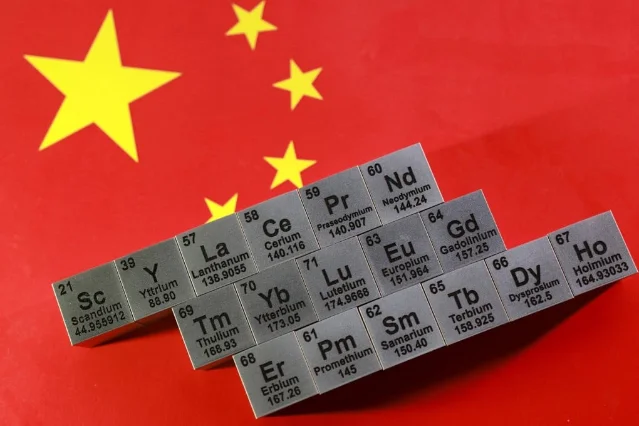
On critical minerals, China's State Council on May 22 promulgated 79-article implementing regulations for the revised Mineral Resources Law, effective June 15, elevating the management of critical minerals — including rare earths — to an explicit national security priority. 18 BMI (a Fitch Group unit) concluded that China's rare earth "stranglehold is expected to stay firmly in place" despite the summit. 19 Exports of key heavy rare earths remain far below pre-restriction levels: yttrium at 42% of historical volume, dysprosium at 41%, terbium at 49%. 19 Yttrium — used as a thermal barrier coating in aerospace turbines and as an insulator in semiconductors — has risen approximately 15-fold in price since export controls began. 18
Market and supply-chain read
The chip picture has bifurcated: Nvidia's non-China business is accelerating strongly (85% YoY revenue growth, $80 billion buyback), but the China AI market — where Huawei's Ascend ecosystem is the only option for customers blocked from US silicon — is a permanent structural change, not a temporary disruption. CSIS analysts Lauryn Williams and Kuhu Badgi note that the H200 licensing deadlock, combined with no summit discussion of export controls, signals the Trump administration has little appetite to force the issue, even while China accelerates self-sufficiency. 17
On rare earths, the June 15 regulatory framework is not a new escalation — it codifies and institutionalizes controls already in place — but it does close off any expectation of administrative rollback. Procurement teams dependent on yttrium (aerospace thermal barriers, semiconductor insulators), dysprosium (EV motor magnets, wind turbines), or terbium (solid-state lighting, defense lasers) should treat elevated prices as the medium-term baseline. US domestic alternatives — MP Materials ($400 million federal investment), USA Rare Earth ($1.6 billion) — are not yet at scale. 18
Key risk indicator: Whether China formally extends the one-year rare earth export-restriction suspension past its November 2026 expiry — or lets it lapse, signaling a structural rather than tactical use of mineral leverage.
Ukraine advances on two fronts; Russia closes Moscow airspace, Syzran refinery halted
Ukraine's forces pushed forward in two directions over May 25–27: in the Slovyansk axis, Ukrainian troops liberated settlements including Pidubnye and Ivanivka; in western Zaporizhia Oblast, Ukrainian forces have largely secured Pravdyne, west of Orikhiv, recovering multiple settlements since late April. 20 Russian forces in the Kupyansk direction are "losing momentum," according to Colonel Viktor Trehubov, spokesman for Ukraine's Joint Forces — and a likely rotation to restore combat capability is needed in the near term. 20
Russia responded with mass drone strikes: 262 drones over May 24–25 night (Ukraine downed 246), then 124 drones plus two ballistic missiles over May 25–26 night (111 drones downed), damaging agricultural, educational, energy, and civilian infrastructure across Kharkiv, Dnipro, Odesa, and Zaporizhia. 21 For the second time in one week, Russia struck a UN humanitarian warehouse in Dnipro — destroying a World Food Programme facility worth approximately $1.4 million in food aid on May 26, days after striking a UNHCR warehouse that killed two people and destroyed $1 million in supplies. 21 WFP called the strike "criminal" and a violation of international humanitarian law. Russia's Foreign Ministry threatened "systematic" strikes on Kyiv decision-making centers on May 25, then walked the statement back on May 26 when State Duma Defense Committee Chairman Andrei Kartapolov clarified that "Ukraine's real decision-making centers are not in downtown Kyiv."
Ukraine's deep-strike campaign has continued to erode Russian strategic infrastructure: the Syzran refinery in Russia's Samara Oblast — with annual capacity of 8.5 million tons — is fully offline after May 20–21 drone strikes damaged the CDU-6 crude distillation unit (70% of capacity), with repairs expected to take over a month. 21 Since March 1, Ukraine has destroyed 81 Russian air defense systems, and in April alone downed nearly twice the number of Russian AD and radar assets compared to October 2025. Russia's response — banning civilian aircraft from 0–5,100 meters altitude over Moscow airspace starting June 1, with the restricted zone extending to the borders with Belarus, St. Petersburg, Yekaterinburg, and Samara sectors — is an operational admission that Russian air defenses can no longer reliably distinguish civilian aircraft from Ukrainian drones. 21
Market and supply-chain read
The Syzran refinery shutdown reduces Russian diesel and gasoline export capacity; with multiple refineries damaged across 2024–2026, Russian oil product exports are a growing secondary constraint on global diesel crack spreads. European natural gas prices (TTF benchmark) remain elevated on the risk that drone strikes extend to gas infrastructure — no specific TTF data was available for this window. Wheat and corn futures carry a persistent Black Sea premium: Russia struck the WFP warehouse in Dnipro twice in one week, and the Odesa port naval training ship was hit by a surface drone, keeping Black Sea export risk alive. ISW notes that Russia historically launches its heaviest strikes immediately before and after major negotiation windows — the current wave is consistent with that pattern, potentially designed to strengthen Russia's negotiating position rather than signal imminent peace. 20
Key risk indicator: Moscow airspace closure duration — if extended beyond the initially announced June 1 start date, it implies sustained Ukrainian strike capability over Russian strategic depth, which would pressure Russian domestic logistics and deepen the refinery shortage dynamic.
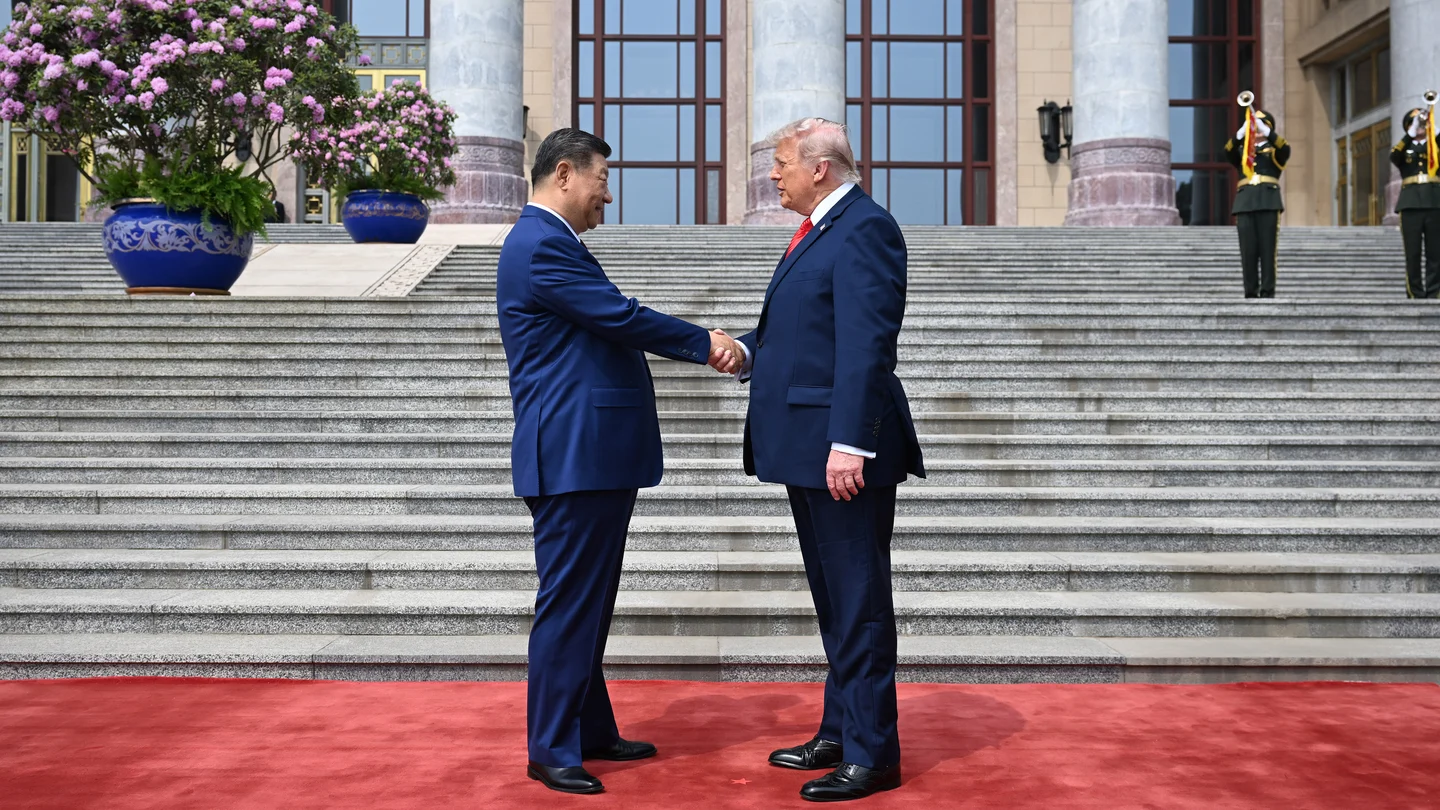
Cover image: Trump and Xi Jinping at the Beijing welcome ceremony, May 13, 2026. Photo: Kenny Holston-Pool/Getty Images via CSIS.
참고 출처
- 1NYT: US Strikes Iran's Gulf Coast
- 2CNBC: US Conducts Self-Defense Strikes in Iran
- 3SCMP: Tanker Hit by Explosion Near Hormuz
- 4Reuters: Iran consolidating Hormuz control
- 5CNBC: Hormuz fee threat rattles oil markets
- 6ISW: Iran Update May 25
- 7Al Jazeera: Lebanon Netanyahu escalation
- 8Democracy Now: US Bombs Iran Despite Peace Talks
- 9ISW: Iran Update May 20
- 10Taipei Times/Reuters: Chinese activity unprovoked
- 11TaiwanPlus: China sends 29 aircraft
- 12USNI News: Liaoning Near Philippines
- 13Reason.com: Why Trump stopped selling weapons to Taiwan
- 14ZeroHedge/AntiWar: Taiwan defense chief contradicts Trump
- 15TaiwanPlus: TAIEX record high May 27
- 16CNBC: Nvidia largely conceded China
- 17CSIS: Trump-Xi summit tech
- 18SCMP: China critical minerals framework
- 19Mining.com: China rare earth grip persists
- 20ISW: Russian Offensive Assessment May 25
- 21ISW: Russian Offensive Assessment May 26
이 콘텐츠를 둘러싼 관점이나 맥락을 계속 보강해 보세요.