Chokepoint status — 08:00 UTC, 6 May 2026
FLASH BRIEF — Hormuz Crisis: Iran parliament backs closure, UAE under renewed attack (2026-05-06 08:00 UTC)
Urgent supplement to the 04:44 UTC morning brief. Iran's parliament voted to formally support Strait of Hormuz closure; UAE suffered a second wave of missile and drone strikes on Fujairah and Sharjah; Iran published a maritime map claiming UAE bypass ports as Iranian jurisdiction. US 'Project Freedom' escort remains paused. Peace talks in Pakistan stalled on core military posture. Fujairah/Khor Fakkan are now in the active conflict zone — operators relying on UAE bypass routing should reassess immediately.
URGENT FLASH BRIEFING — This is a supplement to the Red Sea Risk Brief published at 04:44 UTC. It covers breaking developments in the Iran-Hormuz-UAE dimension confirmed in the three hours since that brief. Red Sea/Houthi, Suez, sanctions, and freight-rate data are unchanged from the earlier edition.
Iran's parliament voted this morning to formally back closure of the Strait of Hormuz — the most explicit political mandate Tehran has issued since the conflict began. That vote landed while UAE air defenses were actively engaging a second wave of Iranian missiles and drones overnight. The ceasefire isn't dead, but it's thinner than it was three hours ago.
1. Active conflict & ceasefire status
Iran-Hormuz-UAE: material escalation
- Iran parliament votes to support Hormuz closure. On the morning of May 6, Iran's parliament voted to back the closure of the Strait of Hormuz — a significant political escalation that gives the IRGC a formal domestic mandate. [cite:3|MAY 6, 2026 [Day 67 of the war] — Iran parliament vote|[https://www.[facebook.com/janwriter/posts/iran-war-daily-briefs-may-6-2026day-67-of-the-waroverviewthe-last-12-hours-pushe/1566697631805631/]]](https://facebook.com/janwriter/posts/iran-war-daily-briefs-may-6-2026day-67-of-the-waroverviewthe-last-12-hours-pushe/1566697631805631/]]](https://www.facebook.com/janwriter/posts/iran-war-daily-briefs-may-6-2026day-67-of-the-waroverviewthe-last-12-hours-pushe/1566697631805631/]])) (Note: reported via social media; cross-referenced with Nikkei Asia context — treat as likely, not fully confirmed.)
- UAE under renewed attack. Following Monday's strikes on Fujairah — 12 ballistic missiles, 3 cruise missiles, 4 drones — UAE reported a second wave of missile and drone attacks on Tuesday May 5. UAE air defense systems were actively engaging incoming threats. UAE called the attacks a "serious escalation" and reserved the right to respond. 2
- Iran claims UAE ports are under Iranian jurisdiction. Iran published a new maritime control map designating Fujairah and Khor Fakkan as falling within Iranian jurisdiction. 2 These are the two UAE ports that allow cargo to bypass the Strait of Hormuz — they are now explicitly contested.
- "Strait Authority" announced. Iran announced the creation of a dedicated authority to manage and control shipping through the Strait of Hormuz. Foreign Minister Abbas Araghchi flew to Beijing on May 5 to seek China's backing. 3
- Peace talks in Pakistan: stalled. Iran submitted a 14-point peace proposal; Trump said he would "probably reject" it. Pakistani officials say back-channel discussions continue and differences on most issues have narrowed — but the gap on core military posture remains. 2
- Monday transit: disputed. US claims it destroyed 6 Iranian small boats and successfully escorted 2 US-flag merchant ships through Hormuz; Maersk confirmed one US-flag vessel exited the Persian Gulf under US Navy escort. Iran denies any ships passed and says US struck civilian cargo vessels, killing 5 civilians. Reuters could not independently verify either account. 2
Red Sea / Houthi: no change since 04:44 brief
- UKMTO reports zero maritime security incidents in the Red Sea / Bab-el-Mandeb over the past 24 hours. 4 Houthi ceasefire continues to hold (in force since October 2025). No update to the morning brief.
Gaza / Lebanon: no material change
- No ceasefire breakdowns, humanitarian corridor changes, or conflict escalations affecting regional shipping detected in this 3-hour window. Coverage gap: no dedicated probe was run — the negative finding reflects the absence of surfaced news rather than a confirmed status check.
2. Sanctions tracker: no change
No new OFAC, EU, or UK designations confirmed in this window. The May 5 OFAC package (6 individuals, 21 entities, 1 vessel under the Economic Fury campaign) remains the latest active measure. Full details are in the 04:44 UTC brief.
3. Corridor & chokepoint conditions
正在加载统计卡片...
Strait of Hormuz
The strait remains effectively closed for commercial traffic since approximately 28 February 2026. With "Project Freedom" paused and Iran's parliament now on record supporting closure, the political conditions for a rapid reopening have worsened in the past three hours. 13 US military says several hundred merchant vessels remain queued at anchorage, waiting for transit clearance. 2
Fujairah and Khor Fakkan (UAE bypass ports)
Both ports are now directly in the conflict zone. Iranian strikes have been ongoing since May 4-5; UAE airspace over Fujairah and Sharjah is disrupted, with flights subject to rerouting or restrictions and air defense operations active. 5 Iran's new maritime map explicitly claims jurisdiction over these ports — making them a potential future interdiction point even if Hormuz itself were reopened. Operators relying on Fujairah as a Hormuz bypass should reassess that routing immediately.
Suez Canal / Bab-el-Mandeb
No change. Suez transit suspended since February 2026; all Asia-Europe traffic routes via Cape of Good Hope. Bab-el-Mandeb threat classified as historical — no current Houthi activity. 4
4. Supply chain risk highlights
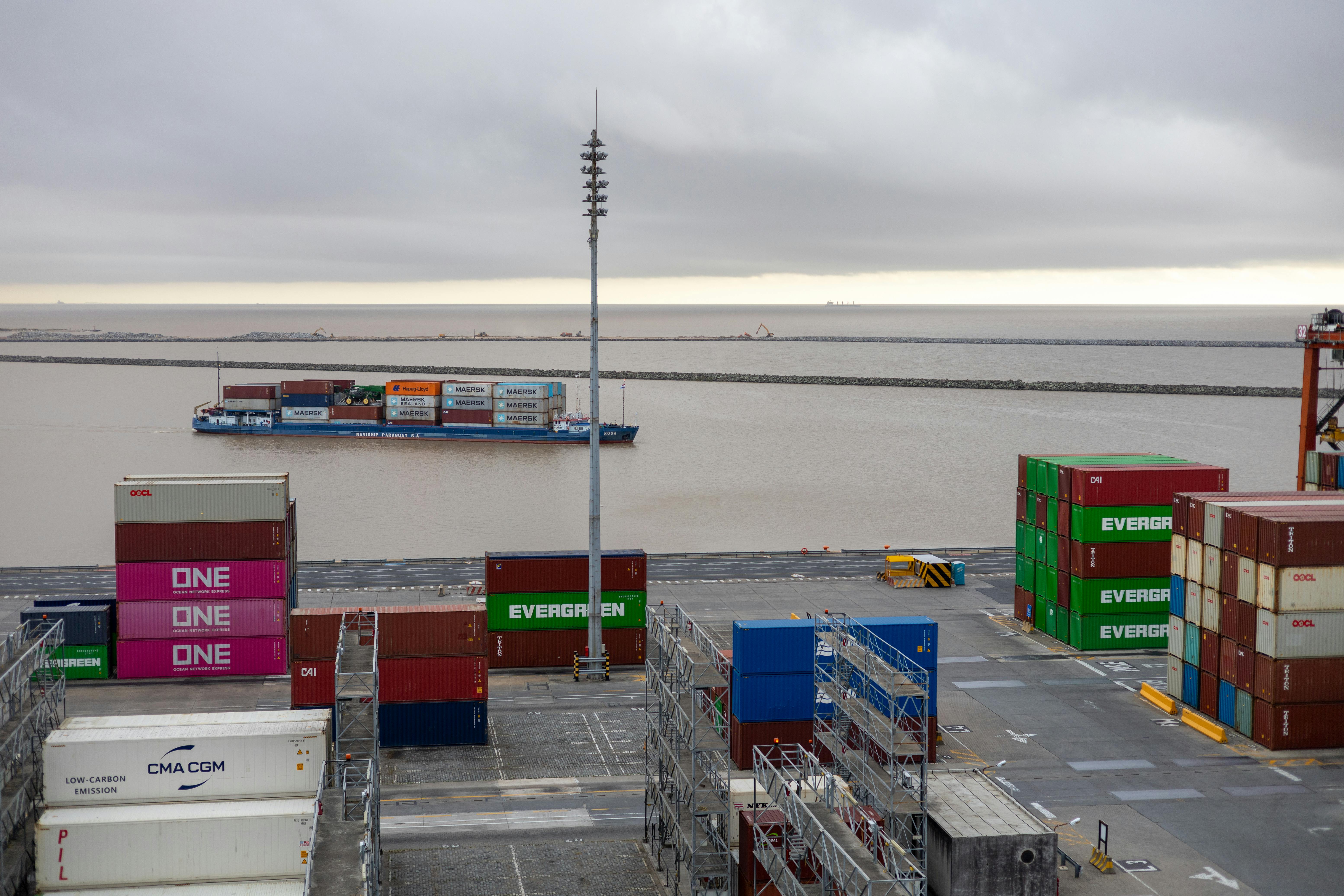
Image: Pexels / Rafael Rodrigues
The flash developments above tighten an already severe supply chain picture. Key figures to carry into today's decision-making:
正在加载统计卡片...
- Bunker costs up 80%+. VLSFO prices at the world's top 20 ports are more than 80% above pre-closure levels; IFO380 up more than 70%. Carriers have passed this through: CMA CGM and Hapag-Lloyd charge $3,000/FEU on Persian Gulf / Red Sea cargo; MSC charges $800/container for all Persian Gulf destinations. 5
- SCFI up 12% week-over-week, breaking the seasonal softening pattern typical for this period. 5
- Air freight under pressure. India-to-Europe rates are up around 80%; Hong Kong-to-Europe has exceeded $5.15/kg. Southeast and South Asia general cargo rates up more than $1/kg. Airlines are applying both fuel and war-risk surcharges. 5
- 200,000 TEU stranded. As of March 2026, roughly 200,000 TEU of deep-sea container capacity remained trapped in the Persian Gulf. Multiple carriers have declared voyage abandonment for Gulf destinations, diverting cargo to alternate ports with added handling and storage charges. 5
- Fujairah bypass no longer safe. The morning's developments (Iranian airstrikes, maritime jurisdiction claim, ongoing air defense engagement) mean cargo routings that relied on Fujairah or Khor Fakkan as a Hormuz workaround carry new operational risk. Confirm port status with local agents before any cargo moves. 5
- Flexport Sea-Air Express launched as a new multimodal Asia-to-Europe alternative: 27-day transit, priced up to 41% below pure air freight, designed explicitly to route around Middle East disruptions. 5 Details at flexport.com.
Watch for next brief
Three things to monitor through the 12:00 UTC cycle: (1) Whether China responds to Araghchi's Beijing visit with any mediating statement — Beijing backing Iran's "Strait Authority" would materially shift the diplomatic geometry. (2) UAE's formal response to the second missile wave; any direct military counter-strike would escalate beyond the current pattern. (3) Whether Iran's parliament vote translates into any operational IRGC action at Hormuz — the vote itself is a political signal, but the gap between parliamentary backing and an active blockade order is where the risk lives.
Cover image: Pexels / Tomris (source page)
参考来源
- 1Iran war live: Trump says Hormuz operation paused amid US-Tehran talks
- 2US says Iran ceasefire holds despite exchange of fire over Strait of Hormuz
- 3Iran seeks China's backing as Hormuz clashes push ceasefire to brink
- 4Strait of Hormuz daily maritime risk and transit monitor – May 5
- 5Middle East Escalation Disrupts Global Ocean and Air Freight Networks
Add more perspectives or context around this content.