science.nasa.gov
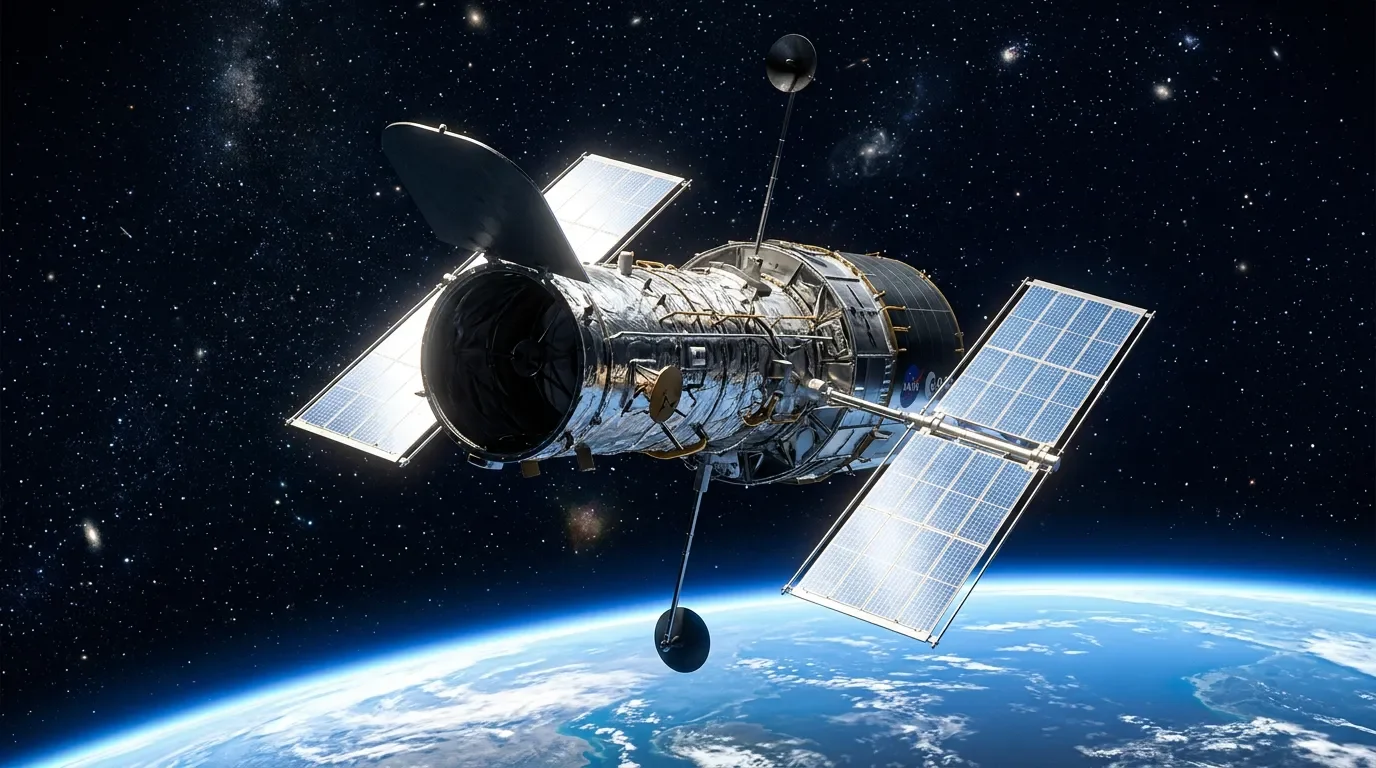
Hubble Space Telescope: engineering the most productive observatory ever built
A 5,445-word engineering teardown of the Hubble Space Telescope: from the infamous 1.3 mm null corrector misalignment that turned the most precisely ground mirror in history into a $4.7 billion first-light failure, through five Space Shuttle servicing missions and in-orbit circuit-board surgery, to the June 2024 single-gyro science mode that keeps Hubble operating today.
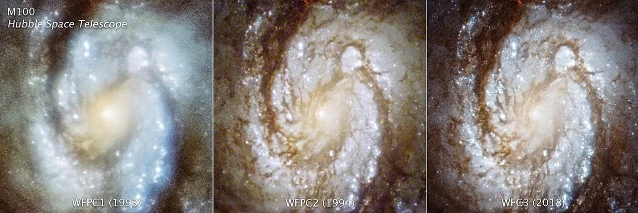
On June 27, 1990, NASA announced what should have been impossible. The most precisely manufactured optical surface in human history — Hubble's 2.4-meter primary mirror, polished to within 10 nanometers of its target shape — was blurry. Point sources spread across an arc wider than 1 arcsecond instead of the specified 0.1. The images looked like they were taken through frosted glass. 1
The mirror hadn't been made badly. It had been made perfectly — to the wrong specification.
What followed over the next three and a half decades is one of the most instructive engineering case studies in the modern era: how a single misaligned lens caused a systemic quality-assurance failure, how a modular architecture that was designed for one purpose accidentally enabled a rescue, and how five shuttle servicing missions turned a $4.7 billion embarrassment into the most scientifically productive telescope ever built. As of June 2026, Hubble is 36 years old — more than twice its original design life — and producing science in single-gyro mode that no other instrument on Earth or in orbit can replicate.
The optical design: a telescope built to be serviced
Hubble's core optical assembly is a Ritchey-Chrétien Cassegrain reflector — two hyperbolic mirrors arranged so that light from the 2.4-meter primary bounces off a 0.3-meter secondary and converges at a focal point behind the primary, producing an effective focal length of 57.6 meters at f/24. 2 The Ritchey-Chrétien geometry was chosen over classical Cassegrain designs for specific engineering reasons: the hyperbolic figure on both mirrors eliminates coma across a wide field, giving Hubble a flat, essentially coma-free image plane over its full detector array. The price is fabrication difficulty — hyperbolic mirrors are significantly harder to manufacture and verify than spherical ones, which is precisely why the null corrector became so important.
The primary mirror is made from Corning ultra-low expansion (ULE) glass, a material with a thermal expansion coefficient close to zero. This matters enormously in an environment where the telescope cycles between sunlit and shadow every 95 minutes, with temperature swings that would cause a conventional glass mirror to deform enough to ruin the optical prescription. The mirror weighs 828 kg, but it isn't solid — it uses a honeycomb sandwich construction: two 25-millimeter-thick glass faceplates bonded to a hollow lattice core. This reduces mass while maintaining the structural stiffness needed to keep the optical surface stable. 2
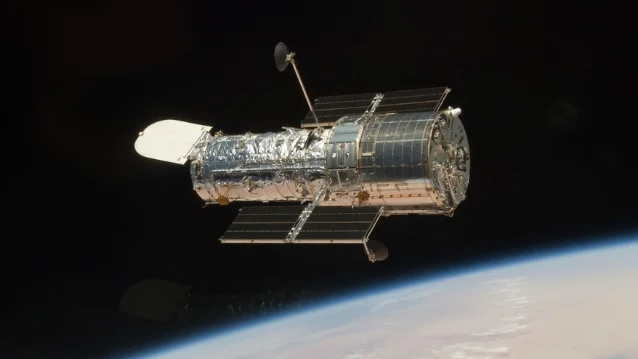
The telescope's overall envelope — 13.2 meters long, 4.2 meters in diameter, roughly the dimensions of a city bus — was constrained from the outset by the Space Shuttle cargo bay: 18.3 meters long, 4.6 meters wide. Everything downstream, from the truss frame to the instrument bay layout, traces back to that rectangle.
The instrument architecture deserves particular attention because it later enabled the rescue. Hubble carries instruments in two regions: four axial bays at the rear of the optical tube, and a radial bay positioned along the side. The axial bays receive focused light directly from the secondary mirror; the radial bay receives light via a pick-off mirror. This modular arrangement was designed to allow instruments to be swapped during shuttle servicing visits — a forward-looking decision by NASA engineers in the 1970s. The telescope was, from the start, intended to be upgraded. That decision turned out to matter more than anyone anticipated.
Hubble orbits at approximately 537–541 km altitude, at an inclination of 28.47°, completing one orbit every 95.42 minutes. 3 Its pointing stability — the ability to hold a target without drifting — is specified at 0.007 arcseconds. To put that in physical terms: if you aimed a laser pointer from New York to Boston (~350 km), 0.007 arcseconds corresponds to keeping the spot within roughly a 12-centimeter circle on arrival. This precision is achieved through a combination of Fine Guidance Sensors (interferometric sensors that lock onto guide stars), reaction wheels, and magnetic torquers that interact with Earth's magnetic field to manage angular momentum.
The aberration: how 1.3 millimeters became 2.2 micrometers
The Hubble mirror was fabricated by Perkin-Elmer Corporation in Danbury, Connecticut between 1979 and 1981. To achieve the required hyperbolic profile, the surface was continuously measured during polishing using a null corrector — an optical device that introduces a known wavefront distortion so that, when the mirror is correct, the reflected test beam appears flat (null). If the null corrector itself is wrong, the mirror gets polished to exactly the wrong shape, with no indication anything is off. That is what happened. 4
Perkin-Elmer used a reflective null corrector — a device they considered the definitive reference instrument. During setup, a small lens within the corrector was positioned 1.3 millimeters too far from its intended location. The effect propagated directly into the mirror's surface figure: the outer edge of the primary ended up 2,200 nanometers (2.2 µm) too flat relative to the correct hyperbolic shape. This is about 1/50 the width of a human hair — but 10 times the allowable tolerance. 1
The deeper failure was systemic. Three separate refractive null correctors had also been used during fabrication, and all three indicated spherical aberration — but those results were dismissed because the reflective null corrector was assumed more authoritative. The Allen Commission, formed under Jet Propulsion Laboratory director Lew Allen just five days after the flaw was announced, found that Perkin-Elmer had not assigned its best optical scientists to the project, had not involved optical designers in the construction and verification phase, and had failed to reconcile conflicting test data. 5 NASA's share of the blame was equally direct: the agency had accepted results from a single measurement instrument without independent verification. Kodak and Itek — who had bid on the mirror contract with a proposal explicitly calling for cross-checking between two companies — had their alternative approach rejected. Their process would almost certainly have caught the error.
The result: a mirror polished to 10-nanometer accuracy over its full surface, but converging light to the wrong focal point by design. Images were blurred beyond scientific usefulness for bright, compact sources, though diffuse targets like large galaxies remained partially usable.
The engineering lesson here is not simply "check your instruments twice." It is that independent cross-validation — the kind Kodak and Itek proposed — needs to be treated as a hard requirement, not a cost item, when a single measurement system is the last gate before shipping. Perkin-Elmer's reflective null corrector was found undisturbed by the Allen Commission nine years after the mirror was polished, still assembled exactly as it had been during fabrication, still 1.3 millimeters out of specification.
COSTAR and SM1: glasses for an orbital telescope
The fix required reimagining what a corrective optic could be. Since the primary mirror had been ground to a precise wrong shape — and retrieving it for repolishing was never an option — the solution was to introduce an equal and opposite wavefront error downstream of the mirror, before the light reached any instrument. For the Wide Field/Planetary Camera 2 (WFPC2), which occupied the radial bay, the solution was built directly into the camera: the relay optics inside WFPC2 were designed with the inverse of the mirror's aberration baked in.
For the four axial instruments, a different approach was needed. NASA and Ball Aerospace developed COSTAR — Corrective Optics Space Telescope Axial Replacement — a device that occupied one of the four axial bays. COSTAR contained five pairs of small corrective mirrors mounted on motorized deployable arms. Some of these mirrors were as small as a U.S. five-cent coin. Each mirror was figured with the conjugate of the primary's spherical aberration, so that light passing through COSTAR arrived at the downstream instruments in the correct wavefront. The device was approximately the size of a large telephone booth. 6
The cost of installing COSTAR was losing one science instrument — the High Speed Photometer had to be removed to make room. But the alternative was losing the telescope entirely.
Space Shuttle Endeavour launched on December 2, 1993 carrying seven crew members and a flight plan for up to seven extravehicular activities. Commander Richard Covey, pilot Ken Bowersox, and mission specialists Story Musgrave, Jeffrey Hoffman, Kathryn Thornton, Tom Akers, and Claude Nicollier then executed five EVAs on five consecutive days — a sustained orbital spacewalking campaign that had never been attempted before. Total EVA time: 35 hours 28 minutes, breaking the previous record set by STS-49 in May 1992. 7
The EVA sequence was:
- EVA 1 (Musgrave/Hoffman, 7h 54m): Two Rate Sensor Units — each containing two gyroscopes — replaced, along with two Electronic Control Units and eight fuse plugs.
- EVA 2 (Thornton/Akers, 6h 36m): Both original ESA solar arrays removed and replaced. The original arrays flexed thermally each time the telescope passed from shadow into sunlight, inducing a jitter that degraded pointing. The old array was jettisoned over the Indian Ocean.
- EVA 3 (Musgrave/Hoffman, 6h 47m): The original Wide Field/Planetary Camera removed and WFPC2 (280 kg, with built-in corrective optics) installed. Two magnetometers replaced.
- EVA 4 (Thornton/Akers, 6h 50m): The High Speed Photometer removed; COSTAR installed. A 386 co-processor was also added to the main DF-224 onboard computer.
- EVA 5 (Musgrave/Hoffman, 7h 21m): Solar array drive electronics replaced; the Goddard High Resolution Spectrograph repair kit installed.
When the first corrected images were returned — a spiral galaxy's arm resolved into individual star-forming regions, a quasar point source condensed to a pinprick — the scope of what had been recovered became clear. Not just the telescope's capability, but the credibility of the entire science program it was meant to support.
Four more missions: the engineering decisions that accumulated
SM2 (February 1997) — infrared eyes and a tape-recorder retirement
Discovery launched on February 11, 1997, with a crew including Steven Hawley, who had originally deployed Hubble on STS-31 in 1990. Five EVAs over ten days (33 hours 11 minutes total) installed two second-generation instruments. 8
STIS (Space Telescope Imaging Spectrograph) replaced both the Goddard High Resolution Spectrograph and the Faint Object Spectrograph, delivering 30 times more spectral data and 500 times more spatial coverage than its predecessors in a single observation. STIS carries three detector arrays (CCD for visible, two MAMA photon-counting detectors for UV) covering 115–1030 nm. It would later become the instrument that made the first detection of an exoplanet atmosphere.
NICMOS (Near Infrared Camera and Multi-Object Spectrometer) gave Hubble its first near-infrared capability — three 256×256 HgCdTe detector arrays covering 0.8–2.4 µm, cooled to 61 K using a 104-kg solid-nitrogen dewar. The cooling design carried a hidden flaw: a thermal short discovered during commissioning caused the nitrogen to sublimate faster than the design predicted. The dewar was exhausted in January 1999 rather than in 2001. NICMOS went dark — but not forever.
Also retired during SM2: the original reel-to-reel tape recorders, replaced by solid-state recorders with 10 times the capacity.
SM3A (December 1999) — seven months from crisis to Christmas
On November 13, 1999, a fourth gyroscope failed. Hubble needed three functioning gyros for normal pointing; it now had two. The telescope was placed in safe mode and became scientifically inert. NASA made the decision to split the planned SM3 mission into two parts and accelerate the first — SM3A had to launch before any more gyros failed.
The mission launched on December 19, 1999 — seven months after the gyro failure, a schedule that would be extraordinary for a normal hardware development cycle and was genuinely remarkable for a space mission. Discovery's crew of seven (including Michael Foale and Claude Nicollier, who had flown SM1) executed three EVAs totaling 24 hours 33 minutes. 9
All six gyroscopes were replaced — three Rate Sensor Units, each containing two gyros. The failure mechanism of the original gyros had been identified: thin metal "flex leads," wires carrying power into and data out of the spinning gyro assembly, had been assembled using pressurized air that contained trace oxygen. Over years of operation, that oxygen corroded the wire insulation. New gyros were assembled in nitrogen. The failed gyro wheel spun at a constant 19,200 rpm on gas bearings; the flex leads were the Achilles' heel of the design.
The main computer was also replaced during SM3A — the original DF-224 (1.25 MHz, a processor design from the early 1970s) was swapped for an Intel 80486-based system running at 25 MHz, 20 times faster with six times the memory. The telescope was released back to orbit on Christmas Day.
SM3B (March 2002) — the cryocooler and the power shutdown
Columbia launched on March 1, 2002, with a crew including John Grunsfeld and Michael Massimino, who would return for SM4. Five EVAs over eleven days (35 hours 55 minutes) accomplished several things simultaneously. 10
The Advanced Camera for Surveys (ACS) replaced the Faint Object Camera — the last of Hubble's original 1990 instruments to be retired. ACS cost $86 million to develop and carries three independent optical channels: a Wide Field Channel (16-megapixel, field 202×202 arcseconds, 350–1100 nm), a High Resolution Channel (optimized for UV, now permanently disabled after a 2007 electrical fault), and a Solar Blind Channel using a MAMA photon-counting detector for far-UV work. By discovery efficiency, ACS was 10 times more capable than the camera it replaced.
NICMOS was revived with a mechanical cryocooler — the NICMOS Cooling System (NCS) — developed in 14 months from contract award to installation, against a typical Hubble instrument development schedule of five to ten years. The NCS uses a Brayton-cycle turbine spinning at over 200,000 rpm (roughly 50 times the redline of a car engine) to circulate neon through NICMOS's detector array, cooling it to 77 K. This replaced the one-time solid-nitrogen dewar with a system that can theoretically run indefinitely.
SM3B also included the first complete power-down of Hubble since launch. Replacing the Power Control Unit — the central electrical distribution hub — required shutting off all systems simultaneously. The procedures developed for this were among the most elaborate ever written for an orbital servicing operation.
After SM3B, COSTAR was redundant: every instrument now had its own internal corrective optics.
SM4 (May 2009) — cancellation, reinstatement, and circuit-board surgery
On January 16, 2004, three months after the Columbia accident, NASA Administrator Sean O'Keefe cancelled SM4. His reasoning: any shuttle mission to a non-ISS orbit could not be rescued by the station if the orbiter was damaged on ascent, and Columbia had proven that damage could be catastrophic. The science community, led by Senator Barbara Mikulski, pushed back hard.
In October 2006, new Administrator Michael D. Griffin — an aerospace engineer who had worked on Hubble hardware — reversed the decision. A standby rescue shuttle, Endeavour on STS-400, was positioned on Launch Complex 39B during SM4's launch window. Atlantis lifted off on May 11, 2009.
The SM4 crew of seven — Scott Altman (commanding his second Hubble mission, also SM3B), John Grunsfeld (his fifth spaceflight), Mike Massimino, Megan McArthur, Andrew Feustel, Michael Good, and Gregory Johnson — executed five EVAs totaling 36 hours 56 minutes, the most of any Hubble servicing mission. 11
Two instruments were installed. WFC3 (Wide Field Camera 3) replaced WFPC2: a panchromatic camera covering 200–1700 nm with a UV/visible channel (two 2048×4096 CCDs, 16 megapixels, field 164×164 arcseconds) and a near-IR channel (1024×1024 HgCdTe, 800–1700 nm, field 135×127 arcseconds). The IR channel was deliberately cut off at 1700 nm rather than extending to 2500 nm like NICMOS: above 1700 nm, Hubble's own warm structure would flood the detector with thermal emission. By limiting the bandpass, the IR channel could be cooled thermoelectrically rather than with consumable cryogens — eliminating a repeat of the NICMOS dewar problem. WFC3 was 7–16 times more capable per unit observing time than the camera it replaced. 12
COS (Cosmic Origins Spectrograph) replaced COSTAR, occupying the axial bay that the correction device had held for 16 years. COS uses a single holographically ruled aspheric diffraction grating that simultaneously corrects for Hubble's primary mirror aberration — this geometric trick is built into the grating itself rather than requiring separate corrective optics. COS's far-UV channel is 30 times more sensitive than any previous UV spectrograph on Hubble. 13
The most technically demanding SM4 achievements were two instrument repairs. STIS had been inoperative since August 2004, when its Side-2 power supply failed. To reach the failed circuit board, the EVA crew — wearing bulky pressure suits with rigid gloves — had to remove 111 captive screws from an access panel. The tools required for this (a fastener capture plate, a miniature power screwdriver) were custom-developed specifically for the mission; nothing like them had existed before. After the screws came out, four circuit boards and a power supply were replaced inside the instrument chassis. Grunsfeld, monitoring from inside the shuttle, received confirmation of a successful repair. His reaction: "Congratulations, you brought STIS back to life." 14
ACS had suffered a power-supply short in January 2007 that took the Wide Field Channel and High Resolution Channel offline. SM4 restored the WFC by replacing four circuit boards and installing a new power supply through its own access panel. The HRC could not be recovered and remains permanently offline.
SM4 also replaced all six gyroscopes, all six batteries, the Fine Guidance Sensor, and the science computer, and installed thermal blanket sections and a Soft Capture and Rendezvous System — a docking ring that enables a future robotic or crewed vehicle to grab the telescope for controlled de-orbit.
The five missions together form a systematic table:
| Mission | Shuttle | Date | EVAs | EVA hours | Key additions | Key removals |
|---|---|---|---|---|---|---|
| SM1 (STS-61) | Endeavour | Dec 1993 | 5 | 35h 28m | WFPC2, COSTAR, SA2 arrays | WF/PC, HSP, SA1 arrays |
| SM2 (STS-82) | Discovery | Feb 1997 | 5 | 33h 11m | STIS, NICMOS, SSR | GHRS, FOS |
| SM3A (STS-103) | Discovery | Dec 1999 | 3 | 24h 33m | 6 new gyros, 80486 computer | DF-224, 6 old gyros |
| SM3B (STS-109) | Columbia | Mar 2002 | 5 | 35h 55m | ACS, NCS cryocooler, SA3 arrays, new PCU | FOC, SA2 arrays |
| SM4 (STS-125) | Atlantis | May 2009 | 5 | 36h 56m | WFC3, COS, STIS repair, ACS repair | WFPC2, COSTAR |
The gyroscope saga: flex leads and the path to single-gyro mode
Hubble's pointing system requires gyroscopes to measure angular rate — the rate at which the telescope is rotating about each of its three axes — so that the reaction wheels can null that rotation and hold a target. The gyros are Rate Integrating Gyros: a steel wheel spinning at exactly 19,200 rpm on gas bearings inside a fluid-damped housing. 15
The failure mechanism for the original gyros — and for the replacement batch installed in SM3A — was the flex lead. Inside each gyro housing, hair-thin metal wires (the "flex leads") carry power and telemetry through the viscous suspension fluid. These wires flex as the gimbal moves; over tens of thousands of hours, they fatigue and corrode. The original gyros had been assembled using pressurized air with residual oxygen content; after SM3A identified this as the failure cause, all replacement gyros were assembled in nitrogen. Standard flex-lead gyros had a mean runtime at failure of approximately 44,000 hours. The six SM4 gyros included three "enhanced" units with a redesigned flex-lead intended for up to five times the standard design life.
The SM4 gyros lasted well. By May 2024, the three remaining gyros — G3, G4, and G6 — had accumulated runtime hours that exceeded all expectations. G4 had logged 142,409 hours, the most of any gyroscope in Hubble's history. G6 had 89,523 hours. G3, an enhanced unit, had 71,911 hours — but it had been behaving erratically. 16
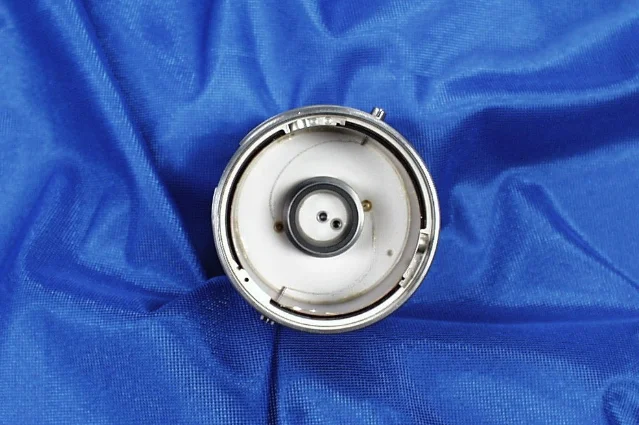
G3's degradation followed a characteristic pattern. In November 2023, it began returning anomalous rate readings and triggering "safing" events — automatic safe-mode entries that interrupt science. Between late December 2023 and late January 2024, three safing events occurred. Between April 14 and May 25, 2024, nine more safing events occurred, with G3 progressively less responsive to reset commands. The telescope entered safe mode on May 24 and stayed there. 17
On June 4, 2024, NASA Astrophysics Division Director Mark Clampin announced the permanent transition to one-gyro mode. "After completing a series of tests and carefully considering our options, we have made the decision that we will transition Hubble to operate using only one of its three remaining gyros," Clampin said. 18 Two gyros would remain: one active for pointing, one powered off as a cold spare. G3 would stay powered but only for monitoring, not used for attitude control.
Single-gyro pointing works through a hierarchy of sensors. Magnetometers and sun sensors provide coarse attitude knowledge accurate to fractions of a degree. Star trackers narrow the uncertainty to arcseconds. The single active gyro then measures residual angular rate, and the Fine Guidance Sensors lock onto guide stars to provide the sub-arcsecond stability needed for science exposures. The sequence takes longer than three-gyro operations — each slew between targets requires more settling time.
The operational impact: approximately a 12% reduction in scheduled observations per week (from roughly 85 orbits to 74), per HST Project Manager Patrick Crouse. 18 An earlier STScI study estimated overall scientific productivity falls about 25% in this mode, driven by both the scheduling reduction and the inability to track moving targets closer than Mars. Image quality is unaffected.
NASA engineering analysis gives at least a 70% probability that Hubble retains at least one working gyroscope through the mid-2030s. "We do not see Hubble as being on its last legs," Crouse said. 18
The private servicing mission that wasn't
In September 2022, NASA signed a Space Act Agreement with SpaceX to study whether a Crew Dragon mission could reboost Hubble and potentially service it. The Polaris Program — a private spaceflight initiative funded by Jared Isaacman — separately proposed a servicing visit. The SpaceX study, completed roughly a year before the June 2024 announcement, produced no public results and no recommendation for or against. 18
NASA declined to proceed. Clampin cited several concerns: contamination of Hubble's mirror from thruster plume volatiles during close approach, the risk of damaging the telescope during docking, and insufficient confidence in the technology readiness of robotic instrument exchange. "Our position right now is that, after exploring the current commercial capabilities, we are not going to pursue a reboost right now," he said. 18 NASA has not ruled out reconsidering in the future.
Science legacy: three discoveries that required Hubble's engineering precision
The deep fields: pointing stability as a scientific instrument
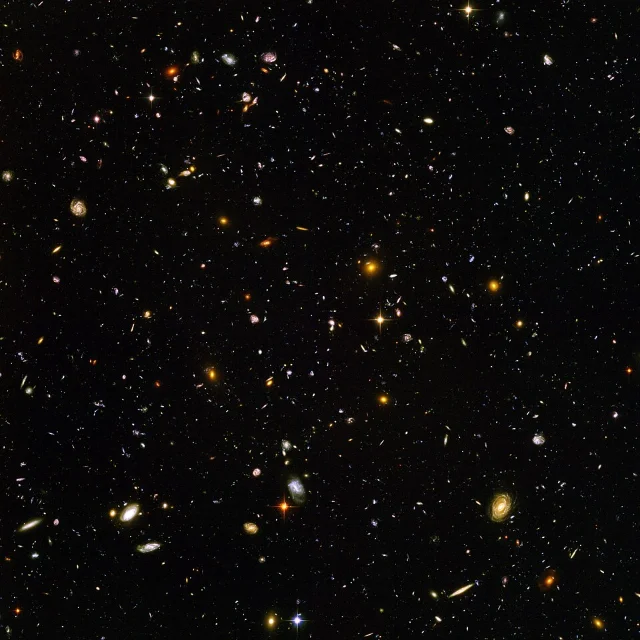
In December 1995, STScI director Robert Williams used his Director's Discretionary Time — a block of telescope access allocated to the institute director for high-risk experiments — to point Hubble at a patch of sky in Ursa Major that appeared, by all prior measurements, to contain nothing. The field was 2.6 arcminutes across: roughly 1/24,000,000 of the full sky, equivalent in angular size to a tennis ball seen from 100 meters away. The telescope stared at it for 10 consecutive days, making 342 separate exposures in four wavelength bands. 19
The result contained approximately 3,000 galaxies, some at redshifts approaching 6 — meaning their light had traveled for most of the universe's age before arriving at the mirror. The Hubble Deep Field image revealed that early-universe galaxies were irregular, disturbed, and colliding far more frequently than nearby galaxies today. It also effectively excluded the hypothesis that faint red dwarf stars could account for dark matter.
None of this was possible without the pointing stability. The drizzle image-combination technique used for the Deep Field — in which each exposure is taken with a sub-pixel offset from the previous one, allowing the final reconstructed image to exceed the detector's native resolution limit — required the telescope to maintain 0.007-arcsecond pointing across consecutive orbits. Any drift and the drizzle offsets would be corrupted. The science was a function of the engineering.
The Ultra-Deep Field (2003–04) pushed further: 800 ACS exposures plus 4.5 days of NICMOS coverage, totaling approximately one million seconds of integration, revealing ~10,000 galaxies out to redshifts of 7–12 — within 400–800 million years of the Big Bang. 20 The Extreme Deep Field (2012) combined 10 years of ACS and WFC3 data for 2 million seconds of total integration, resolving ~5,500 galaxies with the oldest visible just 450 million years after the Big Bang.
The Hubble constant tension: a 5-sigma problem that won't close
The SH0ES (Supernova H₀ for the Equation of State) project, led by Adam Riess, uses Hubble to calibrate the extragalactic distance ladder: Cepheid variable stars observed in nearby galaxies establish period-luminosity relationships; Type Ia supernovae in those same galaxies are calibrated against the Cepheids; supernovae in distant galaxies then extend the ladder to cosmological distances, yielding the Hubble constant H₀ — the current expansion rate of the universe. 21
The Hubble-based distance ladder produces H₀ = 73.50 ± 0.81 km/s/Mpc (H0DN Local Distance Network consensus, April 2026). The Planck satellite's measurement of the cosmic microwave background, fitted to the standard ΛCDM cosmological model, yields H₀ = 67.66 ± 0.42 km/s/Mpc. The two values disagree at 5σ — a level at which random chance as the explanation has probability below one in a million. 21
This measurement is only possible with Hubble because Cepheid calibration requires resolving individual pulsating stars in galaxies tens of millions of light-years away. Ground-based telescopes cannot do this — atmospheric seeing smears stars in adjacent galaxies into an unresolvable blur. Hubble's orbital photometric stability (no atmosphere, no seeing-induced brightness variations) and its ability to observe in the UV-visible where Cepheids' temperature-based pulsation signatures are sharpest are the physical reasons the measurement exists. JWST cross-validation, published in late 2024, confirmed the HST Cepheid calibration using three independent methods and returned H₀ = 72.6 ± 2.0 — consistent with the distance-ladder value and inconsistent with Planck. The tension is real.
Dark energy and exoplanet atmospheres
In 1998, two independent teams observing Type Ia supernovae at high redshift — the High-Z Supernova Search Team and the Supernova Cosmology Project — found that distant supernovae were fainter than expected: the universe was not decelerating under gravity, it was accelerating. Hubble's contribution was the ability to image the host galaxies of high-redshift supernovae with enough resolution to confirm the supernova's type (ruling out contamination by differently typed events). Ground telescopes could detect the supernovae but could not cleanly resolve the host-galaxy environment. 22 The 2011 Nobel Prize in Physics went to Perlmutter, Schmidt, and Riess for this discovery.
In 2001, Hubble's STIS made the first detection of an exoplanet atmosphere: David Charbonneau and collaborators observed sodium absorption during a transit of HD 209458b, demonstrating that the planet's atmosphere was blocking starlight at specific wavelengths. 14 This opened transit spectroscopy as a field. Hubble has since detected water vapor, hydrogen, carbon, methane, and hazes in multiple planetary atmospheres. Critically, Hubble's UV capability — particularly the hydrogen Lyman-alpha line at 121.6 nm — allows it to detect atmospheric escape: hydrogen streaming away from a hot Jupiter under stellar radiation pressure. JWST's wavelength coverage begins at 600 nm; Lyman-alpha is far outside its range. This UV channel makes Hubble irreplaceable for atmospheric-escape science until a successor UV observatory is operational — STScI estimates that window extends to at least the 2040s. 23
Cargando vista previa del enlace…
Current status and the engineering path forward
As of June 2026, Hubble carries four active instruments: ACS (Wide Field Channel and Solar Blind Channel), COS, STIS, and WFC3. NICMOS remains in hibernation; it could in principle be revived if WFC3's IR channel fails. The telescope is operating in one-gyro science mode, which it entered on June 14, 2024. Orbit altitude is 537–541 km; without a reboost, atmospheric drag will continue lowering the orbit. Current projections place atmospheric reentry in the 2030s.
The life-extension portfolio maintained by NASA and STScI is more extensive than most observers realize. Beyond one-gyro mode itself, it includes completed or in-progress initiatives across four domains: pointing and control (two-gyro science mode used 2005–2009, one-gyro mode now), science instrument management (a Side-B C&DH switchover scheduled for 2026 to restore redundancy), data management (single solid-state recorder operations, data management system side switches in 2008 and 2021), and power system (battery charge optimization, solar array slew reduction by ~50%). 24 These are not heroic rescues — they are the systematic engineering discipline of squeezing operational life from hardware that was never meant to run this long.
The cumulative cost through SM4 was approximately $11.3 billion in 2015 dollars, making Hubble NASA's most expensive science mission. 3 Hubble currently generates roughly 1,000 peer-reviewed papers per year, with about one in six observing proposals accepted — oversubscription that reflects both the telescope's unique capabilities and the absence of any replacement for its UV and visible-light performance at the angular resolution it provides.
Key technical parameters
| Parameter | Value |
|---|---|
| Primary mirror diameter | 2.4 m |
| Primary mirror mass | 828 kg |
| Mirror material | Corning ultra-low expansion (ULE) glass |
| Mirror surface figure accuracy | 10 nanometers |
| Focal ratio | f/24 (effective focal length 57.6 m) |
| Telescope design | Ritchey-Chrétien Cassegrain |
| Pointing stability | 0.007 arcseconds |
| Orbital altitude | ~537–541 km |
| Orbital inclination | 28.47° |
| Orbital period | 95.42 minutes |
| Total length | 13.2 m |
| Launch mass | 11,110 kg |
| Solar array power | 2,800 W |
| Onboard computer (post-SM3A) | Intel 80486, 25 MHz |
| Launch date | April 24, 1990 |
| Active instruments (2026) | ACS, COS, STIS, WFC3 |
| Cumulative cost (through SM4) | ~$11.3 billion (2015 USD) |
The Hubble case study is ultimately about what happens when a modular, serviceable architecture meets an organization willing to use it. The instrument-bay design that enabled COSTAR was not conceived as a contingency for catastrophic mirror error — it was conceived for routine upgrades. The null corrector failure that made COSTAR necessary was not a manufacturing accident in any straightforward sense; it was a quality-assurance process failure of the kind that modular architectures are uniquely positioned to survive.
No other telescope of Hubble's complexity has been serviced five times in orbit. No other science mission has had its central optical flaw corrected after launch and gone on to produce decades of irreplaceable results. The lesson is not that you can always fix mistakes — it is that the decision to design for serviceability, made in the 1970s before anyone knew there would be a mistake to fix, is what made fixing possible.
Cover image: AI-generated illustration of Hubble Space Telescope in low Earth orbit
Fuentes de referencia
- 1NASA: Hubble's Mirror Flaw
- 2Wikipedia: Hubble Space Telescope
- 3Wikipedia: Hubble Space Telescope
- 4ESA/Hubble: The Spherical Aberration Problem
- 5Wikipedia: Hubble Space Telescope — Origin of the problem
- 6NASA: Servicing Mission 1
- 7Wikipedia: STS-61
- 8Wikipedia: STS-82
- 9Wikipedia: STS-103
- 10Wikipedia: STS-109
- 11Wikipedia: STS-125
- 12Wikipedia: Wide Field Camera 3
- 13Wikipedia: Cosmic Origins Spectrograph
- 14Wikipedia: Space Telescope Imaging Spectrograph
- 15NASA: Operating Hubble with Only One Gyroscope
- 16STScI: HST Operations June 2024 STUC
- 17NASA: NASA to Change How It Points Hubble Space Telescope
- 18SpaceNews: Hubble goes to single-gyro operating mode
- 19Wikipedia: Hubble Deep Field
- 20Wikipedia: Hubble Ultra-Deep Field
- 21Wikipedia: Hubble's law
- 22Wikipedia: Accelerating expansion of the universe
- 23NASA: Hubble vs. Webb
- 24NASA: Hubble Life Extension Initiatives
Añade más opiniones o contexto en torno a este contenido.