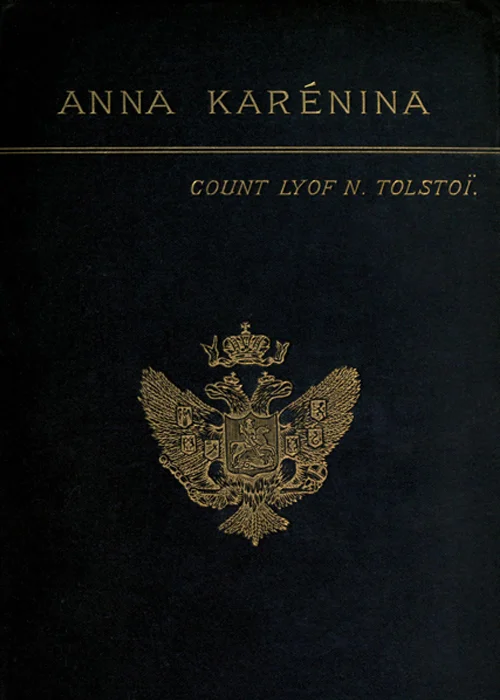
"Every unhappy family is unhappy in its own way" — Tolstoy's opening sentence, examined
Tolstoy opens Anna Karenina with a chiasmus that is also a theory of narrative: happiness is uniform, unhappiness is personal. A close read of the opening three paragraphs shows how Tolstoy announces the whole novel's method in under 200 words — moving from philosophical abstraction to a man on a leather sofa.

The most famous first sentence in the Russian novel is a philosophical claim in the guise of an aphorism. Tolstoy opens Anna Karenina (1877) with a thesis, then spends three paragraphs — and nine hundred more pages — proving only the second half of it.
The passage
Anna Karenina, Part One, Chapter 1 (trans. Constance Garnett) 1
Happy families are all alike; every unhappy family is unhappy in its own way.Everything was in confusion in the Oblonskys' house. The wife had discovered that the husband was carrying on an intrigue with a French girl, who had been a governess in their family, and she had announced to her husband that she could not go on living in the same house with him. This position of affairs had now lasted three days, and not only the husband and wife themselves, but all the members of their family and household, were painfully conscious of it. Every person in the house felt that there was no sense in their living together, and that the stray people brought together by chance in any inn had more in common with one another than they, the members of the family and household of the Oblonskys. The wife did not leave her own room, the husband had not been at home for three days. The children ran wild all over the house; the English governess quarreled with the housekeeper, and wrote to a friend asking her to look out for a new situation for her; the man-cook had walked off the day before just at dinner time; the kitchen-maid, and the coachman had given warning.Three days after the quarrel, Prince Stepan Arkadyevitch Oblonsky — Stiva, as he was called in the fashionable world — woke up at his usual hour, that is, at eight o'clock in the morning, not in his wife's bedroom, but on the leather-covered sofa in his study.
About Tolstoy and this work
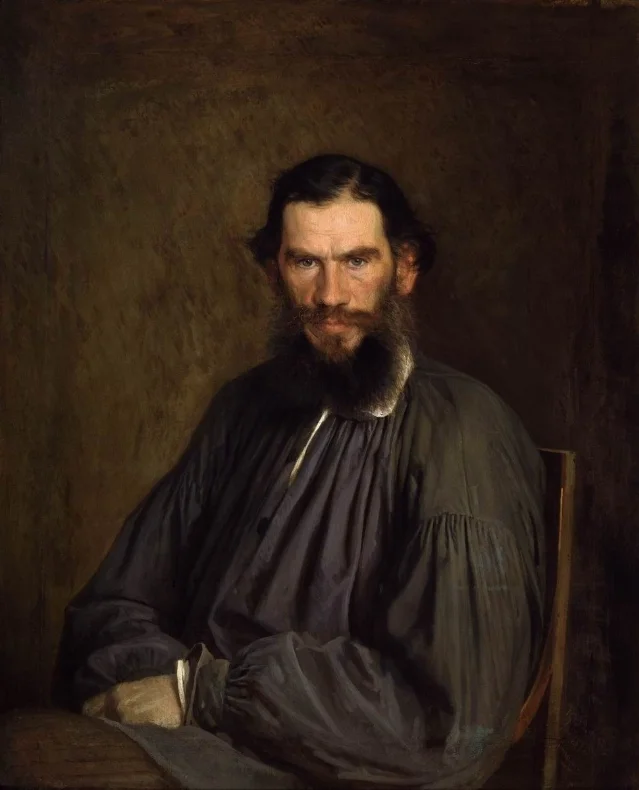
Leo Tolstoy (1828–1910) began Anna Karenina in 1873 — the same year Kramskoi sat with him for this portrait. He had spent the previous decade on War and Peace; this novel was, by his own account, his first attempt at a "true" novel: tighter in scope, closer to the social world he actually inhabited. The book ran in The Russian Messenger from 1875 to 1877, then appeared in full in 1878. 1
The translation here is by Constance Garnett (1861–1946), whose work in the 1890s and 1900s introduced the Russian novel to English readers almost singlehandedly. Her Anna Karenina appeared in 1901. Newer translators argue that Garnett irons out Tolstoy's rougher rhythms; for our purposes today, her version captures the sentence structure of the opening faithfully.
Gloss
"all alike" — Tolstoy's Russian (vse schastlivye sem'i pokhozhi drug na druga) is even blunter: "all happy families resemble one another." "Alike" flattens happiness into a single interchangeable shape. Happiness, he implies, has no individual story worth telling; it is a condition, not a character.
"in confusion" — The Russian original is vsyo smeshilos': "everything was mixed up." It carries a physical, almost visceral sense of things tumbling out of their assigned places. Tolstoy chose a word that describes disorder the way a child might: the house has been shaken and has not settled yet.
"gave warning" — A 19th-century English idiom for giving notice of resignation. The kitchen-maid and coachman are quitting. The household is disintegrating top to bottom, simultaneously, because the bond that held it — a credible marriage — has already dissolved.
Close read
The opening sentence is a chiasmus: a rhetorical figure in which the second clause inverts or mirrors the logic of the first. "Happy families are all alike" states a universal. "Every unhappy family is unhappy in its own way" takes that abstract category and breaks it back into particulars. The sentence moves from plural sameness to singular difference in a single breath — twenty words that function as a complete theory of narrative.
What makes this more than a neat epigram is what it does to the novel it opens. Tolstoy sets out to prove the second half of the sentence, not the first. We never see a happy family in Anna Karenina. We see three or four distinct shapes of unhappiness: the Oblonskys' domestic chaos, Anna and Vronsky's social exile, Kitty's humiliation, Levin's metaphysical dread. The first sentence is a thesis, and the nine hundred pages that follow are its proof — case by case, each one unrepeatable.
Notice what Tolstoy does after the philosophical preamble. He descends with startling speed into concrete, almost comic, household detail: the cook walking off at dinner time, the governess writing to a friend, the coachman giving notice. This is a deliberate gear-shift. The chiasmus operates at the level of the universal — family, happiness, unhappiness — and then Tolstoy refuses to stay there. He drops us into specific domestic wreckage, naming characters by their roles, measuring time in days, itemizing small defections. The abstract claim earns its credibility by being immediately grounded in the grotesquely particular.
The third paragraph then performs a further pivot. Prince Oblonsky receives his full aristocratic name and his intimate nickname in the same sentence: "Stiva, as he was called in the fashionable world." He wakes up on the study sofa, not in his wife's bed. The social world he inhabits is named; the piece of furniture he has been exiled to is described. Tolstoy domesticates his own chiasmus: a philosophical claim about the nature of unhappy families becomes, within three paragraphs, one man's leather sofa.
The movement — abstract → grotesquely particular → one individual's specific circumstances — is the whole novel's method, announced in miniature on its first page.
Reflection
The opening sentence claims that unhappy families are each unhappy in their own way — meaning the texture of unhappiness is specific, not generic. Think of a difficult period in a family you know, your own or someone else's. What was the particular shape of that unhappiness — the people, the habits, the silences — that made it that family's trouble and no one else's?
Añade más opiniones o contexto en torno a este contenido.