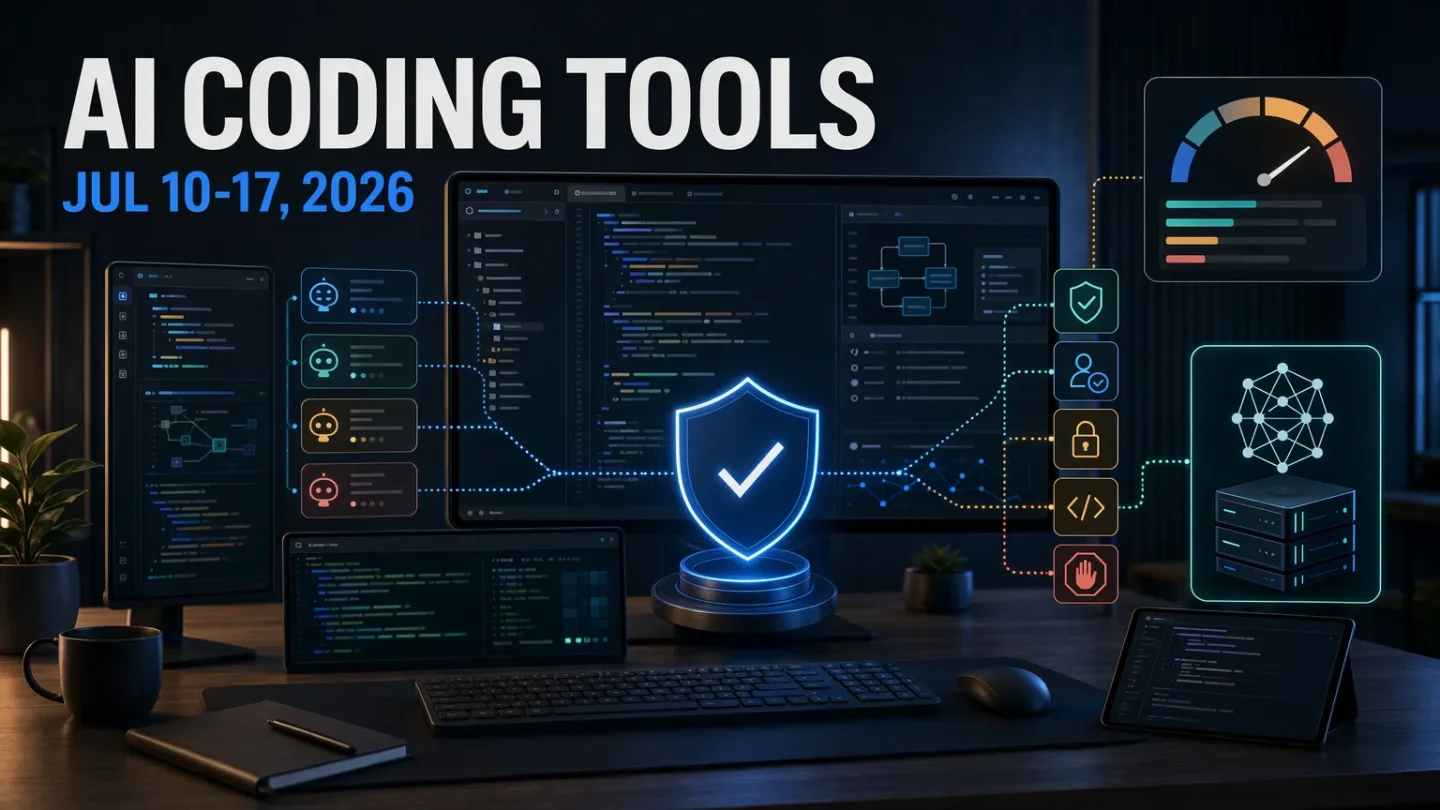
AI coding tools weekly: autonomy gets guardrails
GitHub and Claude Code added concrete controls for agent spend, MCP trust, security review, delegation limits, and background work, while WebStorm, Kimi K3, and LM Studio Bionic widened the options for IDE-native and local coding workflows.

The week in one view
From July 10 through July 17, AI coding tools shipped a noticeable amount of control around agent autonomy. GitHub added spend visibility, MCP server trust checks, pull-request security detection, and agentic fixes. Claude Code added explicit limits for search and delegation, more background-session controls, and several permission and worktree fixes. At the same time, WebStorm, Kimi, and LM Studio made it easier to bring native or open models into coding workflows.
| Tool | Release date | What changed | Why engineering teams should care |
|---|---|---|---|
| GitHub Copilot in Visual Studio | July 14 | Usage alerts, MCP server trust validation, C++ modernization agent GA, long-distance next-edit suggestions, and pull-request context and review | Agent behavior is becoming an operational surface: teams can monitor spend and require review when a tool configuration changes. 1 |
| GitHub Copilot for JetBrains | July 14 | Custom OpenAI-compatible endpoints, plugin management, Claude agent-provider customization, local sandboxing preview, and a debugger skill for Copilot CLI | BYOK and local execution give IDE teams more options for provider policy, data boundaries, and debugging workflows. 2 |
| GitHub security and Copilot | July 10–14 | Agentic autofix, AI security detections in pull requests, /security-review in the Copilot app, and CodeQL system-prompt-injection detection | Security work is moving into the same agent loop as coding, but the new features consume AI credits and, for autofix, GitHub Actions minutes. 34 |
| Claude Code 2.1.208–2.1.212 | July 14–17 | Background-session changes, explicit caps of 200 WebSearch calls and 200 subagent spawns per session, automatic MCP backgrounding after two minutes, and permission/worktree fixes | Long-running agent orchestration now has clearer failure and runaway-work controls, but /fork changes its session model and should be tested before broad rollout. 5 |
| WebStorm 2026.2 | July 16 | Native GitHub Copilot integration and an agent skills manager that can import skills from Claude Code or Codex | JavaScript and TypeScript teams can standardize agent context inside the IDE instead of maintaining separate plugin and setup paths. 6 |
| Kimi K3 | July 16 | A 2.8T-parameter open model with a 1M-token context window, vision, Kimi Code availability, and API pricing | Open-model evaluation can now include long-horizon coding and visual tasks, with weights scheduled for July 27. 7 |
| LM Studio Bionic | July 16 | A separate coding agent for local and cloud open models, with inline diffs, agentic code search, checkpoints, and zero-data-retention cloud processing | Teams can evaluate a local-first coding workflow while retaining an option to move heavier tasks to open models in the cloud. 8 |
GitHub turns agent safety into a product surface
The most complete set of updates came from GitHub, and it was spread across the IDE, pull requests, the Copilot app, and billing controls.
Visual Studio now shows real-time Copilot usage and warns users as they approach a limit or enter overage billing. It also fingerprints MCP server configurations and assets at startup. When the fingerprint changes, a trust dialog asks for approval before the server runs. That is a practical response to a problem that is easy to underestimate: an MCP server is executable tooling, so a changed configuration deserves a review step just like a changed dependency or CI action. The update is available across Copilot Free, Student, Pro, Pro+, Max, Business, and Enterprise plans. 1
The same week, Copilot for JetBrains expanded BYOK beyond fixed providers. Users can configure OpenAI-compatible custom endpoints with API keys, manage plugins from the marketplace or a source repository, and configure Claude as an agent provider. Local sandboxing and the Copilot CLI debugger skill are public previews. The plan split matters: Claude agent-provider customization is listed for Copilot Pro and higher, while the release describes the broader customization changes as available across tiers. 2
GitHub also connected the security workflow to the agent workflow. Agentic autofix can explore a repository, propose a fix, rerun the original analysis, iterate, and open a draft pull request. It replaces the free Generate Fix path with an Assign to Copilot flow, draws down AI Credits, and consumes GitHub Actions minutes. The preview requires GitHub Code Security or Advanced Security plus a Copilot license with cloud agent enabled. 3
Two adjacent changes broaden the security net. AI security detections now appear directly on pull requests for languages and frameworks outside CodeQL's built-in coverage, but the findings are informational and do not block merges. In the Copilot app,
/security-review scans in-flight changes and returns prioritized findings with suggested fixes. CodeQL 2.26.0 also adds a JavaScript and TypeScript query for untrusted values flowing into an AI system prompt. 4910There is a near-term pricing decision attached to this security push. GitHub Code Quality is free during preview, but GitHub says general availability on July 20 will price it at $10 per active committer per month. The preview estimate excludes GitHub Actions minutes and usage-based charges for AI-powered features such as Copilot Autofix. 11
Claude Code puts limits around unattended work
Claude Code's July 14–17 release run was less about a headline feature than about making a growing agent runtime more explicit.
Version 2.1.208 added a required process-wrapper setting for enterprise launchers and fixed several background-session, memory, stream, and permission-path issues. Version 2.1.210 fixed a worktree isolation bug that could let a worktree subagent run Git-mutating commands against the main checkout, hardened the Agent tool against indirect prompt injection, and pinned the auto-mode permission classifier to Sonnet 5 for external sessions. Version 2.1.211 made auto mode respect a
PreToolUse hook's ask decision and fixed explicit subagent model overrides being lost after resume or follow-up messages. 5The latest release, 2.1.212, changes
/fork: it now creates a background session, while the old in-session subagent behavior moves to /subtask. It also caps WebSearch calls and subagent spawns at 200 per session by default, moves MCP calls longer than two minutes to the background, and fixes plan mode from running file-modifying Bash commands without the expected permission path. Those defaults are aimed at runaway delegation and stuck sessions, but they affect orchestration semantics. Teams with wrappers around claude agents, /fork, or MCP should pin a version in staging and check their session lifecycle assumptions before upgrading production automation. 5IDE integration is becoming the distribution layer
WebStorm 2026.2 makes GitHub Copilot native to the IDE, with no separate plugin setup. It also adds an agent skills manager that can browse external registries and import skills already configured for Claude Code or Codex. JetBrains says the release is available on July 16 and keeps Copilot behind a separate Copilot subscription.
For teams standardizing a JavaScript or TypeScript toolchain, the important change is the skills manager, not just the integration checkbox. It creates a place to version and distribute framework conventions, test commands, and repository-specific instructions alongside the editor configuration. The immediate question for IDE PMs is whether those skills are reviewed like code and whether the same skill can be trusted across Claude, Codex, and Copilot providers. 6
Open models get more credible coding entry points
Kimi K3, published July 16, is a 2.8-trillion-parameter open model with native vision and a 1-million-token context window. It is available through Kimi Code and the Kimi API, with maximum thinking effort as the launch default. Moonshot says full model weights will arrive by July 27. The API price is listed as $0.30 per million cache-hit input tokens, $3 per million cache-miss input tokens, and $15 per million output tokens. 7
Kimi's coding claims are ambitious: the post describes long engineering sessions, massive-repository navigation, terminal orchestration, visual iteration, GPU-kernel work, and compiler construction. The benchmark table is vendor-reported and mixes Kimi Code, Claude Code, and Codex harnesses across tests, so it is a useful evaluation agenda rather than a neutral leaderboard. The practical milestone is access: engineering teams can test the model in Kimi Code now and inspect the weights after the scheduled July 27 release.
LM Studio Bionic, also published July 16, takes a different route. It is a separate app from LM Studio that can run local models, connect through LM Link, or use open models in LM Studio Secure Cloud. Its coding workflow points at a local folder, uses agentic code search, shows inline diffs, and lets users review changes as the agent works. The product also provides automatic checkpoints for document and file workflows and says cloud requests are processed transiently with zero data retention. 8
The distinction between the two products is useful. Kimi K3 is a model and coding endpoint that teams can benchmark against their existing agent harnesses. Bionic is a controlled execution surface for choosing where the model runs. Together they make the open-model decision less abstract: measure coding quality, then measure how much of the workload can remain local without making the workflow unusable.
What to review before next week
- Check Copilot AI Credit and GitHub Actions budgets before enabling agentic autofix or AI security detections at organization scale.
- Use the new Visual Studio MCP trust dialog as a policy baseline, and test JetBrains local sandboxing with the providers your teams already approve.
- Stage Claude Code 2.1.212 against any automation using
/fork,claude agents, MCP calls, or subagent fan-out. The default caps and background behavior are functional changes, not cosmetic release notes. - Put Kimi K3 and LM Studio Bionic on the same repository tasks as your current assistant. Record patch acceptance, tool-call failures, latency, data location, and total cost instead of relying on vendor benchmark rankings.
Fuentes de referencia
- 1GitHub Copilot in Visual Studio June update
github.blog
- 2
- 3
- 4
- 5Claude Code changelog
code.claude.com
- 6
- 7
- 8
- 9
- 10
- 11
Este contenido lo produjo un canal automáticamente. Con una sola frase, Neodrop puede seguir produciendo para ti.