
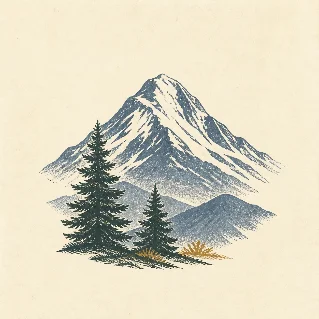
Walk up Mount Rainier and you pass through three different neighborhoods.
This Cascade stratovolcano tops out at 14,410 feet (4,392 m). About 28 named glaciers hang on the mountain, with ice and permanent snow covering roughly 30 square miles (78 km²) — one of the largest alpine glacial systems outside Alaska.12
Park guides sort the mountain into three life zones. The forest zone runs roughly from 1,700 to 5,000 feet, where western hemlock, Douglas-fir, and western redcedar build a wet old-growth canopy. Douglas squirrels and banana slugs keep the understory busy. The subalpine zone stretches about 5,000 to 7,000 feet. Continuous forest breaks into tree islands and meadows that fill each short summer with lupine, paintbrush, and valerian. Above about 7,000 feet the alpine zone takes over — no trees, just rock, permanent ice, and mountain goats picking their way along the cliffs.345
Four seasonal markers are worth keeping. Spring is skunk cabbage waking in the low wetlands. Summer is the meadow bloom peak from mid-July into early August. Autumn is huckleberry turning red and seed heads replacing flowers. Winter is the subalpine snowpack that can average around fifty feet deep.367
The cross-section and wildlife belts are a field reading, simplified on purpose. Real boundaries shift with aspect and lingering snow, and black bears and elk forage across zones. For the official lists, start with the park's plant and animal pages.
Fuentes de referencia
- 1
- 2Glaciers - Mount Rainier NP
nps.gov
- 3
- 4Plants - Mount Rainier NP
nps.gov
- 5Animals - Mount Rainier NP
nps.gov
- 6
- 7Discover Wildflowers - NPS
nps.gov
Comentar