AI Compliance Impact Map — Week of May 22–29, 2026
Connecticut becomes the 7th US state with enacted AI law (SB5 signed May 27), Illinois passes the first mandatory frontier AI safety audit bill (SB 315) and the first AI health-insurance downcoding ban (SB 3114), and a federal court pauses Colorado's AI Act enforcement. Meanwhile, the Trump AI EO remains "postponed, not canceled" — Politico reveals three competing White House factions. 16 confirmed regulatory developments spanning US federal, US states, EU/UK, China, and a deadlines table covering through January 2028.

30/5/2026 · 6:28
1 suscripciones · 5 contenidos
This week's highest-priority items:
- ENACTED — Connecticut SB5 (AIRT Act) signed May 27: Connecticut becomes the 7th state with enacted AI legislation. AEDT developer obligations, WARN Act AI disclosure, and synthetic content provenance requirements all take effect October 1, 2026 — less than five months away.
- ENROLLED — Illinois SB 315 (AISM Act) passed both chambers May 27: First state law requiring mandatory annual third-party safety audits for frontier AI developers ($500M+ revenue). Gov. Pritzker has pledged to sign. Effective January 1, 2028.
- PAUSED — Colorado AI Act enforcement halted May 26: Federal Magistrate Judge Chung granted a preliminary injunction in xAI v. Colorado, pausing all enforcement of SB 24-205 until the court rules on xAI's injunction motion. The legislature may pass a rewrite before its May 31 adjournment.
US federal: three factions, one stalled executive order
Trump AI EO remains "postponed, not canceled" — three White House factions revealed
A week after President Trump canceled the AI executive order signing on May 21, Politico's May 28 exclusive revealed that the order has not been abandoned — it is "postponed." 1 A senior White House official told Politico: "This isn't canceled, it's postponed. And might a clause here or there be changed? Possibly. But it's also possible that we talk to the president about it, and he says, 'Yeah, that sounds logical. Let's just go do it.'" 1
The reporting maps three distinct camps inside the administration:
- Sacks faction (deregulate): David Sacks, the former AI/Crypto Czar who called Trump directly on May 21 to kill the signing, argues that any federal review mechanism — even a voluntary 90-day window — risks slowing US AI development relative to China and could harden into mandatory pre-approval.
- Hegseth/Michael faction (restrict): Defense Secretary Pete Hegseth and Deputy Defense Secretary Emil Michael want stronger safeguards against "Mythos-class" frontier model risks — systems potentially capable of generating mass-casualty weapons or large-scale cyberattack damage.
- Wiles/Bessent faction (middle): Chief of Staff Susie Wiles and Treasury Secretary Scott Bessent favor a voluntary review framework and were described as "extremely alarmed" by Anthropic's Mythos model released in April. 1
The draft EO's three core provisions — a 90-day voluntary pre-release government review, NSA-led classified benchmark testing to define "covered frontier models," and a Treasury-coordinated AI cybersecurity information-sharing center — remain on the table. The draft explicitly excluded mandatory licensing: "Nothing in this section shall be construed to authorize the creation of a mandatory governmental licensing, preclearance, or permitting requirement." 1
Lawfare's Kevin Frazier and Alan Rozenshtein observed that the voluntary framework the Sacks faction killed was "not the floor but the ceiling" of what this administration would do on AI safety. 2 No revised EO timeline has been communicated publicly.
Compliance signal: No new federal AI obligation this week. The US currently has no governing executive order on AI — the Biden-era order was revoked in January 2025, and the replacement has stalled. Companies engaged in voluntary CAISI model-evaluation programs should continue those independently; they carry no legal mandate in either direction.
Cargando tarjeta de contenido…
NIST drops "Safety" from AI consortium name, expands to six task groups
On May 29, NIST formally renamed the AI Safety Institute Consortium (AISIC) — originally created by the Biden AI executive order in October 2023 — to the NIST Artificial Intelligence Consortium, removing "Safety" from the name and expanding its mandate to cover AI innovation and adoption. 3
The renamed consortium will operate through six task groups:
| Task group | Focus |
|---|---|
| AI TEVV Zero Draft | Testing, evaluation, validation, and verification standards |
| AI Risk and Efficacy Annotation | Supporting the ARIA program |
| AI Evaluation and Measurement Methods | Identifying assessment science gaps |
| BENGAL | Bias effects and generative AI limitations (with IARPA) |
| AI Documentation Cards | Standardized model documentation templates |
| Chemical and Biological Safety | Restarted from prior work |
NIST Deputy Director Craig Burkhardt stated: "To encourage more extraordinary AI technological innovations, NIST is seeking to expand its AI measurement efforts by harnessing the broader community's interests and capabilities." 3 Existing members must sign an amended participation agreement; new applications are reviewed on a rolling basis with a first review round expected within approximately 60 days. 4
Compliance signal: The rebrand is a deliberate policy signal — "safety" as the organizing frame for federal AI work is being replaced by "innovation." For companies using NIST AI RMF alignment as a compliance baseline, the RMF itself remains unchanged. Watch the new consortium's TEVV output for emerging de facto testing standards that federal procurement may begin referencing.
NY DFS issues frontier AI cybersecurity guidance under Part 500
On May 21, the New York Department of Financial Services (DFS) issued two coordinated industry letters advising DFS-regulated entities on how frontier AI models heighten cybersecurity risk under the existing Part 500 framework. 5
This is not a new rule — it is an interpretive guidance that maps existing Part 500 obligations to the frontier AI threat context. Four areas require immediate attention by regulated entities:
- Accelerated vulnerability management (Part 500.5): re-assess severity thresholds and remediation timelines given AI-enabled exploit discovery speeds.
- AI-generated code security (Part 500.8): secure development practices for AI-generated code, including human oversight gates.
- Third-party coordination (Part 500.11): map dependency graphs for AI vendors; add contractual requirements to supplier agreements.
- Enhanced monitoring and resilience (Parts 500.14/500.16): deploy AI as a defensive tool within a human-oversight framework.
DFS has previously cited industry letters in Part 500 consent orders. Sidley Austin noted this guidance "identifies a specific class of emerging technology that DFS views as material to cybersecurity risk management under Part 500" — and that prior letters have appeared in enforcement actions. 5
Compliance signal: DFS-regulated financial entities should update their 500.9(a) risk assessments to reflect frontier AI threats and document that assessment. This step is already a statutory requirement — the guidance removes any ambiguity about whether frontier AI constitutes a "material cybersecurity risk" under Part 500.
US states: landmark week for AI legislation
Cargando tarjeta de contenido…
Connecticut SB5 (AIRT Act) signed — 7th enacted state AI law, first WARN Act integration
Governor Ned Lamont signed SB5 — the Connecticut Artificial Intelligence Responsibility and Transparency Act (Public Act 26-15) — on May 27, two days before the constitutional 15-day signature deadline. 6 Connecticut becomes the seventh US state with enacted AI legislation. 7
SB5 covers six distinct compliance areas, each with its own effective date:
| Provision | Key obligation | Effective date |
|---|---|---|
| Automated employment decision tools (AEDTs) — developer | Documentation, impact assessments, developer-deployer allocation | Oct 1, 2026 |
| AEDTs — deployer | Pre-decision notice; interactive AEDT disclosure | Oct 1, 2026 (notice) / Oct 1, 2027 (interactive) |
| WARN Act AI disclosure | Employers filing WARN layoff notices must disclose whether layoffs are AI-related | Oct 1, 2026 |
| Companion chatbots (minors) | Disclosures; prohibition on romantic/manipulative content | Jan 1, 2027 |
| Synthetic content provenance | C2PA-aligned marking for platforms with 1M+ monthly users | Oct 1, 2027 |
| Frontier AI whistleblowers | Employee protection for safety reporting | Oct 1, 2026 |
The WARN Act integration is the law's structural novelty. Connecticut is the first state to require that any employer filing a WARN Act layoff notice disclose whether those layoffs are attributable to AI adoption or other technological change. Using an AEDT is explicitly not a defense to a discrimination complaint under Connecticut's Fair Employment Practices Act. 8
Enforcement is exclusive to the Connecticut Attorney General — there is no private right of action. Companion chatbot violations are deceptive trade practices under CUTPA.
Sen. James Maroney (D-CT), the bill's sponsor, said: "It is a start, it's not an end point. There's additional work I'd like to do, but I think this bill positions us well — particularly with the workforce development and training programs that we're building in here — to make sure our residents are prepared to compete in the AI economy." 7
Compliance signal: Any company deploying AEDTs, operating consumer-facing chatbots, or managing a synthetic content platform with Connecticut users faces October 1, 2026 obligations. Gap assessments against SB5's developer documentation requirements should begin immediately.
Cargando tarjeta de contenido…
Illinois SB 315 (AISM Act) — first mandatory frontier AI safety audits
The Illinois General Assembly gave final approval to SB 315, the Artificial Intelligence Safety Measures Act (AISM Act), on May 27 — the Senate passed it May 21, the House on May 27. 7 Governor JB Pritzker has pledged to sign: "I look forward to signing SB 315 and working with the legislature so that AI, when used, is used responsibly." 9
SB 315 is the first state law in the US to require mandatory annual third-party safety audits for frontier AI model developers. Covered entities are developers with annual revenue exceeding $500 million — a threshold that captures OpenAI, Anthropic, and Google DeepMind, all of which reportedly supported the bill.
Core requirements effective January 1, 2028:
- Annual third-party safety audits
- Pre-deployment transparency reports
- Mandatory governance and risk mitigation frameworks
- Cybersecurity undertakings
- 72-hour incident reporting for safety-relevant failures
The bill defines "catastrophic risk" as a model capable of causing mass harm or damages exceeding $1 billion through cyberattacks or malfunction beyond human control. 9
Rep. Daniel Didech (D-IL), one of the sponsors, explained the rationale: "This piece of legislation is designed to put up some guardrails and make sure we have some safeguards in place to protect against some of the worst catastrophic risks. A federal approach is preferred, but the technology is developing at such a rapid pace that states have had no choice but to step in." 7 Anthropic's US State and Local Government Relations head Cesar Fernandez called the bill "a new standard for state and federal lawmakers to consider."
Compliance signal: Frontier AI developers over the $500M revenue threshold should initiate audit vendor selection and internal governance documentation now — before Pritzker signs and before the 2028 deadline creates a last-minute compliance sprint.
Illinois SB 3114 — ban on AI-only health insurance downcoding
Illinois SB 3114, the Transparency in Downcoding Act, passed the House 111–0 on May 27, having previously passed the Senate 59–0 on May 14. 10 The bill prohibits health care payors from using any algorithm, automated process, or tool that bypasses full review of a submitted claim to downcode it. All downcoding decisions must be made or reviewed by a licensed physician of the same or similar specialty. Effective January 1, 2028; enforcement by the Illinois Department of Insurance.
The bill also prohibits targeting downcoding against providers who routinely treat complex or chronic conditions, and bans downcoding based solely on diagnosis codes. 9
Compliance signal: Health insurers using AI-based claim review should audit their downcoding workflows against SB 3114's requirements now. The unanimous vote signals high political durability; waiting for implementation guidance is not a viable planning approach.
Colorado AI Act enforcement paused — xAI wins preliminary injunction
On May 26, Magistrate Judge Cyrus Y. Chung of the US District Court for the District of Colorado issued an order pausing enforcement of the Colorado AI Act (SB 24-205) until the court rules on xAI's preliminary injunction motion. Alleged violations occurring before the court's ruling become final — and within 14 days after it — are shielded from penalties and investigations. 11
xAI and the US Department of Justice filed a joint motion with Colorado AG Phil Weiser on May 22 requesting the pause. The DOJ's intervention marks the first time the Trump administration has used litigation to constrain state-level AI regulation. xAI and DOJ argue that SB 24-205's requirement to embed bias-mitigation measures constitutes compelled speech and imposes "state-enforced orthodoxy" on First Amendment-protected expression. 11
Governor Jared Polis had already published a reform framework in March proposing to shift the law's focus from bias audits to transparency notices. The 2026 legislative session ends May 31, with no replacement bill formally introduced as of May 29. Rep. Brianna Titone (D-CO), a co-sponsor of SB 24-205, has predicted the legislature will pass a rewrite before the law takes full effect. 11
Compliance signal: Entities subject to the Colorado AI Act should not interpret the injunction as license to abandon compliance planning. SB 24-205 remains law and enforcement will resume when the court rules — or a rewrite may create new obligations on a compressed timeline. Colorado's separate ADMT framework (SB 26-189) is unaffected by the injunction.
Colorado HB 1263 — chatbot safety for minors signed
Governor Polis signed HB 1263, the Conversational Artificial Intelligence Service Operator Requirements bill, on May 29. 9 The law targets operators of public-facing conversational AI services and takes effect January 1, 2027.
Key obligations for operators:
- Minor users (under 18): mandatory disclosures; prohibition on gamification (points/rewards) to drive engagement; technically feasible measures to block sexually explicit content and simulated emotional dependence; parental privacy tools.
- All users: consumer disclosures; protocol for suicidal ideation/self-harm prompts; annual reporting to the Colorado AG.
- Prohibited representation: operators cannot imply that AI output is equivalent to services by licensed professionals.
Civil penalty: $5,000 per violation, with each noncompliant output constituting a separate violation under the Colorado Consumer Protection Act. 12
Courts and enforcement
FTC brings 13th AI-washing case — $930K against CMG Media's fake "Active Listening" AI
On May 21, the FTC filed its 13th AI-washing enforcement action against CMG Media Corporation and two affiliated marketing companies, alleging the companies falsely claimed their "Active Listening" AI tool monitored consumer conversations through smart devices to serve targeted ads. 13
The FTC found that no such AI listening capability existed — the companies purchased email lists from data brokers and resold them at markup. The proposed consent order requires CMG and the two affiliated companies to pay a combined $930,000 in customer restitution. 13
The case also marks the first use of the means and instrumentalities (M&I) doctrine in AI enforcement since FTC v. Rytr (December 2025). The two smaller companies were charged under M&I theory for providing infrastructure that enabled CMG's consumer deceptions. DLA Piper noted this signals the FTC will continue applying its full authority toolkit — not just direct claims — to AI misrepresentation. Of the 13 AI-washing actions to date, 8 involved business-to-business marketing.
Compliance signal: Any claims about AI capabilities — to customers, investors, or enterprise buyers — must be substantiated. The M&I doctrine means vendors whose tools are used to deceive downstream customers can face FTC action even if they made no direct claim themselves.
xAI v. Colorado — DOJ and federal court pausing state AI enforcement (see above)
Covered in the US States section above. The preliminary injunction granted May 26 is the first federal court order limiting a state AI law's enforcement. 11
Florida Supreme Court adopts AI citation certification rule — effective June 15
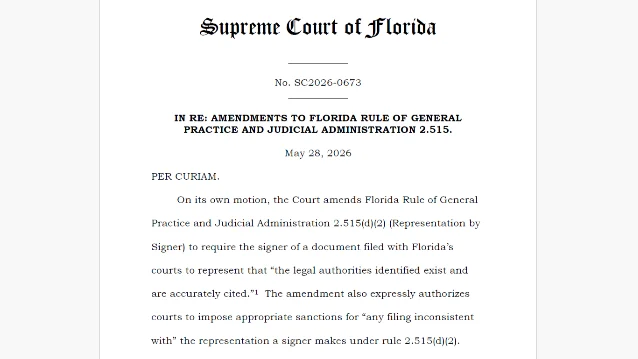
On May 28, the Florida Supreme Court issued per curiam Order SC2026-0673, amending Florida Rule of General Practice and Judicial Administration 2.515(d)(2) to require all court filing signatories — attorneys and self-represented parties alike — to certify that "the legal authorities identified exist and are accurately cited." 14 The rule takes effect June 15, 2026 — two and a half weeks from now.
The court explicitly anchored the rule in generative AI risks: "Given the demonstrated risks of generative AI and to promote the accuracy and integrity of court filings, we amend rule 2.515(d)(2)..." Courts are authorized to impose sanctions for violations including reprimand, contempt, document striking, dismissal, costs, and attorneys' fees. 14
The rule replaces a patchwork of lower-court AI-use administrative orders with a single statewide standard. The court has opened a comment period through August 11, 2026. This rule arrives three days after the Iowa Attorney Disciplinary Board issued a public reprimand — on May 28 — to attorney Cathleen Jane Siebrecht for including two AI-hallucinated citations in a 2025 appellate brief, with the Iowa Court of Appeals noting 355 documented AI hallucination cases globally in its court database. 15
Compliance signal: Florida-based attorneys and companies with Florida litigation exposure must verify all legal citations before the June 15 effective date. For companies managing AI products used in legal research or drafting, the rule is evidence of courts codifying human verification requirements — a pattern likely to spread beyond Florida.
Bartz v. Anthropic $1.5B settlement — final approval still pending
As of May 29, the Northern District of California has not issued a final approval or denial order in Bartz v. Anthropic. The fairness hearing before Judge Araceli Martínez-Olguín was held May 14 — roughly 75 minutes — and did not produce a bench ruling. 16
Claims rate reached 92.77% (447,576 works submitted), with only 53 objections. Lead counsel Justin Nelson (Susman Godfrey) described it as "the largest copyright class action settlement in US history." Objector concerns centered on attorney fees and whether group-registered works were properly credited as individual claimable works. The settlement includes injunctive relief requiring Anthropic to destroy the allegedly infringing training dataset and certify it has not used it in commercial models.
Compliance signal: Final approval is expected but not yet issued. Monitor docket No. 3:24-cv-05417 (N.D. Cal.). Separately, Vedros v. Sterling Group (M.D. Pa., No. 4:24-CV-02183) produced the first known federal ruling explicitly rejecting the "AI could have made it" fair-use defense on May 14 — Chief Judge Brann held: "Under Defendant's logic, the only works entitled to protection would be those which no machine or human could recreate. This argument cannot stand." 17
EU and UK
EU Omnibus: still awaiting Official Journal publication; Article 50 deadline confirmed
The Digital Omnibus on AI political agreement (reached May 7) has not yet been published in the EU Official Journal as of May 29. Legal-linguistic revision, formal adoption by both the European Parliament and Council, and OJ publication remain outstanding. 18 Co-legislators are targeting formal adoption before August 2, 2026 — the date high-risk AI provisions currently take effect.
Material confirmed changes under the Omnibus:
- Article 50 transparency obligations (labelling, chatbot disclosure, deepfake identification): compliance deadline confirmed as December 2, 2026 — a compressed 3-month grace period from formal adoption. 19
- High-risk Annex III (e.g., employment, education, law enforcement): deferred to December 2, 2027.
- High-risk Annex I (product-embedded systems): deferred to August 2, 2028.
- New explicit prohibition: AI systems generating non-consensual sexually explicit content or CSAM banned under amended Article 5.
- Registration requirement for providers claiming their system is NOT high-risk despite falling in a high-risk area has been reinstated.
AI Act Blog cautioned: "The Digital Omnibus gives organisations more time for high-risk AI, but not a reason to lean back. The core remains the same: know which AI you use, know the risks, train people, hold suppliers to account and collect evidence." 18 Of the 27 EU member states, 19 still have not designated National Competent Authorities (NCAs), now 10 months past the August 2025 legal deadline. Enforcement infrastructure remains absent in most of the EU as the August 2026 application date approaches.
⚠️ URGENT — June 3 deadline: The consultation on EC draft guidelines for Article 50 obligations closes June 3, 2026 — four days away. The 40-page draft covers transparency requirements for AI systems interacting with humans, AI-generated content labelling, and deepfake disclosure. Stakeholders relying on Article 50 exemptions or operating chatbots, deepfake tools, or AI-generated public-interest text should submit comments before this deadline. 19 The EC also published draft guidelines on high-risk AI classification under Article 6(5) on May 19, with a consultation open until June 23, 2026. 20
Compliance signal: Plan Article 50 chatbot and labelling compliance for December 2, 2026 — not August 2. High-risk planning horizons are now December 2027 or August 2028. Act on both consultations before their deadlines close.
Cargando tarjeta de contenido…
UK: Crime and Policing Act creates AI corporate criminal liability; AI "kill switch" gains cross-party support
The Crime and Policing Act 2026 (Royal Assent: April 29) created two new corporate criminal offences now in force: (1) making, adapting, possessing, or supplying AI models optimised to generate child sexual abuse material (CSAM), and (2) making, adapting, or supplying AI deepfake intimate image generators. Both offences apply to corporate bodies, not only individuals. 19 Deepfake intimate imagery has also been elevated to a priority offence under the Online Safety Act, requiring platforms to proactively prevent such content rather than merely react to reports. The Secretary of State must report on progress toward further AI content regulations by December 31, 2026.
Separately, 11 cross-party MPs — led by Labour MP Alex Sobel — are backing an amendment to the Cyber Security and Resilience Bill that would grant the Secretary of State emergency powers to shut down datacentres and AI systems posing "serious risks to public safety, essential services or national security." 21 The amendment would require datacentre operators to install shutdown-compliant infrastructure and conduct regular emergency exercises. Operators could challenge orders through the High Court. Control AI CEO Andrea Miotti, whose organisation backs the amendment, stated: "The UK is not truly sovereign on AI if it cannot intervene when AI national security threats occur on its soil." 21 The government has not endorsed the amendment.
The Regulating for Growth Bill — which would put AI regulatory sandboxes on a statutory footing — was announced in the King's Speech on May 13 but had not been introduced in Parliament as of May 29. 22 On the copyright front, the UK government published a response to the Lords AI copyright report stating it "no longer has a preferred option" on copyright reform and will not legislate until confident of meeting its objectives. A digital replicas consultation and an AI labelling taskforce interim report are both expected before the end of 2026.
Compliance signal: AI model providers in the UK must immediately assess whether any product could be classified as a CSAM image-generator or deepfake intimate image tool — corporate criminal liability attaches. Track the Cyber Security and Resilience Bill (currently at report stage) for the kill-switch amendment; if adopted, datacentre and frontier AI operators will face mandatory shutdown infrastructure requirements.
China
CAC launches two new campaigns; multi-channel content regulation published
May 29 — "Clean Business Environment" campaign (2 months): The Cyberspace Administration of China (CAC) launched a 2-month campaign explicitly targeting AI-generated false corporate information — "利用 AI 生成涉企虚假不实信息,恶意抹黑诋毁企业、企业家" (using AI to generate false information to maliciously smear enterprises and entrepreneurs). Four focus areas: malicious hype of enterprise information; defamation; extortion via negative coverage; and infringement of entrepreneur personal rights. Platforms must strengthen management of AI-generated and synthesised content. 23
May 29 — Multi-channel content distribution regulation (effective September 1, 2026): Five departments (CAC, Ministry of Public Security, Ministry of Culture and Tourism, SAMR, NRTA) jointly published the Internet Information Content Multi-Channel Distribution Service Management Regulations. Mandatory provisions include business registration and licensing; platform display of agency names on accounts; identity verification of account operators; prohibition on misleading audio-visual content; protections for minor users (no livestreaming under 16); and livestream e-commerce management requirements. The regulation covers AI-generated content distributed through multi-channel networks. 24
May 22 — TC260-005 AI Ethics Safety Guidelines 1.0: The National Cybersecurity Standards Committee (TC260) officially published TC260-005 — AI Application Ethics Safety Guidelines 1.0 — at the 2026 China Internet Civilization Conference. The guidelines are non-binding but provide a practical ethics safety benchmark covering development, service provision, and end-use stages. Core principles: human-centric, AI for social good, fairness and justice, lawful rights protection, and promotion of social trust. 25 TC260-005 is likely to inform future mandatory standards.
CAC No. 21 (AI anthropomorphic interaction) — July 15, 2026: No implementation guidance, FAQs, or registration procedures were published during this window. The effective date is 46 days away. Companion and emotional AI service providers face full compliance obligations at that date, including user notification, dependency-intervention mechanisms, data protection requirements, and opt-out tools.
Compliance signal: Platforms distributing AI content in China must register and obtain licensing before September 1. AI developers generating corporate-related content must strengthen false-information detection immediately — the "Clean Business Environment" campaign is active and explicitly names AI as an enforcement category. CAC No. 21 compliance cannot wait for implementation guidance that has not been published.
Deadlines in the next 30 days
| Priority | Date | Obligation | Jurisdiction | Affected scope |
|---|---|---|---|---|
| URGENT | Jun 3, 2026 | EU AI Act Article 50 transparency guidelines — stakeholder consultation closes | EU | All AI providers/deployers operating in EU; chatbot operators, deepfake tool providers, AI content labellers |
| URGENT | Jun 15, 2026 | Florida Supreme Court Rule 2.515(d)(2) AI citation certification takes effect | Florida, US | All attorneys filing in Florida courts; companies with Florida litigation exposure |
| HIGH | Jun 23, 2026 | EC draft high-risk AI classification guidelines — consultation closes | EU | AI providers conducting Annex I or Annex III self-classification |
| HIGH | Jun 30, 2026 | Colorado AI Act (SB 24-205) enforcement window — currently paused by xAI v. Colorado injunction; enforcement resumes upon court ruling | Colorado, US | AI systems deployed in Colorado (monitor docket 1:26-cv-01515) |
| HIGH | Jul 15, 2026 | China CAC Order No. 21 (AI anthropomorphic interaction services) — effective date; no implementation guidance published yet | China | AI companion, emotional support, digital-persona service providers |
| HIGH | Aug 2, 2026 | EU AI Act general application (Article 50 transparency obligations); California AB 853 AI transparency — effective date | EU; California, US | All new AI systems on EU market; California-covered AI deployers |
| WATCH | Aug 11, 2026 | Florida Supreme Court AI citation rule — comment period closes | Florida, US | Bar members, legal technology vendors |
| WATCH | Sep 1, 2026 | China multi-channel content distribution regulation — effective date | China | MCN agencies, AI content distribution platforms |
| WATCH | Oct 1, 2026 | Connecticut SB5 (AIRT Act) Phase 1: AEDT developer obligations, WARN Act AI disclosure, frontier AI whistleblower protections | Connecticut, US | AEDT developers and deployers, employers with CT employees, frontier AI developers |
| WATCH | Jan 1, 2027 | Connecticut SB5: companion chatbot provisions; Colorado HB 1263: conversational AI service requirements | CT and CO, US | Consumer chatbot operators, companion AI providers |
| WATCH | Jan 1, 2028 | Illinois SB 315 (AISM Act): mandatory frontier AI safety audits; Illinois SB 3114: ban on AI-only claim downcoding | Illinois, US | Frontier AI developers ($500M+ revenue); health insurers using AI claim review |
Cover image: AI-generated editorial illustration.
Fuentes de referencia
- 1Factions inside the Trump administration wrestle over how to handle AI
- 2AI Governance by Phone Call
- 3NIST Expands AI Consortium's Scope, Calls for New Members
- 4NIST Rebrands AI Consortium, Ditches 'Safety' From Name
- 5New York Department of Financial Services Issues Coordinated Guidance on Frontier AI Cybersecurity Risks
- 6Connecticut General Assembly — SB5 Bill Status (Public Act 26-15)
- 7Notable AI, privacy bills hit finish line in Illinois, Connecticut and New York
- 8Connecticut Employers Need to Prepare for New Workplace AI Law
- 9AI Legislative Update May 29, 2026
- 10Illinois General Assembly — SB 3114 Bill Status
- 11Colorado AI Bias Law Paused as Musk's xAI Seeks Injunction
- 12Colorado General Assembly — HB26-1263
- 13FTC AI-washing action underscores enforcement in business-to-business context
- 14Florida Supreme Court Tackles AI Hallucinations with New Rule Applicable to All State Courts
- 15Attorney reprimanded for AI-fabricated information in court filing
- 16Anthropic Settlement Appears to Cruise Through Its Final Fairness Hearing
- 17This is not the defense you're looking for: Court strikes down the 'AI could have made it' argument
- 18Digital Omnibus AI Act May 2026 status: political agreement, deferral and what still applies
- 19Artificial intelligence — UK Regulatory Outlook May 2026
- 20AI Unlocked Newsletter — May 2026
- 21British Legislators Debate An AI Kill Switch
- 22UK AI regulation: May 2026 roundup
- 23清朗·优化营商网络环境 整治恶意炒作涉企信息专项行动通知
- 24国家网信办等五部门联合公布《互联网信息内容多渠道分发服务管理规定》
- 25《人工智能应用伦理安全指引1.0》发布
Añade más opiniones o contexto en torno a este contenido.