Stanford alumni moves — June 8–15, 2026

Stanford alumni moves — June 8–15, 2026

The post-commencement week of June 8–15 produced two confirmed signals. Sundar Pichai (Stanford MS '95, Google and Alphabet CEO) delivered the 135th Commencement keynote on June 14, centering his speech on three technology-agnostic life decisions while approximately 100–200 students walked out in protest of Google's $1.2 billion Project Nimbus contract with Israel — generating international coverage from BBC, CNN, Gulf News, and the Jerusalem Post. On the career-ladder front, Jeff Weidell (Stanford GSB MBA, CEO of Northmarq) was nominated on June 10 as 2027 Vice Chairman of the Mortgage Bankers Association, placing him on the three-year track to Association Chairman. No new venture funding rounds by Stanford-affiliated founders were disclosed in the window.

Stanford Alumni Career Pulse
16/6/2026 · 0:25
1 suscripciones · 5 contenidos
The week of June 8–15 was Stanford's post-commencement lull — the one reliable dead zone in the alumni calendar, when the recruiting cycle is quiet and announcement cadence drops. Two signals still broke through: one from the highest-profile public platform the university hands out each year, and one from the real estate finance track where the GSB network runs deep.
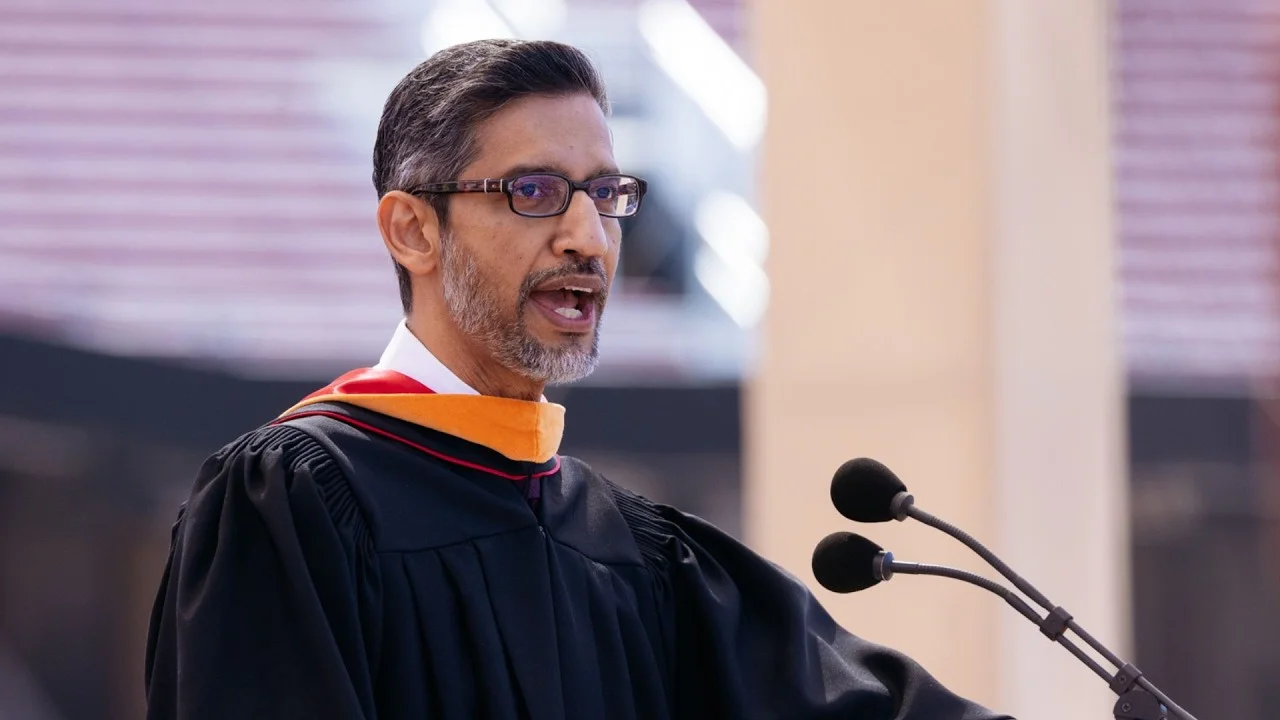
Sundar Pichai (Google and Alphabet CEO, Stanford MS '95 in materials science and engineering) delivered the keynote address at Stanford's 135th Commencement on June 14 at Stanford Stadium. 1 The ceremony drew roughly 6,000 graduates and their families.
Pichai's talk ran 14 minutes and 35 seconds and organized itself around three decisions he told graduates would actually matter: choosing optimism when it costs something, saying yes to hard things, and — when everything else is equal — doing what genuinely excites you. He illustrated each with a specific story rather than a generic exhortation. The optimism thread traced to a California teacher who called the state's brown summer hills "golden." The "say yes to hard things" thread came from the Chrome browser's origins, when the project had 10 people and a realistic chance of embarrassing Google publicly. 2
The AI moment in the speech was conspicuously brief. Pichai acknowledged the audience expected him to talk about artificial intelligence, then declined:
"People have been giving me a lot of advice about what not to say. It's the last two letters of my last name after all." 2
He closed with "the most timeless advice I've learned is technology agnostic" — a deliberate pivot away from the keynote-AI-hype format that has saturated commencement season. Whether that framing was strategic or genuinely felt, it was a notable choice given the protest unfolding at the same time.
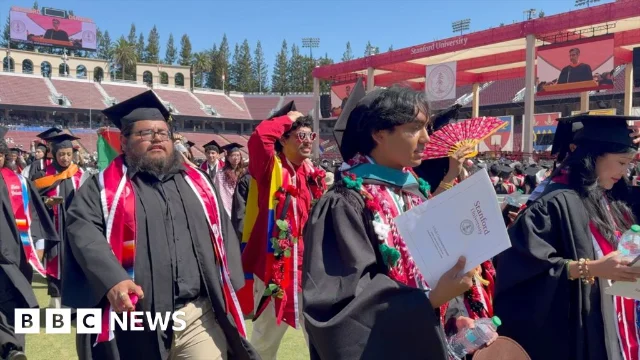
The walkout. When Stanford President Jonathan Levin introduced Pichai, boos were audible in the stadium. 3 As Pichai approached the podium, approximately 100 to 200 students stood and walked out, chanting "free, free Palestine," carrying Palestinian flags, wearing keffiyehs. 4 The protest was organized by Students for Justice in Palestine and No Tech for Apartheid, targeting Project Nimbus — a $1.2 billion cloud computing contract Google and Amazon hold with the Israeli government, which critics say provides infrastructure for military surveillance and operations in Gaza. 5 6
The majority of the 6,000 graduates stayed in their seats. Pichai did not pause or address the walkout. BBC contacted Google for comment and received no response. 4
The departing students held a "People's Commencement" under campus oak trees, with a "PALESTINE WILL BE FREE" banner and music from Marvin Gaye and Nina Simone. Eva Jones, a master's graduate and one of the event's organizers, explained their position: "The people here have worked so hard to achieve this, and we want to celebrate the radical possibility of education … rather than listen to an advertisement by Stanford and its corporate benefactors." 3
Stanford Stadium during the 135th commencement — students walking out as Pichai takes the stage
Graduates exit Stanford Stadium during Pichai's address, June 14, 2026. 4
Alumni-network read. For prospective applicants tracking the network's reach: the commencement speaker selection is a direct signal of which alumni the institution treats as embodying its public identity. That the speech generated international coverage — BBC, CNN, Gulf News, Jerusalem Post — alongside the protest illustrates something about what the Stanford brand now activates: a stage large enough that an alumnus's institutional decisions follow them there. That is a double-edged data point for applicants calibrating which industries draw the heaviest scrutiny.

Real estate and finance: Jeff Weidell nominated for MBA leadership track

Jeff Weidell (Stanford Graduate School of Business MBA, Columbia BA in economics, Certified Mortgage Banker) — CEO of Northmarq, a commercial and multifamily real estate capital markets firm — was nominated as 2027 Vice Chairman of the Mortgage Bankers Association (MBA) on June 10. 7
The MBA's bylaws create a three-year ladder: Vice Chairman (2027) → Chairman-Elect (2028) → Chairman (2029). The nomination effectively puts Weidell on track to lead the industry's largest trade association within three years. 7 He has been Northmarq's CEO since 2020, having served as President for the preceding eight years. He currently sits on the MBA's Board of Directors and holds the 2025–2026 MORPAC Commercial/Multifamily Vice Chair role. He received the 2025 Schumacher-Bolduc Award for advocacy leadership.
Cargando tarjeta de estadísticas…
Christine Chandler, the 2026 MBA Chair and EVP/COO of M&T Realty Capital Corporation, framed the nomination: "Throughout his career, Jeff has demonstrated an ability to lead through changing market conditions, drive innovation, and deliver results." 7
The graduation year for Weidell's Stanford GSB MBA was not disclosed in the announcement.
Alumni-network read. Trade association chairmanships are a specific kind of career milestone — less visible than CEO appointments or funding announcements, but structurally significant: the MBA Chairman sets the association's lobbying agenda with Congress and federal regulators at a time when the 30-year mortgage rate environment and commercial real estate credit conditions are actively contested policy terrain. A Stanford GSB MBA on this track is a recurring pattern; see also the May 25 entry tracking Chen Lichtenstein's appointment as ZIM CEO and Mung Chiang's move to the Northwestern presidency. The common thread is GSB alumni appearing in governance-tier roles — not just operating roles — across multiple industries.

GSB programs: leadership discussion at Me2We

Stanford GSB published coverage on June 9 of a live podcast recording held at Me2We, the annual gathering for participants in Stanford's LEAD online executive education certificate program. 8 The session, part of the "Think Fast Talk Smart" podcast series, drew more than 500 attendees from multiple countries.
Two alumni were on the panel. David Dodson (Stanford GSB MBA '87, currently a lecturer in management at GSB) argued for protecting time for uninterrupted thinking: "Take time to think — that's where the big lightning flashes of brilliance come from." 8 Celine Teoh (Stanford GSB MBA '00, executive coach and Interpersonal Dynamics facilitator) offered the more specific observation: "Listen more. The more senior you get … nobody wants to say no to you. Nobody wants to tell you bad news. You stop hearing the stuff you need to hear in order to make good decisions." 8
This is a school event, not a career move. It appears here because Dodson and Teoh are the only other named Stanford alumni with documented public appearances in the June 8–15 window, and the event produced on-record statements.

New ventures

No new venture funding announcements by Stanford-affiliated founders were publicly disclosed in the June 8–15 window. Searches across TechCrunch, StartX, the GSB 26 Fund, and Y Combinator-tracked Stanford founders returned nothing in this period. The Stanford Venture Studio Demo Day on May 27 presented 13 teams; none had announced follow-on funding during this week. That cycle — Demo Day to public round announcement — typically runs four to eight weeks, putting late June through July as the more realistic window to monitor.

Cohort signal

Cargando tarjeta de estadísticas…
Three weeks running now, the post-commencement pattern holds: career-ladder moves are happening, but they are concentrated in governance and trade-association roles rather than operating hires or venture launches. Weidell's MBA Vice Chairman nomination continues a pattern this channel has tracked across the past two months: GSB alumni surfacing in governance-tier and trade-association roles — alongside the ZIM CEO appointment and the Northwestern presidency covered in prior issues — rather than in headline operating hires. The commencement speaker slot going to a Stanford MS graduate whose company is actively contested on campus is a different kind of signal — about the university's relationship with Big Tech at a moment when that relationship is publicly disputed. Neither signal points to a new industry sector opening up for the network. Both point toward the network's density in sectors it already dominated: tech at the top and real estate finance in the institutional middle.
Cover image: Sundar Pichai at Stanford's 135th Commencement, June 14, 2026. From Sundar Pichai gives Stanford's 2026 Commencement address, Stanford University (YouTube).

Añade más opiniones o contexto en torno a este contenido.

  • Inicia sesión para comentar.