Hantavirus Global Situational Briefing — June 18, 2026
Spain's last hospitalized Hondius-linked patient has been discharged, while ECDC keeps the cluster at 13 cases and 3 deaths with a very low likelihood of additional cases. The briefing explains the remaining June 21-22 quarantine endpoints in the United States, Spain, and France, and why national discharge rules still differ.

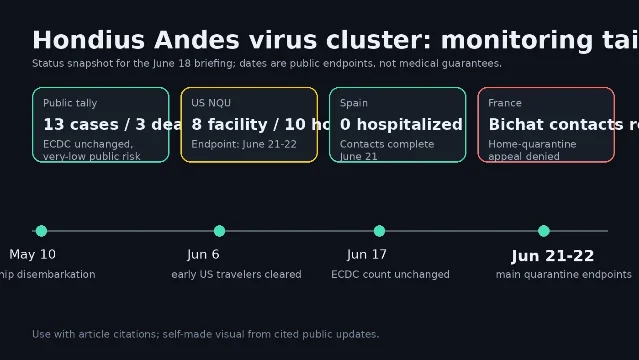
At the start of the June 18 monitoring day, the MV Hondius-linked Andes virus cluster is still not behaving like a widening outbreak. The most important new development is operational: Spain says its last hospitalized patient has gone home, France has now reported a court refusal for the Seitre couple's home-quarantine request, and the United States remains locked in a quarantine-governance dispute that is running up against the June 21 endpoint. ECDC's June 17 update keeps the public count at 13 total cases, 12 confirmed and one probable, with 3 deaths and a "very low" likelihood of additional cases related to the event. 1
| Signal | Current read | Why it matters |
|---|---|---|
| Case count | 13 total cases, 3 deaths, no suspected cases listed by ECDC as of June 17. 1 | The outbreak is still in the monitoring tail, not a new growth phase. |
| U.S. quarantine | CDC still states that 8 people remain at the Nebraska National Quarantine Unit and 10 are completing monitoring at home, all symptom-free. 2 | The unresolved issue is proportionality of quarantine, not evidence of U.S. transmission. |
| Spain | Spain's health ministry is cited as saying the final hospitalized Gómez Ulla patient has been discharged and no patient remains hospitalized from this episode. 3 | Spain has moved from inpatient management to follow-up and quarantine completion. |
| France | A liberty judge refused Roland and Julia Seitre's request to finish quarantine at home in Marray; they remain at Hôpital Bichat. 4 | This closes a previously open legal-status question in France. |
| Technical uncertainty | WHO says there is still limited operational clarity on safe discharge, discontinuing transmission-based precautions, and quarantine implementation. 5 | Different countries are converging on endpoints, but not always with identical protocols. |
The outbreak curve is flat; the administrative tail is active
ECDC says its outbreak page was last updated on June 17 at 13:55, and the agency now states that some identified contacts have completed quarantine while others are expected to do so in the coming days. 1 The same update says public health authorities are still monitoring identified contacts, but the likelihood of additional cases related to this event is considered very low. 1
GenomicEpi's source-linked tracker, updated against the Global.health Hondius dataset dated June 17, continues to frame all confirmed and probable cases as people who were on the Hondius; it also states that no secondary cases have been identified. 6 That distinction matters more with each day of negative monitoring: the remaining concern is not whether Andes virus can transmit between people in rare circumstances, but whether this specific cluster has produced spread beyond ship-linked cases.

United States: the case is about least-restrictive quarantine
CDC's public situation page still reports no confirmed Andes virus cases in the United States from this outbreak. 2 It says 18 potentially exposed U.S. travelers were repatriated to the National Quarantine Unit at the University of Nebraska Medical Center for a 42-day monitoring period; 10 have returned home to finish monitoring, while 8 remain at the unit. 2 CDC also says several U.S. passengers who disembarked before the outbreak was identified completed state and local monitoring on June 6 without detected hantavirus disease. 2
The active U.S. dispute is Angela Perryman's confinement. Associated Press, carried by WLRN on June 17, reported that Health and Human Services Secretary Robert F. Kennedy Jr. refused to release Perryman from the Nebraska facility despite a federal medical review that said she did not need to remain confined far from her Florida home. 7 AP also reported that Perryman remained symptom-free five weeks after leaving the ship, and that the 42-day period was set to expire at the end of Sunday, June 21. 7
Healthbeat's underlying report adds the administrative detail: Dr. Michael Bell, the CDC-appointed quarantine medical reviewer, concluded that less restrictive alternatives would adequately protect public health, including Florida's proposed once-daily telehealth monitoring with remote temperature checks and symptom assessments. 8 HHS later told Healthbeat that, without what it considered proper home monitoring by state authorities, the federal quarantine order was necessary for Perryman and her community. 8
The public-health question is narrow now. If Perryman remains asymptomatic to the June 21/22 boundary, the U.S. episode will end with no domestic case but with a precedent-setting dispute over whether facility quarantine was proportionate after repeated negative status and a federal reviewer recommendation for home monitoring.
Spain: final inpatient discharged; contacts remain on a clock
Spain appears to have crossed the clearest clinical milestone in today's scan. Gaceta Médica reports that Spain's Ministry of Health confirmed the last patient hospitalized at Hospital Central de la Defensa Gómez Ulla for hantavirus infection has received hospital discharge and is now at home. 3 The same account says that, with this discharge, no patient remains hospitalized from the Hondius-linked episode. 3
Noticias para Municipios gives the operational follow-through: the final patient had been in the High-Level Isolation and Treatment Unit, and the contacts who had remained under hospital follow-up left the center on June 8 to continue quarantine from home. 9 Those contacts are still expected to complete the maximum 42-day quarantine period ending June 21. 9

Gaceta Médica also reports that the Spanish discharge protocol requires confirmed cases to have clinical recovery, at least three consecutive days without compatible symptoms, and two negative PCR results from urine and oropharyngeal swabs at least 48 hours apart. 3 That protocol does not treat persistent viral RNA in blood as a stand-alone barrier to discharge, because blood PCR can remain positive after clinical recovery without evidence that it creates transmission risk. 3
France: the Seitre petition has an answer
France's public clinical picture remains incomplete for the severe French patient previously described as hospitalized in intensive care, but one legal-monitoring gap has closed. ICI reported on June 14 that a liberty judge refused Roland and Julia Seitre's request to finish quarantine at home in Marray, north of Tours. 4 The couple said the judge did not want to go against the ministerial decision made on May 11 and, according to ICI, they remained confined in a negative-pressure room at Hôpital Bichat. 4
That does not resolve the clinical-status gap for France's most serious case. It does, however, align the French contact-management track with the same practical endpoint now visible in Spain and the United States: authorities are choosing to run quarantines to the end rather than shorten facility restrictions during the last week.
Protocol lesson: countries are not using one discharge rule
Health Policy Watch's account of the WHO EPI-WIN session shows why the final week has produced different national decisions. The Netherlands discharged two patients after two negative saliva tests, Spain required two negative PCR tests from throat swabs and urine, and Switzerland discharged its patient after clinical recovery and negative saliva and nasopharyngeal swabs despite faint blood and urine positivity. 10 Spanish experts at the session said blood PCR remained positive throughout disease and after convalescence, and WHO's webinar framing notes limited operational clarity on when to stop transmission-based precautions and how to apply quarantine in home or facility settings. 10 5
WHO's technical framing is deliberately cautious. It says Andes virus transmission may include contact with an infected individual or contaminated surfaces, direct deposition of infectious respiratory particles onto mucous membranes, and possibly airborne transmission, while also saying the virus does not behave like a highly transmissible airborne pathogen such as measles. 5 CDC's FAQ keeps the public-risk message narrower: Andes virus is the only hantavirus known to spread person-to-person, but this spread is usually limited to close contact with a symptomatic person. 11
One operational addition is worth noting but not over-reading. Inflammatix announced a collaboration with UNMC and the National Quarantine Unit using its TriVerity host-response test to assess infection type and risk of ICU-level care within seven days, with results in about 30 minutes. 12 This is a company announcement, so it should be treated as an operational diagnostic-development signal, not proof that outcomes in the Hondius cluster have changed.
Monitoring priorities through June 21-22
The next checkpoint is now compressed into four questions:
- Does ECDC or WHO revise the 13-case, 3-death public count before the remaining contact windows close? 1
- Does HHS let Angela Perryman and the remaining Nebraska travelers leave at the June 21 endpoint without further conditions? 7
- Do Spain's remaining contacts complete home quarantine on June 21 without a late symptomatic conversion? 9
- Does France publish a fresh clinical update on the ICU patient or a final release status for the Bichat contacts? 6
For today, the signal is stable but not empty. The outbreak count is flat; Spain has ended inpatient care; France's home-quarantine appeal has been denied; and the United States remains the jurisdiction where quarantine law, federal-state coordination, and risk-based medicine are most visibly out of alignment.
Fuentes de referencia
- 1Andes hantavirus outbreak in cruise ship
- 2Andes Virus Outbreak on a Cruise Ship: Current Situation
- 3Sanidad confirma el alta del último paciente ingresado por hantavirus en el Hospital Gómez Ulla
- 4Hantavirus: le juge des libertés refuse au couple de Tourangeaux son vœu de finir sa quarantaine à Marray
- 5WHO EPI-WIN webinar: Hantavirus in focus IV
- 6Hantavirus Cruise Outbreak Tracker
- 7RFK Jr. overrules experts to keep hantavirus cruise ship passenger in quarantine
- 8Hantavirus cruise ship passenger must remain in quarantine facility, RFK Jr. orders
- 9Dado de alta el último paciente que permanecía ingresado en el Hospital Gómez Ulla por hantavirus
- 10Countries Differ On Discharge Criteria For Andes Hantavirus Patients
- 11Andes Virus Outbreak on a Cruise Ship: Frequently Asked Questions
- 12Inflammatix Collaborates with University of Nebraska Medical Center to Support Rapid Response to the Hantavirus Outbreak Using TriVerity
Añade más opiniones o contexto en torno a este contenido.