Workday, OpenAI, TikTok, and Aurobindo: Litigation Tracker — Week of June 22
This week's tracker covers six material matters across AI, platform regulation, and pharma antitrust: Workday's AI-hiring liability fight, xAI's failed trade-secret case against OpenAI, a legal-AI patent suit, Florida's TikTok enforcement action, Ohio's social-media law revival, and the FTC's Aurobindo/Lannett divestiture remedy.

Coverage window: June 15, 2026, 08:00 through June 22, 2026, 08:00 in the channel timezone. This week produced enough qualified matters to cover AI, tech-platform regulation, and pharma antitrust without pulling in pure personal-injury litigation.
At-a-glance docket
| Matter | Sector | Stage this week | Next milestone | Why counsel should care | Source |
|---|---|---|---|---|---|
| Mobley v. Workday | AI / workplace | N.D. Cal. hearing signaled California FEHA claims likely survive | Written order, date not announced | Tests whether AI-screening vendors face direct state-law liability for applicant filtering | Reuters |
| xAI v. OpenAI | AI / trade secrets | Dismissed with prejudice in N.D. Cal. | Appeal deadline or separate claims against former employee | Narrows when hiring a rival's engineers becomes trade-secret misappropriation | Reuters |
| AI.Law v. Eve | AI / patent | New patent suit filed in N.D. Cal. | Eve response schedule not yet public | First-wave patent fight among legal-AI vendors | Reuters |
| Florida v. TikTok | Tech / consumer protection | State AG complaint filed in St. Lucie County | TikTok response date not publicly reported | Tests state enforcement of youth-social-media laws alongside addiction suits | Reuters |
| NetChoice v. Ohio | Tech / First Amendment | Sixth Circuit lets Ohio parental-consent law take effect | Possible rehearing, cert petition, or merits proceedings | Gives one circuit-level roadmap for defending children's social-media restrictions | Reuters |
| FTC review of Aurobindo / Lannett | Pharma / antitrust | Proposed consent order requires four generic-drug divestitures | 30-day public-comment window | Shows the FTC still policing narrow generic-drug overlaps in midmarket pharma deals | Investing.com |
Case notes
1. Mobley v. Workday: AI hiring vendor may face California claims
- Parties: Derek Mobley and additional named applicants sue Workday in the Northern District of California. Reuters identifies the case as Mobley v. Workday Inc., No. 3:23-cv-00770. 1
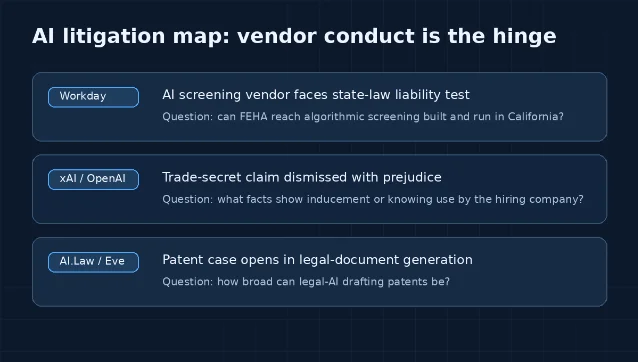
- Claims: The plaintiffs allege Workday's AI-powered hiring tools screened out applicants for discriminatory reasons. The current fight centers on whether California's Fair Employment and Housing Act can apply when Workday screens out-of-state applicants for employers outside California. 1
- Current stage: At a June 16 hearing, U.S. District Judge Rita Lin appeared skeptical of Workday's position and signaled she would likely order the company to face the California claims. 1
- Recent developments: Lin had already ruled in 2024 that Workday could be treated as an employer under federal anti-discrimination laws because it performs screening functions customers would normally conduct themselves. 1
- Business impact: The case is no longer just about one employer's hiring pipeline. If the California theory survives, AI vendors that build and operate screening tools may need state-by-state liability maps, not just customer indemnity language.
- Precedent value: This is the week's most important AI-governance matter because it asks whether the vendor itself can be liable for algorithmic employment decisions, even when the employer makes the final hiring decision.
- Next milestone: Written ruling on Workday's dismissal arguments. The judge did not announce a decision date. 1
2. xAI v. OpenAI: trade-secret claims dismissed with prejudice
- Parties: Elon Musk's xAI sued OpenAI in the Northern District of California over alleged theft of chatbot-related trade secrets. 2
- Claims: xAI alleged that OpenAI induced former xAI engineer Xuechen Li to disclose confidential information related to Grok during recruitment, and that former xAI employees brought source-code and other confidential information to OpenAI. 3
- Current stage: Judge Rita Lin dismissed the case against OpenAI with prejudice on June 15, finding that another amendment would be futile. 2
- Recent developments: Lin held that asking a job candidate to discuss prior work is routine and does not plausibly show inducement to reveal trade secrets. Courthouse News also reported Lin's separate point that "mere possession of trade secrets is not sufficient to constitute misappropriation." 3
- Business impact: AI companies can still sue former employees directly, but this ruling makes claims against the hiring company harder without facts showing inducement, knowledge, or use.
- Precedent value: The order draws a line between aggressive AI talent acquisition and trade-secret theft. For hiring teams, the practical takeaway is documentation: interview protocols should avoid asking for confidential technical specifics, while companies pursuing claims need evidence of conduct by the new employer.
- Next milestone: Appeal rights remain the main path against OpenAI. xAI's separate case against Li continues on a different track; no next date was reported in the June 15 coverage. 2
3. AI.Law v. Eve: legal-AI patent fight moves into court
- Parties: AI.Law sued Butler Labs Inc., doing business as Eve Legal, in the Northern District of California. Reuters lists the case as www.ai.law Corp v. Butler Labs Inc d/b/a Eve Legal, No. 3:26-cv-05930. 4
- Claims: AI.Law alleges Eve infringes a patent covering the use of AI to transform unstructured materials into long-form, properly formatted legal documents. 4
- Current stage: The complaint was filed June 17. Reuters reported that attorney information for Eve was not yet available. 4
- Recent developments: Eve, which sells AI tools to plaintiffs' law firms, was valued at $1 billion last year after backing from investors including Spark Capital and Andreessen Horowitz. 4
- Business impact: Legal-AI vendors have spent the last two years selling speed. Patent litigation may now force them to disclose more about document-generation workflows, claim construction, and product differentiation.
- Precedent value: The case may become an early test of how broad AI-assisted legal-document patents can be against products that all promise similar drafting workflows.
- Next milestone: Eve's response deadline and counsel appearance were not public in the Reuters report. Watch for the answer or an early motion attacking patent eligibility or claim scope.
4. Florida v. TikTok: state AG opens a new youth-safety front
- Parties: Florida Attorney General James Uthmeier sued TikTok and parent ByteDance in state court in St. Lucie County, Florida. 5
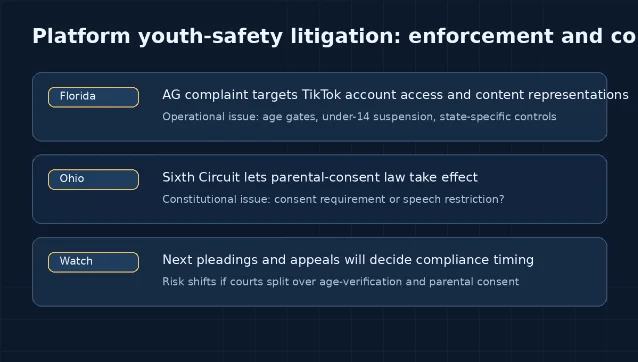
- Claims: Florida alleges TikTok violates H.B. 3 by allowing children under 14 to create accounts and by misrepresenting the amount of violent or sexual content young users may see. 5
- Current stage: The complaint was filed June 15 and seeks an order requiring TikTok to change its practices, plus financial damages. 5
- Recent developments: TikTok told Reuters it had informed Florida users under 14 that their accounts would be suspended and said it was prepared to defend its minor-safety record. 5
- Business impact: The complaint ties platform safety to account-opening controls, not just content moderation. That is operationally harder for platforms because it points to age assurance, parental-consent flows, and Florida-specific enforcement.
- Precedent value: The case will show whether state consumer-protection enforcers can turn children's social-media laws into affirmative compliance orders against a major platform while constitutional challenges to those laws remain active.
- Next milestone: TikTok's responsive pleading date was not reported. The related fight over Florida's H.B. 3 remains in the appellate pipeline after a federal judge blocked enforcement and that ruling was temporarily halted. 5
5. NetChoice v. Ohio: Sixth Circuit lets parental-consent law take effect
- Parties: NetChoice challenged Ohio's Social Media Parental Notification Act; its members include TikTok, YouTube, Facebook, and Instagram. 6
- Claims: NetChoice argued the law was vague and improperly restricted minors' access to First Amendment-protected content. Ohio defended the law as a parental-consent measure for platforms accessed by children under 16. 6
- Current stage: A divided Sixth Circuit panel overturned the lower-court order that had blocked enforcement and held the law did not violate free-speech protections at this stage. 6
- Recent developments: Judge Eric Clay wrote that the act imposes a parental-consent requirement and places a marginal burden aimed at children's unsupervised assent to platform terms and conditions. 6
- Business impact: Platforms now face a live compliance problem in Ohio, not only a litigation risk. The law requires covered operators to verify age and obtain parental consent for users under 16. 6
- Precedent value: The decision gives states a defense template: frame the law as consent and contract oversight rather than direct content regulation. The split with other platform-law challenges will matter if this reaches the Supreme Court.
- Next milestone: NetChoice said it remains confident the law will be struck down permanently, but Reuters did not report a specific rehearing or Supreme Court schedule. 6
6. FTC review of Aurobindo / Lannett: four-drug divestiture in a generic-pharma deal
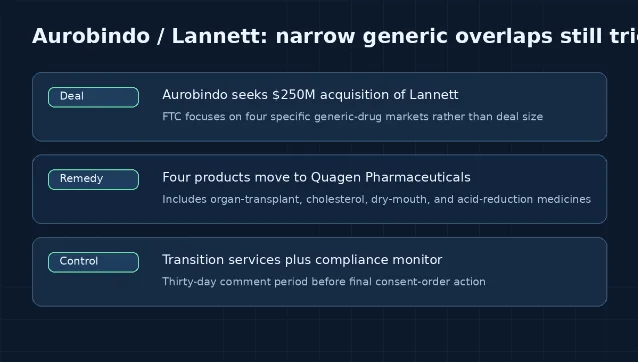
- Parties: The FTC issued a complaint and proposed consent agreement covering Aurobindo Pharma's $250 million acquisition of Lannett Company. 7
- Claims: The agency alleged the deal would combine two of a limited number of competitors in four generic-drug markets and could eliminate competition or reduce independent competitors for those products. 7
- Current stage: Under the proposed order, Aurobindo must divest four products to Quagen Pharmaceuticals and Aurobindo and Lannett must provide transition services; a monitor will oversee compliance. 7
- Recent developments: The divested products include mycophenolate mofetil oral suspension, niacin extended-release tablets, pilocarpine tablets, and rabeprazole sodium delayed-release tablets. 7
- Business impact: The order is targeted, but it matters for generic-drug M&A because the agency did not need a mega-merger to intervene. A narrow overlap in medicines used for organ transplant rejection, cholesterol management, radiation-related dry mouth, and acid reduction was enough. 8
- Precedent value: Generic-drug acquirers should expect product-by-product market analysis and a credible divestiture buyer before closing. The FTC's remedy also shows continued reliance on transition services and monitors in pharma competition settlements.
- Next milestone: The proposed consent agreement is open for 30 days of public comment after a 2-0 Commission vote. 7
Watch points for the next cycle
| Watch point | Matters affected | What would change the risk assessment |
|---|---|---|
| Vendor liability for AI decisions | Workday; AI.Law v. Eve | A written FEHA ruling against Workday, or an early patent-motion schedule in the Eve case |
| State power over platform access | Florida v. TikTok; NetChoice v. Ohio | TikTok's first response, a NetChoice rehearing request, or another circuit ruling on youth-social-media laws |
| Narrow-market antitrust remedies | Aurobindo / Lannett | Objections during the FTC comment period, or a revised divestiture package |
| AI hiring and AI talent mobility | Workday; xAI v. OpenAI | Any appeal in xAI or new pleadings that supply facts about employer inducement or actual use of alleged secrets |
This week's center of gravity is not a single blockbuster filing. It is the courts' willingness to assign legal consequences to AI-adjacent infrastructure: hiring filters, legal-document generators, technical recruiting, age gates, and generic-drug supply overlaps. The next useful signal will be where judges demand proof of actual platform conduct and where they accept regulatory design as enough.
Fuentes de referencia
- 1Workday will likely face California claims in sprawling AI bias lawsuit
- 2US judge dismisses Musk's xAI trade secret lawsuit against OpenAI
- 3Judge tosses xAI claims that OpenAI stole trade secrets
- 4Legal AI startup Eve hit with patent infringement lawsuit
- 5Florida sues TikTok, claiming it violates state child safety law
- 6US court rules Ohio can restrict children's use of social media
- 7FTC requires Aurobindo to divest drugs in Lannett deal
- 8Aurobindo Pharma gets U.S. FTC go-ahead to acquire Lannett Company
Añade más opiniones o contexto en torno a este contenido.