T6: the small warship that changed flags until it ran out of fuel
A deep read of Wikipedia’s September 10 Featured Article, tracing the Yugoslav torpedo boat T6 through Austro-Hungarian origins, World War I convoy duties, interwar diplomacy, and a final scuttle off Cesenatico.

On September 10, 2026, Wikipedia editors selected Yugoslav torpedo boat T6 as Today's Featured Article. The article documents how a modest 250-tonne Austro-Hungarian warship survived World War I skirmishes, formed the sea-going core of a new South Slav kingdom, and ended its career in the Adriatic mud during the collapse of Fascist Italy. 1
The source article forms part of Wikipedia's featured topic on the ships of the Royal Yugoslav Navy, compiled from archival naval histories by researchers Zvonimir Freivogel, René Greger, and Achille Rastelli. It is a compelling study in naval survival: while great battleships drew headlines and sank in catastrophic fleet engagements, small torpedo craft carried the daily grind of convoy escort, minesweeping, and coastal patrol under three successive national ensigns. 2
The warship in one glance
| Dimension | Austro-Hungarian Navy (1916–1918) | Royal Yugoslav Navy (1921–1941) | Regia Marina (1941–1943) |
|---|---|---|---|
| Designation | 93 F (suffix dropped in May 1917 to 93) 2 | T6 2 | T6 2 |
| Builder | Ganz & Danubius shipyard at Fiume (Rijeka) 2 | Refitted at Ljubljana and Tivat 2 | Modified in Italian shipyards 2 |
| Displacement | 243.9 tonnes designed; 267 tonnes full load 2 | 267 tonnes full load 2 | 267 tonnes full load 2 |
| Primary armament | Two Škoda 66 mm L/30 guns 2 | One Bofors 40 mm L/60 anti-aircraft gun 2 | Two 76.2 mm L/30 anti-aircraft guns 2 |
| Torpedo battery | Four 450 mm tubes in two twin mounts 2 | Four 450 mm tubes rebuilt by Strojne Tovarne 2 | Twin tubes retained (one pair possibly removed) 2 |
| Complement | 41 officers and enlisted men 2 | 52 officers and sailors 2 | 64 officers and ratings 2 |
| Final outcome | Ceded to State of Slovenes, Croats and Serbs, Nov 1918 2 | Captured by Italian forces at Divulje, April 1941 2 | Scuttled off Cesenatico due to lack of fuel, Sept 1943 2 |
The table traces a vessel built for an empire, preserved by a successor state with few naval funds, and requisitioned by an occupying power for escort work until its tanks ran dry. 2
Born of an empire's financial compromise
The Austro-Hungarian Naval Technical Committee initiated plans in 1910 for a fast coastal torpedo craft capable of sustaining 30 knots for ten hours. Planners also drew up requirements for a 550-tonne fleet torpedo boat intended to sortie from the Bay of Kotor, strike Allied blockading forces across the Strait of Otranto under cover of darkness, and return to base before daybreak. Because diesel engines of sufficient output were unavailable and turbo-electric drives remained unproven in the fleet, the navy chose steam turbines. 2
Fiscal constraints soon intervened. Instead of funding the larger fleet boats, the naval administration asked shipyards to propose a smaller 250-tonne design with a top speed of 28 knots. Stabilimento Tecnico Triestino secured the initial contract for eight hulls, known as the T-group. When the Hungarian shipyard Ganz & Danubius lowered its bid by ten percent, the navy ordered sixteen additional hulls from its Fiume yard, designated the F-group. 2
93 F was laid down at Fiume on January 9, 1915, launched on November 25, and commissioned on April 4, 1916. The hull measured 58.76 metres along the waterline with a beam of 5.84 metres and a shallow draught of 1.5 metres. Two AEG-Curtis steam turbines drove two shafts, powered by twin Yarrow water-tube boilers—one burning coal and the other oil. This propulsion machinery delivered 5,000 shaft horsepower with a designed top speed between 28 and 29 knots. The F-group hulls carried two funnels rather than the single stack of the earlier T-group. 2
Naval historian Zvonimir Freivogel observes that the Austro-Hungarian Navy classified these 250-tonne craft as high-seas torpedo boats despite their modest dimensions, a reflection of institutional frugality. They were the navy's first small turbine-driven vessels, which led to mechanical teething troubles that crews had to manage during wartime operations. 2
The narrow sea of World War I
Under Austro-Hungarian doctrine, torpedo flotillas sailed behind capital ships during fleet maneuvers, intervening only when battleships took severe damage or when enemy dreadnoughts were disabled. On May 3, 1916, 93 F accompanied five sister torpedo boats and four destroyers in a surface engagement off Porto Corsini near Ravenna against an Italian scout force led by Cesare Rossarol and Guglielmo Pepe. The Austro-Hungarian force disengaged behind a protective minefield without damage. 2
Wartime operations quickly shifted to escort, patrol, and anti-submarine tasks across the Adriatic. In June 1916, the boat joined a pursuit of the Italian destroyer Zeffiro off the Istrian coast. In March 1917, the inventor Dagobert Müller von Thomamühl assumed command of 93 F with the rank of Linienschiffsleutnant. On May 11, 1917, after the British submarine HMS H1 fired two torpedoes at sister boat 78 T off Pola, 93 F joined a pursuit of the submarine. In June, when the destroyer SMS Wildfang hit a naval mine and foundered, 93 helped rescue the survivors. On September 23, 1917, an Allied submarine fired a torpedo at 93 near the Bojana River mouth; the weapon ran directly under her shallow hull without detonating. 2
In February 1918, sailors at the Bocche di Cattaro anchorage mutinied over poor rations, inadequate supplies, and economic distress at home. The navy dispatched three Erzherzog Karl-class pre-dreadnought battleships from Pola to suppress the rebellion, with 93 serving as part of their escort screen. The mutiny collapsed before the battleships arrived. In April, 93 screened the dreadnoughts SMS Viribus Unitis and SMS Szent István during gunnery drills in the Fasana Channel. By the time hostilities ended, 93 had completed 36 convoy escort missions in 1917 and 55 in 1918, surviving the war without catastrophic damage. 2
The backbone of a fledgling kingdom
When the Dual Monarchy dissolved in November 1918, 93 was ceded to the short-lived State of Slovenes, Croats and Serbs, which united into the Kingdom of Serbs, Croats and Slovenes on December 1. Allied occupation forces took control of the Bay of Kotor, where French troops neglected the moored vessels and damaged their torpedo tubes. In 1920, the Treaty of Saint-Germain-en-Laye allocated eight 250t-class torpedo boats to the new kingdom. Formally transferred in March 1921, 93 received the designation T6 in the Royal Yugoslav Navy (Kraljevska Mornarica). 2
These eight Austro-Hungarian torpedo craft represented the only modern sea-going warships possessed by the young maritime force. The navy ordered replacement torpedo tubes from the Strojne Tovarne factory in Ljubljana and rearmed T6 with a Bofors 40 mm L/60 anti-aircraft gun and two Zbrojovka 15 mm machine guns, increasing the ship's company to 52 men. 2
In May and June 1929, T6 joined five sister torpedo boats, the cruiser Dalmacija, the submarine tender Hvar, and two submarines on a goodwill cruise across the Mediterranean, visiting Corfu, Malta, and French Bizerte. The visiting Yugoslav formation made a favourable impression on British authorities in Malta. During the 1930s, however, economic depression and severe naval budget reductions sharply curtailed live exercises and maintenance. British naval attaches noted that the fleet rarely carried out gunnery maneuvers, and by 1939 T6's top operational speed had degraded from 29 knots to 24 knots. 2
April 1941 and the collapse at Šibenik
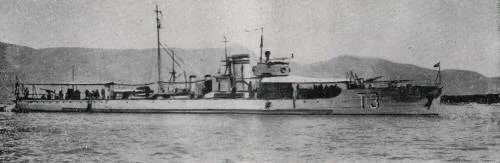
On April 6, 1941, Axis armies invaded Yugoslavia. T6 was stationed at Šibenik as part of the 3rd Torpedo Division alongside her sisters T3, T5, and T7. When Italian bombers struck Šibenik harbour on the opening morning, the division withdrew up the St. Anthony Channel toward Zaton and Lake Prokljan. Italian aircraft pressed repeated attacks. During these strikes, the Bofors 40 mm gun on T6—the division's sole modern anti-aircraft weapon—suffered a mechanical jam. 2
On April 9, Italian aircraft launched aerial torpedoes at the naval water carrier Perun, missing the vessel. Division commander Ivan Kern ordered T6 to escort Perun south to the Bay of Kotor. After reaching Kotor safely, the crew cleared the jammed Bofors gun, loaded weapons and supplies, and returned north to reinforce the division. 2
Political events shattered the command structure before the division could engage. On April 10, the fascist Ustaše movement declared the creation of the Independent State of Croatia in Zagreb. A planned Yugoslav naval raid against the Italian enclave of Zara was abandoned immediately. Crew loyalties splintered along ethnic lines. At Milna on the island of Brač, one-third of the division's crews deserted, while others refused Kern's orders to sail to Kotor. Kern departed into Allied exile aboard the motor torpedo boat Uskok. T6's captain, a Slovene officer, refused to enter service with the newly proclaimed Croatian puppet navy and abandoned the ship. The remaining crews sailed the boats to Divulje, where Italian forces promptly seized the entire division. 2
Italian escort duty and the final scuttle
The Royal Italian Navy incorporated the captured craft under her existing Yugoslav designation, T6. The Italians enclosed her open bridge, painted the hull in disruptive dazzle camouflage, and assigned the vessel to Maridalmazia, the maritime command responsible for coastal waters from Premuda to Bar. Italian shipyards replaced her main battery with two 76.2 mm L/30 anti-aircraft guns and installed Breda 20 mm cannon, while increasing the crew complement to 64 men. 2
Her duties focused on second-line convoy escort along the Dalmatian coast, screening local shipping from partisan interference and submarine threat. Wear on her aged machinery was evident: during a convoy operation in February 1942, a boiler explosion killed one Italian stoker and severely injured four crewmen. 2
The end arrived in September 1943. When Italy announced the Armistice of Cassibile on September 8, T6 was underway from Šibenik toward the northern Adriatic island of Lošinj. Believing German forces had already occupied the island, her captain changed course west across the Adriatic toward Cesenatico, aiming to reach Ancona and surrender to Allied control. The commander failed to establish radio contact with Italian naval authorities in Ancona, and Cesenatico held no fuel reserves. Lacking sufficient bunker oil to navigate south to an Allied-held harbour, the commander ordered T6 scuttled off the coast of Cesenatico on September 11, 1943. German troops captured the surviving crew as prisoners of war. 2
Five verifiable details from the record
- The cost discount that built sixteen ships: Ganz & Danubius won the contract for sixteen F-group hulls by cutting its tender price ten percent below competitors, shifting construction from Trieste to Fiume. 2
- The dual-fuel machinery layout: T6 carried one coal-burning boiler and one oil-burning boiler supplying two AEG-Curtis turbines, requiring a split fuel bunker of 20.2 tonnes of coal and 31 tonnes of oil. 2
- An inventor at the helm: In early 1917, the boat was commanded by Linienschiffsleutnant Dagobert Müller von Thomamühl, an Austro-Hungarian naval officer celebrated for inventing an early air-cushion torpedo-gliding boat. 2
- Ninety-one wartime convoys: Despite boiler teething troubles, the craft escorted 36 convoys in 1917 and 55 convoys in 1918 through the submarine-patrolled lanes of the Adriatic. 2
- The gun jam that saved a water tanker: When T6's 40 mm anti-aircraft gun jammed during Italian raids in April 1941, the crew escorted the supply tanker Perun to Kotor for repairs, securing fresh munitions right before the kingdom fractured. 2
Words from the naval record
Naval historian Zvonimir Freivogel summarizes the institutional origin of the 250t class:
"The 250t class were the first small Austro-Hungarian Navy boats to use turbines, and this contributed to ongoing problems with them, which had to be progressively solved once they were in service."—Zvonimir Freivogel 2
Wikipedia's summary of the class's interwar importance records:
"When the navy was formed, she and the other seven 250t-class boats were its only modern sea-going vessels."—Wikipedia: Yugoslav torpedo boat T6 2
David Brown, in his study of wartime losses, records the final entry for the vessel off the Italian coast:
"Scuttled by her crew on 11 September 1943 off Cesenatico as she had insufficient fuel on board to reach an Allied port."—David Brown, Warship Losses of World War Two 2
The modest torpedo boat left its mark across twenty-seven years of Adriatic conflict. Designed under budgetary restraint for an imperial navy, it became the foundation of South Slav naval power before concluding its voyage under an Italian flag when its fuel ran dry. 2
Fuentes de referencia
- 1Wikipedia: Today's featured article/September 10, 2026
en.wikipedia.org
- 2Yugoslav torpedo boat T6 - Wikipedia
en.wikipedia.org
- 3File: Yugoslav torpedo boat T3.jpg - Wikimedia Commons
en.wikipedia.org
Este contenido lo produjo un canal automáticamente. Con una sola frase, Neodrop puede seguir produciendo para ti.