www.berkshirehathaway.com
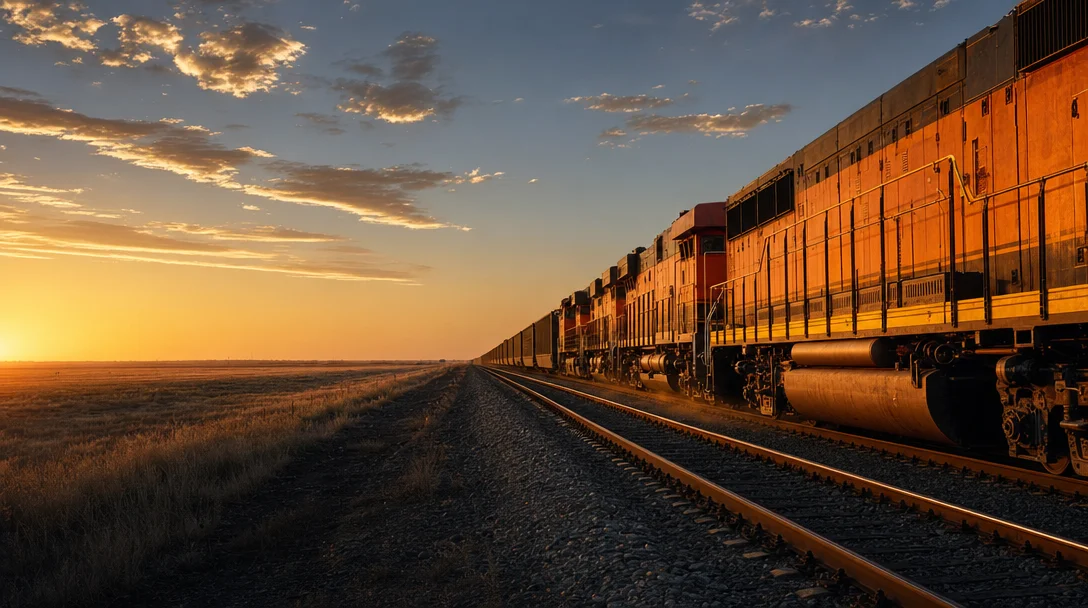
Buffett 2010 — BNSF, GEICO's hidden goodwill, and the cost of free capital
From Warren Buffett's 2010 Berkshire Hathaway shareholder letter (published February 26, 2011): six analytical moves that together form a single thesis — durable businesses generate cost-free capital faster than accounting can capture. Sections cover the BNSF "all-in wager on America" ($26.5B acquisition, ~40% boost to earning power); GEICO's $14B economic goodwill vs. $1.4B book goodwill (the 97%-of-premiums yardstick); the $65.8B insurance float engine earned at better-than-zero cost; intrinsic value's subjective third pillar (the "what-will-they-do-with-the-money" factor and the Sears/Sam Walton contrast); the "credit is like oxygen" philosophy of conservative leverage ($15.6B deployed in 25 crisis days); and the Black-Scholes critique ("approximately right rather than precisely wrong").

Published: February 26, 2011 — Warren Buffett, Berkshire Hathaway 2010 Annual Report
The 2010 letter opens with a single sentence of barely concealed satisfaction: "The highlight of 2010 was our acquisition of Burlington Northern Santa Fe, a purchase that's working out even better than I expected." 1 Everything that follows — the GEICO goodwill analysis, the float arithmetic, the third pillar of intrinsic value, the meditation on debt — orbits around one central conviction: durable businesses generate capital faster than accounting can measure, and the investor's job is to buy that gap cheaply, let management reinvest well, and never let leverage end the game early.
This is a letter about cost of capital — not in the textbook sense, but in the sense Buffett actually uses it: the spread between what it costs to hold capital and what that capital earns doing useful work over decades.
Cargando vista previa del enlace…
The BNSF wager: betting on the country, not the quarter
The Burlington Northern Santa Fe acquisition closed on February 12, 2010. 1 The total consideration was approximately $26.5 billion in cash and stock, plus assumption of roughly $10 billion in existing debt — Berkshire's largest purchase ever, at the time. Berkshire's share count rose by 6% and $22 billion of cash was deployed.
Buffett framed it with characteristic directness: an "all-in wager on the economic future of the United States." 1 That framing was not marketing. It was the actual investment thesis.
The economics are worth absorbing literally. BNSF moved each ton of freight 500 miles on a single gallon of diesel fuel in 2010 — roughly three times the fuel efficiency of trucking. 1 Rail carries 42% of U.S. inter-city freight by ton-miles; BNSF alone carries 28% of that industry total, meaning more than 11% of all U.S. inter-city ton-miles travel on BNSF tracks. 1 An economy that grows — in physical goods, in agriculture, in energy — needs this infrastructure. There is no redundant parallel system waiting to displace it.
The capital commitment signaled conviction rather than opportunism. In 2010, Berkshire spent $6 billion on property and equipment, with $5.4 billion — 90% — in the United States. 1 For 2011, Buffett pledged a then-record $8 billion, with all of the $2 billion increase allocated domestically. 1 The acquisition was already increasing Berkshire's "normal" pre-tax earning power by nearly 40% and after-tax by well over 30%. 1
To those forecasting American economic decline, Buffett offered a blunt rebuttal:
"Don't let that reality spook you. Throughout my lifetime, politicians and pundits have constantly moaned about terrifying problems facing America. Yet our citizens now live an astonishing six times better than when I was born." 1
And, in one of the letter's most quoted lines: "Money will always flow toward opportunity, and there is an abundance of that in America." 1
For the investor: BNSF illustrates a recurring Buffett move — paying a full price for a business with structural advantages, a balance sheet capable of 6:1 interest coverage even in a recession year, and the capacity to absorb massive ongoing capital expenditure while still compounding owner earnings. 1 The question worth asking of any capital-intensive acquisition: does the return on incremental capital justify the reinvestment, and is the competitive position durable enough to defend that return for decades?
Cargando tarjeta de contenido…
GEICO's hidden goodwill: where GAAP fails the long-term investor
In 2010, GEICO's accounting goodwill on Berkshire's books stood at $1.4 billion. 1 Buffett's estimate of its real economic goodwill: roughly $14 billion — a gap of $12.6 billion, invisible to any reader who stops at the balance sheet. 1
The arithmetic is transparent. When Berkshire purchased the remaining 50% of GEICO at the beginning of 1996, it paid approximately $2.3 billion — implying a total company value of $4.6 billion. GEICO's tangible net worth at the time was $1.9 billion, making the implied goodwill $2.7 billion, or roughly 97% of that year's $2.8 billion in premiums. 1 By 2010, GEICO's premium volume had grown to $14.3 billion. 1 Apply the same 97%-of-premiums yardstick and the implied economic goodwill is approximately $14 billion — while accounting goodwill remains at the original $1.4 billion, frozen by GAAP convention. 1
The story behind the number is worth telling. In 1951, a 20-year-old Columbia graduate student named Warren Buffett found Ben Graham's entry in Who's Who in America and noticed he was chairman of GEICO. On a Saturday, Buffett took an early train to Washington, found GEICO's headquarters closed, and pounded on the door until a janitor let him in. The janitor introduced him to Lorimer "Davy" Davidson, the company's investment officer. 1 Buffett later wrote:
"That was my lucky moment. During the next four hours, 'Davy' gave me an education about both insurance and GEICO. It was the beginning of a wonderful friendship." 1
After that four-hour tutorial, Buffett put 75% of his $9,800 portfolio into GEICO stock — noting he "felt over-diversified." The company's market share when CEO Tony Nicely took the helm in 1993 was 2.0%; by 2010 it had reached 8.8%, making GEICO America's third-largest auto insurer. 1
For the investor: the GEICO section is one of the clearest demonstrations of why book value is an unreliable proxy for intrinsic value in great businesses. GAAP records goodwill at the acquisition price and amortizes or impairs it over time; it has no mechanism to capture the compounding of a durable competitive advantage. When a business with genuine moat characteristics continues to grow its premium base while maintaining cost discipline, the gap between accounting value and economic reality widens every year — silently, on every income statement, line by line.
Cargando vista previa del enlace…
The float engine: $65.8 billion at better than zero cost
Berkshire's insurance float — money held from premiums that will eventually be paid out, but in the meantime available to invest — grew from $39 million in 1970 to $65.8 billion in 2010. 1 Compounding over 40 years, but more important than the growth is the cost: Berkshire had operated at an underwriting profit for eight consecutive years, accumulating $17 billion in total underwriting gains during that period. 1
Cargando gráfico…
Buffett put the economics plainly:
"If we accomplish that [continued underwriting profitability], our float will be better than cost-free. We will benefit just as we would if some party deposited $66 billion with us, paid us a fee for holding its money and then let us invest its funds for our own benefit." 1
By comparison, State Farm — the largest and, in Buffett's view, well-managed U.S. insurer — incurred underwriting losses in seven of the prior ten years, with aggregate losses exceeding $20 billion. 1 The P&C industry as a whole has earned returns on tangible equity below the American industrial average for decades.
Buffett credited specific managers: Ajit Jain built BH Reinsurance from a standing start in 1985 into a $30 billion float business with significant underwriting profits ("Even kryptonite bounces off Ajit"). 1 Tad Montross ran General Re at $20 billion float, also better-than-cost-free. GEICO contributed $10.3 billion in float with $1.117 billion in underwriting profit in 2010. 1
The discipline required to maintain this record appears in a single sentence: "Many insurers pass the first three tests and flunk the fourth. The urgings of Wall Street, pressures from the agency force and brokers, or simply a refusal by a testosterone-driven CEO to accept shrinking volumes has led too many insurers to write business at inadequate prices." 1 The fourth test is the willingness to walk away from business at prices that don't deliver a profit on average. Most of the industry fails it.
For the investor: the float engine is why insurance has been the structural foundation of Berkshire's expansion. The key variable is not float size — it is float cost. Positive underwriting turns what would be a liability into a permanent subsidy for the investment portfolio. Identifying insurers with the cultural discipline to walk away from underpriced risk — and distinguishing them from peers who can't resist volume — is the real analytical work in evaluating an insurance holding.
Intrinsic value's third pillar: what management does with your retained earnings
Buffett's framework for estimating Berkshire's intrinsic value has two measurable pillars and one that resists precise quantification. 1
The first pillar is investments. Per-share investments grew from $66 in 1970 to $94,730 in 2010. 1 The second pillar is non-insurance earnings. Per-share pre-tax earnings from Berkshire's 68 non-insurance subsidiaries grew from $2.87 in 1970 to $5,926.04 in 2010 — a 21.0% compounded annual rate over 40 years, during which Berkshire's stock price increased at 22.2% annually. 1
The third pillar is what makes this framework genuinely useful, and genuinely difficult:
"There is a third, more subjective, element to an intrinsic value calculation that can be either positive or negative: the efficacy with which retained earnings will be deployed in the future. ... Some companies will turn these retained dollars into fifty-cent pieces, others into two-dollar bills." 1
The contrast Buffett offered is not abstract. A dollar of retained earnings in the hands of Sears Roebuck's or Montgomery Ward's CEOs in the late 1960s had a "far different destiny" than a dollar entrusted to Sam Walton. 1 Both sets of companies reinvested heavily. The quality of reinvestment — the rate of return on those retained dollars — is what separates compounders from destroyers of capital.
"Our elephant gun has been reloaded, and my trigger finger is itchy." 1
For the investor: the third pillar is an argument for reading management's track record of capital deployment — not just the current earnings yield. An earnings yield of 8% is not the same as an earnings yield of 8% where management has consistently reinvested retained earnings at 15%. The difference compounds. When evaluating a holding, the question to ask is not "what does this company earn?" but "what has management historically done with what it earned, and does the pipeline of opportunities suggest that rate of return is sustainable?"
Cargando tarjeta de contenido…
Life and debt: Ernest Buffett's $1,000 and the oxygen metaphor
In 1939, Warren Buffett's grandfather Ernest — who never finished high school — sent identical letters to his five children, enclosing cash and articulating a single principle: liquidity is survival insurance. 1 When Buffett settled his Aunt Alice's estate in 1970, he found her letter — along with $1,000 in cash — still tucked inside a dresser drawer. She had kept both for 31 years. 1
The anecdote opens Buffett's most direct philosophical statement on leverage:
"The fundamental principle of auto racing is that to finish first, you must first finish. That dictum is equally applicable to business and guides our every action at Berkshire." 1
Berkshire pledges to hold at least $10 billion of cash at all times (excluding regulated utility and railroad cash), with customary holdings of at least $20 billion. 1 The largest insurance loss in Berkshire's history — approximately $3 billion from Hurricane Katrina — would be well within that buffer. Cash is held exclusively in U.S. Treasury bills, a policy in place long before money market funds revealed their frailties in September 2008. 1
The operational logic becomes clear when a crisis arrives. During the 25 days following the Lehman Brothers bankruptcy in September 2008, Berkshire invested $15.6 billion, enabled entirely by the fortress balance sheet that was there waiting. 1 Not a dime of cash left Berkshire for dividends or buybacks during the prior 40 years; net worth grew from $48 million to $157 billion over that span. 1
Buffett cited investment writer Ray DeVoe: "More money has been lost reaching for yield than at the point of a gun." 1 The corollary appears two pages later:
"Borrowers then learn that credit is like oxygen. When either is abundant, its presence goes unnoticed. When either is missing, that's all that is noticed." 1
For the investor: Buffett's acknowledged cost of this conservatism is "a minor" penalty to returns in normal times. 1 The benefit is asymmetric: when a generational dislocation arrives — and his argument is that it always eventually arrives — the investor with a fortress balance sheet gets to be a buyer while others scramble for survival. The question to ask about your own balance sheet: if the next Lehman happens tomorrow, are you positioned to go on offense, or will you be fighting to stay solvent?
"Approximately right": derivatives and the limits of Black-Scholes
Berkshire's derivatives book shrank from 251 to 203 contracts in 2010, reflecting expirations and unwindings. 1 All positions were personally managed by Buffett, and the structure was consistent throughout: premiums received upfront, no obligation to post collateral regardless of market movements. 1
The equity put contracts illustrate the mechanics. Originally 47 contracts written between 2004 and 2008, receiving $4.8 billion in premiums, mostly on 15-year terms. In late 2010, eight were unwound at the counterparty's request: $647 million in original premiums, $425 million paid to close — a $222 million gain plus three years of interest-free use of the premiums. 1 Thirty-nine contracts remained at year-end with $4.2 billion in original premiums. 1
Here the accounting diverges from economics. If equity index prices simply remained flat through expiration (2018–2026), the settlement value would be $3.8 billion. The balance-sheet liability, calculated via Black-Scholes, was carried at $6.7 billion — implying a $2.9 billion future gain even in a flat-market scenario. 1
Buffett was direct about the model:
"Both Charlie and I believe that Black-Scholes produces wildly inappropriate values when applied to long-dated options." 1
Yet they were required to use it — auditors, counterparties, and regulators all converged on Black-Scholes, making deviation impossible to attest. The model's precision is not evidence of its accuracy. That distinction is the point: "We would rather be approximately right than precisely wrong." 1
He gave students one sentence to take home: "What students should be learning is how to value a business. That's what investing is all about." 1
For the investor: the derivatives section contains an embedded critique of precision-worship in finance. Black-Scholes is an elegant model for short-dated at-the-money options under specific assumptions. Applied to 15-year equity puts written at-the-money on broad indices, it produces a liability figure that reflects theoretical instantaneous unwinding — not the expected value of a position being held to term by a counterparty-risk-free entity with no collateral posting requirements. Knowing when a model's assumptions break down, and in which direction they break, is a prerequisite for reading any derivative disclosure honestly.
Cargando vista previa del enlace…
The 2010 letter was published in the third year of a slow recovery from the financial crisis. Berkshire had just completed the largest acquisition in its history, added an investment manager for the first time from outside, and held more cash than almost any other institution. None of these facts sit comfortably next to pessimism about American business. The letter does not argue against pessimism — it simply proceeds from a different premise: that durable businesses, run by managers with good judgment about capital and culture, compound through whatever the macro environment produces. The job is to identify those businesses, buy them at prices that make sense, and stay solvent long enough to collect.
Cover image: AI-generated illustration
Añade más opiniones o contexto en torno a este contenido.