Geopolitics Daily Brief — June 12, 2026
Trump claims a "great settlement" with Iran but Hormuz skirmishes continued into June 12 as a deal remained unsigned; Ukraine's drone campaign cuts Crimea's fuel supply and E3 ambassadors hold emergency talks in Moscow; China cancels two high-level EU meetings signalling a trade-diplomacy chill; Taiwan fires HIMARS into the Strait for the first time as China extends coast-guard pressure east of the island; and markets rally 1.75–2.54% on the Iran deal announcement even as US PPI hits 6.5% and the ECB raises rates for the first time since 2023.

Five stories at 08:00 UTC on Friday, June 12, 2026.
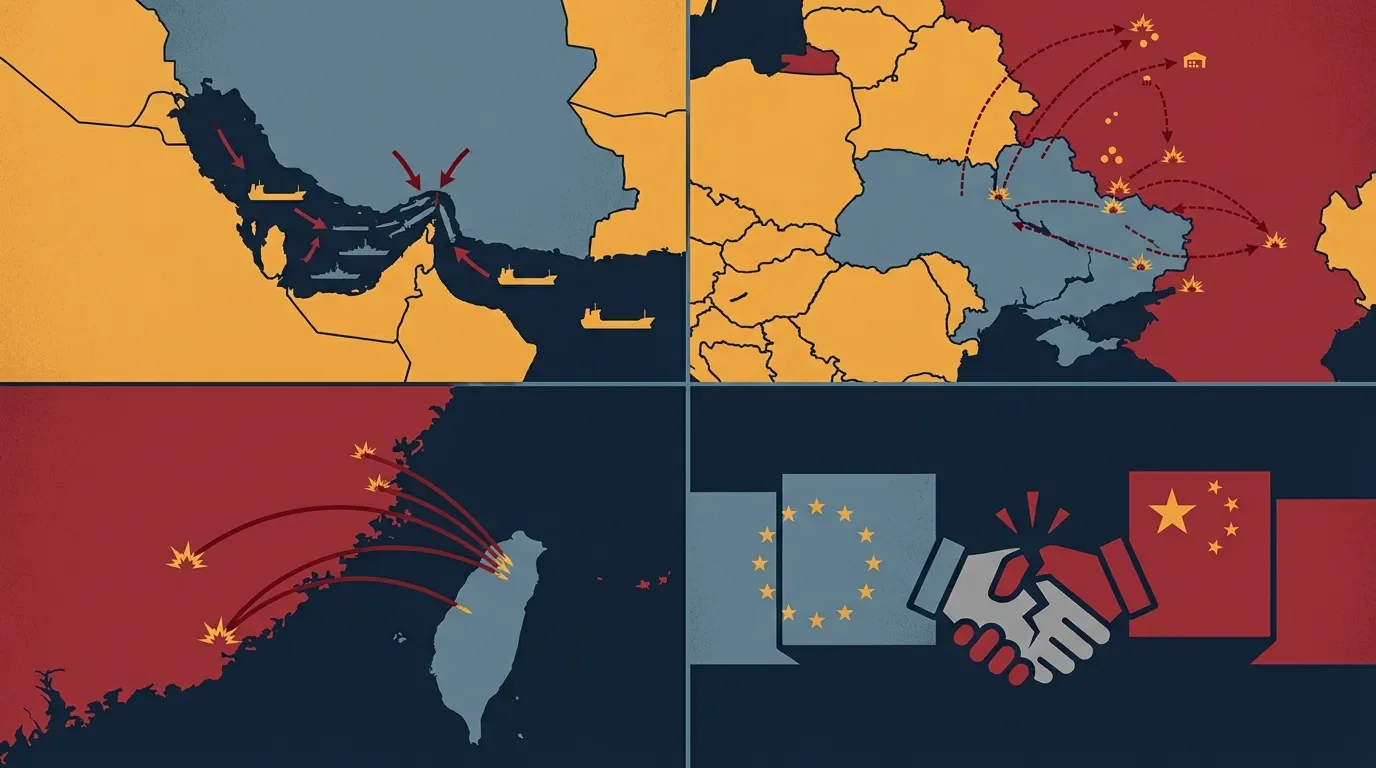
1. Iran–US: Trump claims "great settlement," drones still flying at Hormuz
After three days of strikes, US President Donald Trump cancelled a fourth round of attacks on Iran on June 11, posting on Truth Social that "discussions and final points have been approved by all parties involved." At the Oval Office he told reporters, "We just made a great settlement of the war with Iran," and said documents were "in pretty final shape" ahead of a possible signing "maybe in Europe" within days. 1
Tehran denied any final decision had been reached. Iran's Foreign Ministry said the US strikes had "effectively rendered the ceasefire meaningless," and the IRGC navy closed the Strait of Hormuz to all traffic on June 11, warning ships attempting passage would be fired upon. Hours into June 12, US forces shot down two Iranian attack drones near Hormuz after Tehran's forces fired on a transiting commercial vessel; the tanker later pulled back after IRGC warnings. 2 Netanyahu's office said Trump had assured Israel that any deal would require removal of enriched nuclear material, dismantling enrichment infrastructure, limits on missile production, and an end to support for Tehran's proxy network.
Supply-chain and market impact. Trump's announcement pushed Brent from a June 11 intraday high of $93.48 to a close of $90.38 — a drop of 2.92% — and WTI settled at $87.71, down 2.58%. 3 The US naval blockade of Iranian ports remains active, keeping roughly 20% of global oil and gas prewar volumes off the market. With the Strait still closed in practice, tanker diversions via Cape of Good Hope add 10–14 days to Asia-bound cargoes. The ECB raised its key deposit rate by 25 basis points to 2.25% on June 11, citing war-driven inflation — the first G7 central bank to move since the conflict began. 4
Key uncertainties. Iran has not confirmed any signed deal; skirmishes in the strait continued into June 12. Trump's prior "imminent deal" claims have twice preceded renewed exchanges.
Cargando tarjeta de estadísticas…
2. Russia–Ukraine: Crimea supply lines buckle, E3 ambassadors meet Moscow
Ukraine's drone campaign is severing Crimea's logistics. Ukraine's Unmanned Systems Forces commander Robert "Madyar" Brovdi said June 12 that the Novorossiya highway — Moscow's main military supply route through occupied southern Ukraine — had seen traffic cut by more than two thirds over the past month, and predicted Crimea would be "isolated in the near future." 5 Fuel stations in Sevastopol and Yevpatoriya ran dry; local authorities have imposed rationing covering petrol and, in some areas, food. Ukraine's 1st Separate Assault Regiment separately claimed the destruction of 50 Russian military vehicles loaded with ammunition and fuel on the Armiansk bridge linking Crimea to the mainland, calling the route "completely paralysed." Drone strikes also hit Togliatti — home to Russia's largest carmaker Avtovaz, on the Volga some 800 km southeast of Moscow — and Ukrainian forces struck deep targets using the domestically produced FP-5 Flamingo cruise missile.
On the diplomatic track, UK, French, and German ambassadors attended talks at Russia's Foreign Ministry in Moscow on June 12 with Lavrov's deputy — the first formal E3 engagement with Moscow since the E3 leaders set five peace conditions in London last week. Russia has stated it is "open to hear what Europe has to say." Germany's Chancellor Friedrich Merz said he envisioned a "just and lasting peace that also takes German security interests into account." 5
Supply-chain and market impact. Fuel shortages now reported in around a dozen Russian regions add logistics pressure on Russian defence production. Avtovaz, the Togliatti drone target, accounts for roughly 22% of Russian passenger car production; any extended shutdown would reduce domestic vehicle supply and strain already-squeezed dual-use component networks. European defence procurement — General Dynamics upgraded by Jefferies to buy with a $400 price target citing "continued strength of near-term results" — continues to benefit from the conflict's duration. 6
Key uncertainties. The E3–Russia talks have no confirmed agenda items; Moscow has not withdrawn its demand for a broader framework before a ceasefire. Whether Crimea's supply crunch translates into battlefield setbacks or internal Russian political pressure remains unclear.
Cargando tarjeta de contenido…
3. China–EU: Beijing cancels high-level meetings as trade tensions harden
China cancelled two high-level diplomatic meetings with the EU this month at short notice, including a ministerial-level digital dialogue and a session with Olof Skoog, deputy secretary-general of the EU diplomatic service, according to sources cited by the Financial Times. 7 No reason was given; both sides have previously used cancellations as diplomatic signals during trade and regulatory disputes. Xinhua ran commentary warning the EU against "trade war with China," while Chinese exports to Europe have surged sharply in 2026, prompting Brussels to advance new tariff investigations and proposals restricting Chinese access to public procurement and critical infrastructure.
A separate Reuters commentary published June 11 flagged that the renewed US–China trade truce struck in London last month left military-use rare earth export restrictions unresolved — an open question that constrains any fuller deal. 8 German Chancellor Merz has yet to back Brussels's plans to crack down on Chinese trade practices, with Reuters Breakingviews noting that his reluctance stems from Germany's €90 billion trade deficit exposure to China.
Supply-chain and market impact. Beijing's cancellations raise uncertainty over the timeline for EU–China trade negotiations as Europe tries to coordinate a unified posture. Delays in procurement access rules affect European semiconductor equipment and clean-energy component sourcing strategies. German industrial equities are most exposed; the DAX closed 0.6% higher on June 11, driven more by ECB rate news and the Iran deal announcement than by EU–China developments, with the China trade risk priced as a longer-term drag rather than an immediate shock. 3
Key uncertainties. The EU Commission said cancelled meetings would likely be rescheduled, but gave no timeline. Whether Merz's reluctance shifts after his domestic political situation stabilises is the key variable for a coordinated Brussels response.
4. Taiwan Strait: HIMARS fired west for the first time; China extends maritime pressure east
Taiwan completed a two-day live-fire exercise on June 11, firing US-supplied HIMARS rockets into the Taiwan Strait — the first time the system has been used in live-fire drills oriented toward the Chinese coast rather than the Pacific. Army Sgt. Wang Ming-hui said: "Due to the current enemy threat, we will continue HIMARS training with unwavering determination to protect Taiwan as the nation's strongest force." Taiwan's representative to the United States, Alexander Yui, acknowledged the geography plainly: "We're an island; we can only shoot east or west, so they chose west." Launchers manoeuvred into position and fired within three minutes, demonstrating the "shoot-and-scoot" mobility central to Taiwan's asymmetric doctrine. 9
China simultaneously announced a new maritime operation east of Taiwan — in the Philippine Sea — citing Japan–Philippines maritime boundary discussions as a pretext and asserting "maritime administrative jurisdiction" over the shipping lanes there. Beijing has been deploying coast guard vessels, civilian inspections, and sustained maritime pressure eastward, opening a second pressure front that has traditionally been seen as Taiwan's less-contested rear zone. A Reuters commentary published June 11 noted that Japan has responded by sinking a decommissioned US minesweeper in joint drills — the first time Japan fired missiles outside its own territorial waters since World War Two. Japan's PM Sanae Takaichi has boosted defence spending more than 9% in 2026 to ¥9 trillion ($58 billion), pledging to double it to 2% of GDP over five years. 10
Supply-chain and market impact. The $14 billion US arms package to Taiwan — which includes 82 additional HIMARS launchers — remains on hold following Trump's description of it as a "very good negotiating chip" after his Beijing summit with Xi. A sustained delay in that package limits Taiwan's rate of asymmetric rearmament. TSMC's Hsinchu fabs and the broader Asia semiconductor supply chain remain the principal commercial exposure; SOXX (iShares Semiconductor ETF) gained 8% on June 11, driven largely by Intel's Bank of America upgrade and the Iran deal announcement rather than Taiwan-specific developments. 3
Key uncertainties. South Korea's Supreme Court sentenced former President Yoon to 30 years in prison on June 12 over his drone-incursion role, adding a regional governance overhang. 11 Whether China's eastern maritime pressure constitutes a permanent shift or a negotiating signal ahead of 2028 Taiwan elections is unresolved.
Cargando tarjeta de contenido…
5. Markets snapshot: Iran deal rally, ECB hike, PPI overshoot
The Iran deal announcement reversed two days of equity losses. The Dow Jones Industrial Average closed up 929.97 points (+1.86%) to 50,848.75; the S&P 500 gained 1.75% to 7,394.30; the Nasdaq added 2.54% to 25,809.66. 3 Semiconductors led: SOXX gained more than 8%, with Intel up 9% after a Bank of America double-upgrade from underperform to buy. The rally ran parallel to two significant macro negatives. First, the US Producer Price Index rose 1.1% in May against a consensus of 0.7%, putting the 12-month headline PPI at 6.5% — the highest since November 2022. Second, the ECB raised its deposit rate to 2.25%, the first G7 central bank to respond to war-driven inflation. Pimco, in its 2026 secular outlook, warned of "fragmentation … in energy prices, supply chain data, growth rates, and investment returns" and called for "high-quality fixed income portfolios with yields of 5%–7%." 12
SpaceX priced its IPO at $135 a share, valuing the company at roughly $1.8 trillion for its Nasdaq debut on Friday, June 12 — the largest public offering in history. 13 Retail traders rotated out of AI chip positions to fund SpaceX allocations, contributing to this week's semiconductor volatility before Thursday's rebound. Asian markets closed mixed ahead of the deal announcement: Nikkei 225 ended flat at 64,217.27; Kospi recovered to +0.43% at 7,763.95 after opening down more than 4%; Hang Seng fell 0.77%; CSI 300 dropped 0.55%.
Key uncertainties. Whether the Iran deal holds and Hormuz reopens within days will determine whether the PPI overshoot fades or becomes entrenched. A failed deal signing would push Brent back toward $95 and likely prompt Fed commentary on inflation persistence.
Sources: Euronews, RFE/RL, The Independent, Reuters, CNBC, Caliber.Az/FT, Interactive Brokers. Data as of 08:00 UTC, 12 June 2026.
Fuentes de referencia
- 1Euronews — Trump says he is cancelling fresh strikes on Iran
- 2RFE/RL — US shoots down 2 Iranian drones near Hormuz
- 3CNBC — Stock market live updates June 11 2026
- 4Euronews — ECB raises interest rates for the first time in three years
- 5The Independent — Ukraine-Russia war live June 12 2026
- 6CNBC — Stocks making midday moves
- 7FT via Caliber.Az — China cancels high-level EU meetings
- 8Reuters — Breakingviews: Merz wavering cripples EU's tough China stand
- 9Caliber.Az — Taiwan conducts first HIMARS drill into Strait
- 10Reuters — As China menaces Taiwan and US grows unpredictable, Japan stands taller
- 11Reuters — South Korea court sentences ex-President Yoon
- 12Interactive Brokers — Wall Street Rebounds June 11 2026
- 13Reuters — Musk's SpaceX prices record $75 billion IPO
Añade más opiniones o contexto en torno a este contenido.