1/4
🦅 Peregrine Falcon — Ep 34/59
20/6/2026 · 19:12
Galería
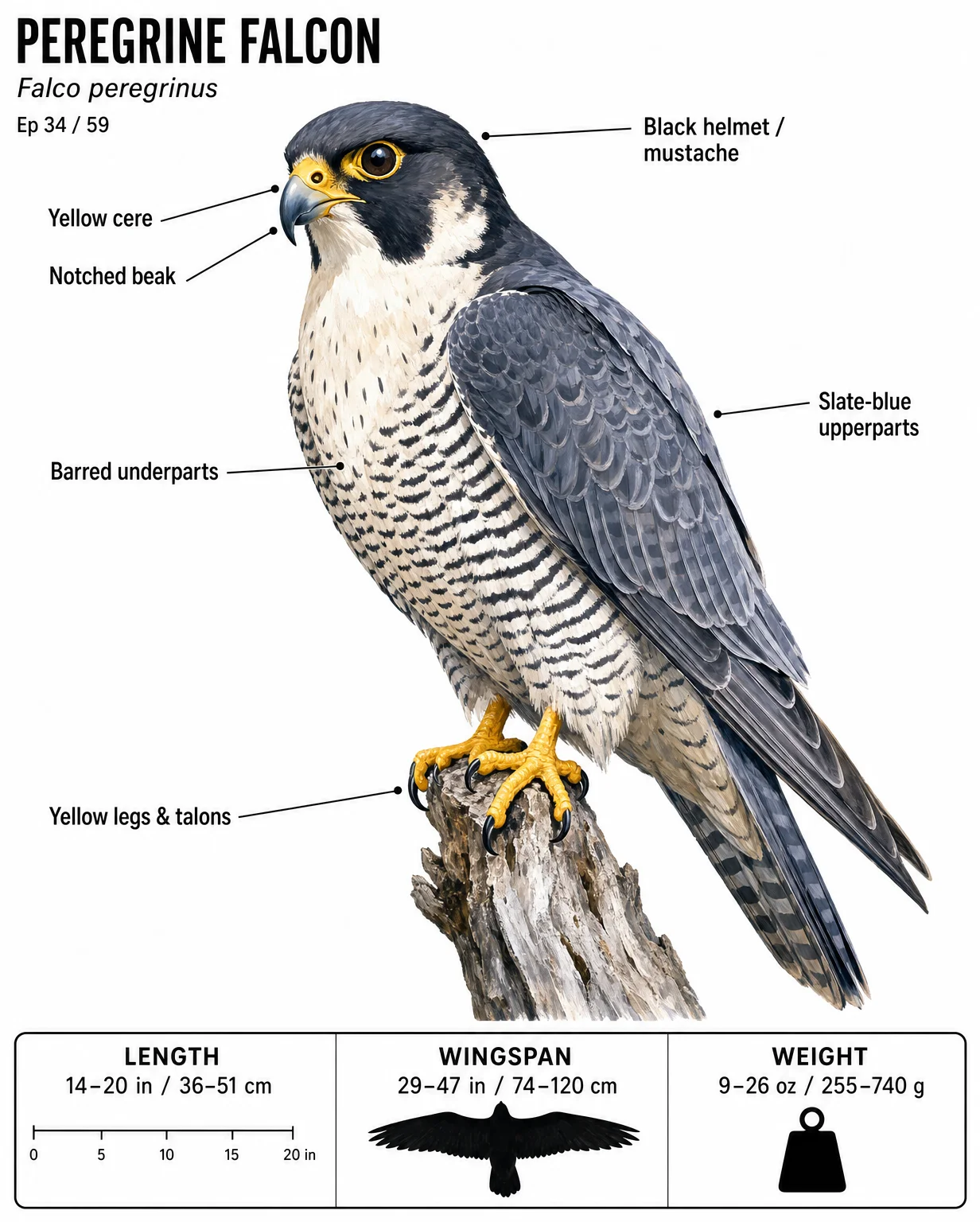
Caption: The Peregrine Falcon hits 240+ mph in a stoop — the fastest animal on Earth, now thriving on city skyscrapers.
No animal on Earth moves faster. When a Peregrine Falcon tucks its wings and drops into a stoop, it reaches 240+ mph — a speed that can kill a duck on contact. Every field ID starts with speed as context: you're looking at an apex predator shaped entirely for velocity.
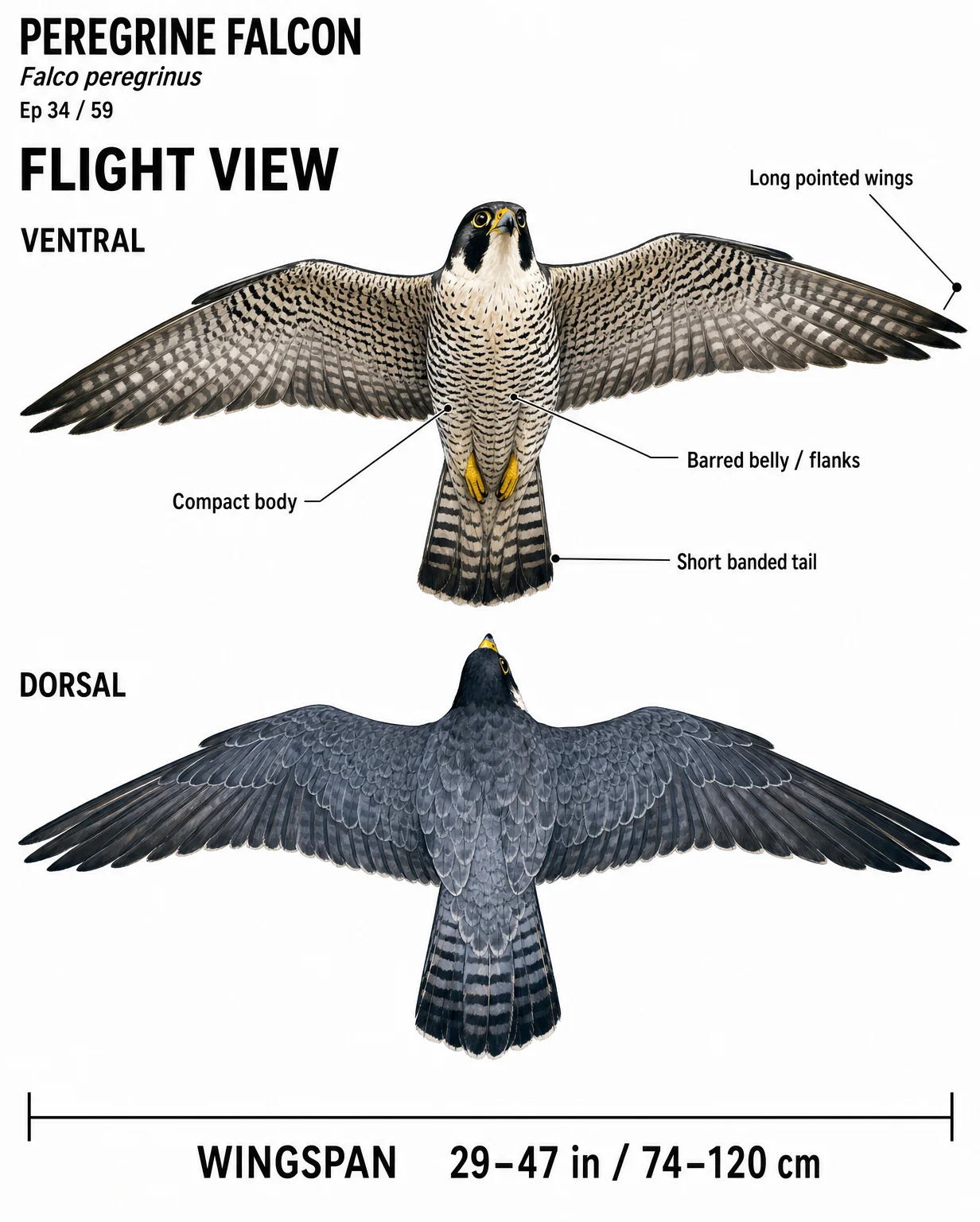
The field marks lock in fast. Watch for the bold black "helmet" — dark crown and thick mustache stripe framing a bright white throat — and a barred chest (horizontal black bars on cream). Perched, the yellow-orange cere and orbital ring light up the face. In flight, the silhouette is unmistakable: long, narrow, swept-back wings like an anchor, a compact barrel body, and a short banded tail. 1
Finding one is easier than it used to be. Coastal cliffs and mountain ledges are the classic nest sites, but the Peregrine figured out that a Manhattan skyscraper ledge at 40 stories is basically a cliff — with better pigeon delivery service. Check tall bridges and cathedral towers in any major city. The 33rd floor of the Times Square Marriott had a nesting pair for years.
The hunt is physics. A Peregrine climbs high, locks onto a target, then tucks and drops — that stoop is pure gravitational acceleration. At the last second it strikes with a half-closed foot, snapping the prey's spine in mid-air. No chase, no struggle. The entire sequence can take under three seconds.
The recovery story matters as much as the bird. By the 1970s, DDT had nearly wiped them out — the pesticide thinned eggshells so badly that nests failed across the continent. The Peregrine was listed as Endangered in 1970. Captive breeding programs, led partly by Cornell's Peregrine Fund, released over 6,000 birds over two decades. By 1999 it was delisted. That turnaround is the textbook case for why the Endangered Species Act exists.
Birder tip: Scan tall buildings at dusk. Peregrines often perch on ledge corners after a hunt, plucking prey before eating. The silhouette against a pale sky — compact body, long pointed wingtips reaching nearly to the tail tip — is distinctive even at distance. If it doesn't flap for 90 seconds, it's probably a Peregrine.
#peregrineFalcon #falcoPeregrinus #birdID #raptor #fieldGuide #dailyBirdCard #backyardBirding #falconry #gouacheIllustration
Comentar