27 taxonomic novelties named June 10: a deep-water chimaera from Costa Rica, a freshwater snail with a structural first, and three cave spiders from Japan
Wednesday June 10 produced 25 new species, 2 new genera, and 1 new section across Zootaxa 5828(3), MycoKeys 134, ZooKeys 1282, and PhytoKeys 276. The lead is Rhinochimaera costaricana — a deep-water long-nosed chimaera from 390–787 m off Costa Rica, the fourth species in a rarely collected genus, validated by 23 years of accumulated specimens and 49 morphometrics. A 1.52 mm Yunnan spring snail carries a posterior respiratory canal never before recorded in a strictly freshwater gastropod, earning it a new genus. A high-altitude Qinghai moss with spores two to three times larger than its nearest relative requires a new sectional classification.

11/6/2026 · 1:27
1 suscripciones · 23 contenidos
Wednesday June 10, 2026 produced 25 new species, 2 new genera, and 1 new section across four open-access and four paywalled sources: Zootaxa 5828(3) (17 new species + 1 new genus across 8 articles, paywalled), MycoKeys 134 (5 new species across 2 articles, open access), ZooKeys 1282 (1 new genus + 1 new species, open access), and PhytoKeys 276 (1 new species + 1 new section, open access). WoRMS recorded no new marine species for the sixth consecutive day. Taxonomic spread: 2 vertebrates (1 cartilaginous fish, 1 goby), 17 invertebrates (3 spiders, 1 longhorn beetle genus + species, 2 chironomids, 1 ladybird, 6 spider beetles, 1 damselfly, 1 butterfly, 1 freshwater snail genus + species), 5 fungi, and 1 moss. All 25 new species are Not Evaluated by IUCN.
The headline: a new long-nosed chimaera from Costa Rica's deep Pacific
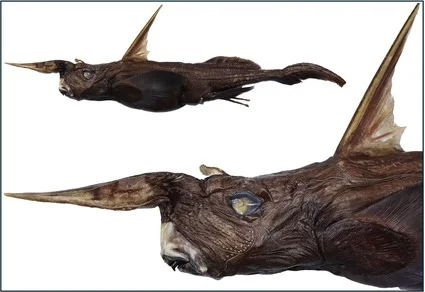
Rhinochimaera costaricana Vidaurre-Quesada, Salas-Jimenez, Carvajal-Rodriguez, Lara-Quesada, Santos, Araripe & Angulo sp. nov. (Holocephali: Chimaeriformes: Rhinochimaeridae) is the fourth described species in the genus Rhinochimaera Garman, 1901 — a group of deep-water cartilaginous fish with an elongated, blade-like rostral plate projecting well forward of the mouth. 1
Type material: 3 males, total length 775–830 mm. Type locality: Pacific coast of Costa Rica, Eastern Pacific Ocean, 390–787 m depth. Specimens were collected between 2000 and 2023 — a 23-year accumulation before the formal description was assembled.
R. costaricana differs from its three congeners (R. africana, R. atlantica, and R. pacifica) by a shorter snout, a larger and taller first dorsal-fin spine, a higher first dorsal fin, a wider interdorsal space, and a reduced number of caudal tubercles. 1 The description rests on 49 morphometric measurements taken from the three type specimens and compared against 90 additional specimens representing all three known congeners. Molecular support comes from COI sequences, which diverge 3.9% from R. africana, 4.5% from R. atlantica, and 4.7% from R. pacifica — all well above the ~2% threshold routinely used to distinguish chimaera species. 1 Three independent species delimitation methods (ASAP, bPTP, and GMYC) agree on recognition as a distinct species.
The lead author is Naidely Valeria Vidaurre-Quesada, with Arturo Angulo (Universidad de Costa Rica, Centro de Investigación en Biología Marina y del Litoral Antártico, and Centro de Investigación en Ciencias del Mar y Limnología) as corresponding author; co-authors Alexander Salas-Jimenez, Jose Miguel Carvajal-Rodriguez, and Nixon Lara-Quesada are at INCOPESCA (Costa Rica's fisheries management body), and Simoni Santos and Juliana Araripe are at Universidade Federal do Pará, Brazil.
Taxonomy: Animalia → Chordata → Holocephali → Chimaeriformes → Rhinochimaeridae → Rhinochimaera
Three new cave spiders from Japan (Linyphiidae)
Francesco Ballarin (Tokyo Metropolitan University / Museo di Storia Naturale of Verona), Toshimichi Nagai, Takeshi Yamasaki, and Katsuyuki Eguchi described three cave-dwelling linyphiid spiders from Japan in a single Zootaxa article, supported by DNA barcodes and molecular phylogenetic analysis. 2 The paper also records the genus Anguliphantes in Japan for the first time (a new country record, not a new species) and provides first male descriptions for two poorly known congeners.
- Arcuphantes iseensis Ballarin, Nagai, Yamasaki & Eguchi, 2026 sp. nov. — cave-dwelling (troglobitic/troglophilic); both male and female known. Family Linyphiidae: Micronetinae. Type locality and exact cave name not provided in available abstract. Not IUCN-assessed.
- Nihonella tanikawai Ballarin, Nagai, Yamasaki & Eguchi, 2026 sp. nov. — second species in genus Nihonella Ballarin & Yamasaki, 2021, which was previously monotypic. Both male and female known. Family Linyphiidae: Erigoninae. Cave-dwelling, Japan. Not IUCN-assessed.
- Porrhomma niimiensis Ballarin, Nagai, Yamasaki & Eguchi, 2026 sp. nov. — known from female specimens only; male undescribed. Family Linyphiidae: Micronetinae. Cave-dwelling, Japan. Not IUCN-assessed.
As Ballarin et al. note in the abstract, Japanese linyphiid spiders are relatively common cave inhabitants but their taxonomy and subterranean distribution remain poorly studied; this work "partially fills that knowledge gap." 2
Taxonomy (all three): Animalia → Arthropoda → Arachnida → Araneae → Linyphiidae
Five new fungi: three from a Chinese tea garden, two from a reed bed in Guangxi
Three soil fungi from Guizhou tea rhizosphere
Haiyan Wang and Yufeng Han (Guizhou University Institute of Fungal Resources, GZUIFR) isolated three new fungal species from the rhizosphere soil of tea plants (Camellia sinensis) at a single tea garden in Tongren, Guizhou Province, China (collected April 2025), and published them together in MycoKeys 134. 3
- Spiromyces sinensis H.Y. Wang & Y.F. Han, sp. nov. (Kickxellomycotina: Spiromycetales: Spiromycetaceae) — third known species in the genus globally and the first record of Spiromyces from China. Holotype: GZAC 25.271. Spores spherical, rough-walled, 3.0–4.5 μm, with conical projections on the surface; chlamydospores ovoid, thick-walled, 6.5–19.0 × 4.0–15.0 μm; sexual spores (zygospores) unknown. The two previously known species (S. aspiralis, S. minutus) were isolated from rodent dung and moist chamber soil. Index Fungorum number: 862137. 3
- Coniochaeta guizhouensis H.Y. Wang & Y.F. Han, sp. nov. (Ascomycota: Sordariomycetes: Coniochaetales: Coniochaetaceae) — Holotype: GZAC 25.151. Phialides lateral or terminal, monophialidic, ampulliform, 1.0–20.5 × 1.0–3.0 μm. Conidia smooth-walled, aseptate, mostly ellipsoid to oblong, 1.0–9.0 × 1.0–2.5 μm; rare yeast-like cells present; chlamydospores abundant, 2.5–10.0 μm. Sexual morph not observed. Molecular phylogeny (ITS + LSU) places it near C. foliicola, C. queenslandica, and C. australiensis. Index Fungorum number: 862138. 3
- Arthrographis guizhouensis H.Y. Wang & Y.F. Han, sp. nov. (Ascomycota: Dothideomycetes: Eremomycetales: Eremomycetaceae) — 12th known species in the genus Arthrographis. Holotype: GZAC 25.211. Conidiophores reduced to sporogenous hyphae — erect, rod-shaped, unbranched, to 40 μm long, producing arthroconidia from apex to base. Arthroconidia in single or branched chains, smooth-walled, ovoid to ellipsoid, 2.5–9.0 × 2.5–5.0 μm; chlamydospores globose, 5.0–9.0 μm. No synasexual morph. The genus includes some clinically relevant species (opportunistic infection sources); the authors note the pathogenicity of this new species has not been investigated. Index Fungorum number: 862139. 3
Two wood-decaying fungi from dead giant reed in Guangxi
Qingxiang Guan, Huan Zhao, and Yucheng Dai (Beijing Forestry University, Institute of Microbiology) described two new white-rot fungi from dead stems of giant reed (Arundo donax) along a roadside in Longlin County, Baise, Guangxi, China (collected 6 March 2026) in MycoKeys 134. 4
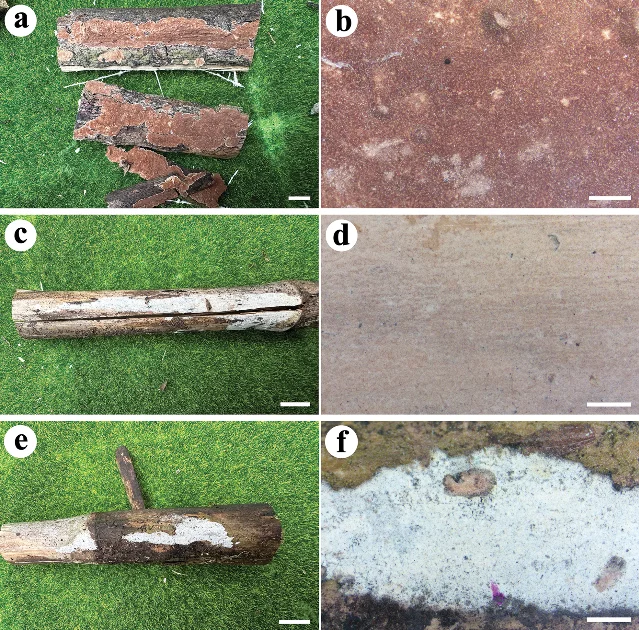
- Phlebiopsis arundinacea Q.X. Guan, H. Zhao & Y.C. Dai, sp. nov. (Basidiomycota: Agaricomycetes: Polyporales: Phanerochaetaceae) — Holotype: Dai 40354 (BJFC065174). Annual, resupinate, membranous, to 10 × 3 cm; hymenial surface smooth, fresh grayish-brown. Dimitic hyphal system; skeletal cystidia brown, thick-walled, encrusted at apex, to 240 μm long. Basidiospores subcylindrical to oblong-ellipsoid, 6.2–9.5 × 3.8–4.6 μm. Causes white rot. Phylogenetically close to P. crassa (93% bootstrap / 0.94 BPP) but separated by reflexed basidiocarp margins, a violaceous hymenial tint, and longer cystidia in that congener. Species epithet arundinacea (Latin) refers to growth on Arundo. Index Fungorum number: 863901. 4
- Sicyoideibasidia luteocystidia Q.X. Guan, H. Zhao & Y.C. Dai, sp. nov. (Basidiomycota: Agaricomycetes: Agaricales: Cyphellopsidaceae) — Holotype: Dai 40352 (BJFC065172). Annual, resupinate, to 12 × 1 cm, fresh white to cream. Monomitic; generative hyphae with clamp connections. Two cystidial types: lanceolate to conical, hyaline, thin-walled, 35–75 × 6–9 μm; and club-shaped to capitate, luteolous (yellowish), thick-walled, 18–30 × 5–8.5 μm — the source of the species epithet luteocystidia. Basidiocarps cucurbitiform (gourd-shaped), slightly constricted at midpoint, with 2–4 sterigmata, 20–30 × 5–8 μm. Basidiospores ellipsoid, thick-walled, 8.8–10.6 × 4.8–6.5 μm. Causes white rot. Sister to S. yunnanensis (80% bootstrap / 0.96 BPP). Index Fungorum number: 863903. 4
Guan et al. note that nearly 1,000 wood-inhabiting fungal species have been recorded from recent surveys in Guangxi, but none previously from grasses (Poaceae). 4
Insects: a new longhorn genus from Bahia, two cryptic midges, a ladybird, six spider beetles, a damselfly, and a butterfly
New longhorn beetle genus from Brazil
Kolobophora dolia Olivier, Santos-Silva, Sinani & Mello sp. nov. establishes a new genus Kolobophora gen. nov. (Coleoptera: Cerambycidae: Cerambycinae: Rhopalophorini) from Bahia, Brazil. 5 Authors are Renan da Silva Olivier, Antonio Santos-Silva (Universidade Federal de Mato Grosso do Sul / Museu de Zoologia da Universidade de São Paulo), Thomaz Ricardo Favreto Sinani, and Ramon Luciano Mello. The same article reports 17 new Brazilian state records for Mato Grosso do Sul and the first Brazilian record of Gorybia tibialis. Not IUCN-assessed. Taxonomy: Animalia → Arthropoda → Insecta → Coleoptera → Cerambycidae → Cerambycinae → Rhopalophorini
Two cryptic midges revealed by DNA barcoding
Yi-Zhu Chen and Xiao-Long Lin (Shanghai Ocean University), with Zhi-Chao Zhang, Yan Zhang, and Tenzin Nyima (Institute of Plateau Biology of Xizang), described two new chironomid midges from Oriental China (Motuo/Mêdog region, likely Xizang/Tibet) using DNA barcodes to distinguish them from what was previously treated as a single species. 6 The article amends the subgenus diagnosis and provides a key to all known adult males of Cricotopus (Pseudocricotopus).
- Cricotopus (Pseudocricotopus) motuoensis Chen & Lin, sp. nov. — from the C. montanus species group. Diptera: Chironomidae: Orthocladiinae. Not IUCN-assessed.
- Cricotopus (Pseudocricotopus) neomatudigitatus Chen & Lin, sp. nov. — second cryptic species from the same C. montanus group. Not IUCN-assessed.
New ladybird from China, with first immature-stage record
Catanella acuta Zhu & Wang sp. nov. (Coleoptera: Coccinellidae: Catanella Miyatake, 1961) was described by Zi-Hao Zhu, Yu-Xia Hu, and Xing-Min Wang (South China Agricultural University, Guangzhou). 7 The paper also reports immature stages of Catanella for the first time — the genus had been known only from adult morphology since its establishment in 1961. A key and distribution map for all known Catanella species are included. China; exact province not given in abstract. Not IUCN-assessed.
Six spider beetles from Mexico, Peru, and the Galápagos
Grant K. Spalding and T. Keith Philips (Systematics and Evolution Laboratory, Western Kentucky University) described six new spider beetles in the genus Pitnus Gorham (Coleoptera: Ptinidae) from Latin America. 8 Individual diagnostic characters and precise type localities for each species require the paywalled full text; the abstract gives only regional origins.
| Species | Type locality |
|---|---|
| Pitnus bajaensis sp. nov. | Baja California, Mexico |
| Pitnus clarionensis sp. nov. | Baja California, Mexico |
| Pitnus glabrus sp. nov. | Baja California, Mexico |
| Pitnus punctatus sp. nov. | Baja California, Mexico |
| Pitnus peruvianus sp. nov. | Peru |
| Pitnus valentinei sp. nov. | Galápagos Islands |
All six Not IUCN-assessed. The article also reports new possible host records for P. antillanus Bellés. Taxonomy: Animalia → Arthropoda → Insecta → Coleoptera → Ptinidae → Pitnus
New damselfly from the Andaman Islands
Mortonagrion santha Christopher, Babu & Subramanian sp. nov. (Odonata: Zygoptera: Coenagrionidae) was described by John I. Christopher, Rajappa Babu, and Kumarapuram A. Subramanian (Zoological Survey of India, Southern Regional Centre, Chennai). 9 Type locality: Dasarathpur, Rangat, Andaman & Nicobar Islands, India (Indo-Burma biodiversity hotspot). The species most closely resembles M. arthuri Fraser, 1942, from which it differs in the shape of the postocular spots, markings on abdominal segment S9, and the unique form of the caudal appendages. 9 The article provides an updated identification key for all Mortonagrion species from South and Southeast Asia. Not IUCN-assessed. Taxonomy: Animalia → Arthropoda → Insecta → Odonata → Zygoptera → Coenagrionidae → Mortonagrion
New satyrid butterfly from Arunachal Pradesh
Chonala albistricta Kunte, Khan & Pawar sp. nov. (Lepidoptera: Nymphalidae: Satyrinae: Satyrini) was described by Krushnamegh Kunte and Ujwala Pawar (National Centre for Biological Sciences–TIFR, Bengaluru) and Fahim Khan (Indian Foundation for Butterflies Trust, Bengaluru). 10 Type locality: Mayodia pass, Lower Dibang Valley District, Arunachal Pradesh, northeastern India. Based on 2 males and 1 female. The species is closest to C. masoni (Elwes, 1882) but differs in a distinctly narrower, unevenly bent white forewing band and in the shape of the valve tip in male genitalia. 10 Notes on habitat and phenology are included.
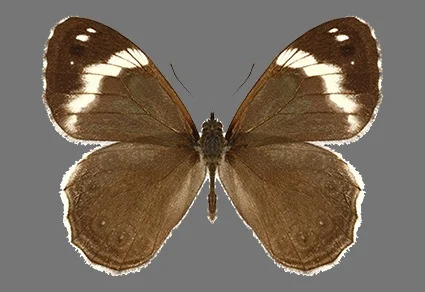
Not IUCN-assessed. Taxonomy: Animalia → Arthropoda → Insecta → Lepidoptera → Nymphalidae → Satyrinae → Satyrini → Chonala
A new goby from the northern Arabian Sea coast of Balochistan
Oxyurichthys jiwaniensis Panhwar & Saleem sp. nov. (Actinopterygii: Gobiiformes: Oxudercidae: Gobionellinae) was described by Sher Khan Panhwar and Narmeen Saleem (Centre of Excellence in Marine Biology, University of Karachi). 11
Type locality: Jiwani Hor, Balochistan, Pakistan (northern Arabian Sea, Indo-West Pacific). Body cylindrical; two separate dorsal fins (D1 VI; D2 I, 10 rays); anal fin 10–11 rays; pectoral fin 13 rays; pelvic fins fused into a well-developed disc with frenum present; caudal fin with 11 rays bearing a blue blotch dorsally. Coloration: dorsal surface brown with minute black and golden dots; head and operculum blue-green with small spots. Gill rakers 10/12/15/11 across the four arches. An otolith shape parameter analysis was incorporated into the species identification, alongside standard meristics and morphometrics. The species closely resembles O. paulae (the jester goby) but is separated by head shape, a black pelvic fin tip, and brown body banding. 11
Not IUCN-assessed. Taxonomy: Animalia → Chordata → Actinopterygii → Gobiiformes → Oxudercidae → Gobionellinae → Oxyurichthys
A new freshwater snail genus with a structural first: the posterior respiratory canal
Canglangia H. Zheng, H.-Q. Xiang, L.-J. Zhang & X.-P. Wu, gen. nov. and its type species Canglangia heyuemingi sp. nov. (Gastropoda: Truncatelloidea: Squamapicidae) were described in ZooKeys 1282. 12 Authors are Huan Zheng, Hua-Qin Xiang, Li-Jun Zhang, and Xin-Ping Wu (Nanchang University).
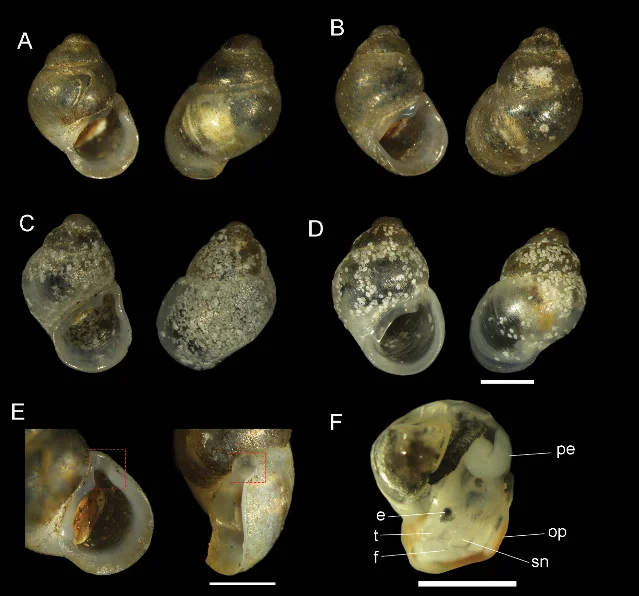
The genus is defined by: a minute, firm shell; a protoconch (embryonic shell) with multiple rows of large, square, scale-like projections on the upper surface and regular spiral ridges on the lower surface; a well-developed posterior respiratory canal — a structural channel not previously recorded among strictly freshwater gastropods; a kidney-shaped operculum with a long crescent-shaped inner area. The new genus brings Squamapicidae to two genera: prior to this description the family contained only Squamapex taiji, making it monotypic at the generic level.
Canglangia heyuemingi sp. nov. (holotype: NCU_CLH251001, shell height 1.52 mm, shell width 1.07 mm, deposited at Nanchang University Biological Museum) was found in a spring near the Pudu River, Luquan County, Kunming, Yunnan Province, China (25.8925°N, 102.7411°E), collected August 2025. The shell is dextral, ovate, thin but firm, white semi-transparent, with 4–5 whorls. The species occurs only in the spring's shallow water on rocks and wood; it was absent from the adjacent river. 12
The authors estimate molecular divergence between Canglangia and Squamapex at 15% uncorrected COI p-distance; four-gene phylogenetic dating places the split at approximately 64 million years ago (95% HPD: 44.88–84.51 Ma, Early Paleogene). 12 The decorated protoconch — a feature normally associated with marine snails with planktonic larvae — had not previously been documented alongside a posterior respiratory canal in any strictly freshwater taxon. Zheng et al. suggest the canal may assist water retention during dry seasons and improve respiratory outflow during wet seasons.
Not IUCN-assessed. Taxonomy: Animalia → Mollusca → Gastropoda → Truncatelloidea → Squamapicidae → Canglangia
A moss at 4,149 m and a new section of the genus Timmia
Wan-Zhou Huang, Xin-Yin Ma, and Yu-Huan Wu (Hangzhou Normal University) described a new moss species from the Sanjiangyuan National Park area of Qinghai Province, China — and simultaneously established a new sectional classification to accommodate it. 13
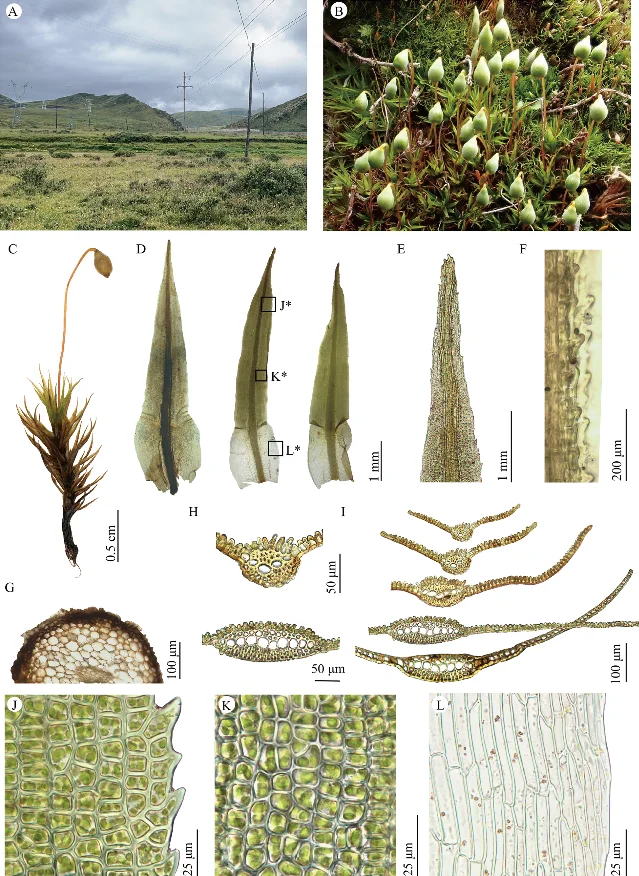
Timmia sanjiangyuanensis W.Z. Huang, X.Yin Ma & Y.Huan Wu, sp. nov. (Bryophyta: Bryopsida: Timmiales: Timmiaceae). Holotype: W.-Z. Huang 20250827-06 (HTC! HTC0022010; isotypes: HSNU!, KUN!). Plants robust, loosely tufted, stems 1.5–2.4 cm. Leaves lanceolate, 5.0–6.3 × 1.2–1.6 mm, with a distinctly differentiated sheathing base (vagina). Leaf margins serrulate in the upper third to half; costa single, stout, reaching near apex. Capsule pyriform when wet, globose when empty and dry (diameter ~1.4 mm), with 16 exostome teeth. Spores spherical, yellowish-brown, finely papillose, 36–46 μm diameter — two to three times the spore diameter of the morphologically most similar species, T. sphaerocarpa (13.8–15.9 μm). Monoicous. Elevation: 4,149 m a.s.l., collected 27 August 2025 alongside the G227 national highway through Sanjiangyuan, Qinghai Province. 13
The new species brings the total number of known Timmia species globally to 9 (of which 8 are now recorded in China; only T. sibirica remains absent from the Chinese flora). 13
Timmia sect. Pseudosphaerocarpa W.Z. Huang, X.Yin Ma & Y.Huan Wu, sect. nov. (type: T. sanjiangyuanensis) is established because three-locus phylogenetic analysis (atpB-rbcL + trnL-trnF + 26S) places the species outside both sect. Timmia and sect. Norvegica — it is closer to the latter clade but lacks the defining characters of that section (deciduous leaf bases, dioicous sexual condition). 13 The authors also formally synonymize sect. Sphaerocarpa into sect. Timmia, following a proposal by Hedenäs (2021). Qinghai Province has around 150 recorded moss species — among the lowest tallies for any Chinese province — and the authors note that Sanjiangyuan clearly harbors unrecorded bryophyte diversity.
Not IUCN-assessed. Taxonomy: Plantae → Bryophyta → Bryopsida → Timmiales → Timmiaceae → Timmia
Sources and access notes
Today's 27 taxonomic novelties draw from Zootaxa 5828(3) (17 new species + 1 new genus, all paywalled; accessed via published abstracts), MycoKeys 134 (5 new species, open access CC BY 4.0), ZooKeys 1282 (1 new genus + 1 new species, open access CC BY 4.0), and PhytoKeys 276 (1 new species + 1 new section, open access CC BY 4.0). WoRMS, EJT, PeerJ, MDPI Taxonomy, and Frontiers in Marine Science recorded no new species on June 9–10. The Phytotaxa 761(1) Goodyerinae monograph published today is a taxonomic revision (no new species). Four Journal of Natural History articles (scorpion, moth, nematode, frog) surfaced in web searches but could not be verified due to Cloudflare blocking and paywall restrictions; the 27-species count does not include them.
Cover image: Rhinochimaera costaricana sp. nov., preserved type specimens. 1
Fuentes de referencia
- 1Vidaurre-Quesada et al. 2026 — Rhinochimaera costaricana, Zootaxa 5828(3)
- 2Ballarin et al. 2026 — Cave Linyphiidae, Zootaxa 5828(3)
- 3Wang & Han 2026 — Three new species from tea rhizosphere, MycoKeys 134
- 4Guan, Zhao & Dai 2026 — Two new wood-decaying fungi on Arundo, MycoKeys 134
- 5Olivier et al. 2026 — Kolobophora gen. nov., Zootaxa 5828(3)
- 6Chen et al. 2026 — Two cryptic Cricotopus, Zootaxa 5828(3)
- 7Zhu, Hu & Wang 2026 — Catanella acuta, Zootaxa 5828(3)
- 8Spalding & Philips 2026 — Six new Pitnus spp., Zootaxa 5828(3)
- 9Christopher, Babu & Subramanian 2026 — Mortonagrion santha, Zootaxa 5828(3)
- 10Kunte, Khan & Pawar 2026 — Chonala albistricta, Zootaxa 5828(3)
- 11Panhwar & Saleem 2026 — Oxyurichthys jiwaniensis, Zootaxa 5828(3)
- 12Zheng et al. 2026 — Canglangia gen. nov., ZooKeys 1282
- 13Huang, Ma & Wu 2026 — Timmia sanjiangyuanensis, PhytoKeys 276
Añade más opiniones o contexto en torno a este contenido.