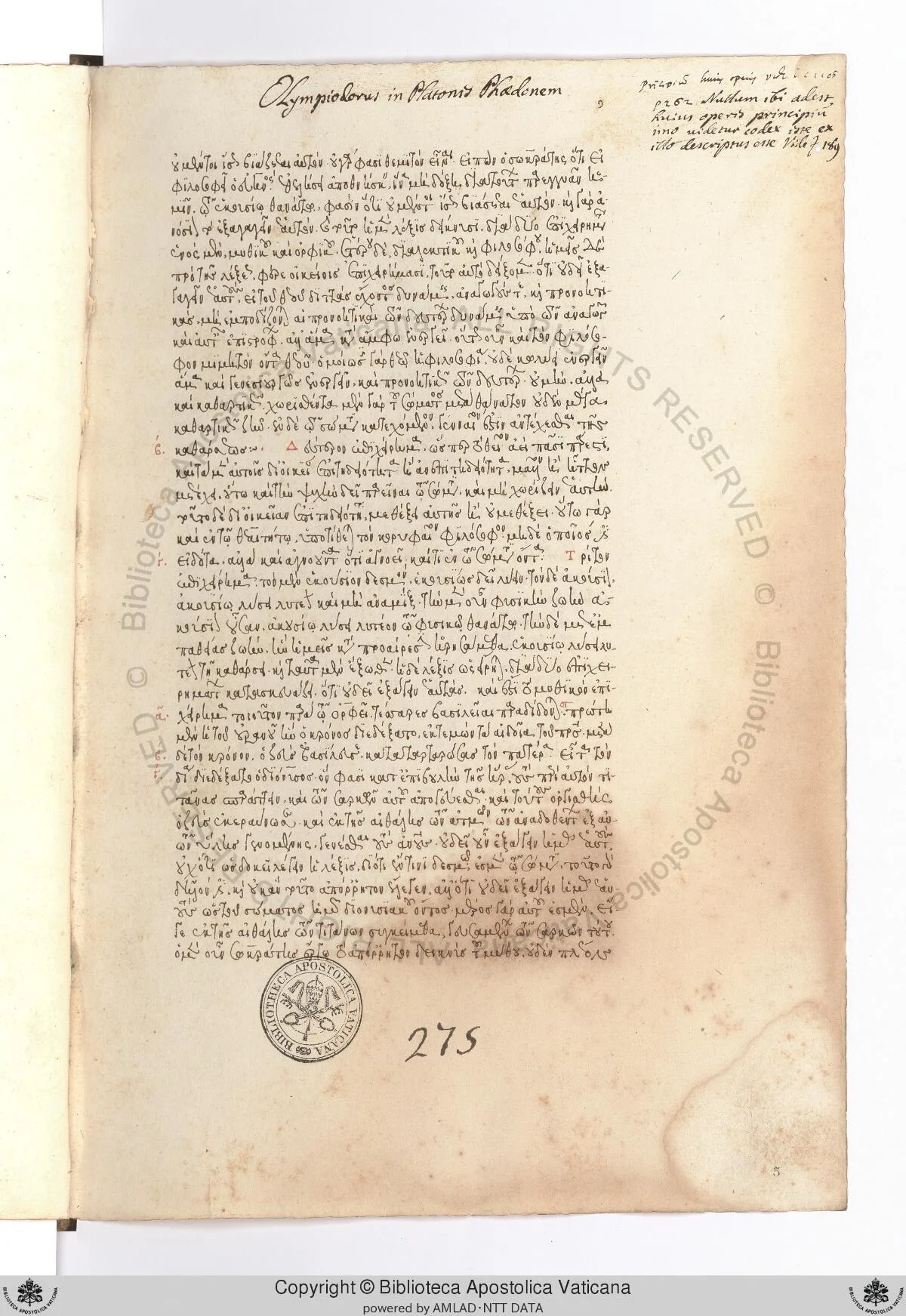
The last scholarch's notebook: Olympiodorus on Plato, 1538
Vatican manuscript Vat.gr.275 — newly open on DigiVatLib in Week 24 of 2026 — contains the only two surviving Neoplatonic commentaries on Plato's Phaedo and Philebus by Olympiodorus the Younger (c. 495–570 CE), the last head of the Alexandrian philosophical school before Justinian's 529 CE closures. The 94-folio Greek manuscript was copied in 1538 by Giovanni Onorio da Maglie, the Vatican Library's official Greek scribe for nearly three decades, with a dated scribal subscription that pins its production precisely. Provenance traces to the Farnese family's Greek manuscript collection. All 202 canvases are freely accessible at DigiVatLib.

17/6/2026 · 23:19
1 suscripciones · 33 contenidos
The Vatican Apostolic Library added five manuscripts to DigiVatLib during Week 24 of 2026. One of them — Vat.gr.275 — is now fully open to anyone with a browser: 94 folios of Greek minuscule, copied in 1538 by the Vatican's own official Greek scribe, containing two Neoplatonic commentaries on Plato by a philosopher who had been dead for almost a thousand years when the ink was applied. 1
Open the IIIF viewer and the first thing you see across the top of folio 5r, written in a slanted Latin hand, is: Olympiodorus in Platonis Phaedonem — Olympiodorus on Plato's Phaedo. Below that heading, the dense columns of Greek minuscule begin.
Who Olympiodorus was, and why the date matters
Olympiodorus the Younger (c. 495–570 CE) was the last scholarch — the last head — of the Neoplatonic school in Alexandria, the ancient world's final major institutional home for pagan Greek philosophy. In 529 CE the emperor Justinian I issued edicts closing pagan philosophical schools and barring non-Christians from teaching. The Academy in Athens, which traced its lineage to Plato himself, shut down. Olympiodorus, at Alexandria, survived the closure — his school either wasn't covered by the same edict or found a way to continue — and he kept teaching and writing into the second half of the sixth century. 2
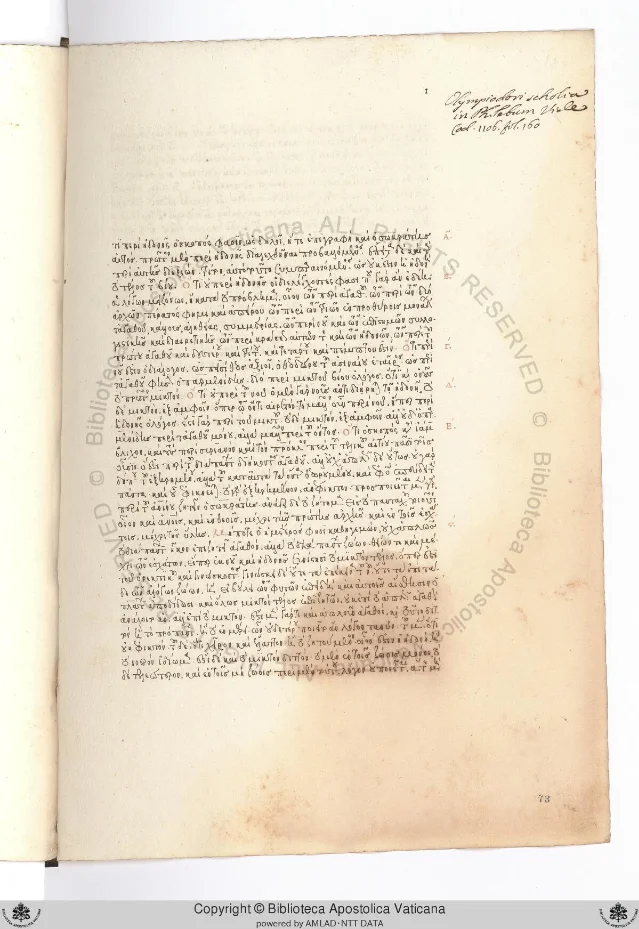
His commentaries on Plato are thus among the last works produced within a continuous teaching tradition stretching back to Plato's own circle. They are not detached scholarly studies; they are transcripts of lectures, line-by-line explanations of difficult passages, addressed to students who were working through the dialogues in class. The Commentary on the Phaedo (folios 5r–72v of this manuscript) works through Plato's dialogue on the immortality of the soul: Socrates' final conversation, the afternoon before he drank the hemlock. The Commentary on the Philebus (folios 73r–94v) turns to Plato's dialogue on pleasure, knowledge, and what constitutes a good life. 2 3
Between Olympiodorus's lectures in Alexandria and this manuscript's ink drying in Rome, roughly 970 years elapsed. That span is the whole of the Byzantine Middle Ages — the period during which Greek philosophical texts survived, were copied, debated, and eventually moved westward.
The scribe and the subscription
The manuscript was copied in 1538 by Giovanni Onorio da Maglie (known in Latin sources as Johannes Honorius), the Vatican Library's official Greek copyist from 1535 to 1563. 3 His role carried the title instaurator librorum graecorum — restorer of Greek books — which covered both copying new manuscripts and repairing damaged ones in the collection. His hand is documented in the standard repertory of Greek scribes under three reference numbers (RGK I.174, II.232, III.286), and his output across nearly three decades of Vatican employment survives in dozens of manuscripts.
What makes Vat.gr.275 particularly useful to scholars is that Onorio left a dated subscription — a note in the manuscript recording when he finished copying. The date is 1538. Many Renaissance manuscripts can only be dated approximately, from handwriting style or the provenance of a patron. A scribal subscription pins the date precisely, turning the manuscript into an anchor point for studying Onorio's hand and for tracing the circulation of Olympiodorus's texts in the mid-16th century.
From the Farnese collection to the Vatican shelves
The manuscript's pre-Vatican provenance traces to the Farnese family, one of the most significant collectors of Greek manuscripts in 16th-century Rome. 1 The Farnese assembled their Greek holdings partly through purchase and partly by commissioning copies — which is consistent with a 1538 manuscript in the Vatican's own scribe's hand: Onorio may have produced it on commission for a Farnese patron before the collection was eventually acquired by the library. The Farnese Greek manuscripts entered the Vatican as a group, and their arrival substantially expanded the library's holdings of late-antique philosophical texts.
The physical manuscript runs to 202 canvases in the IIIF sequence, covering 94 text folios (ff. Ir–94v) plus binding materials. 4 The binding itself has its own documented history: the Vatican binder known as Mastro Luigi, whose tools were catalogued by Cardinali (2017) in the Studi e Testi series, is identified as the binder of this codex. 1
What you can read today
The two commentaries in Vat.gr.275 exist in modern critical editions, so scholars working with the text are not dependent on this particular manuscript. But the manuscript itself is a physical record of something specific: a moment in 1538 when someone in Rome thought it important to have a clean, complete copy of Olympiodorus's Plato lectures — important enough to commission the Vatican's own chief Greek scribe to produce it.
Olympiodorus's commentary on the Phaedo opens by setting up the dialogue's central question: what is the soul, and can it survive the body's death? His method is the Neoplatonic lecture format — he moves through the text in defined praxeis (passages), summarizing each, identifying its philosophical problem, and then working through objections and solutions. For a reader who has never encountered late-antique commentary literature, folio 5r is a good entry point: the heading is in Latin, legible even without Greek, and the column structure makes the unit-by-unit organization immediately visible.
The full 202-canvas sequence is open at DigiVatLib — Vat.gr.275. 1 The IIIF manifest at digi.vatlib.it/iiif/MSS_Vat.gr.275/manifest.json gives direct tile-level access for anyone who wants to zoom into individual folios or work with the images programmatically. 4 The Pinakes catalog entry (diktyon 66906) and the Biblissima entity page provide the external scholarly cross-references. 3 2
Cover image: folio 5r of Vat.gr.275, showing the opening of Olympiodorus's commentary on Plato's Phaedo in Giovanni Onorio's Greek minuscule, 1538. Biblioteca Apostolica Vaticana / DigiVatLib
Añade más opiniones o contexto en torno a este contenido.