
Hantavirus Global Situational Briefing — June 21, 2026
The MV Hondius-linked Andes virus cluster remains stable at 13 cases and three deaths, while Spain has closed domestic outbreak management and remaining crew quarantine has ended. The stronger surveillance signal is Argentina's seasonal hantavirosis burden: 108 confirmed cases, 36 deaths, and a 33.3% case-fatality proportion through epidemiological week 22.
Fuentes:...

Situation date: 21 June 2026, UTC+8. This briefing separates two signals: the ship-linked Andes virus event is moving through its monitoring tail, while Argentina's domestic hantavirosis season remains above expected historical levels.
Bottom line
The MV Hondius-linked Andes virus cluster remains a containment-tail event, not an expanding international outbreak signal. ECDC's latest outbreak page keeps the count at 12 confirmed cases, one probable case, no suspected cases, and three deaths, and rates both the likelihood of additional event-linked cases and the risk to the EU/EEA general population as very low. 1 CDC likewise reports no confirmed U.S. cases from the outbreak and says the pandemic risk and overall risk to the American public and travelers are extremely low. 2
The operational news changed more than the epidemiology. Oceanwide Expeditions said the remaining MV Hondius crew members completed quarantine, tested negative earlier in the week, and were returning to their home countries; Ouest-France also cited WHO Director-General Tedros Adhanom Ghebreyesus' statement that no new cases or deaths had been reported since 2 May. 3 Spain has formally closed its domestic management of the outbreak after all monitored people completed quarantine with negative PCR results and the two positive cases were discharged from hospital. 4
The day's stronger surveillance signal is Argentina's seasonal burden. BEN 812 reports 108 confirmed hantavirosis cases and 36 deaths in the 2025-2026 season through epidemiological week 22, a 33.3% case-fatality proportion and the highest mortality rate in the 2019-2026 comparison window. 5 That is separate from the cruise-ship event but highly relevant to Andes virus risk management because Argentina remains one of the core endemic settings for severe cardiopulmonary hantavirus disease.
Signal table
| Signal | Latest read | Why it matters |
|---|---|---|
| MV Hondius event-linked cases | 13 total: 12 confirmed, one probable; three deaths | Stable international count; no new death reported since 2 May. 1 3 |
| United States | No confirmed U.S. cases; 18 exposed people repatriated to Nebraska NQU; CDC's June 18 page lists six still at NQU and 12 home-monitoring | Risk remains low, but quarantine governance remains contested. 2 |
| Spain | Domestic management closed on 20 June; all followed contacts finished quarantine with negative PCR tests; both positive patients discharged | Spain has moved from active containment to post-event precautions for confirmed cases. 4 |
| France | Four French contacts were expected to finish hospital isolation on Sunday; one previously ill passenger remains in intensive care but was reported as improving by France's Director-General for Health | France remains the main European clinical follow-up to watch after Spain's closure. 3 |
| Argentina domestic season | 108 cases, 36 deaths through SE 22; national cumulative curve above the outbreak threshold for much of the season | This is the main non-ship surveillance burden in today's brief. 5 |
MV Hondius: monitoring tail, not growth phase
The most useful framing today is that the ship-linked event is shrinking operationally while remaining medically important. The Eurosurveillance rapid communication on the April-June investigation describes 13 cases as of 18 June: 12 confirmed, one probable, three deaths, with a 23% case-fatality proportion among identified cases. It also identifies 188 high-risk contacts across seven countries and lists the latest quarantine completion dates extending into late June or early July for some national cohorts. 6

The public-health implication is narrower than the early alarm suggested. ECDC's latest risk assessment says the likelihood of additional cases related to the event is very low, while CDC says there are no confirmed U.S. cases from the outbreak and all 18 repatriated exposed people remained symptom-free in its June 18 update. 1 2 The monitoring tail still matters because Andes virus can rarely transmit person to person, but the published risk language does not support describing this as an expanding global outbreak.
The ship itself is now largely a background variable. Ouest-France reports that MV Hondius had been allowed to return to sea on 30 May after cleaning and disinfection, and that the remaining crew members completed quarantine with negative tests and no reported health problems. 3 Unless a new case is reported, the operational focus should now be on final contact releases, residual clinical care, and the scientific work-up of exposure source and incubation intervals.
National response differences are now the story
Spain moved the fastest toward closure. The Ministry of Health told EFE that all people under follow-up had completed the required quarantine, all relevant PCR tests were negative, and the two positive Spanish cases had already been discharged and were at home following preventive recommendations for confirmed cases. 4 The Spanish cohort began with 14 people admitted to Gómez Ulla on 10 May after evacuation in Tenerife: 13 passengers and one crew member; 12 remained as contacts and two tested positive, with the last hospital discharge on 16 June. 4

France is ending isolation more cautiously. Ouest-France reports that four French people still in hospital isolation were due to finish quarantine on Sunday, while a fifth French passenger who became ill remained in intensive care but was said to be improving by Didier Lepelletier, France's Director-General for Health. 3 Earlier French reporting also shows why this cohort became a liberty-versus-precaution case: Julia and Roland Seitre, both reported as healthy and repeatedly negative, were required to finish 42 days in Bichat hospital after a liberty judge declined their request to complete quarantine at home despite a public-health opinion that had allowed for that possibility. 7
The United States has the sharpest governance dispute. CDC's public page says 18 potentially exposed people were repatriated to the National Quarantine Unit at the University of Nebraska Medical Center; as of the June 18 update, six remained at the NQU and 12 had returned home to complete monitoring, with all 18 symptom-free. 2 The Guardian reported on 20 June that HHS Secretary Robert F. Kennedy Jr overrode a CDC medical-review conclusion that Angela Perryman could quarantine effectively at home with daily remote symptom monitoring and public-health support, continuing mandatory facility quarantine instead. 8 Public-health law experts quoted by the Guardian criticized the decision as unsupported by scientific rationale and warned that over-restrictive quarantine can undermine future outbreak cooperation. 8
The lesson across countries is not that one model automatically wins. It is that the same risk assessment produced different legal and operational thresholds: home monitoring in some settings, hospital isolation in France, and contested federal facility quarantine in the United States. For future Andes virus contacts, the unanswered operational question is how authorities define the least restrictive measure when the disease is severe but onward transmission remains rare.
Argentina: the domestic season is the bigger surveillance burden
Argentina's BEN 812 is the most important non-cruise source this week. It treats the current season as July-to-June rather than a calendar year, and reports 108 confirmed hantavirosis cases through epidemiological week 22 of 2026. The national cumulative curve sat above the outbreak threshold for most of the analysed period, with sustained increases during the season. 5
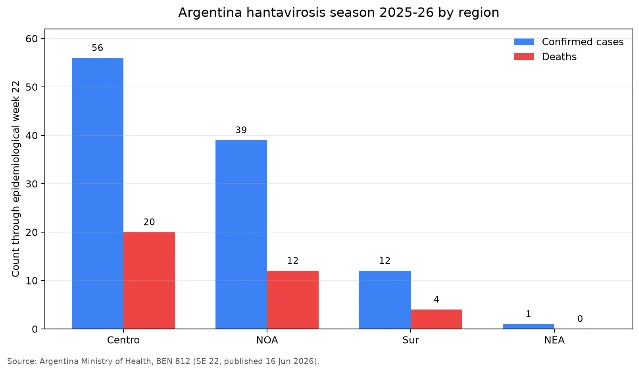
The regional pattern is not uniform. Centro, covering Buenos Aires, Entre Ríos, and Santa Fe, stayed above the outbreak threshold for the whole analysed period, with the main rise between epidemiological week 45 of 2025 and week 5 of 2026. 5 NOA, concentrated in Salta and Jujuy, remained in the alert zone rather than crossing the outbreak threshold, but Salta accounted for 82% of NOA cases and had the country's highest incidence at 2.11 cases per 100,000 inhabitants. 5 Sur crossed its outbreak threshold from week 35 of 2025, though BEN cautions that the stepped curve must be interpreted against small case numbers. 5
Mortality is the red flag. BEN 812 lists 36 deaths through SE 22, a 33.3% case-fatality proportion; the national mortality rate of 0.76 deaths per million inhabitants is three times the prior season's rate at the same point and the highest in the comparison period. 5 Buenos Aires had the largest absolute number of deaths, 18, representing half of the season's national total, while Salta had the highest mortality rate among jurisdictions at 7.90 deaths per million inhabitants. 5
Two field-investigation details deserve monitoring. BEN reports a Río Colorado, Río Negro case outside historically endemic areas; environmental investigations in Río Colorado and neighbouring La Adela found low rodent capture success, no captured species recognised as pathogenic hantavirus reservoirs, and serologically negative specimens, while recommending periodic environmental monitoring. 5 BEN also reports an intrafamilial cluster in Cerro Centinela, Chubut, involving three related cohabiting cases with sequential symptom onset; human sequences corresponded to Andes virus with 99.99% similarity, compatible with person-to-person chains, while zoonotic transmission could not be excluded pending sequencing of virus detected in a seropositive rodent. 5
Research and countermeasures
The science response is now moving from crisis coordination to evidence generation. WHO's 12 June departmental update says NAVIS, a 21-country natural-history study, has begun implementation after the MV Hondius outbreak. The study is designed to follow exposed individuals longitudinally and generate comparable data on Andes virus transmission dynamics, incubation periods, immune responses, viral kinetics, and determinants of severe disease. 9 WHO says the protocol was developed by Hospital Germans Trias i Pujol and coordinated through the UKHSA-led Hantavirus Collaborative Open Research Consortium, with support from ANRS-MIE, BE READY, and ISARIC. 9
On vaccines, keep the level of evidence precise. Gavi's VaccinesWork summary of the Lancet study reports that a single dose of an experimental UTMB mRNA vaccine fully protected Syrian hamsters against lethal Andes virus challenge, with no replicating virus found in tissues after infection and detectable antibodies within 14 days. 10 The same article stresses that no Andes virus vaccine is approved anywhere and that the next step is human clinical testing. 10 For public-health planning, this is a promising preclinical countermeasure signal, not a deployable tool for the current contact-monitoring tail.
Watch list for the next briefing
- United States: whether CDC updates the NQU count after the June 21-22 monitoring boundary, and whether HHS issues any further public rationale for continuing or ending Angela Perryman's facility quarantine. 2 8
- France: confirmation that the four remaining hospital-isolated contacts were released, and any clinical update on the passenger still in intensive care. 3
- Argentina: follow-up laboratory and environmental results from the source investigations, especially fieldwork connected to suspected exposure geographies and BEN's Cerro Centinela sequencing gap. 5
- Research: NAVIS enrolment signals, early protocol outputs, and whether the UTMB mRNA vaccine programme moves from animal protection data toward a registered human trial. 9 10
Fuentes de referencia
- 1ECDC — Andes hantavirus outbreak in cruise ship
- 2CDC — Andes Virus Outbreak on a Cruise Ship: Current Situation
- 3Ouest-France — Tous les membres d’équipage du MV Hondius ont pu rentrer chez eux
- 420minutos / EFE — Sanidad cierra la gestión del brote de hantavirus en España
- 5Argentina Ministry of Health — Boletín Epidemiológico Nacional N°812, SE 22
- 6Eurosurveillance — Andes virus outbreak linked to expedition cruise ship travel
- 7Ouest-France — Deux retraités obligés de finir leur quarantaine à l’hôpital Bichat
- 8The Guardian — Health experts decry RFK Jr order on hantavirus quarantine
- 9WHO — Twenty-one countries launch coordinated Andes virus research initiative
- 10Gavi VaccinesWork — Could a hantavirus vaccine be on the horizon?
Añade más opiniones o contexto en torno a este contenido.