The error correction inflection: quantum fault tolerance crosses a threshold, and four signals to watch
A June 2026 Nature paper demonstrated 11×–800× improvements in quantum logical error rates on a trapped-ion processor — the clearest signal yet that fault-tolerant quantum computing is an engineering challenge, not a physics question. This issue maps the infrastructure whitespace opening up as IBM commits $10B and commercial deployments begin, then covers four signals: cellular reprogramming entering its first human trial, AI antibiotic discovery reaching clinical candidates, blue perovskite LEDs hitting 21.8% efficiency, and durable carbon removal posting its largest quarter on record.

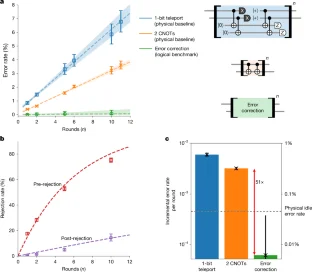
Quantum error correction has crossed a threshold that specialists have been targeting for years. A paper published in Nature on June 10, 2026 showed that a trapped-ion processor achieved logical error rates 11× to 800× lower than the physical baseline, depending on the circuit — using a 12-qubit code and a 16-qubit "tesseract colour code" that encodes four logical qubits. 1 The same week, IBM announced a $10 billion investment over five years to build a large-scale fault-tolerant quantum computer by 2029. 2
The two pieces of news reinforce each other: the Nature result is the academic confirmation that aggressive error suppression is not just theoretically possible but experimentally reproducible; IBM's capital commitment is the commercial bet that it will become manufacturable. For entrepreneurs, this convergence marks a shift worth paying attention to — not because quantum computers are suddenly useful today, but because the window for building the infrastructure layer is open.
What quantum error correction actually is — and why it's hard
A classical computer bit is either 0 or 1. A qubit can be in a superposition of both simultaneously, which is what makes quantum computing powerful. The catch: qubits are extraordinarily sensitive to their environment. Any vibration, thermal fluctuation, or stray electromagnetic field causes an error. Physical error rates on today's best machines run around 0.1–1% per gate operation — unusable for the kinds of calculations that would beat classical computers on real problems.
Quantum error correction (QEC) solves this by spreading one logical qubit across many physical qubits, so that errors on individual physical qubits can be detected and corrected without destroying the logical information. The challenge is that QEC introduces overhead: you need many more physical qubits per logical qubit, and the correction operations themselves can introduce new errors. Whether QEC helps or hurts depends on whether the physical error rate is below a critical threshold.
The Microsoft Majorana 2 chip, announced June 2, 2026, took a different approach: topological qubits designed to be intrinsically more resistant to noise. 3 The hardware team reports qubit coherence times of more than 20 seconds — roughly 1,000× longer than Majorana 1. But independent researchers remain unconvinced. Henry Legg of the University of St Andrews told Nature: "In this paper, there's nothing that shows that this is a qubit." The distinction matters for builders evaluating which architecture to design for: Microsoft's claims are still disputed, while the trapped-ion results are published in peer-reviewed form with reproducible protocol.
Why this inflection matters commercially
The 11×–800× error rate improvement range is not a single magic number. The 800× figure applies to specific simple circuits; more complex computations see smaller improvements. But the direction is clear and the pace is accelerating. The question for builders is: what does the infrastructure layer need to look like before fault-tolerant quantum computing becomes commercially deployable?
Four whitespace areas stand out:
Quantum middleware and compiler toolchains. Fault-tolerant QEC requires constant real-time decoding of syndrome measurements to identify and correct errors. Classical hardware running these decoders must keep up with qubit operation rates — a latency problem. There is almost no commercial tooling here. Startups focused on co-designed classical–quantum control stacks have a defensible niche that doesn't require owning the qubit hardware itself.
Cryogenic infrastructure. Most leading quantum platforms (superconducting and some trapped-ion systems) require cooling to millikelvin temperatures. The dilution refrigerators used cost $500K–$2M each, are custom-configured, and have 6–18 month delivery times. As quantum systems scale to thousands of logical qubits, the cooling infrastructure bottleneck becomes the binding constraint. Companies in cryogenic supply chain — vibration isolation, wiring, feedthroughs — face demand that currently has no reliable supplier of scale.
Benchmarking and verification services. Corporations evaluating quantum access need to know whether the hardware they're using is actually error-corrected. There are no standardized commercial benchmarking services. This is an unsexy but necessary consulting + software product that will exist whether the hardware is built by IBM, Google, IonQ, or Microsoft.
Quantum-ready algorithm development. Most current quantum algorithms were designed for ideal (noiseless) hardware. Adapting them for near-term fault-tolerant machines — where logical qubit counts are small and circuit depth is limited — requires specialized expertise that doesn't exist at scale. The talent gap here is an opportunity for curriculum businesses, developer tooling, and algorithm licensing.
The market trajectory supports sustained infrastructure investment. IBM's $10B commitment, Aramco and Pasqal launching the Middle East's first commercial quantum platform in May 2026, 4 and IonQ's 22,000 sq ft Boulder facility targeting 256 qubits in 2026 with a path to 2 million qubits — these are not moonshots. They are capital formation signals for an infrastructure build-out.
The question for entrepreneurs is not whether fault-tolerant quantum computing will arrive, but whether the software, services, and supply chain will be ready when the hardware crosses the threshold.
Four signals from adjacent fields
Cellular reprogramming enters its first human trial
On June 9, 2026, Boston-based Life Biosciences announced that its first patient had been dosed with ER-100, a cellular reprogramming therapy targeting optic nerve degeneration in glaucoma. 5 This is the first FDA-cleared human trial of epigenetic reprogramming — a technique that uses Yamanaka factors (proteins that can reset a cell's gene expression to a more youthful state) to attempt to reverse age-related cellular decline.
The approach was first demonstrated in mice by Shinya Yamanaka in 2007, earning a Nobel Prize. Until now it had stayed in animal models, partly because two of the four Yamanaka factors are oncogenes with cancer risk. Life Biosciences uses only three factors and includes a doxycycline-based kill switch. The trial plans to enroll fewer than 20 patients at clinics in Boston, New York, Los Angeles, and Charleston.
Investors including Jeff Bezos and Sam Altman have placed bets across the sector (Altos Labs and Retro Biosciences respectively), and Eli Lilly recently participated in a $435 million Series C for New Limit, another reprogramming startup. If ER-100 shows safety and even modest efficacy in the eye — a useful testbed because it is anatomically isolated — the next targets are liver cells and muscle tissue, which carry much larger commercial addressable markets.
Builders to watch: the current bottleneck is not the concept but delivery vehicles (AAV vs. lipid nanoparticle for retinal vs. systemic administration), patient monitoring protocols, and data infrastructure for tracking epigenetic age markers across trials.
AI is accelerating antibiotic discovery — and shortening the pipeline
A Nature technology feature published June 8, 2026 surveyed the state of AI-driven antibiotic discovery and found a field that has moved from proof-of-concept to active clinical candidates in roughly five years. 6 Drug-resistant infections currently kill an estimated 1.27 million people per year globally; without new antibiotics, projections put that figure at 39 million deaths by 2050.
The practical mechanics: MIT's Chemprop model trains on molecular structure-activity data and screens millions of compounds to identify candidates that inhibit bacterial growth — it found halicin, a kinase inhibitor with broad-spectrum activity against drug-resistant strains, in 2020. By 2025, the same lab's DiffDock tool added the ability to predict how candidate molecules bind to protein targets, cutting the experimental confirmation work from months to weeks. César de la Fuente's group at Penn has used generative AI to screen a database of 10 million peptides and synthesize 69 candidates, of which 86% showed antimicrobial activity against at least one pathogen.
The commercial bottleneck is not discovery but manufacturing: AI-designed molecules are often chemically complex, expensive to synthesize, and poorly suited to standard pharmaceutical scale-up. The whitespace is in synthesis route optimization and continuous manufacturing technology for novel chemical scaffolds — a niche where process chemistry startups can add real value without taking on the full drug development risk.
Blue perovskite LEDs reach 21.8% external quantum efficiency
A paper in Nature (published June 10, 2026) from researchers at Peking University, Huanping Zhou's group, reports blue perovskite light-emitting diodes (LEDs) with an external quantum efficiency (EQE) of 21.8% at 491 nm emission — among the highest reported for the blue end of the spectrum, where perovskite materials have historically lagged behind their red and green counterparts. 7
The mechanism: a polymer network formed during perovskite nanocrystal growth constrains crystal size while maintaining crystallinity, achieving a photoluminescence quantum yield of 83%. Blue is the hardest color to hit efficiently in perovskite LEDs because small-bandgap nanocrystals that emit at 491 nm are prone to defects and non-radiative recombination.
Why it matters for builders: the display industry is under sustained pressure from organic LED (OLED) cost and color gamut limitations. Perovskite LEDs offer superior color purity and theoretically lower materials cost. Blue efficiency was the blocking problem. A display industry that can produce R/G/B perovskite pixels with matched efficiency profiles changes the materials supply chain for LCD and OLED alternatives — opening whitespace for patterning equipment, encapsulation materials (perovskites degrade in moisture), and deposition tooling companies.
Durable carbon removal records its largest Q1 ever
CDR.fyi's Q1 2026 market report, released in May 2026, found that 2.3 million tonnes of durable carbon dioxide removal (CDR) were contracted in Q1 2026 — the largest single quarter on record, and approximately 560% higher year-over-year compared to Q1 2025. 8 Microsoft alone accounted for 1 million tonnes of that figure.
The composition of supply matters: biochar represented 93% of contracted volume, with 7 of the top 10 suppliers using biomass-based methods. Enhanced weathering, direct air capture, and ocean-based approaches remain small fractions of the total.

The growth signal is real but the buyer concentration is a structural problem. Strip out Microsoft and the remaining market is 1.3 million tonnes — still growing, but still dependent on a handful of large buyers fulfilling voluntary commitments. The whitespace this creates is not in building more biochar supply (that category is competitive and priced in) but in demand infrastructure: measurement and verification tooling, corporate procurement platforms that help mid-market buyers enter the market without sourcing custom, and new supply-side categories (enhanced rock weathering, ocean alkalinity enhancement) that are currently too small to attract procurement attention but where early supply agreements can lock in favorable pricing.
If durable CDR sustains 100%+ annual growth, the market reaches 20–30 million tonnes per year by 2028–2029 — which is when the structural demand from corporate net-zero commitments turns from voluntary to contractually required for most large companies with 2030 targets.
Fuentes de referencia
- 1Improved quantum processor logical error rates via correction and detection, Nature
- 2Quantum Computing Race Accelerates as IBM Commits $10 Billion Investment
- 3Microsoft upgrades controversial quantum chip — researchers are still sceptical, Nature
- 4Aramco and Pasqal launch Saudi Arabia's first Quantum Computer and QCaaS platform
- 5The first-ever reverse-aging treatment has been injected into a human, Business Insider
- 6AI is taking on antibiotic resistance — here's how, Nature
- 7In situ nanocrystal confinement for efficient blue perovskite LEDs, Nature
- 82026 Q1 Durable CDR Market Update: Largest Q1 on Record, CDR.fyi via LinkedIn
Añade más opiniones o contexto en torno a este contenido.