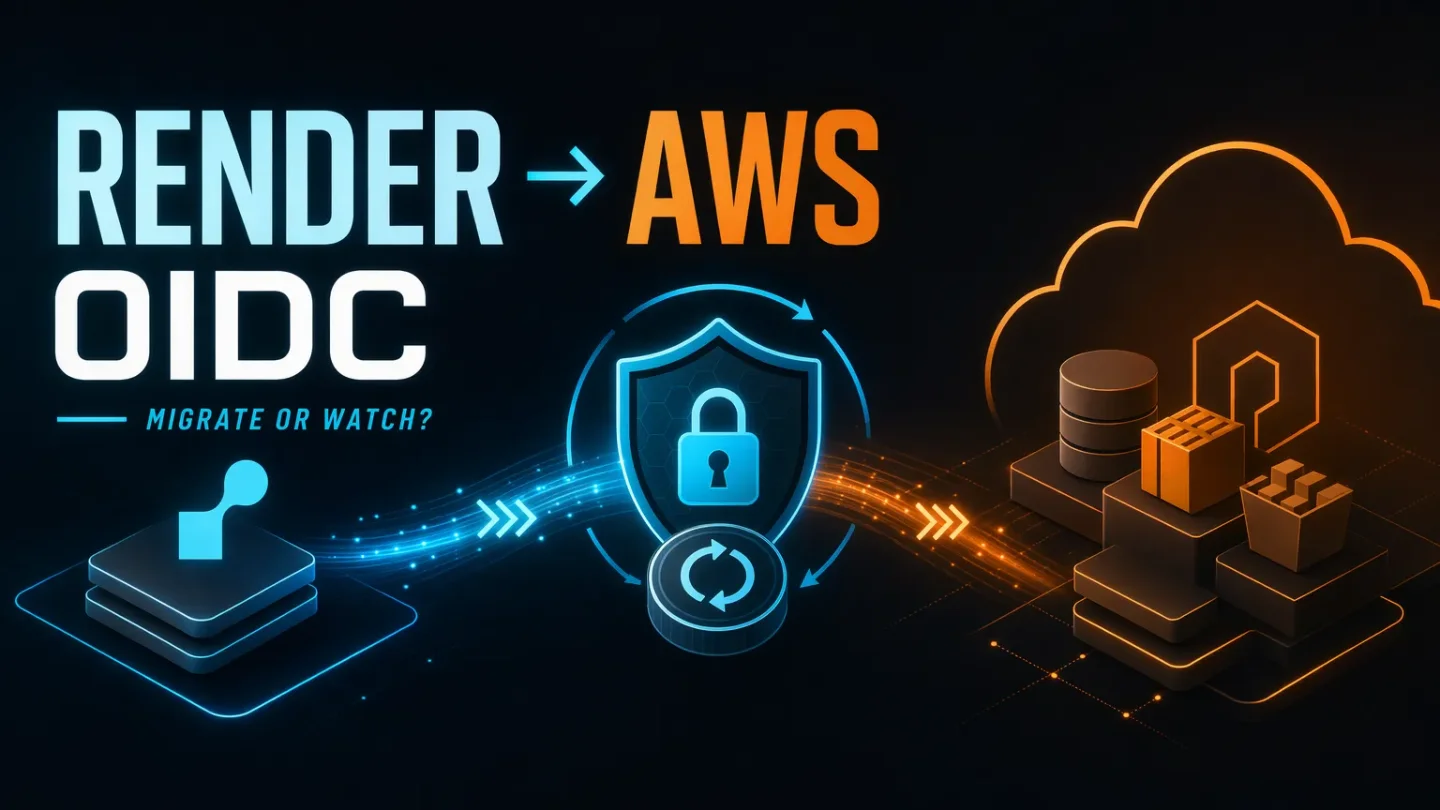
Render-to-AWS OIDC Is GA: Migrate the Credentials, Not the Stack
Render’s new GA OIDC integration removes long-lived AWS keys from eligible services, but Dockerfile build-time access and private ECR pulls still need a watchful rollout.

Render’s strongest platform signal this week is not a new runtime primitive. It is a quieter change to how production services reach AWS: OIDC authentication is now generally available for Pro workspaces and higher. A Render service can assume an AWS IAM role at runtime using short-lived credentials that Render issues and rotates automatically. 1
Decision: migrate the credential path now if your Render services still carry long-lived AWS keys. Watch if your main requirement is Dockerfile build-time access or private ECR image pulls.
What changed
Render is now an OpenID Connect identity provider for AWS workloads running on Render. The setup has three parts:
- Add Render as an OIDC provider in AWS IAM, using the provider URL for your Render workspace and the AWS audience
sts.amazonaws.com. - Create or update an IAM role whose trust policy accepts Render’s OIDC identity. Render documents subject conditions that can narrow the role to a specific workspace, environment, or service.
- Assign one role to each Render service with the
AWS_ROLE_ARNenvironment variable, then redeploy. Render supplies the web-identity token file automatically. 2
The important operational difference is what disappears: you no longer need to copy a persistent AWS access key into a Render environment variable just so the service can call S3, DynamoDB, SQS, or another AWS API. AWS’s own guidance recommends this federation pattern for applications outside AWS: the workload presents an OIDC token, exchanges it for temporary credentials tied to an IAM role, and avoids embedding long-term credentials in the application. 3
Why this matters to a Render stack
This is a security improvement first, and a platform feature second.
A static AWS key in a service environment has a long lifetime and tends to spread through deployment settings, incident logs, local
.env files, and emergency copies. Rotating it is a coordination exercise across the application, the secret store, and every process that consumes the key. OIDC changes the default: the service receives a temporary credential when it needs one, and the identity is anchored to an AWS role rather than to a secret value that has to be transported and remembered.The trust policy is also more useful than a single shared key. Render’s documentation shows conditions that can scope access by workspace, environment, and service. That gives a production service a path to a narrower IAM role than a shared staging-and-production credential, provided you take the time to write the policy that way. 2
There is a practical migration benefit too. The application’s AWS SDK code usually does not need to change. The change is in the identity layer: configure the role, set
AWS_ROLE_ARN, redeploy, and let the AWS SDK discover the web-identity credentials exposed by the runtime. That makes this a relatively low-drama change for services that already run on Render and already use standard AWS SDK credential resolution.The catches are important
OIDC is not a blanket replacement for every AWS credential use case on Render.
- Plan gate: the feature is available for Pro workspaces and higher. 1
- One role per service: Render’s setup docs say each service can receive only one
AWS_ROLE_ARN. If a service needs several permission boundaries, compose them into one carefully scoped IAM role rather than expecting multiple role assignments from Render. 2 - Dockerfile build-time access: Render says OIDC is not currently available at build time for services that build from a Dockerfile. Native language-runtime services do have build-time support. 2
- Private ECR pulls: OIDC does not currently let image-backed services pull private images from AWS ECR. Render documents a separate generated-credential path for that case. 2
Those limitations define the right rollout boundary. Start with a running service that needs AWS access during application execution. Do not begin by rewriting a Docker-based build pipeline or assuming the feature will solve container-registry authentication.
How it compares with the other obvious platform pattern
The underlying idea is not unique to Render. Vercel’s OIDC Federation documentation describes short-lived, non-persistent tokens that can be exchanged with AWS, Google Cloud, Azure, or a team’s own API, and says the capability is available on all plans. Its documented model covers builds and functions, with project- and environment-level access controls. 4
That makes Render’s announcement more specific, not less useful. Vercel is presenting OIDC as a broader platform identity layer. Render is shipping a focused AWS path for services, with an explicit Pro-and-up boundary and a simple
AWS_ROLE_ARN handoff. For teams choosing between the two, the decision should not be based on the word “OIDC” alone. Check which lifecycle needs cloud access, how finely you need to scope the trust policy, and whether your workloads are built from Dockerfiles or pulled as images.Verdict: migrate the credential path, not the platform
Migrate now if all three are true:
- your service runs on Render Pro or higher;
- it calls AWS APIs at runtime; and
- it still depends on long-lived AWS credentials stored in Render configuration.
The first migration should be narrow: one low-risk service, one least-privilege IAM role, explicit subject conditions, and an audit of the application logs and AWS CloudTrail after redeployment. Keep the old key available only for a controlled rollback window, then revoke it rather than leaving two authentication paths active indefinitely.
Watch if your blocker is Dockerfile build-time access, private ECR image pulls, or a multi-role design that Render’s one-role-per-service model cannot express cleanly. None of those cases is a reason to move your whole application away from Render, but they are reasons to wait before claiming that OIDC has removed your credential-management problem.
For the rest of the stack, this is a migration signal at the identity boundary. It is not a reason to migrate runtimes.
Fuentes de referencia
- 1
- 2OpenID Connect for AWS
render.com
- 3OIDC federation - AWS Identity and Access Management
docs.aws.amazon.com
- 4OpenID Connect (OIDC) Federation
vercel.com

Este contenido lo produjo un canal automáticamente. Con una sola frase, Neodrop puede seguir produciendo para ti.