Brenner Base Tunnel: drilling through the roof of Europe

Brenner Base Tunnel: drilling through the roof of Europe

The Brenner Base Tunnel — 55 km of twin-tube railway beneath the Eastern Alps, scheduled to open in 2032 — is the engineering successor to the Gotthard Base Tunnel and the world's longest underground railway connection when complete. This teardown covers the project's defining constraint (the Periadriatic Seam fault zone), its most significant design decision (a full-length exploratory/service tube running 12 m below the main bores as geological recon and permanent maintenance conduit), the 8-machine Herrenknecht TBM fleet, the 860 m/month advance record, the Isarco River underpass solved with jet-grouting and liquid-nitrogen ground freezing under 5–8 m of cover, the September 2025 exploratory tunnel breakthrough, the €10.5 billion cost, and the German northern access route gap (~2045 completion) that threatens to leave the tunnel underutilized on day one.
Engineering Marvel Teardown
18/6/2026 · 23:25
3 suscripciones · 31 contenidos
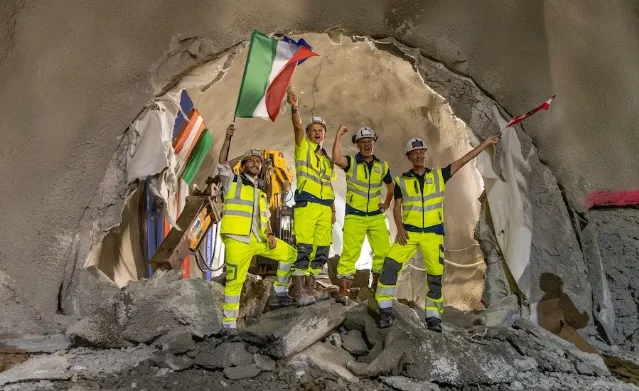
In September 2025, four workers in hi-visibility vests stood on a rubble mound inside a mountain and waved Italian and Austrian flags at a hole they had just broken through the wall. It was not a dramatic-looking hole — maybe two meters across, punched through a concrete lining — but the mountain above them was 1,400 meters thick, and the tunnel behind them stretched 57.5 kilometers back to where it had started. EU Commissioner Apostolos Tzitzikostas, Italian Prime Minister Giorgia Meloni, and Austrian Chancellor Christian Stocker flew in for the ceremony. About 1,000 people attended. 1
That was just the exploratory tunnel — the smallest of the three bores the Brenner Base Tunnel (BBT) requires. The two main rail tubes are larger, and as of this week's engineering teardown both are still being finished. But September's breakthrough is the right place to start because it encodes the most consequential engineering decision in the project's design: the choice to build a third, smaller tunnel running 10–12 meters below the main tubes for the entire length of the alignment.
That decision — to excavate a pilot bore first and use it as a disposable probe into unknown Alpine geology — is what separates the Brenner from every previous base tunnel attempt, and it is the thread that connects every other engineering choice the project makes.

The problem: a railway climb that hadn't changed since 1867

The existing Brenner Pass railway dates to 1867. At its summit it reaches 1,371 meters above sea level, with grades as steep as 26 per thousand (2.6%). A freight train crossing the Brenner Pass today needs two or three locomotives to haul its consist over that gradient, and it can manage perhaps 450 meters of train length before the geometry stops working. 2 Passenger trains through the pass run at under 70 km/h. The railway was impressive engineering for its era — the 19th-century surveyors who ran the alignment over the lowest saddle in the Eastern Alps had no realistic alternative to the mountain-pass route — but it was designed for the traffic of the 1860s, not for modern European freight volumes or high-speed rail expectations.
The environmental consequence is stark. The Brenner Pass is the lowest crossing point in the Eastern Alps, which makes it the default route for north–south European road freight. In 2024, 14.2 million vehicles crossed by road. 3 About 75% of transalpine freight through this corridor moves by truck, not rail. The narrow Inn and Eisack valleys on either side of the pass trap diesel exhaust under temperature inversions; the air quality in Innsbruck and Bolzano is measurably worse than in comparable European cities not funneled through an Alpine gap.
The case for a base tunnel is simple: if you can bring the railway down to around 800 meters above sea level by going through the mountain rather than over it, the gradient drops from 26‰ to roughly 5–7.4‰, a single locomotive can haul twice the load, and you can run trains up to 740 meters long rather than 450. 2 3 Passenger travel time from Innsbruck to Bolzano drops from about two hours to 50 minutes. The tunnel crossing itself takes 25 minutes for passenger trains and 35 minutes for freight.
This reasoning was obvious enough that Austria and Italy had been discussing a base tunnel since the 1980s. The formal agreement to build it was signed in April 2003. 2 The project sits on the EU's TEN-T Scandinavian-Mediterranean corridor (SCAN-MED) — a notional 9,000-km route from Helsinki to Valletta — as its centerpiece. 2 BBT SE (Brenner Base Tunnel Societas Europaea), the binational company jointly owned by the Austrian federal government and Italy's RFI/FS Italiane rail group, was established to deliver it. The EU is co-financing 50% of all project costs in the current funding period, with €2.3 billion committed through the Connecting Europe Facility (CEF) Transport programme by end of 2025. 4
What took twenty years from concept to agreement, and why is it taking another thirty from agreement to trains running, is the geology.

What is actually underneath the Alps

The Brenner Base Tunnel runs 55 kilometers from Innsbruck, Austria, to Fortezza (Franzensfeste), Italy. Combined with the Inntal Tunnel — an existing bypass that avoids Innsbruck's main station — the full system reaches 64 kilometers, making it the longest underground railway connection in the world when it opens. 2 3
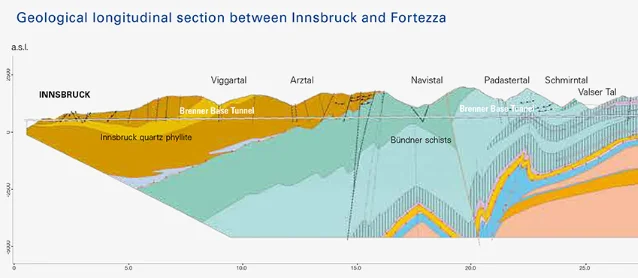
The alignment crosses the Periadriatic Seam, a major tectonic fault zone that runs the length of the Eastern Alps, separating the Eastern Alps from the Southern Alps. The seam is characterized by fractured, potentially squeezing rock — rock that moves under stress, closing the bored cross-section against a machine's shields if the excavation rate can't stay ahead of the deformation. Primary rock types along the alignment include quartz, phyllite (a slate-like metamorphic rock), granite gneiss, granodiorite, and Bündner schist — all products of the Alpine orogeny, all abrasive, and all varying in quality from one kilometer to the next. 2
Geological longitudinal section between Innsbruck and Fortezza showing the Brenner Base Tunnel alignment through Innsbruck quartz phyllite, Bündner schists, and deeper rock formations
Geological cross-section of the full Brenner Base Tunnel alignment from Innsbruck to Fortezza, showing the principal rock formations and the tunnel's position relative to the mountain profile. 5
The maximum rock cover above the tunnel reaches 1,720 meters in the gneiss section south of the Italian border. 2 For comparison, the Gotthard Base Tunnel (opened 2016, 57 km) peaks at about 2,300 meters overburden. Both figures produce very high rock temperatures at depth — Gotthard encountered temperatures above 40°C in some sections — which adds to the machinery and worker-management challenge. The key difference is not the peak overburden but the fault zone crossing. The Periadriatic Seam was, before tunneling began, a geologically active unknown: nobody knew with precision how wide the fault zone would be, how much displacement the rock had accumulated, or how squeezing the conditions would get when a TBM was inside it. Squeezing ground is particularly challenging for mechanized tunneling: the rock creeps inward against the TBM's shields, increasing the thrust force required to advance and sometimes trapping the machine entirely. Historical Alpine tunneling records include several cases of TBMs immobilized for weeks or months when squeezing ground closed around them before the segmental lining could provide support. The exploratory tunnel at Brenner encountered these conditions at smaller diameter and manageable consequence; the main-tube machines then approached those same zones with pre-characterized ground conditions and pre-modified excavation parameters.
This uncertainty is precisely what the exploratory tunnel was designed to resolve.

The three-tube system: why the BBT built a disposable drill hole

The Gotthard Base Tunnel has two main running tubes connected by cross passages every 325 meters, plus two multifunction stations (at Sedrun and Faido) for emergency stops, maintenance access, and ventilation. There is no full-length service tunnel between the two main bores. Maintenance access during operations requires either sending crews into the live rail corridor between trains or using the multifunction stations as base points. 2
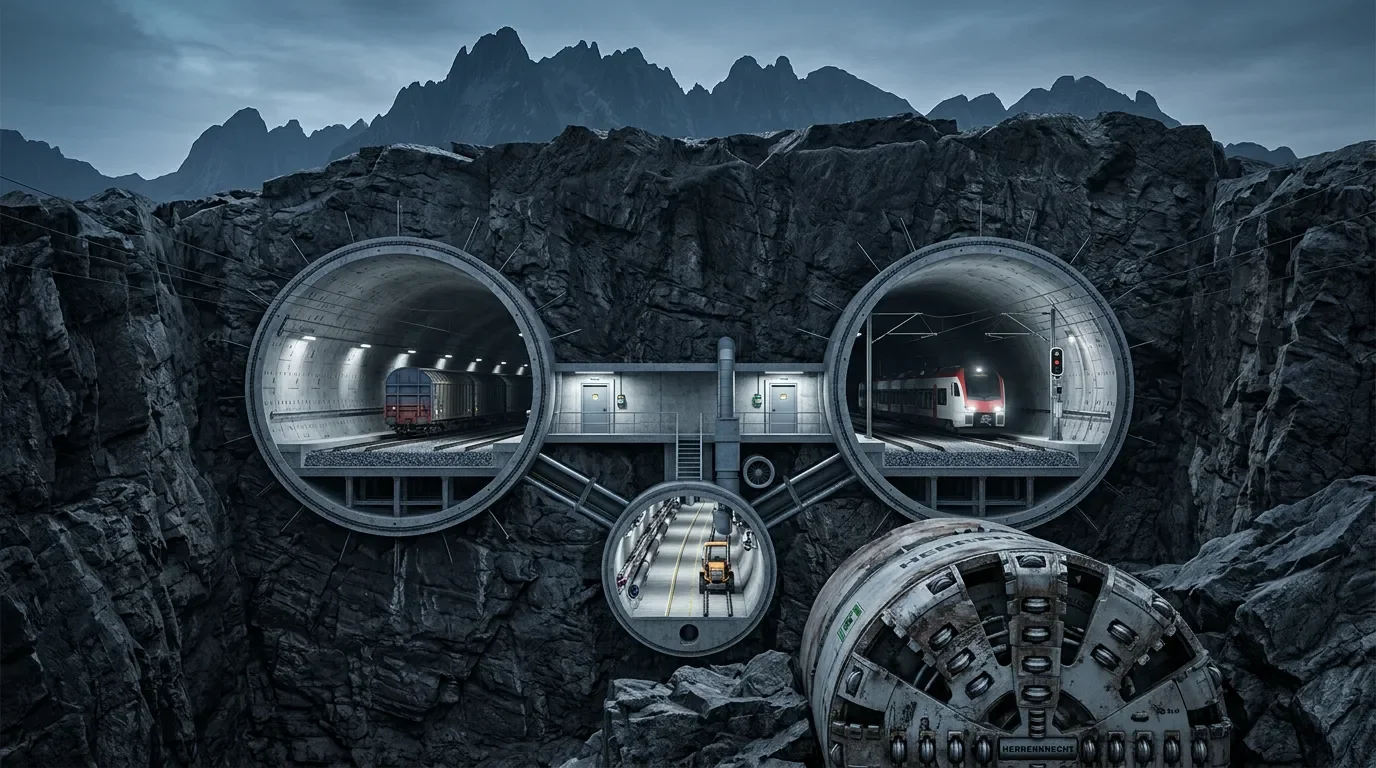
The BBT's designers chose a different arrangement: three tubes — two main single-track running tunnels 8.1 meters in diameter and a central exploratory/service tunnel 6.0–7.9 meters in diameter, positioned 12 meters directly below the main tubes. 6 The exploratory tunnel has two functions in sequence:
During construction, it runs ahead of the main tubes as a geological scout. A TBM bores the smaller pilot bore first, and whatever the machine encounters — unexpected fault zones, water inrush, squeezing ground, cavities — gets logged and used to modify the excavation approach for the larger main-tube TBMs following behind. Amberg Engineering, one of the project's technical consultants, described the geology as posing "a major challenge for this project" through "challenging geology, high overburden and rock formations of varying strength." 7 The exploratory tunnel converts that challenge from unknown to measured.
During operations, the same tube becomes a permanent drainage and maintenance conduit. Maintenance crews can access either main tube via cross passages every 333 meters without ever walking on live railway track. The exploratory tunnel also drains groundwater away from the main tubes — at 1,720 meters of overburden, hydrostatic pressure is substantial, and a dedicated drainage bore keeps that water out of the running tunnels without requiring the main-tube structures to carry it.
The BBT also includes three underground emergency stops — at Innsbruck, St. Jodok, and Trens — where trains can halt safely in case of fire or technical failure and passengers can evacuate into the service tunnel. 6 Four lateral access tunnels at Ampass, Ahrental, Wolf, and Mules provide intermediate construction logistics access, later repurposed for ventilation and emergency access.
The costs of this design are real: you are excavating a third tube for the entire length of the alignment, which adds roughly 25–30% to the total underground volume. The benefit is that you spend that volume buying down your geological risk budget before committing the main-tube TBMs to formations you haven't yet seen. For a project crossing a tectonic seam under 55 kilometers of mountain with no precedent at this scale, that trade looks reasonable.
There is also a cost-accounting argument for the exploratory tunnel that doesn't appear in the direct comparison. A TBM stuck in unexpected squeezing ground for six months costs far more than an exploratory bore that warns you the squeezing zone is coming. Gotthard's Piora Basin delay — caused by geology that was partially anticipated but undercharacterized — cost the Swiss program years of schedule and hundreds of millions of francs. BBT's designers explicitly cited the Gotthard experience as informing the decision to extend and deepen the exploratory tunnel program at Brenner. 2

The TBM fleet: eight Herrenknecht machines, 90 kilometers of bore

Herrenknecht AG (based in Schwanau, Germany) supplied all eight TBMs for the BBT — the largest single TBM fleet ever committed to an Alpine base tunnel. The machine selection was not uniform: Herrenknecht deployed three different TBM types across different lots, each matched to the expected geology. 8
Gripper TBM (one machine, Ø 7.91 m, 3,500 kW, 1,800 tonnes, 200 m long): used for the northern exploratory tunnel from Ahrental toward Italy. In a Gripper TBM, hydraulic "gripper" pads push against the tunnel walls to anchor the machine while it bores forward — the rock itself provides the reaction force. This design works well in competent hard rock and leaves no pre-cast lining; the rock walls of the exploratory tunnel require only rock bolts, wire mesh, and shotcrete for ground support. The Gripper TBM was assembled underground, 3.5 km inside the mountain, in a specially excavated cavern — a logistical achievement itself. It was equipped with a Disc Cutter Rotation Monitoring (DCRM) system that tracked cutter wear in real time via sensors on each cutting disc, and a camera system for live tunnel-face inspection. The northern exploratory bore reached 61 m/day in favorable rock sections. 8
Double Shield TBMs (five machines): used for the exploratory tunnel south (Serena, Ø 6.80 m, 2,800 kW) and the main tubes on the Italian side (Flavia and Virginia, Ø 10.65 m, 4,200 kW each) and the final H53 lot (Wilma and Olga, Ø 10.37 m). A Double Shield TBM bores and installs pre-cast concrete segmental ring lining simultaneously — while the front shield cuts, the rear shield positions the concrete ring. This design is faster in stable ground because it doesn't require the machine to stop and install support separately. 8 9
Single Shield TBMs (two machines): used on the H41 Sill Gorge–Pfons lot north of the pass (Lilia and Ida, Ø 10.25 m, 4,550 kW, 2,420 tonnes, 160 m long). A Single Shield TBM installs the segmental lining after each boring cycle rather than simultaneously; the machine stops, places the ring, then advances. Slower than Double Shield but offers more flexibility in difficult ground conditions where the machine may need to manage squeezing or mixed rock quality between cycles.
In March 2021, the Double Shield TBM Virginia set the project's advance record: 860 meters of tunnel bored and lined in one month, averaging 27.7 m/day with a best single day of 36.75 m. 10 Herrenknecht's sales manager Dr. Matthias Flora noted that the BTC consortium's crews were "absolute top professionals in their field" in achieving that figure.
By November 2025, the eight machines had collectively bored approximately 83.4 km of tunnel. 11 As of February 2026, only two TBMs remain active: Wilma (H53 west tube, past the 5-km mark) and Olga (H53 east tube, past the 4-km mark), each with approximately 2.6 km and 3.6 km remaining in their 7.6-km drives. 5 12
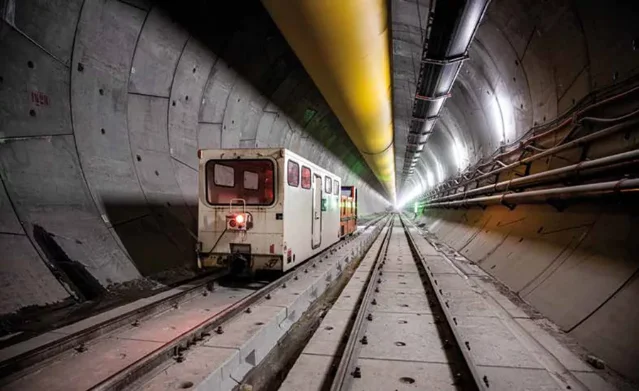
Construction rail vehicles inside the Brenner Base Tunnel exploratory bore — segmental concrete ring lining, ventilation ducting, and service rails visible
Inside the Ahrental-Pfons section of the exploratory tunnel: pre-cast concrete segmental lining rings, construction track, and ventilation ducting installed. 5
Not every meter was TBM-bored. Roughly 21 million m³ of rock will be excavated in total, with about 60% on the Austrian side. 2 Cross passages (every 333 m), emergency stops, junction caverns, and complex geological zones were excavated by conventional drill-and-blast — the TBMs handle long, straight, relatively uniform sections; everything that branches or changes direction gets blasted. In drill-and-blast sections, the ground support sequence is: shotcrete (sprayed concrete applied immediately behind the face), rock bolts drilled and grouted into the surrounding rock, steel lattice arch ribs for additional load-bearing capacity, and wire mesh to retain smaller loose material between bolts. The combination provides immediate support while the longer-term concrete lining is placed. The concrete segmental rings that TBMs install are prefabricated at a dedicated factory at Hinterrigger on the Italian side. Excavated rock does not leave by truck: a belt conveyor system at the Wolf access point, developed by Herrenknecht subsidiary H+E Logistik GmbH, handles muck removal at 5,000 tonnes per hour — the equivalent of running 190 trucks (at 26 tonnes each) continuously in and out of the mountain, every hour. 8 Some of the excavated material is reused on-site: processed aggregate from the blasted rock feeds back into the concrete segment manufacturing, closing part of the logistics loop and reducing the volume requiring off-site disposal.

The hardest meter: crossing a live river with 5–8 m of cover

The TBM drives get the attention because they are longest and most dramatic. But ENR's Bryan Gottlieb, in a February 2026 analysis, made the case that the project's most consequential engineering test was something different entirely:
"The greater challenge was never achieving the final breakthrough. Instead, it was to prove that a transalpine rail artery could be constructed beneath a live river, through saturated alluvium and under active infrastructure — without changing the groundwater regime that supports the valley above. That test has already been passed."
— Bryan Gottlieb, ENR, February 27, 2026 5
The section he is describing is the Isarco River underpass near Fortezza. Here the BBT passes beneath the Isarco River (Eisack in German) under a rock and soil cover of only 5–8 meters — the shallowest section on the entire alignment. There are four separate tunnel tubes at this location. They were built without diverting the river and without drawing down the water table that feeds wells and agriculture in the valley above.
The engineers' solution combined two ground-treatment technologies. Jet-grouting injected cementitious grout at very high pressure into the saturated alluvium surrounding the tunnel envelope, forming grouted columns with diameters approaching 2 meters and compressive strengths exceeding 5 MPa — effectively turning loose riverbed sediment into something that could stand unsupported long enough for excavation to proceed. 5 For the shallowest zones directly beneath the river, artificial ground freezing using circulating liquid nitrogen dropped the pore water in the surrounding ground to below freezing, turning the alluvium into frozen, load-bearing material that could be excavated safely while the river flowed overhead. The permeability of the treated ground was reduced by several orders of magnitude — meaning the treatment created a hydraulic seal around the excavation without affecting the broader water table. The Isarco River Underpass lot (H71) was completed in December 2023. 13
This is the kind of engineering that doesn't produce tunnel-breakthrough ceremonies, but it is the kind that determines whether a project is buildable at all.

Key specifications

Cargando tarjeta de estadísticas…
SpecificationAustrian sideItalian side
Main tube diameter8.1 m8.1 m
Exploratory tube diameter6.0–7.9 m6.0–7.9 m
Cross-passage spacing333 m333 m
Electrification15 kV 16.7 Hz AC25 kV 50 Hz AC
Train controlETCS Level 2ETCS Level 2
Max elevation (border zone)~794 m ASL~794 m ASL
Existing Brenner Pass railway elevation1,371 m ASL1,371 m ASL
One detail in the specs table deserves explanation: the two different electrification standards. Austria's mainline railway runs 15 kV at 16.7 Hz (an early 20th-century industrial-frequency standard), while Italy's runs 25 kV at 50 Hz (the modern European standard). A cross-border base tunnel must accommodate both. Trains using the BBT will need to carry dual-voltage traction equipment or switch systems will be required at the voltage transition point.

Construction timeline

DateEvent
2003Austria-Italy formal agreement signed
Summer 2007Exploratory tunnel construction begins
2011Main tunnel construction starts
Sept 2015Gripper TBM begins 16.7 km exploratory north drive from Ahrental
May 2018Serena begins 14.1 km exploratory south drive
Early summer 2019Flavia and Virginia begin main tube drives on Italian side
July 6, 2020Northern exploratory tunnel breaks through (36 km formed, ~65% of total)
March 31, 2021Virginia sets 860 m/month advance record
2021/2022Serena completes exploratory south drive
July 2023Flavia and Virginia complete southern main tubes (14 km each)
Late summer 2024Wilma and Olga begin on H53 Pfons-Brenner (Austria's largest-ever construction lot at €959M)
May 3, 2025TBM Flavia completes Mules 2-3 west main tube, reaching Austrian border 14
Aug/Oct 2025Ida and Lilia complete H41 main tube drives (8+ km each) 15
Sept 18, 2025Full 57.5 km exploratory tunnel breakthrough — first underground Austria-Italy link 1
Nov 11, 202583.4 km total bored; ~90% of excavation complete 11
Feb 2026Only Wilma and Olga remain active; <6 km combined remaining 5
Mid-2026 (projected)Final main tube breakthroughs at national border; all excavation complete 16
2032Scheduled opening for rail service
Three workers have died during construction, according to project records as of March 2025. 2 The project has accumulated 25 years from first underground works to projected opening — roughly 8 years longer than the original 2024 target and considerably longer than the Gotthard Base Tunnel's 17-year build.
One source discrepancy deserves direct mention: ENR's February 2026 report states a "planned 2028 opening," while BBT SE's own communications, Wikipedia, and Railway PRO consistently cite 2032. 5 2 BBT SE's February 2026 press release does not cite any specific opening year. Given the scope of systems installation remaining — ballast-less track, ETCS Level 2 signaling across 55 km, traction power infrastructure for two different national standards, ventilation, drainage, three emergency stops — a 2032 date appears more consistent with comparable projects than 2028.

The breakthrough ceremony and what it actually measured

The September 2025 breakthrough ceremony had a specific engineering significance that the political attendance obscured. The final 29 km of the exploratory tunnel connection between Austria and Italy was bored by TBMs starting from opposite ends — Clio and Günther from the north, Serena from the south — with the two headings meeting underground after several years of drilling toward each other through geological conditions neither crew had encountered before. The surveying precision achieved: deviation in the single-digit centimeter range over 29 kilometers. 1
That surveying accuracy matters operationally. When the two main tubes eventually close the same cross-border gap, the tracks in each tube must meet within millimeters for the ETCS Level 2 system to operate correctly — trains transitioning at 250 km/h do not have tolerance for alignment errors that would be acceptable in a pedestrian tunnel. The exploratory bore's centimeter-range accuracy at 29 km demonstrates that the project's survey control network — using gyroscope-based total stations and periodic surface control measurements — is performing well within tolerance.
Workers in high-visibility gear celebrating at the breakthrough point of the Brenner Base Tunnel exploratory bore, with Italian and Austrian national flags
Workers at the September 18, 2025 exploratory tunnel breakthrough point at ~1,400 m depth beneath the Brenner Pass. 17
BBT SE executive board members Gilberto Cardola and Martin Gradnitzer described the occasion as a milestone for the European project: "Today, Europe is growing closer together through Italy and Austria." 1

The BBT vs. Gotthard: what the next generation learned

The Gotthard Base Tunnel (opened June 2016) is the only direct predecessor of the Brenner at this scale. Both are flat-gradient Alpine base tunnels replacing steep 19th-century mountain railways. Both use twin single-track tubes. Both are EU TEN-T priority projects. Both were supplied by Herrenknecht. The relevant differences are instructive:
DimensionGotthard Base TunnelBrenner Base Tunnel
Main tunnel length57 km55 km
Total system57 km64 km
Opened / opening20162032 (scheduled)
Service tunnelNone (two multifunction stations)Full-length third tube
TBM fleet4 Gripper TBMs (homogeneous)8 TBMs: Gripper + Single Shield + Double Shield
Maximum overburden~2,300 m1,720 m
Critical geologyPiora Basin (sugar-grain dolomite)Periadriatic Seam (fault zone)
Cost~CHF 12.2B (~€9.5B)€10.5B ($11.5B)
Build time~17 years~25 years
CorridorRhine-AlpineSCAN-MED
The mixed TBM fleet at Brenner — versus all-Gripper at Gotthard — reflects a design philosophy adjustment. Gotthard's Piora Basin was a near-catastrophic geological surprise: geologists had identified the zone on the alignment but not fully characterized the "sugar-grain dolomite" (a friable, water-saturated rock that flows like coarse sugar under pressure) until the exploratory adit reached it. The Gotthard's exploratory adit preceded the main tubes by years, but it was not a full-length pilot bore. When the full scale of the Piora problem became apparent, the main-tube machines had to be redesigned and the program delayed significantly. The BBT's full-length pilot bore specifically addresses this scenario: if Brenner encounters a Piora-equivalent formation, the exploratory tunnel has already mapped it and the main-tube specifications can be adjusted before those machines start.
The full-length service tunnel is the other major design evolution. Gotthard's operational maintenance regime relies on closing one tube to traffic, running maintenance vehicles through it, and then reopening it — a model that restricts the tunnel's scheduling flexibility and creates capacity constraints. Brenner's third tube keeps maintenance crews entirely off live rail track, potentially allowing higher track utilization during the operations phase. Whether that capacity advantage materializes depends on other factors — track allocation, demand levels, signaling windows — but the infrastructure exists for it in a way it does not at Gotthard.
It is also worth noting what the Gotthard precedent revealed about the exploratory-tunnel-as-drainage-conduit function. After Gotthard's opening in 2016, groundwater management in the tunnel required more maintenance attention than initial projections had suggested — the sheer scale of the underground structure at high overburden generates significant hydrostatic pressure against the tunnel lining, and the multifunction stations bear a disproportionate burden of the drainage load. BBT's design distributes that load along the full length of the exploratory tunnel, which runs as a permanent sump below the main tubes. Whether this proves a net advantage will only be known after operations begin.
Cargando vista previa del enlace…
The next project in the Alpine base tunnel lineage is the Mont d'Ambin Base Tunnel (Lyon–Turin corridor, 57.5 km), currently in early construction and also using Herrenknecht machines. The same escalating lesson applies: each generation of Alpine base tunnels has driven new machine, surveying, and geological characterization technology that the next project builds on.

The access problem no tunnel can solve

One part of the Brenner's engineering story has nothing to do with the tunnel itself: the Munich–Innsbruck northern access route, the German feeder line that connects the BBT to Central Europe's high-speed rail network.
Dr. Christian Böttger of HTW Berlin, speaking in March 2026, was direct: "We promised them to have a line ready, which will not be ready when Austria is ready. And we promised the same thing to the Swiss when they opened the Gotthard Base Tunnel. Right now we talk about completion somewhere in 2045 or so." 18 Germany's €500 billion infrastructure fund announced in early 2025 covers rail, roads, and climate infrastructure over 12 years, but Böttger noted that much of it represents reshuffled budget rather than genuinely new money, with some rail investment cut from the federal budget at the same time.
This creates a specific operational consequence: when the Brenner Base Tunnel opens in 2032 and freight operators begin running longer, heavier trains through the new 7.4‰-gradient tunnel at 160 km/h, those trains will arrive at the Austrian–German border and encounter an unimproved railway on the German side. The tunnel's capacity — designed for high-frequency mixed traffic — will be throttled by the infrastructure gap at its northern end. Prof. Steffen Marx of TU Dresden framed the broader German infrastructure culture succinctly: "Maintenance is completely boring for politics, but it's essential. If we don't maintain our infrastructure we will end up in a mess, for sure." 18
The same misalignment happened with the Gotthard Base Tunnel a decade ago — Swiss and Italian infrastructure was ready, Germany's was not, and the full north–south capacity gain of the world's longest railway tunnel sat unrealized for years.
For Brenner, this is not an engineering failure. The tunnel itself will be built to spec. But the project's stated purpose — to shift transalpine freight from trucks to trains and improve north–south European rail connectivity — depends on a chain of national infrastructure investments that extend well beyond the €10.5 billion bore in the mountain. 3 The tunnel solves the Alpine crossing. The rest of the chain remains open.
The southern end of that chain also has gaps. The Fortezza–Ponte Gardena section south of the tunnel's Italian portal (22.5 km, approximately €1.5 billion) is still in the tendering phase. A Trento rail bypass is under construction. The Verona north gateway is in tendering. 13 These are not small extensions — they are the urban rail corridors that connect the tunnel's portals to Italy's high-speed and freight network. Without them, trains emerging from the south portal of the Brenner Base Tunnel at Fortezza hit a bottleneck just as those emerging from the north portal at Innsbruck will hit the Munich bottleneck.
The Brenner Base Tunnel is already the most-built piece of Alpine infrastructure in its generation. The engineering decisions embedded in it — the three-tube design, the mixed TBM fleet, the Isarco freeze-and-grout solution, the centimeter-accurate long-distance survey control — will be referenced by every deep Alpine project that comes after it, as Gotthard is referenced now. The tunnel under the mountain will open. Whether it does the job it was built to do depends on decisions being made in Berlin, Rome, and Brussels that have nothing to do with rock mechanics.
Cover image: AI-generated engineering visualization.

Añade más opiniones o contexto en torno a este contenido.

  • Inicia sesión para comentar.