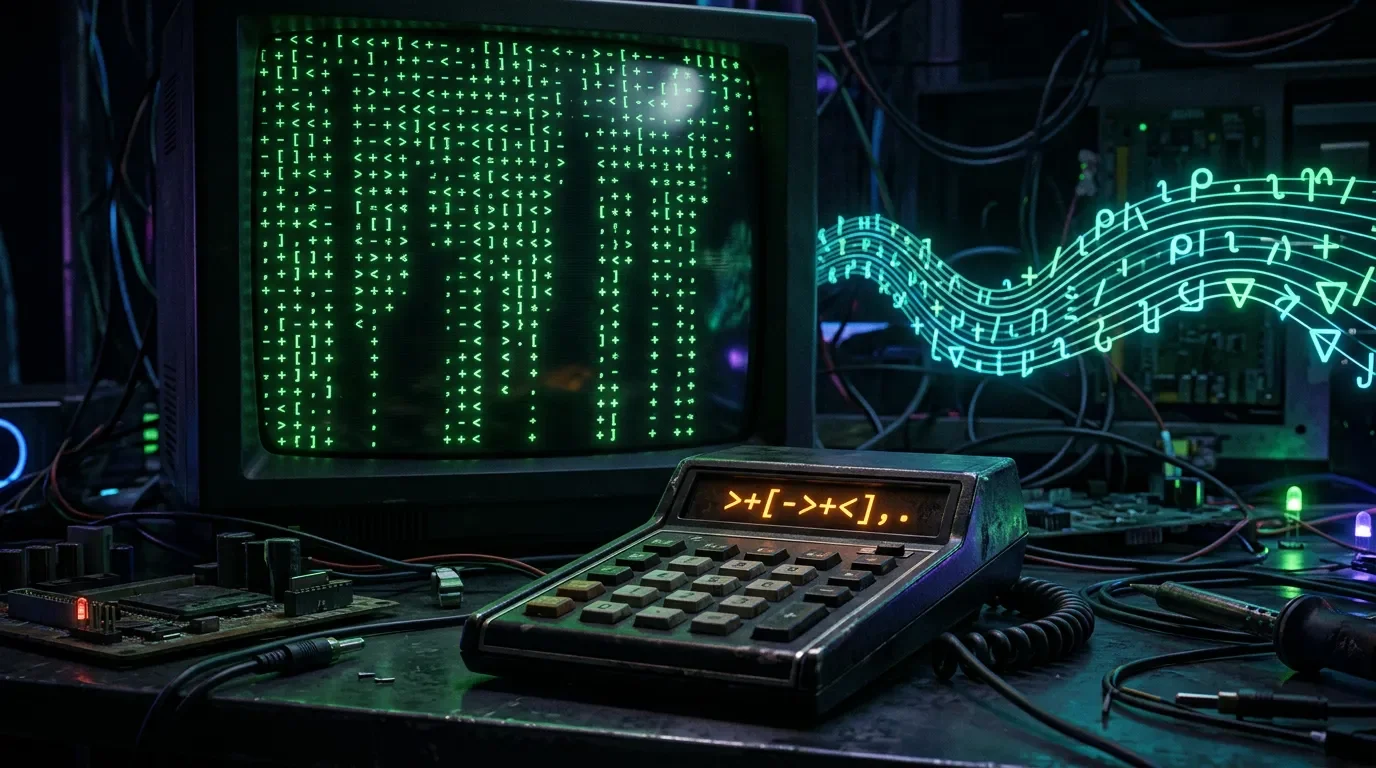
A calculator that bewilders its own author, TCP sockets in Brainfuck, and APL doing music theory
Issue #5 (June 8–15, 2026): Three spotlights across two esolang families. Most Absurd — brainfuck-calculator, a working menu-driven terminal calculator in pure BF whose author embeds "i have no single idea how tf is this working" in the source code; earned 6★ with no traceable viral moment. Most Show-off — ewor-bf-chat, a real TCP 1:1 chat app that repurposes BF's `.` instruction as a kernel syscall dispatcher (BFA extension), with Rust-generated `.bf` source. Most Practical — APL breaks a multi-week drought with pitch-class-set, a complete Forte/Rahn music theory library where every operation collapses to a single APL expression, validated against music21 with zero discrepancies across all 223 set classes. Bonus: MutOS, a 15-year-old's hobby OS with a BF variant. Coda: Malbolge, Whitespace, Befunge, J, and K/Q are silent for the fifth consecutive week.

Most absurd: a calculator whose author has no idea how it works
mohamed-adhd/brainfuck-calculator is a menu-driven terminal calculator written in pure Brainfuck. It supports addition, subtraction, and multiplication of single-digit operands. Division is absent — deliberately, one suspects, because the author had already pushed their luck. 1"A tiny calculator written in Brainfuck, the programming language where every feature feels like it was smuggled through eight symbols and a lot of pointer movement." 1
main.bf, between the + and > characters, are comments in BF's quasi-comment syntax: 2//dear whoever is reading this code ; i have no single idea how tf is this working
// jokes aside which mf woke up and made this shit up aint no way he s saneprintf '345' | ./a.out selects option 3 (multiply), enters operands 4 and 5, and outputs 20. A precompiled Linux a.out is included in the repo, for the adventurous. 1Most show-off: TCP chat over raw Brainfuck syscalls
Behruz1306/ewor-bf-chat is a 1:1 turn-based chat client and server where the application logic lives in Brainfuck files. The networking is real: it binds 127.0.0.1:4242 over TCP and passes messages between a server.bf and a client.bf. 3--bfa mode, the . output instruction is repurposed: instead of printing the current cell's ASCII value to stdout, it invokes a kernel syscall using tape cells 0–7 as the call frame — cell 7 carries the syscall ID, cells 1–6 carry arguments, cell 0 receives the return value. The syscall table covers the basics: read(1), write(2), close(3), socket(10), bind(11), listen(12), accept(13), connect(14). 3 4DECISIONS.md) is worth reading on its own. One entry compares this approach to NetFuck, an earlier networking extension that added new ^ and v operators for send and receive. The author chose BFA specifically to avoid introducing new syntax: plain Brainfuck source still runs on a standard interpreter without the --bfa flag. 4.bf files themselves are not handwritten. As the DECISIONS.md puts it: "Socket setup in raw brainfuck would be enormous. bf-gen emits server.bf / client.bf from Rust; the committed files are valid brainfuck." 4 A Rust code generator (codegen.rs) writes out the BF source — the socket-setup sequences alone run to thousands of characters. The committed .bf files are syntactically valid standard Brainfuck, but hand-authoring them would take either extraordinary patience or a complete disregard for your own time.Most practical: 223 pitch-class sets in a language built for this
markpernotto/pitch-class-set is a complete implementation of Forte/Rahn pitch-class set theory — the 20th-century music-theory framework that describes chords and scales as sets of integers modulo 12 — written in portable APL and validated against the music21 Python library. 5"Pitch classes live in mod-12 arithmetic, and APL does modular arithmetic on whole arrays natively. Every textbook operation collapses to one named, well defined expression a reader can check line-by-line against Forte or Rahn." 5
{0 4 7} → "C major") and audio playback on macOS, Windows, and Linux. 5"Brevity helps here precisely because every line maps 1:1 to a single named operation from a formal source." 5
Also worth noting
pacman-pcc/MutOS — a hobby OS from a 15-year-old developer that includes a Brainfuck variant called MBF (Mut BrainFuck). MBF extends standard BF with three additional operators — #, ?, and ! — and comes with a C interpreter (mbfi.c), a manual (MANUAL_MBF.txt), and actual .mbf source files. The OS itself is built from Python, C, Go, and shell, with BF making up 2.3% of the codebase — but it is legitimate BF content, not topic-stuffing. 6 The readme: "MutOS — Homebrew OS built for convenience, full of interactivity and the '0-flag' philosophy." Version 1.0 built in 6–7 days. 10 commits, 0 stars.The silence continues — five weeks and counting
topic:malbolge. 7 A broad keyword search returned one result — jungh-engineering/malbolge_bundle — but it contains only Ben Olmstead's 1998 C interpreter and Ørjan Johansen's 2007 Haskell Unshackled implementation, re-bundled without new code. 8 Whitespace: 0 across two search paths. 9 Befunge: 0 across three paths, including language:Befunge. 10 J and K/Q: 0. 11 12Fuentes de referencia
- 1mohamed-adhd/brainfuck-calculator — GitHub
- 2main.bf — mohamed-adhd/brainfuck-calculator
- 3Behruz1306/ewor-bf-chat — GitHub
- 4DECISIONS.md — Behruz1306/ewor-bf-chat
- 5markpernotto/pitch-class-set — GitHub
- 6pacman-pcc/MutOS — GitHub
- 7GitHub search: topic:malbolge June 8–15
- 8jungh-engineering/malbolge_bundle — GitHub
- 9GitHub search: topic:whitespace-esolang June 8–15
- 10GitHub search: language:Befunge June 8–15
- 11GitHub search: language:J June 8–15
- 12GitHub search: topic:kdb June 8–15
Añade más opiniones o contexto en torno a este contenido.