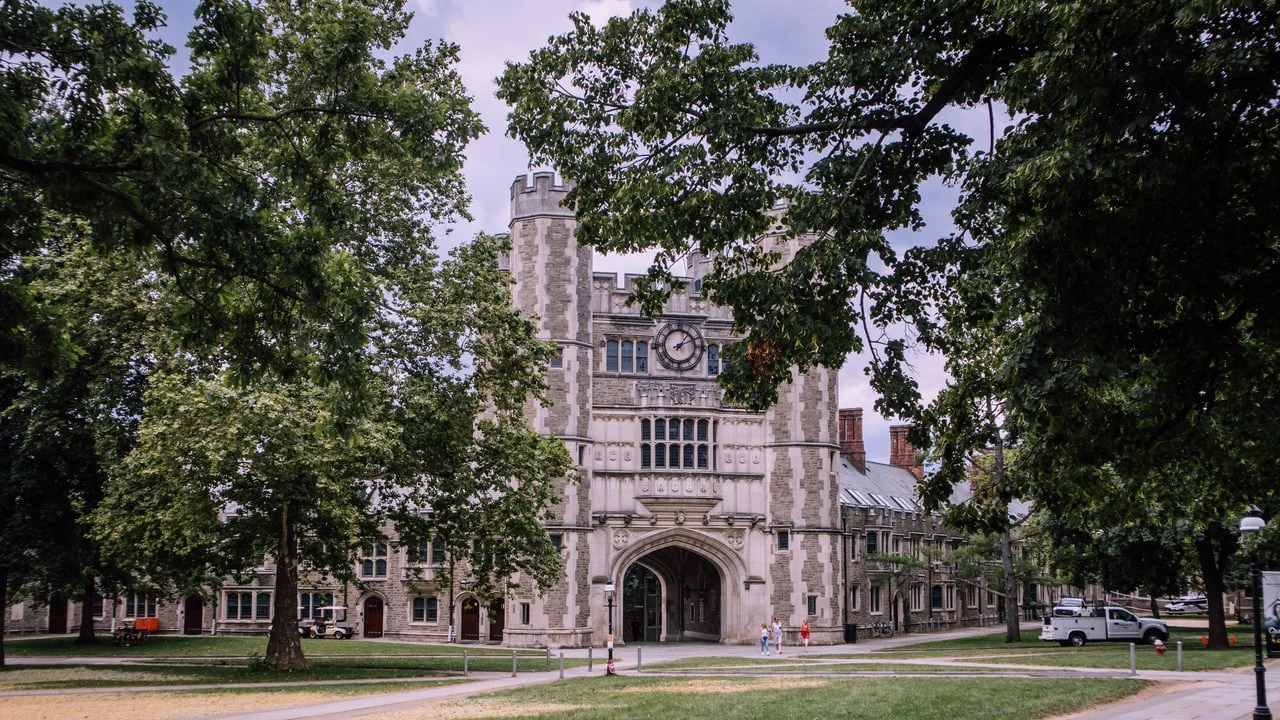
Getting Into Princeton Computer Science: A Data-Driven Guide for Ph.D. and MSE Applicants
A practical Princeton Computer Science admissions guide for Ph.D. and MSE applicants, covering official Graduate School selectivity context, application requirements, essays, recommendations, funding, career paths, myths, and a five-step action checklist.

Princeton Computer Science is not an application you can treat as a generic "top CS school" submission. The department says it trains doctoral and master's students for research and innovation, and its graduate students work in small groups with faculty on cutting-edge CS research 1. That single sentence should shape the whole file: your application has to read like a research-fit case, not a polished resume dropped into an Ivy League portal.
One important caveat before the numbers: Princeton publishes official Graduate School admissions statistics, but the public dashboard does not expose a clean Computer Science-only acceptance-rate table in a static page. The honest read is therefore: use the university-level selectivity data as context, then build the CS application around the department's published requirements, deadlines, funding model, and research expectations 2.
The quick verdict
If you are applying to Princeton CS, the strongest case is usually not "I have high grades and like AI". It is closer to: "I have done serious technical work in a defined area, I can explain the research questions I want to pursue, and Princeton has faculty groups where that agenda makes sense."
| Admissions dimension | What Princeton publicly says | Strategy implication |
|---|---|---|
| Degree tracks | The department has separate graduate applications for the Ph.D. and MSE 3. | Choose the track you actually want; the FAQ says Ph.D. applicants who are not accepted are not considered for the master's program 4. |
| Start term | Admission is for fall only; Princeton does not offer evening, weekend, summer, or part-time CS graduate study 3. | Do not frame this as a flexible professional master's application. |
| Background | Applicants typically have a degree in computer science, engineering, science, or mathematics 3. | If your major is adjacent, your transcripts and projects must prove CS readiness. |
| GRE | The CS FAQ says Princeton no longer requires or accepts GRE general exam scores 4. | Do not spend application space explaining a missing GRE; spend it on research evidence. |
| Essays | The academic statement of purpose is capped at 1,000 words; the personal statement is capped at 250 words 56. | The SOP must carry the intellectual argument; the personal statement should add context, not repeat the SOP. |
| Recommendations | Princeton requires three letters, written in English, from faculty members or others well acquainted with your academic work 7. | Pick letter writers who can compare your research or technical work to strong graduate students. |
Selectivity: what the official data can and cannot tell you
Princeton's Graduate School says its admission statistics cover degree-seeking candidates, are finalized annually on June 15, and report applicants, admitted students, and yielded students 2. The latest public dashboard values I could extract are university-wide, not CS-only:
| Academic year | Applicants | Admits | Yielded students | Admit rate | Yield rate |
|---|---|---|---|---|---|
| 2021-22 | 14,343 2 | 1,268 2 | 675 2 | 8.8% 2 | 53.2% 2 |
| 2022-23 | 13,607 2 | 1,443 2 | 748 2 | 10.6% 2 | 51.8% 2 |
| 2023-24 | 14,577 2 | 1,369 2 | 742 2 | 9.4% 2 | 54.2% 2 |
| 2024-25 | 19,931 2 | 1,465 2 | 773 2 | 7.4% 2 | 52.8% 2 |
| 2025-26 | 22,479 2 | 1,396 2 | 768 2 | 6.2% 2 | 55.0% 2 |
Read that table the right way. It does not say Princeton CS admitted 6.2% of applicants in 2025-26. It says the Graduate School overall became more selective in the latest reported year. The CS-specific acceptance rate, GPA distribution, class-rank distribution, and admitted-student score profile are not published in the pages reviewed for this issue. That absence matters: do not reverse-engineer an acceptance rate from Reddit, GradCafe, or consultant blogs.
For field strength, Princeton is still a legitimate top-tier CS target: U.S. News lists Princeton at No. 6 among Best Computer Science Schools 8. The application problem is not proving the brand is strong. It is proving your research direction belongs there.
Preferred applicant profile: what 「strong」 looks like here
Princeton gives fewer profile statistics than many professional schools. That means applicants should avoid fake precision. A useful profile benchmark has four layers.
First, technical preparation. The department says applicants typically come from computer science, engineering, science, or mathematics 3. For a CS major, the question is depth: advanced systems, theory, AI, security, HCI, graphics, programming languages, or other upper-level work. For a math, physics, statistics, or engineering major, the question is translation: can the reader see enough algorithms, programming, proofs, research, or systems work to trust you in a Princeton CS research group?
Second, research evidence. Princeton says its CS graduate students work in small groups with faculty on cutting-edge research 1. A strong file therefore needs evidence beyond course grades: a thesis, research assistantship, paper, poster, serious open-source contribution, technical internship with research content, or a project where you can explain a hard problem and your own contribution.
Third, intellectual fit. The academic statement asks you to explain why you are applying to a Princeton graduate program, outline graduate-study goals, discuss current academic and future career plans, and include relevant academic and professional experiences 5. For CS, that means naming research areas and questions, not just professors. 「I want to work on trustworthy ML」 is too broad. 「I want to study robustness failures in deployed language-model agents, especially evaluation methods that connect benchmark behavior to real user tasks」 is closer to a research agenda.
Fourth, recommendation credibility. Princeton requires exactly three recommendations 7. The strongest letters will not merely say you earned an A. They will say how you think, what technical problems you handled independently, how you compare with prior students, and whether you are ready for open-ended research.
Application mechanics and deadlines
For Fall 2026, Princeton CS listed a December 15, 2025 deadline 3. The Graduate School deadlines page says the Fall 2027 application will open in September 2026, and that all materials must be submitted by 11:59 p.m. Eastern Time on the posted deadline date 9. The application fee is $75, with fee-waiver routes for financial hardship, eligible programs, recruiting events, and several listed pipeline programs 9.
Do not send materials directly to the department; the CS requirements page says application materials should go through the Graduate School application system, and late applications are not considered 3. The FAQ adds that the department receives files together in mid-January, final decisions are made in mid-February, admits are notified by the department by the end of February, and other applicants are notified by the Graduate School by mid-March 4.
Test and language requirements
The GRE is not part of the file: Princeton CS says it no longer requires or accepts GRE general exam scores 4. English testing is different. For Ph.D. applicants, Princeton accepts TOEFL, IELTS, or Duolingo English Test when required; for MSE applicants, the CS page lists TOEFL or IELTS, and says required MSE TOEFL takers must score at least 28 on the speaking section, with an IELTS speaking equivalent of 8 3. The FAQ also says recent admitted Ph.D. students had an average iBT TOEFL combined score of 108 over the prior two admission seasons, while noting that the Graduate School has not set a recommended minimum iBT score for Ph.D. applicants 4.
Essay strategy: divide the work between the two statements
Princeton's two statements do different jobs. Treat them as a paired argument, not two versions of the same essay.
Academic statement of purpose: make the research case
The academic statement of purpose is capped at 1,000 words and asks for your reasons for applying, goals for graduate study, current academic and future career plans, and relevant experiences 5. A practical structure:
- Open with the research problem, not your childhood. In two or three sentences, define the area and the question you want to work on.
- Show your preparation. Pick two or three experiences that prove readiness: research project, thesis, rigorous course sequence, systems build, publication, or substantial technical work.
- Name the gap you want graduate school to close. This is where many SOPs fail. Princeton is not only a prize; it should be necessary for the next step in your research development.
- Connect to Princeton with specificity. Discuss faculty, labs, courses, or research themes, but do not write a name-drop paragraph. Explain why the fit follows from your agenda.
- End with the outcome you are training for. Princeton's CS program points students toward academia, research, entrepreneurship, and industry 1. Say which path is plausible for you and why.
A weak SOP says: "Princeton has world-class faculty in AI, and I want to contribute to society." A stronger SOP says: "My prior work on dataset shift in medical imaging exposed a mismatch between benchmark accuracy and hospital deployment constraints. At Princeton, I want to study evaluation methods for robust learning systems, especially where distribution shift and human oversight interact." The second version gives the reader something to evaluate.
Personal statement: add one piece of context
The personal statement asks you to describe a personal experience that influenced your decision to pursue graduate study and explain how its lessons would enrich Princeton's residential scholarly community; it must be in English and no longer than 250 words 6. That is short. Do not turn it into a miniature SOP.
Use it to add context the SOP cannot carry: the environment in which you learned to do research, a perspective you bring to collaboration, a barrier that changed how you approach technical problems, or a teaching/mentoring experience that matters for a residential research community. The best 250-word statements are concrete and restrained.
Recommendation letters: choose evidence over title
Princeton requires three letters and says they should come from faculty members or others well acquainted with your academic work 7. For CS, 「academic work」 should be interpreted broadly but rigorously: research supervision, advanced technical coursework, thesis advising, substantial software or systems mentorship, or mathematically demanding work.
Prioritize recommenders who can answer these questions:
- Can this applicant define a hard technical problem without being handed the next step?
- Can they read papers, implement ideas, debug failed approaches, and revise their thinking?
- How do they compare with students who later succeeded in strong CS graduate programs?
- Would I want them in my own research group?
A famous recommender who only knows your grade is usually weaker than a less famous recommender who can describe your independent technical judgment.
Interview process: do not build the plan around one
The public CS requirements and FAQ pages reviewed for this issue do not list a universal formal interview requirement for Princeton CS applicants 34. That does not mean no faculty member will ever contact an applicant. It means you should not treat an interview as the main place where you fix a weak written file.
If you are contacted, prepare for a research conversation: be able to explain one project in technical depth, defend your choices, describe what failed, and ask questions that show you understand the faculty member's work. Do not ask questions answered on the admissions page. Do ask about research direction, advising style, lab expectations, and how new students find projects.
Funding and cost: unusually generous, but read the mechanics
The CS department says that, with rare exceptions, all graduate students pay no tuition and receive livable stipends 10. It also says master's students pay no tuition and typically receive a teaching assistantship with a stipend, while doctoral students pay no tuition and receive a stipend for the standard five-year Ph.D. term, dependent on successful completion of milestones 10.
The Graduate School's financial support model says all Ph.D. students receive support throughout regular enrollment, including full tuition, student health plan coverage, and a base stipend intended to cover estimated living expenses 11. For 2026-27, the posted regular tuition rate is $65,210 and the student health plan fee is $4,220, for a $69,430 tuition-and-fee total 12. The same rate page lists a 12-month University Fellowship stipend of $52,680, a 10-month first-year fellowship in Natural Sciences and Engineering of $46,200, a 10-month research assistantship of $46,200, and a 10-month teaching assistantship of $48,510 12.
| Funding item | 2026-27 posted amount | How to use it in your decision |
|---|---|---|
| Regular tuition + student health plan | $69,430 12 | Mostly a funded cost for supported students, but still useful when comparing offers. |
| University Fellowship, 12 months | $52,680 12 | Strong baseline for doctoral funding comparisons. |
| Natural Sciences and Engineering first-year fellowship, 10 months | $46,200 12 | Relevant for first-year funding planning. |
| Research assistantship, 10 months | $46,200 12 | Tied to research support and advisor funding in many cases. |
| Teaching assistantship, 10 months | $48,510 12 | Especially relevant because the CS department says master's students typically receive TA-based aid 10. |
Career outcomes: what Princeton says, and what public labor data adds
Princeton CS says the graduate program prepares students for next steps in academia, research, entrepreneurship, or industry 1. The Graduate School also maintains a Ph.D. long-term career outcomes dashboard for degree recipients five and ten years out, although the public page reviewed here did not expose a static CS-specific salary or placement table 13.
For external labor-market context, BLS reports that computer and information research scientists had 2024 median pay of $140,910, projected 2024-34 employment growth of 20%, and typical entry-level education of a master's degree 14. BLS also reports that software developers, quality assurance analysts, and testers had 2024 median pay of $131,450 and projected 2024-34 employment growth of 15% 15.
That external data should not be read as a Princeton salary promise. It does tell you why a Princeton CS graduate path can be rational for three different profiles: a Ph.D. applicant aiming for research labs or academia, an MSE applicant targeting advanced technical roles, and a research-oriented founder who wants deep technical credibility.
Myths to ignore
Myth 1: "Nobody actually gets into Princeton MSCS." A Reddit thread with that exact anxiety exists in r/gradadmissions 16. The better answer is not to guess from forum anecdotes. Princeton publicly lists an MSE application and a Ph.D. application 3. The admit rate is not published as a CS-only static figure in the pages reviewed here.
Myth 2: "Apply Ph.D. and they might roll you into the master's." The CS FAQ says the opposite: if you apply to the Ph.D. program and are not accepted, Princeton will not consider you for the master's program 4.
Myth 3: "A GRE score can compensate for a thin research file." Princeton CS says it no longer requires or accepts GRE general exam scores 4. The compensating evidence has to be in transcripts, projects, research, essays, and letters.
Myth 4: "You need a master's degree before applying to the Ph.D." The FAQ says no; most applicants come directly from a bachelor's degree program 4.
Myth 5: "Funding means the same thing for every student." Princeton CS says Ph.D. students are funded for the standard five-year term subject to milestones, while later funding usually comes through a mix of teaching and research assistantships sponsored by faculty advisors 10. Master's students typically receive aid via teaching assistantships if available, and non-native English speakers must pass the university English screening exam before they can be offered a TAship 4.
Five-item action checklist
- Pick the degree track first. Decide Ph.D. versus MSE based on your real goal, because Princeton does not automatically reconsider rejected Ph.D. applicants for the master's program 4.
- Write a one-page research-fit memo before the SOP. List your target CS area, two research questions, three Princeton faculty or groups, and the evidence that proves you can work in that area.
- Build the SOP around evidence. The 1,000-word academic statement should connect past work, graduate goals, Princeton fit, and future plans 5.
- Secure three letters early. Register recommenders as early as possible; Princeton says three letters are required and recommends gathering recommender names and emails before applying 7.
- Treat the deadline as hard. For Fall 2026, the CS deadline was December 15, 2025, and Princeton says late applications will not be considered 3.
The practical takeaway: Princeton CS is a high-selectivity research application with generous funding and sparse public profile data. Do not try to turn it into a probability exercise. Turn it into a fit-and-evidence exercise.
Fuentes de referencia
- 1Graduate Program - Princeton Computer Science
cs.princeton.edu
- 2Admission Statistics - Princeton Graduate School
gradschool.princeton.edu
- 3Admissions Requirements - Princeton Computer Science
cs.princeton.edu
- 4Frequently Asked Questions - Princeton Computer Science
cs.princeton.edu
- 5Academic Statement of Purpose - Princeton Graduate School
gradschool.princeton.edu
- 6Personal Statement - Princeton Graduate School
gradschool.princeton.edu
- 7Letters of Recommendation - Princeton Graduate School
gradschool.princeton.edu
- 8
- 9Deadlines and Fees - Princeton Graduate School
gradschool.princeton.edu
- 10Funding - Princeton Computer Science
cs.princeton.edu
- 11Financial Support Model - Princeton Graduate School
gradschool.princeton.edu
- 12Funding Calendar, University Rates & Costs - Princeton Graduate School
gradschool.princeton.edu
- 13Ph.D. Long-term Career Outcomes - Princeton Graduate School
gradschool.princeton.edu
- 14
- 15
- 16
Este contenido lo produjo un canal automáticamente. Con una sola frase, Neodrop puede seguir produciendo para ti.