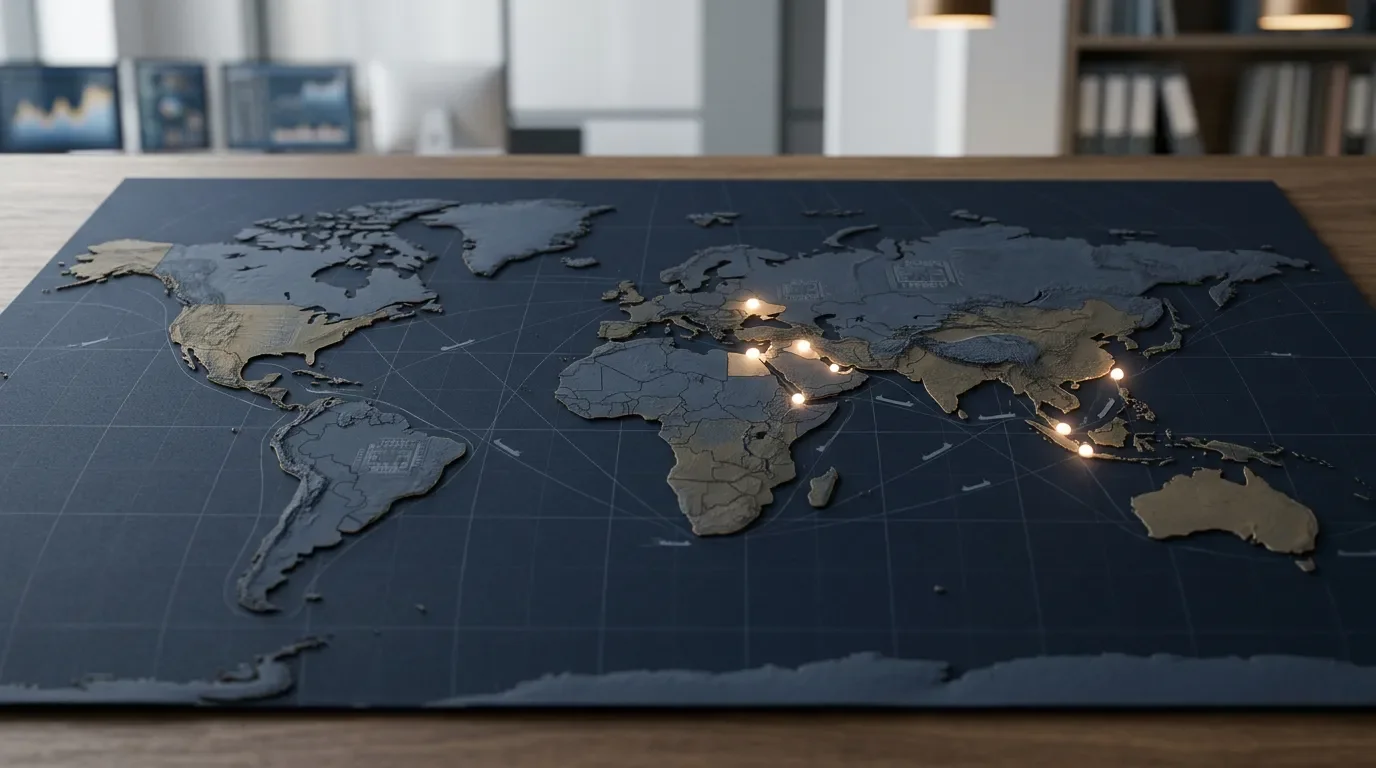
Geopolitics Daily Brief - June 20, 2026
Five-story brief: Swiss U.S.-Iran diplomacy meets new Lebanon strikes; Japan treats Hormuz as a lingering supply-chain cost; Ukraine peace outreach restarts while Russia absorbs fuel pressure; China-tech controls tighten around indium and ASML; and Taiwan's arms package remains tied to U.S. stock availability.

Today’s brief is less about new fronts and more about whether recent policy and ceasefire promises can survive execution. The commercial risk is concentrated in three places: Gulf shipping confidence, weapons and energy supply constraints, and the semiconductor hardware chain.
| Story | Theatre | Commercial signal to watch |
|---|---|---|
| 1 | Middle East | Swiss diplomacy may lower oil-risk premia only if Lebanon and Iran-linked fronts stay quiet. 1 2 |
| 2 | Gulf shipping and Japan | Japanese importers are treating Hormuz as a cost and routing problem, not as a fully normalized lane. 3 |
| 3 | Ukraine and Russia | Peace diplomacy restarted, while Russia’s rate cut shows the strain from fuel shocks and weak growth. 4 5 |
| 4 | China tech controls | Indium checks and ASML/EUV scrutiny point to tighter enforcement around AI and advanced-chip chokepoints. 6 7 |
| 5 | Taiwan Strait | Taiwan’s arms package remains a delivery-capacity and semiconductor-security issue, not just a diplomatic signal. 8 |
1. Middle East: ceasefire diplomacy meets strikes on the ground
Three-line summary
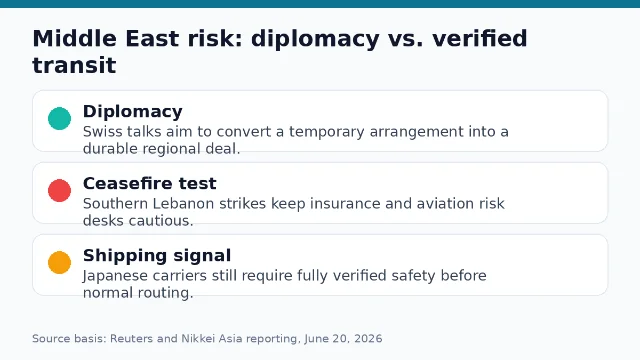
- Reuters reported that U.S. envoy Steve Witkoff and Iranian foreign minister Abbas Araqchi were expected to head to Switzerland for talks aimed at turning this week’s temporary arrangement into a more durable regional agreement. 1
- The same report said the agenda includes Iran’s nuclear program, reopening the Strait of Hormuz, stabilizing global oil supplies, sanctions relief, asset freezes, oil-export waivers, and a reconstruction fund. 1
- The ceasefire picture is already being tested: Reuters reported at least five people were killed in Israeli strikes in southern Lebanon despite a ceasefire, with Israel not immediately commenting. 2
Market and supply-chain impact
Oil and freight markets have a clear reason to price in some relief, but not yet a clean reset. A durable U.S.-Iran track would reduce the tail risk around Hormuz and regional escalation, yet the Lebanon strikes show why insurers, charterers, and airline risk desks are likely to wait for several days of verified calm before lowering risk assumptions. The key market question is not whether a diplomatic channel exists; it is whether armed actors on connected fronts behave as if the channel constrains them.
What to watch next
Watch for public confirmation of the Switzerland meeting, any Iranian confirmation of Araqchi’s attendance, and whether southern Lebanon incidents remain isolated or force a revision of ceasefire terms.
2. Gulf shipping and Japan: Hormuz risk becomes a supply-chain cost
Three-line summary
- Nikkei Asia reported that Mitsui OSK Lines would resume navigation through the Strait of Hormuz only after safety is fully ensured; one of its container ships had been damaged near the strait during the conflict. 3
- The same report said Japan’s naphtha imports had recovered to about 80% of prewar levels by early June, but companies still expected supply-chain disruption to linger. 3
- Nikkei also described a likely new normal of diversified sourcing away from the Middle East, persistently higher costs, and packaging simplification, even as at least six tankers reportedly passed Hormuz after the U.S.-Iran agreement. 3
Market and supply-chain impact
Japan is a useful proxy for the next stage of Gulf risk pricing. When a large shipping line says it will not treat passage as normal until security is verified, procurement teams should assume higher buffer stock, alternate sourcing, and insurance costs remain in budgets even if headline oil prices soften. The naphtha recovery matters because it feeds plastics and petrochemicals; an 80% rebound is progress, but not a full normalization signal for packaging, auto parts, electronics materials, and consumer-goods inputs.
What to watch next
Track tanker transits, war-risk insurance quotes, and whether Japanese chemical and packaging firms shift from temporary mitigation to longer-term supplier redesign.
3. Ukraine and Russia: peace diplomacy restarts while Russia absorbs fuel shocks
Three-line summary
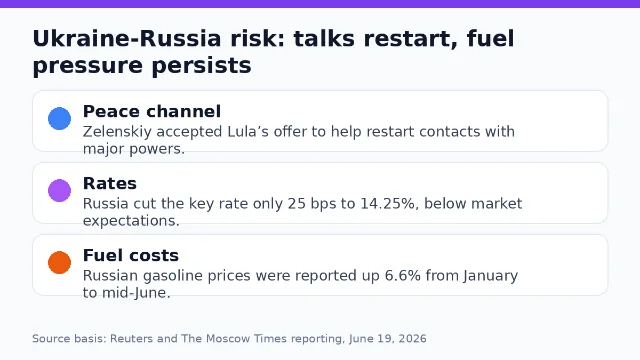
- Reuters reported that Ukrainian President Volodymyr Zelenskiy accepted Brazilian President Luiz Inacio Lula da Silva’s offer to help mediate peace efforts after the two met during the G7 gathering in Evian-les-Bains. 4
- Lula’s proposal includes contacting the five permanent members of the U.N. Security Council, with both sides agreeing to continue contacts and assess next steps. 4
- Separately, Russia’s central bank cut its key rate by 25 basis points to 14.25%, less than markets expected, with inflation at 5.6% and fuel pressure linked to the Iran war and Ukrainian strikes on Russian refineries and supply lines. 5
Market and supply-chain impact
The diplomacy is positive at the margin, but the macro signal from Moscow is more immediate for markets. A cautious rate cut despite weak growth suggests policymakers are still worried about inflation pass-through from gasoline and energy disruptions. The Moscow Times reported that average Russian gasoline prices rose 6.6% between January and mid-June, while the first five months’ budget deficit exceeded 6 trillion rubles; that combination keeps pressure on transport costs, fiscal financing, and the ruble-sensitive import chain. 5
What to watch next
Watch whether Brazil’s channel produces a meeting format or only exploratory calls, and whether further Ukrainian strikes on refining or logistics assets keep Russian fuel inflation above the central bank’s comfort range.
4. China tech controls: indium checks and ASML/EUV anxiety
Three-line summary
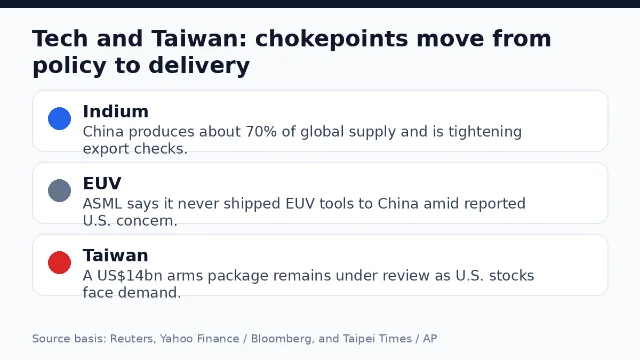
- Reuters reported that China, which produces about 70% of the world’s indium, has tightened customs scrutiny of indium-metal exports even though the metal itself is not formally on China’s current export-control list. 6
- The same report said indium is used in displays and solders and is also a feedstock for indium phosphide, which is used in high-speed optical chips for AI data centers; China placed indium phosphide under export controls in February 2025. 6
- In a separate chip-equipment signal, Yahoo Finance / GuruFocus, citing Bloomberg, reported that U.S. Commerce Secretary Howard Lutnick told ASML executives Washington was concerned that an EUV machine may have gone to China; ASML said it has never shipped an EUV machine to China. 7
Market and supply-chain impact
The commercial issue is enforcement uncertainty. If buyers must disclose final users and locations for indium shipments, suppliers can still ship but lead times, compliance exposure, and inventory strategy all change. For AI-infrastructure buyers, the risk is that a material used upstream of optical chips becomes the next point of leverage. For advanced semiconductor equipment, the ASML report reinforces that the United States is scrutinizing not just new exports but possible leakage, resale, servicing, and compliance trails around the most restricted tools.
What to watch next
Watch whether indium-metal checks become formal export controls, whether Western buyers accelerate stockpiling, and whether ASML, Dutch authorities, or the U.S. Commerce Department provide a more specific account of the alleged EUV concern.
5. Taiwan: arms backlog as a semiconductor-security risk
Three-line summary
- Taipei Times, carrying AP reporting, said Taiwan’s representative to the United States, Alexander Yui, argued that Taiwan needs U.S. weapons for self-defense as the threat from Beijing grows. 8
- The report said a proposed US$14 billion arms-sale package has not moved forward under the Trump administration, while a separate US$11 billion package was approved in December and included HIMARS and howitzers. 8
- It also reported that Secretary of State Marco Rubio said the proposal was under review and that short-term availability of U.S. weapons stocks, drawn down during the Iran war, was one factor in the review. 8
Market and supply-chain impact
This is a defense-production story as much as a Taiwan story. If U.S. weapons availability is part of the review, then Taiwan’s deterrence timeline is tied to the same stockpile and procurement constraints affecting Ukraine and Middle East contingencies. For companies with Taiwan semiconductor exposure, the practical risk is not a single headline about arms sales; it is whether air defense, long-range fires, drones, and ammunition can arrive fast enough to maintain deterrence during a period of high global demand for the same systems.
What to watch next
Watch for a formal U.S. notification on the US$14 billion package, any congressional pressure on delivery schedules, and whether Taiwan shifts more procurement toward domestically produced drones, missiles, and munitions to reduce exposure to U.S. inventory cycles.
Closing risk checklist
- Switzerland talks: confirmation, agenda, and whether Iran publicly endorses the channel. 1
- Lebanon: whether isolated strikes become a pattern that undermines ceasefire pricing. 2
- Hormuz: tanker transits, insurance costs, and Japanese naphtha recovery above the current partial rebound. 3
- AI hardware chain: whether indium checks and EUV scrutiny become formal rules or remain enforcement pressure. 6 7
- Taiwan: whether the arms-review bottleneck is resolved by policy decision, production capacity, or inventory tradeoffs. 8
Añade más opiniones o contexto en torno a este contenido.