
AI Compliance Impact Map — Week of May 8–15, 2026
This week's global AI compliance briefing covers 8 jurisdictions: Colorado's landmark AI Act replacement signed, Connecticut's AIRT Act awaiting signature, EU AI Act Omnibus extending high-risk deadlines, China's anthropomorphic AI rules effective July 15, four US court rulings, a record $12.75M CCPA fine, and an upcoming-deadlines table headlined by the May 19 TAKE IT DOWN Act enforcement date.

15/5/2026 · 15:19
1 suscripciones · 5 contenidos
Three immediate priorities this week:
- HIGH — May 19 deadline: TAKE IT DOWN Act (TIDA) — covered platforms must have a 48-hour AI deepfake removal mechanism live before Monday. FTC compliance letters went out May 12 to Amazon, Alphabet, and Apple. Penalty: up to $53,088 per violation.
- HIGH — Colorado SB 26-189 signed May 14: The US's first comprehensive AI anti-discrimination law was repealed and replaced with a narrower consumer-disclosure regime. If your compliance posture was built around SB 24-205, it needs immediate reassessment.
- HIGH — EU AI Act Omnibus political agreement (May 7): High-risk AI obligations under Annex III are headed for a December 2027 deadline — but formal adoption has not yet occurred. The August 2, 2026 deadline remains legally in force until the Official Journal publishes. Do not pause compliance programs.
US federal: regulatory posture and agency actions
The Trump administration is preparing a draft AI security executive order that would direct federal agencies to revamp information-sharing programs to include AI developers and address AI-enabled cyber threats, according to Bloomberg (May 8). 1 The draft would stop short of requiring mandatory pre-deployment government testing — a point of internal friction between the Commerce Department and intelligence agencies over who should lead model evaluation. 2

Image from Nextgov/FCW
National Economic Council Director Kevin Hassett confirmed the White House is studying the EO and framed the approach by analogy: "We're studying possibly an executive order to give a clear road map to everybody about how this is going to go and how future AI that also potentially create vulnerabilities should go through a process so that they're released in the wild after they've been proven safe, just like an FDA drug." 3
Separately, NPR reported May 14 that the White House's stance on AI safety has shifted materially since Anthropic disclosed its "Mythos" model — described internally as too dangerous to release publicly due to its ability to find and exploit software vulnerabilities. 4 White House Chief of Staff Susie Wiles met with Anthropic's CEO; Treasury Secretary Scott Bessent stated publicly: "There is a very important calculus here between innovation and safety. And at the U.S. government, we're going to make sure that things stay safe." 4 Kyle Chan, a Brookings Institution scholar, characterized the shift: "Safety had become a bad word, and people started using words like AI security instead to try to get around that. And now, safety is front and center again." 4
Compliance signal: The EO remains unsigned. No new federal compliance obligation yet. Monitor whitehouse.gov weekly; the Commerce-vs-intelligence turf dispute may shape which agency gains oversight authority over AI model evaluations.
NIST announced plans to release a draft AI cybersecurity framework profile — including control overlay guidance for predictive AI — this summer, with an agentic AI overlay following in late summer or early fall and a final version targeted for 2027. 5 NIST's Center for AI Standards and Innovation (CAISI, formerly the AI Safety Institute) has signed pre-deployment evaluation agreements with Google DeepMind, Microsoft, and xAI, adding to existing agreements with Anthropic and OpenAI, and has conducted 40 evaluations to date. 5
DOE issued Policy Flash 2026-45 on May 8, implementing OMB Memo M-26-04 under Executive Order 14319 ("Preventing Woke AI in the Federal Government"). 6 The directive requires federal LLM procurement to adhere to "unbiased AI principles" — specifically truth-seeking and ideological neutrality. It does not apply to Management and Operating contracts; supplemental guidance is forthcoming. Compliance impact for AI vendors: Contracts with DOE involving LLM deployment must now pass an ideological-neutrality screen. Review existing agreements and bids.
FTC Chair Andrew Ferguson testified before the Senate Commerce Committee on April 15 that the FTC should not become a "general AI regulator" and will apply existing law to AI fraud, misrepresentation, and harm to children only. 7 The FTC is, however, advancing a personalized-pricing policy statement clarifying when using personal data to set individualized prices violates Section 5 of the FTC Act. SEC Chair Paul Atkins signaled new rulemaking for AI-driven finance and onchain markets on May 8 — the SEC will seek to clarify rules through formal rulemaking rather than enforcement actions. 8
US state legislation
Colorado SB 26-189: the landmark AI Act is gone
Governor Jared Polis signed SB 26-189 on May 14, 2026, repealing and replacing SB 24-205 — the 2024 Colorado AI Act that had been the first comprehensive AI anti-discrimination law in the United States. 9 The bill passed the Senate 34–1 and the House 57–6, with the original law's own sponsors co-authoring the replacement. 10
The new law regulates "automated decision-making technology" (ADMT) used to "materially influence" a "consequential decision" — covering employment, education, housing, financial/lending services, insurance, healthcare, and essential government services. Routine activities — advertising, content moderation, cybersecurity, fraud prevention, and AML/sanctions compliance — are explicitly excluded. 11
Key obligations under the replacement framework:
- Developers must provide deployers with technical documentation covering intended uses, training data categories, known limitations, and human review instructions.
- Deployers must give consumers clear pre-use notice and, within 30 days of an adverse outcome, a plain-language explanation of the ADMT's role.
- Consumers gain rights to access and correct personal data and to request meaningful human review after an adverse decision.
- Anti-indemnification: Contract terms indemnifying a party for its own discriminatory use of ADMT are void and immediately unenforceable. 11
Enforcement is exclusively through the Colorado Attorney General under the Consumer Protection Act, with a 60-day cure period. There is no private right of action. Effective date: January 1, 2027. Attorney General rulemaking begins immediately. 12
Governor Polis framed the replacement explicitly: "I'm so excited to lower the cost of doing business in Colorado, streamlining regulation. That's what we want to do: you want to have the minimum amount of regulation to achieve the best outcome for the people of Colorado." 9
The original 2024 law had been stayed by a federal judge on April 27, 2026, in xAI v. Weiser after xAI sued and the DOJ intervened — the first time the federal government has challenged a state AI law. The constitutional challenge formally mooted by the repeal, but the DOJ's intervention signals continued federal scrutiny of state AI laws under Executive Order 14365. 13
Connecticut AIRT Act (SB 5): a more expansive replacement
Connecticut's House passed Senate Bill 5, the Artificial Intelligence Responsibility and Transparency (AIRT) Act, 131–17 on May 1. 14 Governor Ned Lamont's office confirmed he "looks forward to signing" it — a reversal from 2025, when a similar bill died under his veto threat. At 67+ pages, SB 5 is the most comprehensive state AI law of the 2026 session, covering six distinct regulatory areas:
| Area | Key requirement | Effective date |
|---|---|---|
| Automated employment decision tools (AEDT) | Developer obligations + pre-decision deployer notice | Oct 1, 2026 (dev); Oct 1, 2027 (deployer) |
| AI companion chatbots | Disclosure + child-specific prohibitions (romantic/sexual content, self-harm encouragement, emotional dependence techniques) | Jan 1, 2027 |
| Synthetic digital content provenance | Providers with 1M+ monthly users must embed C2PA-aligned provenance data | Oct 1, 2026 |
| Frontier model whistleblower protections | Protections for employees reporting safety concerns | Oct 1, 2026 |
| Independent verification pilot | First state-level third-party AI model verification program (max 5 firms; sunsets 2030) | Jul 1, 2027 |
| Youth social media protections | 75%-screen Surgeon General warning on first daily access for minors | Jan 1, 2028 |
Two provisions deserve elevated attention. First, the anti-discrimination amendment: SB 5 amends Connecticut's anti-discrimination statutes to make clear that using an automated tool is not a defense to a discrimination claim, while courts may consider anti-bias testing as a mitigating factor — going further than any other state. 15 Second, the companion chatbot provisions: DLA Piper assessed them as potentially functioning as "a practical bar on offering consumer chatbots to users under 18 in Connecticut." 15 Enforcement is through the Attorney General; the chatbot and social media provisions may also allow private actions under Connecticut's Unfair Trade Practices Act. Freshfields flagged federal preemption risk given the Trump administration's December 2025 EO directing DOJ to challenge state AI laws. 16
AI chatbot safety laws: seven states, counting
As of May 2026, seven states have enacted laws regulating AI companion chatbots: Iowa (SF 2417), Nebraska (LB 525, signed April 14), Oregon (SB 1546, signed March 31), New York, California, Washington, and Idaho. 17 Connecticut's SB 5 will be the eighth upon signature. Michigan SB 760 passed the Senate 20–17 and has been transmitted to the House. 17 Common obligations across all enacted state chatbot laws: mandatory AI disclosure to users, suicide/self-harm detection protocols, and prohibitions on romantic/sexual content and emotional dependence techniques with minors. Oregon's SB 1546 is notable for including a private right of action with statutory damages — most other state chatbot laws rely solely on state AG enforcement. As of March 2026, lawmakers in 45 states had introduced 1,561 AI-related bills. 18
EU
AI Act Omnibus: high-risk deadline extended — but not yet in force
EU lawmakers reached political agreement on the AI Act Omnibus on May 7, 2026 — the first major revision to the EU AI Act since its 2024 enactment. 19 Key changes:
- Annex III high-risk AI systems (biometrics, critical infrastructure, education, employment, credit/insurance, public services): deadline deferred from August 2, 2026 to December 2, 2027 — a 16-month extension.
- Annex I product-safety AI systems (medical devices, toys, lifts, radios): deferred from August 2, 2026 to August 2, 2028.
- Article 50 transparency obligations (user disclosure, content labeling): largely on track for August 2, 2026; watermarking requirements shifted to December 2, 2026.
- New prohibition: AI systems designed to generate non-consensual sexually explicit or intimate imagery (nudifier apps) or CSAM. Maximum penalty: €35 million or 7% of global annual turnover, effective December 2, 2026. 20
- SMC relief: simplified compliance framework extended to small mid-cap companies (≤750 employees, ≤€150M annual revenue).
- Industrial AI exemption: AI already regulated under the Machinery Regulation is directly exempt from the AI Act; the definition of "safety component" is narrowed. 20
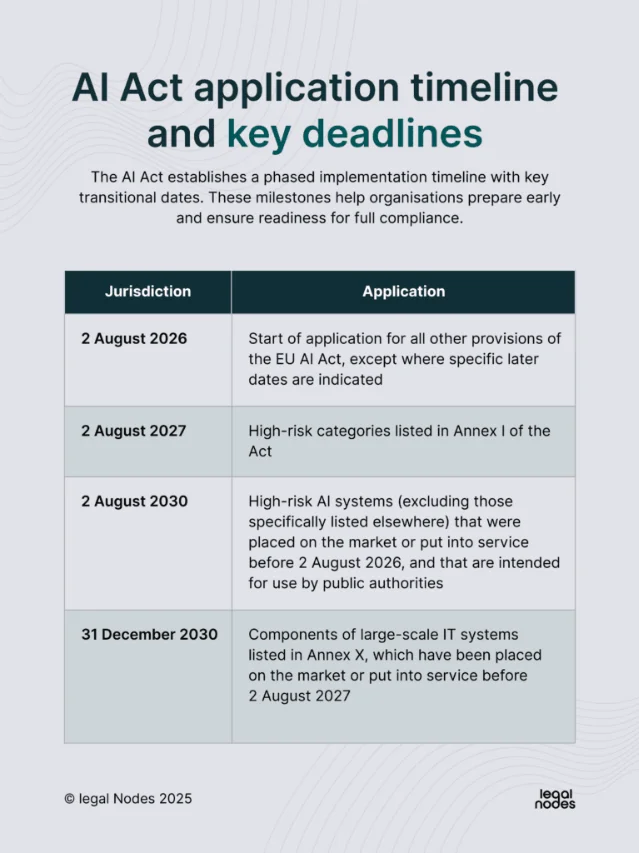
Image from ForbiddenAI Research Desk / Ovidiu Suciu
Critical caveat: The Omnibus agreement is still subject to formal adoption by the Council and Parliament and publication in the Official Journal. Latham & Watkins and DLA Piper both advise that organizations should continue full-speed compliance preparation as if August 2, 2026 remains the date — because until the Official Journal publishes, it legally is. 21 Travers Smith noted that only 8 of 27 EU member states have designated national competent authorities, which limits ground-level enforcement capacity regardless of deadline. 22
Article 50 draft transparency guidelines: consultation open until June 3
The European Commission published draft guidelines on Article 50 transparency obligations on May 8, 2026. 23 The guidelines clarify three core obligations: (1) informing users when interacting with an AI system; (2) implementing machine-readable marks enabling detection of AI-generated or manipulated content; (3) disclosing when users are exposed to deepfakes or AI-generated publications on matters of public interest. Penalties under Article 50: up to €15 million or 3% of global annual turnover. The consultation is open to all companies, public authorities, and individuals until June 3, 2026. 23
Agentic AI: existing rules apply
The EC AI Act Service Desk updated its FAQ to address agentic AI systems. The guidance confirms "AI agent" is not a separately defined category under the AI Act — such systems fall within the existing definitions of "AI system" (Art. 3(1)) and "general-purpose AI model" (Art. 3(63)). Article 5(1) prohibitions on harmful manipulation and exploitation of vulnerabilities are characterized as "particularly relevant" to agentic AI. The level of autonomy or tool use can trigger systemic-risk designation, bringing heightened risk management requirements. The EC described its position as "preliminary." 24
EDPB standardized DPIA template: consultation until June 9
The European Data Protection Board (EDPB) adopted a standardized Data Protection Impact Assessment (DPIA) template, open for public consultation until June 9, 2026. 24 The template — aligned with the EDPB's Helsinki Statement — guides controllers through systematic processing descriptions, lawfulness analysis, risk assessment, and conclusions. Not mandatory, but all EU Data Protection Authorities will adopt it as their standard or national meta-template.
UK
King's Speech: AI oversight via "Regulating for Growth," no standalone AI Act
The King's Speech on May 14, 2026, confirmed the UK government will introduce a Regulating for Growth Bill as the vehicle for AI oversight — the clearest signal yet that the UK will not pass a standalone AI law this parliamentary session. 25 The bill's specific AI provisions have not been published; no draft text was available as of May 15. The AI Regulation Bill sponsored by Lord Holmes of Richmond (Conservative Life Peer) — the only AI-specific bill currently before Parliament — remains at 1st reading only in the House of Lords and carries no government support. [cite:26|Artificial Intelligence (Regulation) Bill [HL]|[https://bills.parliament.uk/bills/3942]]
The King's Speech also announced:
- Cyber Security and Resilience Bill: extends obligations to managed IT service providers and data centers; expands incident reporting and risk management across digital supply chains. Brings the UK into closer alignment with the EU's NIS 2 directive. 25
- National Security Bill: reforms the 1990 Computer Misuse Act to create a statutory defense for legitimate cybersecurity research — a long-sought change for the security community.
Nick Henderson-Mayo, Head of Compliance at VinciWorks, assessed the result directly: "No standalone AI Bill. So the compliance agenda is not quite the one many expected." 25 The UK's AI compliance obligations continue to run through sectoral regulators: ICO for data protection and automated decision-making, FCA for financial services AI, Ofcom for online safety, and MHRA for medical devices.
ICO guidance: AI-generated FOI requests and AI cyber threats
The UK Information Commissioner's Office (ICO) published two pieces of practical guidance this week. On May 6, the ICO released guidance to help public authorities handle Freedom of Information requests generated using AI — addressing requests that misquote legislation, volumes requiring clarification, and consistent handling regardless of how a request was produced. 26 ICO Upstream Regulation Manager Deborah Clark stated: "This guidance is about giving teams practical, sensible support, not adding new burdens. It does not change the law or create new requirements." 26
On May 14, the ICO published a five-step guide for organizations defending against AI-powered cyber attacks: (1) know the threats — including AI-enhanced phishing, deepfake social engineering, automated vulnerability scanning, indirect prompt injection, and data poisoning; (2) layer defenses beyond Cyber Essentials; (3) restrict access points using MFA and least-privilege controls; (4) improve detection, monitoring, and incident response; (5) protect personal data through minimization, audits, AI governance frameworks, and Data Protection Impact Assessments. 27 The guidance references NCSC's updated Cyber Assessment Framework, which now explicitly addresses AI threat vectors. Organizations using AI tools that process high-risk personal data are required to have DPIAs with safeguards against AI-targeting attacks.
China
CAC Order No. 21: anthropomorphic AI rules take effect July 15
Five Chinese government agencies — CAC, NDRC, MIIT, MPS, and SAMR — jointly issued the "AI Anthropomorphic Interaction Service Management Interim Measures" (人工智能拟人化互动服务管理暂行办法) as Order No. 21 on April 10, 2026. 28 Effective date: July 15, 2026. The rules cover AI services providing simulated personality and sustained emotional interaction — virtual companions, emotional support applications, digital family members. Non-emotional services such as customer service bots and work/study assistants are explicitly excluded.
Four regulatory pillars:
- Minor protection: Virtual intimate relationships with minors are banned; guardian consent is required for users under 14; usage time and content restrictions apply.
- Privacy and data: Platforms may not engage in emotional manipulation or psychological inducement to extract user information or drive consumption. User interaction data is classified as sensitive personal information and cannot be used for model training without separate consent.
- Content safety: Mandatory "not a real person" labeling; content endangering national security, inciting extreme emotions, or encouraging self-harm/suicide is prohibited.
- Risk prevention: Platforms must build content review, safety assessment, and risk early-warning systems. Human intervention is required when users display extreme emotions or dangerous behavior. Continuous use exceeding two hours triggers a mandatory pop-up reminder. 29
Services with more than 1 million registered users or 100,000 monthly active users must submit a safety assessment to the provincial CAC. Compliance impact: Any AI product with a companion, emotional support, or digital-persona dimension — including widely used consumer AI assistants with relationship features — must audit against these four pillars before July 15.
GenAI filing update and PIPL enforcement
The CAC reported that 72 new generative AI services completed filing in March–April 2026, and 49 new applications or functions using third-party models completed registration. 30 Cumulative totals as of April 30, 2026: 868 GenAI services filed; 530 applications/functions registered. Under China's current enforcement posture, unfiled AI services face immediate takedown and fines of RMB 10,000–100,000.
In parallel, the CAC published results from a PIPL compliance sweep of 33 apps, identifying four violation categories: missing personal information collection rules (15 apps); undisclosed third-party SDKs collecting data without consent (2 apps); collection of data disproportionate to services provided (4 apps); and defective account-cancellation mechanisms (12 apps). 24 All affected operators were ordered to remediate within 15 working days. The sweep is part of a joint three-department 2026 Personal Information Protection Special Action — marking China's PIPL enforcement shift from rule-building to active rule-enforcement.
Courts and enforcement
AI chatbot conversations are not privileged: US v. Heppner
Judge Jed S. Rakoff (Southern District of New York) ruled on May 1 that conversations with publicly available AI chatbots are protected by neither attorney-client privilege nor the work product doctrine. 31 The defendant, Bradley Heppner, had used Anthropic's Claude to help prepare his legal defense after learning he was under grand jury investigation for an alleged $150 million fraud. The FBI seized approximately 31 documents memorializing those Claude conversations.
Judge Rakoff denied privilege on three independent grounds: (1) Claude is not an attorney; (2) Anthropic's privacy policy expressly permits the collection, training use, and disclosure of user inputs — eliminating any reasonable expectation of confidentiality; (3) Heppner did not consult Claude for the purpose of obtaining legal advice. The court also rejected work product protection because Heppner acted on his own initiative, not at counsel's direction. The ruling stated: "Generative artificial intelligence presents a new frontier in the ongoing dialogue between technology and the law," but "AI's novelty does not mean that its use is not subject to longstanding legal principles." 31
Compliance impact: Any sensitive, legally strategic, or confidential information typed into a public AI platform — including systems your employees use for legal analysis — should be treated as potentially non-privileged. Implement AI use policies that distinguish between licensed, privacy-preserving enterprise AI deployments and consumer-facing public platforms.
Bartz v. Anthropic: $1.5B copyright settlement fairness hearing
A fairness hearing in Bartz v. Anthropic took place on May 14 before Judge Araceli Martínez-Olguín (Northern District of California). 32 The settlement covers approximately 480,000 works with a 92.77% claims rate and only 350 valid opt-outs covering 1,802 works. Class Counsel requested attorneys' fees of 12.5% of the $1.5 billion fund (~$187.5 million) — a 6.92x multiplier over the $27 million projected lodestar. Judge Martínez-Olguín did not rule from the bench but signaled skepticism about the fee multiplier and the $15 million cost reserve administered outside court oversight. Short orders are expected within days.
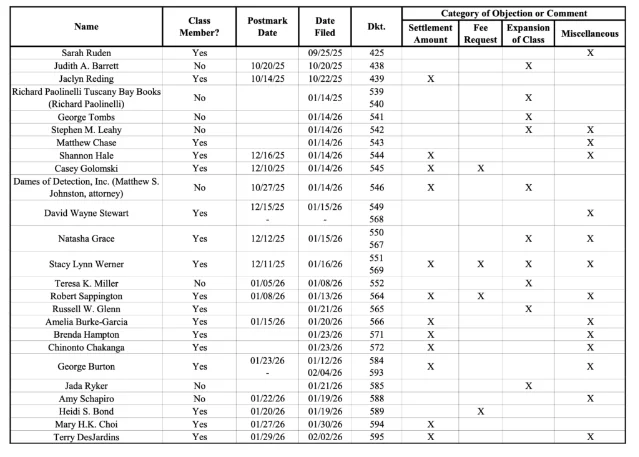
Image from Authors Alliance
Copyright litigation expands: publishers, voice actors join in
On May 5, five major publishers — including McGraw-Hill and Macmillan — and author Scott Turow filed a copyright class action against Meta and Mark Zuckerberg, alleging unauthorized copying of millions of books and articles for training Meta's Llama language models. 33 Elsevier joined the lawsuit on May 13, adding a large academic publishing component. 33 Meta stated: "Courts have rightly found that training AI on copyrighted material can qualify as fair use. We will fight this lawsuit." 33
On May 12, journalists and voice actors filed proposed class actions against Google, Meta, Microsoft, Nvidia, and ElevenLabs in the Northern District of Illinois, alleging their voices were used to train AI models without authorization or compensation. 34 The coordinated filings mark the expansion of AI training data litigation from text and image copyright into voice and biometric data — a new exposure frontier for any company deploying text-to-speech or speech AI systems.
Also on May 12, OpenAI faces a lawsuit in California court alleging that its chatbot's advice contributed to a fatal drug overdose — the first AI wrongful death case to reach court, testing the boundaries of platform liability for AI-generated content that causes physical harm. 35
Enforcement: GM's record CCPA fine, NJ Daniel's Law, AI citation sanctions
California privacy authorities settled with General Motors for $12.75 million on May 1 — the largest CCPA fine to date — over the alleged unlawful collection and sale of consumer data without proper consent and disclosure. 36 Cumulative CCPA fines now total approximately $23.2 million. The California Privacy Protection Agency (CPPA) is scaling up enforcement from the $500K–$1M range to eight-figure penalties. The CCPA's risk assessment requirements for processing activities presenting "significant risk" to consumers took effect January 1, 2026.
On April 22, a New Jersey federal court denied Sterling Data Co.'s constitutional challenge to Daniel's Law — the state statute protecting personal information of judges and law enforcement officers — on First Amendment grounds, finding the law content-neutral. 37 Womble Bond Dickinson assessed the ruling as expanding litigation risk well beyond traditional data brokers to "nearly any consumer-facing company" that may hold New Jersey residents' home addresses or phone numbers — including online retailers, financial institutions, and marketing companies. The NJ Supreme Court declined to consolidate 100+ pending cases on May 4 and has not yet ruled on a separate constitutionality challenge that could expand or limit the litigation wave.
A federal judge in California sanctioned the manager of a law firm on May 1 over a junior attorney's AI-assisted brief containing a false citation, establishing that supervising attorneys bear monetary liability for subordinates' AI errors. 38 A state appeals court ruled separately on April 23 that attorneys must be candid with judges when AI generates errors in filings. Connecticut is also considering a rule that would subject attorneys to sanctions for erroneous AI-generated citations. Compliance signal for law departments: Establish a formal AI-use policy in litigation practice that assigns verification responsibility to a named supervising attorney — delegation of AI output review to a junior associate without documented oversight creates direct sanctions exposure.
In the Musk v. OpenAI/Altman trial, closing arguments are underway as of May 14, 2026, with Musk claiming breach of charitable trust and $38 million in unjust enrichment. 39 The outcome could affect OpenAI's governance structure. Apple settled a consumer class action over delayed Siri AI features for $250 million on May 6. 40
Upcoming compliance deadlines
| Priority | Date | Obligation | Jurisdiction | Affected scope |
|---|---|---|---|---|
| HIGH | May 19, 2026 | TAKE IT DOWN Act (TIDA): 48-hour removal mechanism for non-consensual intimate AI imagery. Penalty: up to $53,088/violation + up to 3 years criminal. FTC actively monitoring. | US (federal) | All covered platforms — social media, image hosting, video sharing |
| HIGH | June 3, 2026 | EU AI Act Article 50 transparency guidelines: public consultation closes. | EU | All AI system providers and deployers in scope of Art. 50 |
| June 9, 2026 | EDPB standardized DPIA template consultation closes. | EU | All data controllers conducting DPIAs | |
| HIGH | July 15, 2026 | China CAC Order No. 21 (Anthropomorphic AI Interaction Services) effective. | China | AI companion/emotional interaction service providers; platforms with 1M+ registered users must submit provincial CAC safety assessment. |
| HIGH | August 2, 2026 | EU AI Act Article 50 transparency obligations for all new AI systems. Full GPAI model enforcement by EU AI Office. | EU | AI system providers; GPAI model providers |
| WATCH | July 2026 | EU AI Act Omnibus expected in Official Journal — will confirm whether Annex III deadline shifts to Dec 2, 2027 or Aug 2, 2028 remains. Until publication, Aug 2, 2026 is the legal default. | EU | All high-risk AI system providers under Annex III and Annex I |
| October 1, 2026 | Connecticut AIRT Act: developer obligations for automated employment decision tools; synthetic digital content provenance; frontier model whistleblower protections effective. | Connecticut, US | AEDT developers; platforms with 1M+ monthly users; AI model developers | |
| January 1, 2027 | Colorado SB 26-189 (ADMT framework) effective; New York RAISE Act effective; Connecticut companion chatbot rules effective. | Colorado, New York, Connecticut, US | ADMT developers and deployers; AI companion chatbot operators |
Cover image: Governor Jared Polis signs SB 26-189 at the Colorado State Capitol, May 14, 2026. Image from CBS News Colorado
Fuentes de referencia
- 1US Prepares AI Security Order That Omits Mandatory Model Tests
- 2In turf battle over AI, U.S. spy agencies vie for more sway than Commerce
- 3WH 'studying' AI security executive order
- 4How Trump may be changing his stance on AI regulation
- 5NIST aims for summer release of AI cyber guidelines
- 6PF 2026-45 Implementation of OMB Memo M-26-04
- 7FTC Oversight Hearing: What Ferguson's Testimony Means for AI, Pricing, and Privacy Compliance
- 8SEC chair Paul Atkins signals rule changes for onchain markets and AI-driven finance
- 9Colorado governor signs new AI regulation bill to replace 2024 law
- 10SB26-189 Automated Decision-Making Technology
- 11Colorado Replaces Landmark AI Act—Creating New Trails for AI Rules and Private AI Litigation
- 12Colorado legislature passes bill to repeal and replace the Colorado AI Act
- 13X.AI sues, DOJ intervenes, enforcement of Colorado's AI Act suspended
- 14Connecticut passes AI regulations after years in development
- 15Unpacking SB5: Connecticut's new AI law
- 16Connecticut Poised to Enact One of the Nation's Most Comprehensive AI Laws
- 17AI Legislative Update: May 8, 2026
- 18Comprehensive List of State AI Laws
- 19EU agrees to simplify AI rules to boost innovation and ban 'nudification' apps to protect citizens
- 20AI Act Update: EU Resolves to Change Rules and Extend Deadlines
- 21The Digital AI Omnibus: Proposed deferral of high risk AI obligations under the AI Act
- 22EU agrees to delay key AI Act compliance deadlines
- 23Consultation on the draft guidelines on transparency obligations under the AI Act
- 24The BR Privacy, Security & AI Download: May 2026
- 25UK outlines cyber & AI regulatory overhaul in King's Speech
- 26New guidance to support public authorities dealing with AI-generated FOI requests
- 27Five steps to protect your organisation from AI-powered cyber threats
- 28Expert Interpretation: Guiding Healthy Development of AI Anthropomorphic Interaction Services Through Human-Machine Value Alignment
- 29Protecting AI Emotional Boundaries — Interpreting CAC 2026 No. 21 Order
- 30All AI Application Websites Must Complete "Double Filing"
- 31When AI Meets the Courtroom: A Federal Judge Rules that Conversations with Chatbots are Not Privileged
- 32Bartz v. Anthropic Fairness Hearing: Observations and Takeaways
- 33Even More Authors, Publishers Sue Meta Over Copyright in AI Training
- 34Google, Meta Hit With Suits Over Use Of Voices For AI
- 35OpenAI faces lawsuit in California court claiming chatbot gave advice that led to fatal overdose
- 36California authorities announce largest CCPA fine to date
- 37Court Ruling Signals Continued Privacy Litigation Exposure Under NJ's Daniel's Law
- 38US judge says senior lawyers must pay for mistakes by subordinates using AI tools
- 39Musk accused of 'selective amnesia,' Altman of lying as trial enters homestretch
- 40Apple settles lawsuit over late Siri AI features for $250 million
Añade más opiniones o contexto en torno a este contenido.